Talk about embarrassing! When Lisa told me that today was Joe Don Baker’s birthday, I decided that I would review Speedtrap, as 1977 car theft movie that Lisa and I watched last week. But, when I took a look at the imdb to double check the name of the character that Baker played in Speedtrap, I discovered that I had already reviewed it!
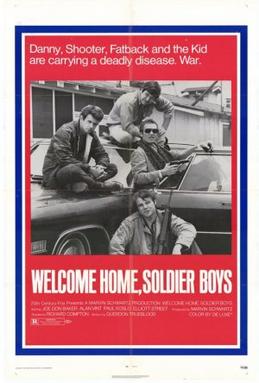
Instead of talking about Speedtrap a second time, I’m going to recommend one of Joe Don Baker’s early films. In Welcome Home, Soldier Boys, Baker stars as Danny, the leader of a group of Green Berets who have just returned from Vietnam and can no longer find a place in society. Danny, Kid (Alan Vint), Shooter (Paul Koslo), and Fatback (Elliott Street) go on a cross-country road trip. After they kill a prostitute (Jennifer Billingsley) who demanded more money than they were willing to pay, they visit many sites from their youth. They go to a high school basketball team. They spend some time in a sleazy motel. (Geoffrey Lewis plays the desk clerk.) They get into a fight with a mechanic (Timothy Scott) over the price of some auto repairs. After being cheated by one too many people and realizing that no one cares about the sacrifices that they made for their country, they put on their uniforms and violently take over a small town, leading the National Guard to show up to take them all out.
Welcome Home, Soldier Boys is a pretty ham-fisted anti-war allegory and the plot sometimes meanders too much for its own good. With its road trip violence, its a dry run for director Richard Compton’s far more cohesive MaconCountyLine. The movie still packs a punch, due to the efforts of the cast and the violent ending. The movie is full of familiar characters actors, who are all convincing in their roles but it really is dominated by Joe Don Baker’s hulking intensity. Danny is the dark side of the amiable country boys that Joe Don Baker would play in so many other movies. Danny is angry but, as a stranger in a strange land, he’s sometimes sympathetic. Ultimately, Danny wants the respect that was given to the returning soldiers of the previous generation. Instead, he comes back to country that doesn’t want much to do with him or his friends. Returning from serving overseas and still trying to deal with the things that he saw in overseas, Danny feels lost in and rejected by his home country. It’s one of Baker’s best performances.
First released in 1981 and then re-released in several different versions since then, Heaven’s Gate begins at Harvard University.
The year is 1870 and the graduates of Harvard have got their entire future ahead of them. At the graduation ceremony, Joseph Cotten gives a speech about how, as men of cultivation, they have an obligation to help the uncultivated. Student orator Billy Irvine (John Hurt) then gives a speech in which he jokingly says the exact opposite. Amongst the graduates, Billy’s friend, Jim Averill (Kris Kristofferson), laughs at Billy’s speech. It’s a bit of a strange scene, if just because all of the graduates appear to be teenagers except for Hurt and Kristofferson, who are both clearly in their 30s. The graduates of Harvard sing to their girlfriends and dance under a tree and, for a fleeting moment, all seems to be right with the world.
Twenty years later, all seems to be wrong with the world. Averill is now the rugged and world-weary marshal of Johnson Country, Wyoming. Cattle barons are trying to force immigrant settlers to give up their land. Gunmen, like Nate Champion (Christopher Walken) and Nick Ray (Mickey Rourke), are accepting contracts to execute immigrants who are suspected of stealing cattle. When Averill stands up for the people of Johnson Country, the head of the Wyoming Stock Grower Association, Frank Canton (Sam Waterston), hires a group of mercenaries to ride into Johnson County and execute 125 settlers. Billy Irvine, who now is dissolute alcoholic who works with Canton, warns his old friend Averill. Averill, who has fallen in love with Ella (Isabelle Huppert), the local madam, announces that he will defend the immigrants. Nate, who is also in love with Ella, considers changing sides.
Heaven’s Gate is loosely based on an actual event. I actually have three distant ancestors who traveled to Wyoming to take part in the Johnson County War. All three of them survived, though one of them was shot and killed in an unrelated manner shortly after returning to Ft. Smith, Arkansas. That said, director Michael Cimino is clearly not that interested in the historical reality of the Johnson County War or the issues that it raised. Just as he did with Vietnam in The Deer Hunter, Cimino uses the Johnson County War as a way to signify a loss of national innocence. Averill and Irvine start the film as hopeful “young” men with the future ahead of them. By the end of the film, one is dead and the other is living on a yacht and dealing with what appears to be crippling ennui.
Heaven’s Gate is a bit of an infamous film. Though the film was pretty much a standard western, Cimino still went far over-budget and turned in a first cut that was over six hours long. A four hour version was briefly released in 1980 but withdrawn after a week, due to terrible reviews and audience indifference. A studio-edited version that ran for two hours and 35 minutes got the widest release in 1981. Since then, there have been several other versions released. Cimino’s director’s cut, which was released as a part of the Criterion Collection in 2012, runs for 212-minutes and is considered to now be the “official” version of Heaven’s Gate.
For years, Heaven’s Gate had a terrible reputation. It’s failure at the box office was blamed for bankrupting United Artists. After the excesses of the Heaven’s Gate production, studios were far more reluctant to just give a director a bunch of money and let him run off to make his movie. (They should have learned their lesson with Dennis Hopper and The Last Movie.) Described by studio execs as being self-indulgent and even mentally unstable, Michael Cimino’s career never recovered and the director of The Deer Hunter went from being an Oscar-winner to being an industry pariah. (Some who disliked The Deer Hunter’s perceived jingoistic subtext claimed that Heaven’s Gate proved The Deer Hunter was just an overrated fluke.) However, the reputation of Heaven’s Gate has improved, especially with the release of Cimino’s director’s cut. Many critics have praised Heaven’s Gate for its epic portrayal of the west and, ironically given the controversy over The Deer Hunter, its political subtext. It’s anti-immigrant villains made the film popular amongst the Resistance-leaning film historians during the first Trump term.
So, is Heaven’s Gate a masterpiece or a disaster? To be honest, it’s somewhere in between. Whereas it was once over-criticized, it’s now over-praised. Visually, it’s a beautiful film but those who complained that the film was too slow had a point. As with The Deer Hunter, Cimino takes the time to introduce us to and immerse us in a tight-knit immigrant community. Personally, I like the much-criticized scenes of the fiddler on skates and Averill and Ella dancing in the roller rink. Overall though, as opposed to The Deer Hunter, the members of the film’s victimized community still feel less like individual characters and more like symbols. As for the political subtext, I think that any subtext of that sort is accidental. (I feel the same way about The Deer Hunter, which I like quite a bit more than Heaven’s Gate.) Cimino is more interested in the loss of innocence than whether or not the Johnson County War can be fit into some sort of nonsense Marxist framework.
The main problem with the film is that there is no center to keep everything grounded. Kris Kristofferson had a definite screen presence but, as an actor who was incapable of showing a great deal of emotion, he lacks the gravitas necessary to keep from being swallowed up by Cimino’s epic pretensions. Isabelle Huppert, an otherwise great actress, also feels lost in the role of Ella and Sam Waterston is not necessarily the most-intimidating villain to ever show up in a western. Christopher Walken, as the enigmatic and intriguing Nate Champion, gives the best performance in the film but his character still feels largely wasted.
There are some brilliant visual moments to be found in Heaven’s Gate. I even like the Harvard prologue and the ending on the boat, both of which are not technically necessary to the narrative but still add an extra-dimension to both Averill and Irvine. But, in the end, Heaven’s Gate is big when it should have been small and epic when its should have been intimate. It’s a misfire but not a disaster. Even great directors occasionally have a film that just doesn’t work. Speilberg had his 1941. Scorsese has had a handful. Coppola’s career has been a mess but no one can take his successes away from him. Michael Cimino, who passed away in 2016, deserved another chance.
Max Baer, Jr. co-wrote, co-produced and co-starred in this southern fried thriller about a couple of good ‘ole boys (brothers Alan & Jesse Vint) who break down in the wrong county. The sheriff (Baer), who’s somewhat suspicious of the boys, goes after them with fierce vengeance when his wife is murdered.
I’m a big fan of this classic drive-in film. For one, I think it’s cool that Max Baer Jr., so well known as Jethro Bodine in the classic sitcom THE BEVERLY HILLBILLIES, took on this role of the somewhat racist sheriff who goes mad with rage in this movie. I enjoyed his performance very much. I also like these ‘70’s drive-in films. You get exactly what you expect in this tale, and it’s very entertaining. Finally, I like the Vint Brothers. Alan had an important role a year after this film was made in the Charles Bronson film BREAKOUT. And what can I say about Jesse. Over the last few years, he’s actually become a friend in real life. He’s such a great guy, and he’s very proud of this movie. He told me one day that Tarantino had said it was one of “the best stories in cinema!” In the first season of his Video Archives podcast, I’ve personally heard Tarantino really brag on Jesse’s performance in the movie THE FORBIDDEN WORLD. I love it when good things happen to good people.
Welcome to Retro Television Reviews, a feature where we review some of our favorite and least favorite shows of the past! On Sundays, I will be reviewing the made-for-television movies that used to be a primetime mainstay. Today’s film is 1977’s The Hunted Lady! It can be viewed on YouTube.
Detective Susan Reilly (Donna Mills) reluctantly teams up with a chauvinistic cop named Sgt. Arizzio (Alan Feinstein) to investigate a United States senator who has presidential ambitions. Arizzio believes that the senator is being back by the Mafia and that it would be disastrous for the country if a mob-connected politician ended up in the White House. (Being mob-connected didn’t seem to hurt John F. Kennedy but still….)
Now, Detective Reilly and Sgt. Arizzio working together to take down a corrupt senator sounds like an intriguing premise for a movie, right? Well, oddly enough, that’s not what this movie is actually about. Instead, it’s about Susan going on the run after she’s framed for Arizzio’s murder. She escapes from police custody with the help of her father. Though she’s still recovering from being shot earlier in the film, Susan makes her way to Reno and attempts to hide out from both the cops and the Mafia assassin that has been sent to kill her.
Susan hiding out in Reno. Hmmm …. sound like an intriguing premise for a movie, right? Well, don’t get to attached to Susan pretending to be a professional gambler because it turns out that bullet wound was more serious than she realized and she ends up passing out from blood loss. When she awakens, she’s in a free clinic that is run by Dr. Arthur Sills (Robert Reed). Dr. Sills doesn’t ask Susan too many questions about her past and even hires Susan on as a nurse. Susan and Dr. Sills fall in love and try to clear the name of a Native American who has been accused of blowing stuff up.
Doing some research, I was not surprised to discover that The Hunted Lady was originally developed as a possible television show. The show would have played out like a combination of Charlie’s Angels and TheFugitive, with Susan moving from town to town and getting involved with a new set of guest stars each week. With both the police and the mob trying to track her down, Susan would try to clear her name while also helping out strangers. Unfortunately, The Hunted Lady wasn’t exactly a hit in the ratings and Susan’s further adventures went untold.
The main problem with The Hunted Lady is an obvious one. The idea of the Mafia trying to install one of their guys in the White House is considerably more intriguing that Susan falling in love with Dr. Sills while working at a free clinic. The whole time that Susan was helping the doctor’s patients, I was thinking, “But what about the senator?” Donna Mills was surprisingly convincing as a tough cop but she had next to no chemistry with Robert Reed. If anything, Reed looked annoyed at just having to be there.
Anyway, here’s hoping that Susan cleared her name eventually. You can only run for so long.
Welcome to Late Night Retro Television Reviews, a feature where we review some of our favorite and least favorite shows of the past! On Thursdays, I will be reviewing Highway to Heaven, which aired on NBC from 1984 to 1989. The entire show is currently streaming on Tubi and several other services!
It’s time for a Christmas episode!
Episode 1.13 “Another Song For Christmas”
(Dir by Michael Landon, originally aired on December 19th, 1984)
Oh, that Fast Eddie!
Played by the familiar character actor Geoffrey Lewis, Fast Eddie is a wealthy used car salesman. He knows how to turn on the charm. He knows how to close the sale. Fast Eddie may have grown up poor but now he’s rich and he’s determined to not sacrifice one cent. It’s the day before Christmas but Fast Eddie has no problem refusing to give money to charity. He has no problem ripping off an elderly couple looking for an affordable car. He has no problem firing Dave Ratchett (Jeff Doucette) when Dave refuses to roll back a car’s mileage. Fast Eddie doesn’t care that Dave’s son is sick and Fast Eddie certainly doesn’t care that it’s Christmas Eve. He even orders his butler (Ivor Barry) to work on Christmas Day.
Jonathan and Mark stop by Fast Eddie’s car lot but they don’t buy a car. They just observe Fast Eddie at work. After they leave, Mark watches as Jonathan has a brief conversation with Santa Claus (Don Beddoe). It turns out that, like Fast Eddie, Mark doesn’t really have the Christmas spirit. Jonathan suggests that Mark should re-read A Christmas Carol. Mark starts to read it but falls asleep after the first page.
Meanwhile, at his mansion, Fast Eddie also falls asleep but is soon awakened by Jonathan who takes him to the past and shows Eddie how his poor childhood led him to grow up to become overly obsessed with money. Mark then appears and shows Eddie what’s happening in the present. Eddie’s lawyers are trying to shut down a charity so that Eddie can buy their headquarters. Poor Dave Ratchett is having to explain to his family that he lost his job. Eddie is moved by the sight of Dave’s wheelchair-bound son, who will die unless he gets the operation that Dave will now never be able to afford. Finally, Jonathan takes him to the future and shows Eddie that no one will visit his grave after he dies.
Eddie wakes up infused with the spirit of Christmas and soon, he’s running around town and giving people, including Dave, all of his money and other gifts. Interestingly enough, Mark also wakes up and he tells Jonathan that he had a dream in which he was the Ghost of Christmas Present. Just like Eddie, Mark wakes up with a new appreciation for the Christmas holidays.
I’ve lost track of how many different version of A Christmas Carol that I’ve seen. The idea of turning Scrooge into a used car salesman is an interesting one and I liked the fact that Eddie and Mark apparently both had the same dream. This may be the only time in which one of the “ghosts” learned a lesson as well as Scrooge. That said, Geoffrey Lewis — who was good in so many different films — goes a bit overboard as Fast Eddie. He’s so desperate and twitchy that it’s easy to believe him as a used car salesman but not as a successful one.
Next week, Jonathan and Mark search for a missing friend.
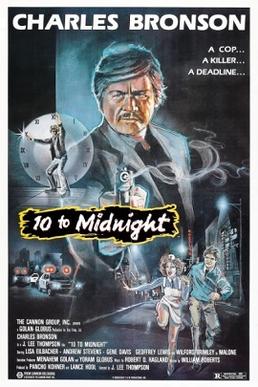
The 1983 film, 10 to Midnight, opens with LAPD detective Leo Kessler (played by legendary tough guy Charles Bronson) sitting at his desk in a police station. He’s typing up a report and taking his time about it. A reporter who is in search of a story starts to bother Leo.
“Jerry,” Leo tells him, “I’m not a nice person. I’m a mean, selfish son-of-a-bitch. I know you want a story but I want a killer and what I want comes first.”
It’s a classic opening, even if Leo isn’t being totally honest. Yes, he can be a little bit selfish but he’s really not as mean as he pretends to be. He may not know how to talk to his daughter Laurie (Lisa Eilbacher) but he is also very protective of her and he wants to be a better father than he’s been in the past. He may roll his eyes when he discovers that Detective Paul McAnn (Andrew Stevens) is the son of a sociology professor but he still tries to act as a mentor to his younger partner. Leo may complain that the criminal justice system “protects those maggots like they’re an endangered species” but that’s just because he’s seen some truly disturbing things during his time on the force and, let’s face it, Leo has a point. When one of Laurie’s friends is murdered, Leo is convinced that Warren Stacy (Gene Davis) is the murderer and he’s determined to do whatever he has to do to get Warren off the streets. “All those girls,” Leo snarls when he sees Warren, his tone letting us know that his mission to stop Warren is about more than just doing his job.
Warren Stacy is handsome, athletic, and he has good taste in movies. (He’s especially a fan of Butch Cassidy and the Sundance Kid. Just don’t try to trick him by saying Steve McQueen played the Sundance Kid.) Warren is also a total creep, the type of guy who complains that a murder victim “wasn’t a good person,” because she trashed him in her diary. When Leo takes a look around Warren’s apartment, he finds not only porn but also a penis pump. (“It’s for jacking off!” Leo yells at Warren, enunciating the line as only Charles Bronson could.) Warren is also a murderer but he’s a clever murderer, the type who sets himself up with an alibi by acting obnoxiously in a movie theater. Warren strips nude before killing his victims, in order to make sure that he doesn’t leave behind any evidence. (This film was made in the days before DNA testing.)
Leo knows that Warren is guilty but, as both his gruff-but-fair captain (Wilford Brimley, naturally) and the D.A. (Robert F. Lyons) point out, he has no way to prove it. When Warren starts to stalk Laurie and her friends (including Kelly Preston), Leo decides that he has no choice but to frame Warren. But when Warren’s amoral attorney, Dave Dante (Geoffrey Lewis, giving a wonderfully sleazy performance), threatens to call McAnn to the stand, McAnn has to decide whether to tell the truth or to join Leo in framing a guilty man.
10 to Midnight is a violent, vulgar, and undoubtedly exploitive film, one that features a ham-fisted message about how the justice system is more concerned with protecting the rights of the accused as opposed to lives of the innocent. And yet, in its gloriously pulpy way, this is also one of Bronson’s best films. It’s certainly my personal favorite of the films that he made for Cannon.
Director J. Lee Thompson and Charles Bronson were frequent collaborators and Thompson obviously knew how to get the best out of the notoriously reserved actor. Bronson was not known for his tremendous range but he still gives one of his strongest performances in 10 to Midnight, playing Leo as being not just a determined cop but also as an aging man who is confused by the way the world is changing around him. Stopping Warren isn’t just about justice. It’s also about fighting back against the the type of world that would create a Warren Stacy and then allow him to remain on the streets in the first place. Interestingly, though Leo doesn’t hesitate when it comes to framing Warren, he is also sympathetic to McAnn’s objections. Unlike other Bronson characters, Leo doesn’t hold a grudge when his partner questions his methods. Instead, he simply know that McAnn hasn’t spent enough time in the real world to understand what’s at stake. McAnn hasn’t given into cynicism. He hasn’t decided that the best way to deal with his job is to be a “mean son of a bitch.” Bronson and Andrew Stevens, who had worked together in the past, have a believable dynamic. McAnn looks up to Leo but is also conflicted by his actions. Leo may be annoyed by McAnn’s reluctance but he also respects him for trying to be an honest cop. Their partnership feels real in a way that sets 10 to Midnight apart from so many other films about an older cop having to deal with an idealistic partner.
One of the most interesting things about the film is Leo’s relationship with his daughter, Laurie. Over the course of the film, Leo and Laurie go from barely speaking to bonding over liquor and their shared regrets about the state of the justice system. When McAnn first meets Laurie, she’s offended when McAnn suggests that she takes after her father. But, as the film progresses, she comes to realize that she and Leo have much in common. (To be honest, I related quite a bit to Laurie, especially as I’ve recently come to better appreciate how much of my own independent nature was inherited from my father.) Lisa Eilbacher and Charles Bronson are believable as father-and-daughter and they play off of each other well. The scenes between Laurie and Leo give 10 to Midnight a bit more depth than one might otherwise expect from a Bronson Cannon film. Leo isn’t just trying to protect his daughter and her roommates from a serial killer. He’s also trying to be the father who he wishes he had been when she was younger. He’s trying to make up for lost time, even as he also tries to keep Warren Stacy away from his family.
As played by Gene Davis, Warren Stacy is one of the most loathsome cinematic villains of all time. Warren’s crimes are disturbing enough. (Indeed, the surreal sight of a naked and blood-covered Warren Stacy stalking through a dark apartment is pure nightmare fuel.) What makes Warren particularly frightening is that we’ve all had to deal with a Warren Stacy at some point in our life. He’s the sarcastic and easily offended incel who thought he was entitled to a phone number or a date or perhaps even more. As I rewatched this movie last night, I wondered how many Warrens I had met in my life. How many potential serial killers have any of us unknowingly had to deal with? Warren tries to strut through life, smirking and going out of his way to let everyone know that he knows more than they do but the minute that Leo turns the table on him, Warren starts whining about he’s being treated unfairly. During his final, disturbing rampage, Warren yells that his victims aren’t being honest with him, blaming them for his actions. The film deserves a lot of credit for not turning Warren into some sort of diabolical and erudite supervillain. He’s not Hannibal Lecter. Instead, like all real-life serial killers, he’s a loser who is looking for power over those to whom he feels inferior and for revenge on a world that he feels owes him something. He’s a realistic monster and that makes him all the more frightening and the film all the more powerful. Warren is the type of killer who, even as I sit here typing this, could be walking down anyone’s street. He’s such a complete monster that it’s undeniably cathartic whenever Leo goes after him.
How delusional is Warren Stacy? He’s delusional enough to actually taunt Charles Bronson! At one point, Warren informs Leo that he can’t be punished for being sick. Warren announces that, when he’s arrested, he might go away for a while but he’ll be back and there’s nothing Leo can do about it. (The suggestion, of course, is that Warren will be back because he committed his crimes in California and all the judges were appointed by a bunch of bleeding heart governors. Warren may not say that out loud but we all know that is the film’s subtext. Some people may agree with the film, some people may disagree. Myself, I’m against the death penalty because I think it’s a prime example of government overreach but I still cheered the first time that I heard Clint Eastwood say, “Well, I’m all torn up about his rights,” in Dirty Harry.) How does Leo react to Warren’s taunts? I can’t spoil the film’s best moment but I can tell you that 10 to Midnight features one of Bronson’s greatest (and, after what we’ve just seen Warren do, most emotionally satisfying) one-lines.
The title has nothing to do with anything that happens in the film. In typical Cannon fashion, the film’s producers came up with a snappy title (and 10 to Midnight is a good one) and then slapped it onto a script that was previously called Bloody Sunday. Fortunately, as long as Bronson is doing what he does best, it doesn’t matter if the title makes sense. And make no mistake. 10 to Midnight is Bronson at his best.
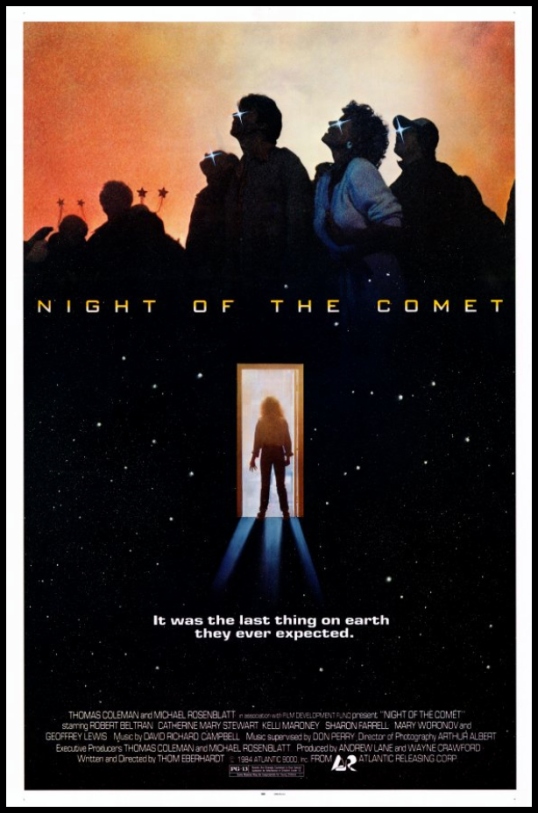
The 1984 film, Night of the Comet, begins with the end.
The end of the world, that is!
When the Earth passes through the tail of a comet, the end result is that the majority of the world’s population is reduced to red dust. Those who are exposed to the comet but not turned immediately into dust face an even worse fate. They are transformed into mindless zombies. Fortunately, 18 year-old Reggie (Catherine Mary Stewart) and her 16 year-old sister, Sam (Kelli Maroney), both managed to avoid getting exposed. Sam was in a steel shed, hiding from their abusive stepmother. Reggie was in a theater projection room with her boyfriend. When Reggie and Sam wake up in the morning to discover that they are two of the few people left alive on the planet, they do what anyone would do.
They go to the mall!
Which is probably the same thing that me and my sisters would have done if we had found ourselves in a similar situation. That’s one reason why Night of the Comet holds up so well. It’s one of the few films to be honest about how most people would probably react to the end of the world. Instead of giving a big dramatic monologue or having a breakdown or getting into a fight about who is to blame and what it all means, Reggie and Sam try to have a little fun. Of course, they also grab some guns while they’re at the mall. They’re not stupid. They know the situation is grim and they need to be prepared. But still, there’s no reason why they shouldn’t try on all the clothes that they previously would not have been able to afford. And why shouldn’t they treat the mall as their own personal playground? They’re young and they’ve survived the end of the world. They deserve to enjoy themselves.
Of course, just because Reggie and Sam survived, that doesn’t mean the world is a safe place. Along with the zombies, there’s also a crazed group of former stockboys who now view the mall as being their own personal kingdom. And then there’s the scientists, who claim that they’re benevolent but who are actually looking for healthy specimens on which they can experiment.
Night of the Comet is a terrifically fun horror movie, a real treat for anyone who has ever imagined what they would do if they were among the last people on Earth. Catherine Mary Stewart, Kelli Maroney, and Robert Beltran (who plays another survivor) brings a lot of energy to their likable roles while Mary Woronov and Geoffrey Lewis are properly menacing as the two main scientists. The zombies, with their crazed eyes and their decaying faces, are genuinely frightening. Director Thom Eberhardt wisely doesn’t overuse the zombies. Indeed, the whole point of the film is that the world is now nearly empty of people, whether they’re zombies or not. But because the zombies aren’t present all of the time, it makes it easy to forget about them and it also makes all the more frightening when they suddenly show up.
Night of the Comet is an enjoyable mix of horror and comedy, one that holds up well nearly 40 years after it was first released.
L.A. 2017 is the Steven Spielberg film about which you’ve probably never heard.
To a certain extent, that’s understandable. Spielberg was only 24 when, in 1971, he directed L.A. 2017. It was a film that he directed for television. In fact, it was only his third directorial assignment. As opposed to the huge budgets that we tend to associate with a typical Spielberg production, L.A. 2017 was made for about $300,000. The entire film was shot in about 12 days. In fact, with a running time of only a scant 69 minutes, L.A. 2017 hardly qualifies as a feature-length film. L.A. 2017 has never been released on DVD or Blu-ray, making it a true oddity in Spielberg’s filmography. Despite the fact that Spielberg has credited L.A. 2017 with opening a lot of doors for him, it’s an almost totally forgotten film.
Of course, some of that is because L.A. 2017 really isn’t a film at all. Instead, it was an episode of a television show called The Name of the Game. The show was about Glenn Howard (Gene Barry), a magazine publisher, and the reporters who worked for him. L.A. 2017 was unique in that it was the show’s only excursion into science fiction. In fact, from everything that I’ve read about the show, it appears that L.A. 2017 was nothing like any of the other episodes of The Name of the Game. This episode was also unique because Spielberg directed it as if he was making a feature, as opposed to just another installment in a weekly series. If not for the opening credits (which announce, among other things, that we’re watching a Robert Stack Production), one could easily imagine watching L.A. 2017 in a movie theater, perhaps as a double feature with Beneath The Planet Of The Apes.
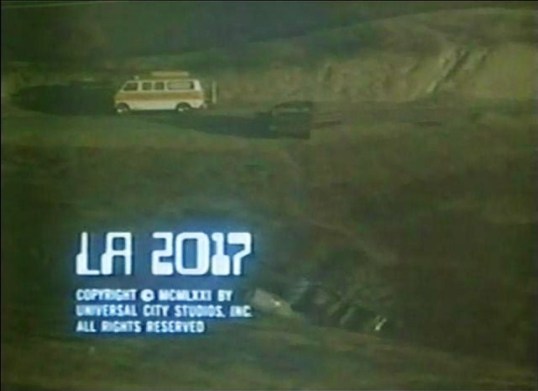
L.A. 2017 opens with Glenn driving down a mountain road in California. He’s heading to a pollution summit and, as he drives along, he awkwardly dictates an editorial into a tape recorder. Glenn worries that society may have already ruined the environment to such an extent that the Earth cannot be saved. As if to prove his point, Glenn starts to cough as he’s overcome by all of the smog in the air. His car swerves into a ditch and Glenn is knocked unconscious.
Welcome to the future
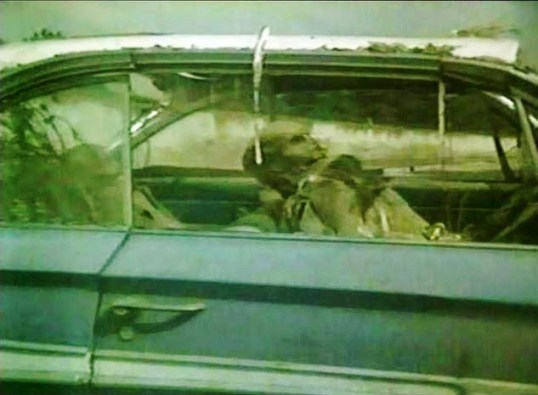
When he wakes up, he finds himself being rescued by men wearing wearing protective suits and masks. The sky is a sickly orange and an ominous wind howls in the background. Glenn’s rescuers take him to an underground city where he discovers that, somehow, he has traveled through time. The year is now 2017, which in this film looks a lot like the 70s except that everyone’s now underground and the landline phones are extra bulky. (Needless to say, watching 1971’s version of 2017 in 2019 is an interesting experience.) It turns out that the pollution got so bad that the surface of the planet became uninhabitable. The U.S. is now run by a corporation that is headquartered in Detroit. (Presumably, the Corporation is a former car company.) The U.S. is also at war with England, for some reason. No mention is made about what’s happened to Canada but, if Detroit’s still around, I assume at least some of Canada managed to survive as well.
The …. uh, Future.
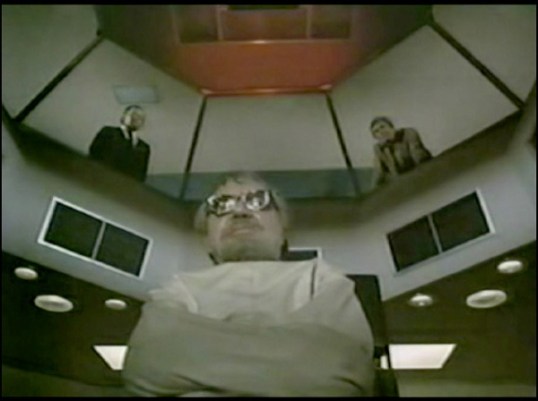
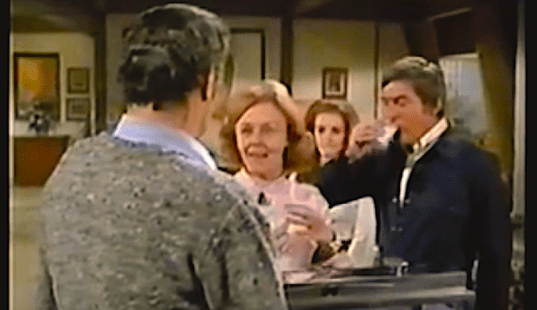
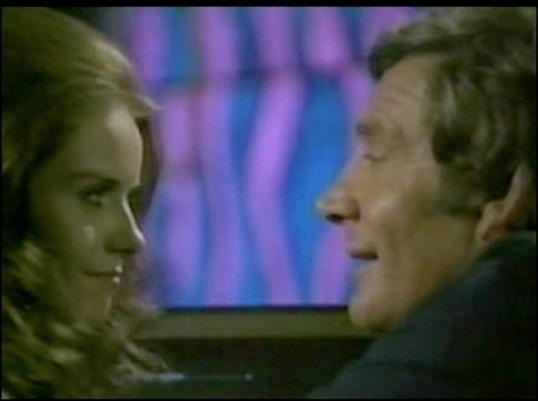
Everyone in the future drinks a lot of milk and, when they’re not listening to cheerful announcements, they’re listening to the soothing music that the Corporation provides for them. Everyone in the future is also very friendly. We know this because everyone keeps assuring Glenn that he’s surrounded by friends. In fact, everyone in the future refers to one another by their first name because “it’s friendlier.” It’s also the law. It turns out that there’s a lot of laws in the future. In fact, the underground cities are pretty fascist in the way that they handle things. There are constant announcements encouraging people to pursue a career in law enforcement and anyone who disagrees with the Corporation ends up in a straight jacket. Glenn feels that maybe he’s been brought to the future so he can start a new magazine and challenge the status quo. The Corporation disagrees….
This is what happens when you don’t go underground in the future.
Okay, so there’s nothing subtle about L.A. 2017. From the villainous corporation to the heavy-handed environmental message, there’s nothing here that you haven’t seen in dozens of other sci-fi films. But the lack of subtlety doesn’t matter, largely because Spielberg directs with so much energy and with such an eye to detail that it’s impossible not to get sucked into the story. As opposed to the somewhat complacent Spielberg who has recently given us rather bland and safe blockbusters like Lincoln, The BFG, and The Post, the Spielberg who directed L.A. 2017 was young and obviously eager to show off what he could do with even a low budget and that enthusiasm is present in every frame, from the wide-angle shots of Glenn driving his car to the scenes of Glenn looking up at the shadowy executives and scientists who are staring down at him when he’s first brought to the underground city. As opposed to the sterile vision of so many other future-set films, Spielberg’s future feels as if it’s actually been lived in. When Glenn finds himself in a new world, it comes across as being a real world as opposed to just a narrative contrivance.
Of course, because L.A. 2017 was just one episode in a weekly series, Glenn couldn’t remain in the future and L.A. 2017 returns Glenn to the present in the most contrived and predictable way possible. Still, L.A. 2017 remains an entertaining example of what a young and talented director can do when he’s determined to be recognized. Watching the film, it’s easy to draw a straight line from Spielberg doing L.A. 2017 to doing Duel and then subsequently being hired for Jaws.
Incidentally, Joan Crawford is somewhere in this film. Crawford worked with Spielberg when he directed her in the pilot for Night Gallery and she was one of his first major supporters in Hollywood. Apparently, in L.A. 2017, she plays one of the people staring down at Glenn when he’s first brought into the underground city. I haven’t found her yet but she’s apparently there somewhere.
Unfortunately, L.A. 2017 has never been released on DVD or Blu-ray but it is currently available on YouTube.
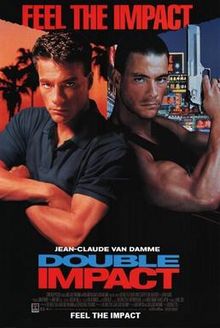
Twice the Van Damme means double the damme trouble in Double Impact!
In this low-budget action flick, Jean-Claude Van Damme plays twin brothers, Chad and Alex Wagner. When they were just six months old, their parents were murdered in Hong Kong and the brothers were separated. Chad grew up to become a goody-goody martial arts instructor in Los Angeles. Alex grew up to become a part of the Hong Kong underworld. Under the direction of the parent’s former bodyguard, Uncle Frank (Geoffrey Lewis), the twins are reunited and team up to take down the gangster who killed their parents.
When it comes to second-tier 90s action heroes, Jean-Claude Van Damme was never as good as Dolph Lundgren but he was still a thousand times better than Stephen Seagal. The secret of Van Damme’s success was that, in real life, he was capable of doing all of the thing that he did in the movies. Van Damme didn’t need a stunt double or trick editing to look athletic. It’s easy to laugh at Van Damme’s propensity to do the splits in every film he made but everyone knows that if Stephen Seagal had ever tried to do the same thing, he probably never would have been able to stand back up.
Double Impact was made early in Van Damme’s career, after he had established himself with Bloodsport but before he went mainstream with Timecop. Van Damme is credited with co-writing the script and it’s the first Van Damme film to feature him playing twins, an idea to which he would return a surprising number of times. The movie is full of moments between the twins that were designed to make critics and audiences say, “He really can act!” Unfortunately, at that time, Van Damme really couldn’t act. Chad smiles like a goof. Alex smokes a cigar and is an angry drunk. When Chad fears that his mentor has been murdered, he shouts, “NO!” in a way that will remind you of Rainier Wolfcastle’s reaction to his partner getting gunned down in McBain. That’s the extent of their characterizations. It wouldn’t be a problem except that the movie is nearly two hours long and that’s a long time to spend listening to Jean-Claude Van Damme argue with himself.
There are a few action scenes, which is the main reason for watching any Van Damme film other than JCVD, but they’re mostly perfunctory. The bad guy’s main henchman is played by Bolo Yeung and the fight scenes between him and Van Damme are exiting to watch. Otherwise, Double Impact is damme forgettable.
Clint Eastwood is posing as a preacher in a small Montana town, giving his Sunday sermon. Meanwhile, carefree Jeff Bridges steals a Trans Am off a used car lot and goes for a joyride. Clint’s sermon is interrupted by a hit man who opens fire in the church, chasing Eastwood down through a wheat field, when Bridges comes speeding along, running the killer down. Clint hops in the Trans Am, and the two become fast friends, setting up THUNDERBOLT AND LIGHTFOOT, a wild and wooly tale that’s part crime caper, part character study, and the directorial debut of Michael Cimino.
Clint plays Korean War veteran John Mahoney, a criminal known as “The Thunderbolt” who pulled off a successful half-million dollar armory robbery. His ex-gang members (George Kennedy ,Geoffrey Lewis ) think he betrayed them, and are out to kill him, but not before finding out where the loot is…
 Talk about embarrassing! When Lisa told me that today was Joe Don Baker’s birthday, I decided that I would review Speedtrap, as 1977 car theft movie that Lisa and I watched last week. But, when I took a look at the imdb to double check the name of the character that Baker played in Speedtrap, I discovered that I had already reviewed it!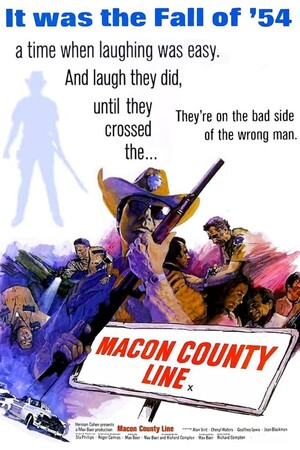

 Twice the Van Damme means double the damme trouble in Double Impact!


 Through the Shattered Lens