Bonus Horror On The Lens: The Devil Bat (dir by Jean Yarborough)


Because today would have been Bela Lugosi’s birthday, it seems appropriate to showcase him in a bonus horror on the lens!

In the 1940 film, The Devil Bat, the owners of a company in the small town of Heathville are super-excited because they’re going to be given their head chemist, Dr. Paul Carruthers (Bela Lugosi), a bonus check of $5,000.  However, since Carruthers’s inventions have made millions for the company, he is offended by the small check and decides that the best way to handle this would be to sue in court and demand fair compensation …. just kidding!  Instead, Dr. Carruthers sends his army of giant bats to kill the families of his employers.

The Devil Bat was produced by Production Releasing Corporation, a poverty row studio that specialized in shooting quickly and cheaply.  Going from Universal to PRC was technically a step down for Lugosi but The Devil Bat is actually an excellent showcase for Lugosi and he gives one of his better non-Dracula performances as the embittered Dr. Carruthers.  Indeed, one can imagine that Lugosi, who played such a big role in putting Universal on the map, could relate to Carruthers and his bitterness over not being fairly rewarded for the work he did to make others wealthy.

Enjoy The Devil Bat, starring the great Bela Lugosi!

Horror On The Lens: The Devil Bat (dir by Jean Yarborough)


In the 1940 film, The Devil Bat, the owners of a company in the small town of Heathville are super-excited because they’re going to be given their head chemist, Dr. Paul Carruthers (Bela Lugosi), a bonus check of $5,000.  However, since Carruthers’s inventions have made millions for the company, he is offended by the small check and decides that the best way to handle this would be to sue in court and demand fair compensation …. just kidding!  Instead, Dr. Carruthers sends his army of giant bats to kill the families of his employers.

The Devil Bat was produced by Production Releasing Corporation, a poverty row studio that specialized in shooting quickly and cheaply.  Going from Universal to PRC was technically a step down for Lugosi but The Devil Bat is actually an excellent showcase for Lugosi and he gives one of his better non-Dracula performances as the embittered Dr. Carruthers.  Indeed, one can imagine that Lugosi, who played such a big role in putting Universal on the map, could relate to Carruthers and his bitterness over not being fairly rewarded for the work he did to make others wealthy.

Enjoy The Devil Bat, starring the great Bela Lugosi!

The Fabulous Forties #38: The Devil Bat (dir by Jean Yarbrough)


1940_devil_bat_012

The 37th film in Mill Creek’s Fabulous Forties box set was 1940’s The Devil Bat, which Gary Loggins reviewed on this site back in October.  Since, for the most part, I agree with Gary’s review, I’m going to recommend that you go read it and then I’ll just add a few thoughts of my own.

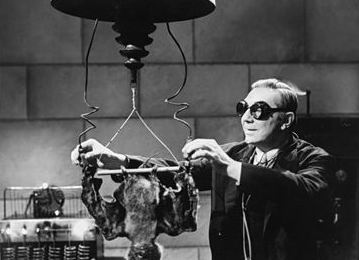
The Devil Bat is usually described as being one of the films that Bela Lugosi made during his decline, even though he made it just a year after appearing in a supporting role in the Oscar-nominated Ninotchka.  Lugosi plays Dr. Paul Carruthers, a small-town chemist who uses radiation to create a gigantic bat that he unleashes on everyone who he feels has wronged him.  The bat targets anyone who makes the mistake of wearing an aftershave lotion that Carruthers has created.

I would argue that there is a hint of genius to be found within The Devil Bat.

First off, there’s the fact that the giant bat is so clearly fake that it actually becomes rather charming.  Wisely, the film makes no effort to convince you that the bat is real.  Whenever that big, fake bat is lowered in on a bunch of often-visible wires, it works as almost a Brechtian alienation device.  In much the same way that Godard used jump cuts in Breathless, Devil Bat uses that big, fake bat to remind the audience that they are watching a film.  As a result, the audience has no choice but to think about the conventions of the horror genre and how their own world view has been shaped by watching movies like Devil Bat.

The other hint of genius is the satirical masterstroke of casting Bela Lugosi as a small town chemist.  Lugosi remains Lugosi, regardless of what role he plays.  When the film’s characters accept, without even a second glance, that Bela Lugosi, with his thick accent and his theatrical acting style, is a humble suburbanite, the film becomes a perhaps inadvertent satire of American conformity.

Needless to say, Lugosi was always a far better actor than he has ever been given credit for being.  In The Devil Bat, he plays Dr. Carruthers with a weary sense of resignation.  Carruthers never becomes a standard evil villain.  Instead, he’s a man who has been so beaten down by life that he now see no other option beyond using a giant bat to kill those who he feels has betrayed him.  Much as he would in Ed Wood’s Bride of the Monster, Lugosi brings an almost redemptive sadness to his mad scientist.

The end result is that poor, misunderstood and underestimated Bela elevates the entire film.

db

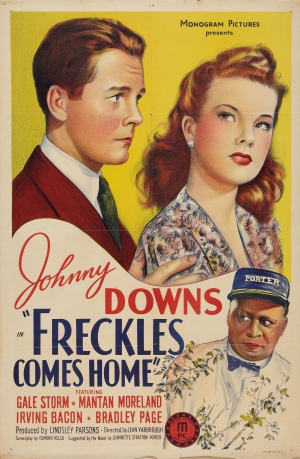
The Fabulous Forties #23: Freckles Comes Home (dir by Jean Yarbrough)


Freckles_Comes_Home_FilmPoster

The 23rd film in Mill Creek’s Fabulous Forties box set was an hour-long “comedy” from 1942.  The name of the film was Freckles Comes Home and I have to admit that I’m struggling to come up with anything to say about it.  That’s the thing about these Mill Creek box sets.  Occasionally, you’ll come across a really good movie and, even more frequently, you’ll come across a really bad movie.  But often times, you find yourself watching filler.  If I had to guess, Freckles Comes Home was probably a movie that was made to act as the 2nd half of a double feature.  Not much money nor effort was put into it.  It’s not terrible and it’s certainly not good.  It’s just sort of there.

With a title like Freckles Comes Home, I was expecting this movie would be about a lost dog but it turns out that I was wrong.  Freckles (played by Johnny Downs) is a human being.  He’s returning home from college because a friend of his has inherited some real estate and isn’t sure what to do about it.  While sitting on the bus home, Freckles spends so much time talking about how much he loves his hometown that the man sitting next to him decides that maybe he’ll make that town his home as well.  Unfortunately, that man is Muggsy Dolan (Walter Sande).  As you would expect with a name like Muggsy, Dolan is a criminal on the run.

Back in town, Freckles attempts to convince his father not to build a road that will go through his friend’s property.  He also romantically pursues a childhood friend named Jane (Gale Storm), despite the fact that everyone insists that Jane can do better than Freckles.  (Personally, I was wondering why — in the year 1942 — a young man like Freckles wasn’t overseas, fighting for his country.  DON’T YOU KNOW THERE’S A WAR ON, FRECKLES!?)  Meanwhile, Muggsy is plotting to rob the town bank…

And then there’s Jeff (Mantan Moreland), who is the porter at the local hotel.  Jeff thinks that he has a machine that will allow him to find buried gold.  And since Jeff is an African-American in a 1940s film, it’s impossible to watch the way the movie treats him without cringing.  There’s a few scenes where Moreland, as an actor, subtly suggests that Jeff is smarter than the movie gives him credit for and certainly, Moreland’s performance is the most memorable in the film but that really doesn’t make the role any less demeaning.

Anyway, Freckles Comes Home was largely forgettable.  I assume that audiences in the 1940s may have enjoyed it (especially if it was included on a double bill with a more interesting movie) but, seen today, there’s just not that much to be said about it.  It exists, it’s something of a time capsule, and that’s pretty much all there is to say about it.

http://www.youtube.com/watch?v=GX4FzShQQ_I