1957’s I Was A Teenage Werewolf combines two genres that were very popular in the late 50s.
On the one hand, it’s a film about a teenage rebel. Tony Rivers (Michael Landon) is a teenager that means well but he keeps losing his temper. If he can’t learn to control his anger, he could very well be looking at a life behind bars.
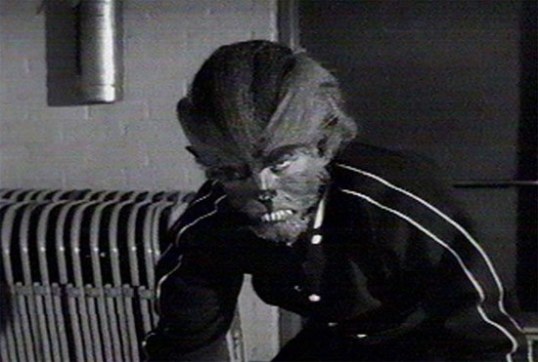
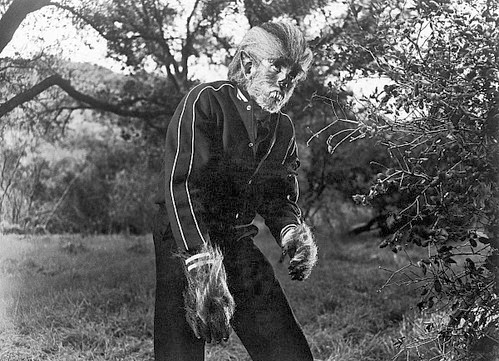
On the other hand, it’s also a horror film. When Tony visits a hypnotist (Whit Bissell), the end result is Tony turning into a werewolf and going on a rampage, all while still wearing his letterman jacket.
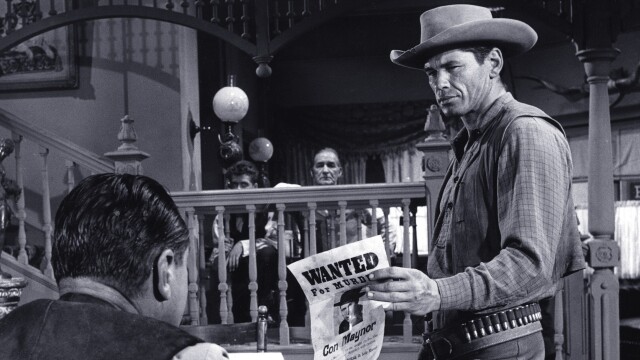
Charles Bronson starred in four movies and one TV show in 1958. Two of those movies were produced by Harold Knox, written by Louis Vittes, and directed by Gene Fowler, Jr. The first of the two films was SHOWDOWN AT BOOT HILL, an excellent low budget western that featured Bronson as a bounty hunter with a chip on his shoulder and love in his heart. The second film was GANG WAR.
In GANG WAR, Charles Bronson plays Alan Avery, a high school teacher in Los Angeles who’s walking home one night and happens to witness a gangland killing. He calls the police to report the murder, but he doesn’t want to get any further involved so he doesn’t give them his name. Avery was on his way home from a trip to the pharmacy where he had picked up a prescription for his pregnant wife (Gloria Henry) who is suffering from migraines. In the stress of the moment, he left the pharmacy sack in the phone booth and the police are able to track him down to his home. After being pressed by the police, Avery reluctantly agrees to testify. He’s a great witness as he’s able to give the police a description of the car and its license plate number. His information leads to the arrest of Joe Reno, the second in command to mobster Maxie Meadows (John Doucette). Maxie sends his attorney Bryce Barker (Kent Taylor) over to the police station to see Captain Finch. Finch happens to be on Maxie’s payroll, and he immediately tells Barker about the witness. He even leaks it to the press so they can run a story revealing Avery’s name and address. Maxie would prefer to buy Avery’s silence, but he also wants a little insurance, so he sends his punch drunk henchman Chester over to slap around Avery’s wife. This order is akin to asking Lennie Small from OF MICE AND MEN to go play with some puppies. Simple-minded Chester proceeds to kill Mrs. Avery. When Avery comes home and finds his wife dead, he heads directly to Maxie’s house to kill him. The cab driver who took Avery to Maxie’s place just happened to see his gun, so he called the cops. Just before Avery can squeeze off a kill shot, the police show up and arrest him. Pissed that Avery was able to get so close to killing him, Meadows puts an actual hit out on him this time. Will the high school teacher be able to survive his battle against the mob?!!
(Note: The analysis below ventures into spoiler territory for both GANG WAR and SHOWDOWN AT BOOT HILL. You may want to watch these films prior to reading the rest of the review.)
As a lifelong fan of Charles Bronson, I really appreciate his work with director Gene Fowler, Jr. in 1958. Fowler recognized Bronson’s charismatic screen presence, but he also recognized something deeper in the legendary icon… his heart. SHOWDOWN AT BOOT HILL seemed to be giving us Bronson as a typical western hero, only to reverse course and turn Bronson into a romantic lead who would choose to throw down his guns so he could establish roots in a community and spend his life with the woman he loves. In a similar way, GANG WAR seems to be setting Bronson up to be a vigilante, not much different than the type of character he would be portraying throughout the 70’s and 80’s. But when 70’s and 80’s Bronson would be pulling his trigger, Fowler presents a more thoughtful Bronson who recognizes that the best revenge can sometimes be in letting someone live with the consequences of their own decisions. This allows him to lower his gun, walk away and continue his life free of the guilt and the legal consequences that would undoubtedly come with taking another person’s life. This decision honors his wife’s legacy much more than murder and a lifetime in jail ever would.
There are many good performances in this little gem. Bronson may not have been a “star” when this film was made, but there is no doubt that he was ready. He simply commands every frame that he appears in from the beginning to the end. John Doucette and Kent Taylor are also memorable as the gangster and his paid off lawyer, respectively. Doucette’s Maxie Meadows is certainly a stereotype of the gangsters in TV’s and movies at the time, but he plays the part well, saving his very best for his last moments of the film. Kent Taylor has the movie’s best story arc. When we meet him, he’s an alcoholic who can’t stand what he’s allowed himself to become, yet he continues to run every time Maxie calls. It’s a strong moment when he decides he won’t do it anymore. And Jennifer Holden is simply gorgeous as Marie, Maxie’s woman. Speaking of nice scenery, it was also fun seeing a Los Angeles that included landmarks like the Capitol Records Building and the old Nickodell Restaurant. So much of the action in GANG WAR takes place against these iconic backdrops, and for a guy who’s never been to LA, seeing these places again almost makes me feel like a resident.
Overall, while GANG WAR does feel like an old fashioned 50’s movie, it has plenty of things to recommend it, not the least of which is an excellent performance from a young Charles Bronson. At a 75 minute run time, it’s definitely worth a viewing.
1958 was an interesting year for 36-year-old Charles Bronson. After mostly playing character parts on movies and TV for the first part of the decade, Bronson would star in four movies in 1958 and also headline his own TV show. On first glance, the western SHOWDOWN AT BOOT HILL would appear to fit nicely into the image that Bronson would project during the heights of his popularity in the 70’s and 80’s. But upon further inspection, this little gem shows us a side of Bronson we rarely would get to see in his heyday.
The story opens with Luke Welsh, played by Bronson, riding into a dusty western town. After dropping his horse off at the livery stable, Welsh strolls into the local restaurant and immediately confronts town citizen Con Maynor. It’s here that we learn that Welsh is a bounty hunter and Maynor is a wanted man. A gunfight ensues and Maynor is gunned down. All Welsh needs is the local authorities to confirm the identity of Maynor so Welsh can collect his bounty. Unfortunately for Welsh, it seems the townsfolk like Con Maynor so they refuse to confirm his identity. This leads to Welsh having to stay in town until he can get someone, anyone, to agree to the name of the dead man.
All of this sounds pretty normal for a western headlined by Charles Bronson. He is a tough guy of action for sure, but there are several things in the film that are quite unique in the Bronson filmography. Let me explain. First, Bronson’s character, Luke Welsh, is extremely insecure about his height, and this turns out to be an ongoing plot device in the film. In the gunfight with Maynor that opens the film, the wanted man refers to Welsh as “pint-sized,” and after gunning him down, Welsh responds with “how tall are you now, big man?” Later in the film, the local storekeeper, Mrs. Bonaventura, notices Welsh looking up at a mannequin in the store that he is standing by. Being a wise lady, she immediately recognizes his insecurity and offers him kind words and encouragement multiple times throughout the film. Many people who have followed Bronson’s career know that the actor was, in fact, insecure about his height and would often insist that his co-stars be no taller than him. I think Bronson’s ability to sympathize with this element of the character would result in a very strong performance. When you think of the characters he played after he hit it big, this type of insecurity would not be featured again in his work.
Another thing that makes SHOWDOWN AT BOOT HILL unique is the fact that Charles Bronson’s character Luke Welsh shows more vulnerability in his relationships than what we would see later in his career. I’ll use his relationship with the lonely young woman, Sally Crane, to illustrate this point. After recognizing how rough her hands are from her work at the restaurant, Welsh goes out of his way to purchase her some hand cream at Mrs. Bonaventura’s shop. When he’s giving her the hand cream in her room, he notices just how plain the room is and begins to see that Sally is doing everything in her power to not be noticed and has shut herself off from the world. He recognizes that they’re both just a couple of misfits, with him hiding behind a gun and her hiding behind her apron. Welsh speaks so softly and sweetly to her at different times in the film. I think Bronson does a fine job with this side of his character and shows he could have played more roles with romantic overtones. Even in his films with his wife Jill Ireland, Bronson would rarely show such vulnerability with his female co-stars in future films.
Finally, the actual showdown at Boot Hill that takes place at the end of the film plays out nothing like you would expect in later films like THE MECHANIC, MR. MAJESTYK or DEATH WISH 3. After getting to know many of the local people like Sally & Mrs. Bonaventura, and after having grown tired of never having a place to call home, Welsh makes the only decision that will allow him to stay. I won’t spoil it for you, but in my opinion, it’s an unexpected and wonderful ending for these characters who I had really grown to like throughout the course of this compact, 71 minute film. I highly recommend SHOWDOWN AT BOOT HILL!
We dedicated an episode of the THIS WEEK IN CHARLES BRONSON podcast to this solid western. I’ve attached the link below if you want to know even more about SHOWDOWN AT BOOT HILL.
1957’s I Was A Teenage Werewolf combines two genres that were very popular in the late 50s.
On the one hand, it’s a film about a teenage rebel. Tony Rivers (Michael Landon) is a teenager that means well but he keeps losing his temper. If he can’t learn to control his anger, he could very well be looking at a life behind bars.
On the other hand, it’s also a horror film. When Tony visits a hypnotist (Whit Bissell), the end result is Tony turning into a werewolf and going on a rampage, all while still wearing his letterman jacket.
Tony Rivers (Michael Landon), the lead character in 1957’s I Was A Teenage Werewolf, is a teenager. You probably already guessed that from the film’s title but, as we all know, titles can be misleading. Teenagers were very popular in the 50s, after all.
But no, Tony is actually a teenager. In fact, he’s one of those troubled teenagers that were all the rage in the late 50s. He lives for kicks and spends too much combing his hair. He skips school. He stays out late. He gets into fights with other teenagers. He’s not dumb, mind you. He has plenty of friends and a girlfriend (Yvonne Lime) who only wants the best for him. He just has a hard time controlling his temper and his father (Malcolm Atterbury) isn’t sure what to do with him.
However, Detective Donavon (Barry Phillips) has a possible solution! After the police are called to break up one of Tony’s fights, Donavon suggests that maybe Tony should seek professional counseling. In fact, maybe he could go see Dr. Brandon (Whit Bissell)! Dr. Brandon is a widely respected hypnotherapist and he has an office right next to the local airplane factory. Only the best therapists are allowed to practice next to the airplane factory. Everyone knows that.
Even though he doesn’t want to, Tony finally agrees to see Dr. Brandon. Even if he doesn’t say it, you can tell that Tony is thinking, “This is totally squaresville. Really melvin, maaaaaan….” the whole time. But Brandon gets results!
In fact, you could argue that he gets too many results. After twice hypnotizing Tony and telling him to think of himself as being a wild animal, Tony becomes just that! That’s right, Tony turns into a werewolf and he’s soon running around town — in his letterman jacket! — and killing anyone that he comes across.
Whenever Tony transforms back into a human, he regrets what he’s done. Unfortunately, it turns out that almost anything can cause Tony to turn back into a wolfman. Most werewolves need a full moon. All Tony needs is to hear the sound of the school bell….
To be honest, I imagine that most people who watch this film do so because they want to see a werewolf creating chaos while wearing a high school letterman jacket. Considering that this was a low-budget film made to play as half of a double feature, the werewolf makeup is actually fairly impressive and that letterman jacket adds just the right touch of weirdness to the whole affair.
Make no mistake, it’s an entertaining and deeply silly film but, at the same time, it does have an interesting subtext. One could argue that Tony’s transformation into a werewolf serves as a metaphor for his struggle to grow up. Neither werewolves nor juvenile delinquents can control themselves and Michael Landon gives a performance that’s just sensitive enough to justify calling this one Werewolf Without A Cause.
That said, the main appeal of this film is definitely the chance to see a werewolf in a letterman jacket.
1957’s I Was A Teenage Werewolf combines two genres that were very popular in the late 50s.
On the one hand, it’s a film about a teenage rebel. Tony Rivers (Michael Landon) is a teenager that means well but he keeps losing his temper. If he can’t learn to control his anger, he could very well be looking at a life behind bars.
On the other hand, it’s also a horror film. When Tony visits a hypnotist (Whit Bissell), the end result is Tony turning into a werewolf and going on a rampage, all while still wearing his letterman jacket.
1957’s I Was A Teenage Werewolf combines two genres that were very popular in the late 50s.
On the one hand, it’s a film about a teenage rebel. Tony Rivers (Michael Landon) is a teenager that means well but he keeps losing his temper. If he can’t learn to control his anger, he could very well be looking at a life behind bars.
On the other hand, it’s also a horror film. When Tony visits a hypnotist (Whit Bissell), the end result is Tony turning into a werewolf and going on a rampage, all while still wearing his letterman jacket.
The 1958 film I Married A Monster From Outer Space tells the story of Marge (Gloria Talbott) and Bill Farrell (Tom Tryon).
Just one year ago, they seemed like the perfect couple. They were newlyweds, looking forward to starting a family and living in a nice house in the suburbs. Bill seemed like the perfect guy, warm, friendly, humorous, and loving.
However, things have changed. On their one-year anniversary, Bill is cold and distant. He certainly seems to have little interest in romance or anything like that. When Marge gives Bill a new dog as his anniversary present, he doesn’t seem to be sure how to react to it. When the dog later ends up dead, Bill gives her an implausible excuse.
Bill has changed but he’s not the only one. Marge notices that all of her friend’s husbands are acting strange as well. It’s as if something has magically turned every man into the neighborhood into a stiff, humorless jerk.
(Either that or it’s the 50s!)
One night, Marge decides to follow Bill into the forest and she sees something that challenges everything that she previously thought she knew about her husband. What does she discover? Well, it’s right there in the title. Marge has married a monster from outer space!
I imagine that most people’s natural instinct with a film like this is to make fun of the title and just go on from there but actually, I Married A Monster From Outer Space is an intelligent and well-done sci-fi film. Gloria Talbott does a great job in the lead role and Tom Tryon’s rather stiff screen presence is perfectly suited for the role of Alien-Bill. Gene Fowler, Jr. directs the film as if it were a film noir where the usual gangsters and bank robbers have been replaced by humanoid aliens who don’t like dogs.
Since this movie is from 1958, there’s all sorts of subtext creeping around. The most obvious, of course, is that America is being invaded from within. You don’t think your husband could be an alien? Well, Alger Hiss’s mother probably didn’t think her son was a communist spy! You think it’s a silly idea that normal seeming humans would be working to conquer the world? Have you not heard of Julius and Ethel Rosenberg? When Bill and the other men turn cold and impersonal, it’s easy to see that they’ve embraced an ideology opposed to individual freedom and we all know what that means.
However, for me, this film works because it strikes at a very primal fear. How well do you really know the people who you love? Is he always going to be as perfect as he seems when you first start going out or is he going to totally change once he’s sure that you’re not going to leave him? Like many women who have tried to escape from abusive boyfriends and spouses, Marge discovers that no one believes her. She lives in a world controlled by men and all of the men have been taken over by the same thing that’s taken over Bill. Even if you’ve never married a monster from outer space, you know what Marge is going through.
So, don’t dismiss this film because of the melodramatic title. I Married A Monster From Outer Space is an intelligent sci-fi horror film, one that’s still relevant today.



 Through the Shattered Lens