October Hacks: Alice, Sweet Alice (dir by Alfred Sole)


Eh.  The 1976 film, Alice, Sweet Alice, is one of the few slasher films to have found critical acclaim and to have been seriously studied in the years after its release but I have to admit that it’s never done much for me.

It’s a film that takes place in 1961, in a Catholic neighborhood of Patterson, New Jersey.  It’s perhaps the ugliest setting of a film outside of Combat Shock The houses that we see are run-down.  The apartment building in which much of the action takes place is dirty and rat-infested.  Even the local church looks like it could use a bit of spring cleaning.  Of course, if you think the neighborhood looks ugly, you should see some of the people who live in it.  There’s really not anyone in this film who could be considered to be at all appealing.  Everyone’s either angry or disturbed or grotesquely obese or pervy.  It’s one of those films where everything is so dirty and sleazy that it’s hard not kind of laugh at it all.  John Waters could have worked wonders with this neighborhood but Alfred Sole, Alice’s director, seems to take his story just a little too seriously to give it the camp approach that it deserves.

(In fact, probably the only appealing sight in Alice, Sweet Alice is a picture of John F. Kennedy that is seen hanging in a few offices.  There’s a lot of not positive things that can be said about JFK but at least he was handsome.)

Anyway, the plot deals with Alice Spages (Paul Sheppard), an annoying twelve year-old sociopath who lives in the desolate apartment building and who enjoys tormenting people by putting on a Halloween mask and scaring them.  Alice is basically a bully but I think we’re supposed to sympathize with her because she’s rebelling against the suffocating hypocrisy all around her.  Again, whatever.  I was a brat when I was 12 years old too.

Alice’s younger sister, Karen (Brooke Shields, making her film debut), is as perfect as Alice is troublesome.  Everyone loves Karen, except for Alice who is obviously jealous.  On the day of her first communion, Karen is strangled to death by someone wearing a Halloween mask and a yellow raincoat, one that looks a lot like the one that Alice owns.  The killer steals Karen’s crucifix and tries to set the body on fire.  Father Tom (Rudolph Willrich) is annoyed that the ceremony has been interrupted.  Actually, it’s hard to think of a moment in this film in which Father Tom isn’t annoyed by something.

Did Alice murder her sister?  A lot of people think so, especially after other people who get on Alice’s nerves end up getting attacked.  Alice ends up getting sent to a mental hospital but, of course, Alice isn’t the murderer.  Who is the murderer?  No need for me to say.  If you watch the film, you’ll figure it out easily on your own.

Alice, Sweet Alice is often described as being an early slasher film.  If anything, it’s more of an American giallo, with the emphasis being on figuring out who is the killer behind the mask.  Many critics have praised Alice, Sweet Alice for its atmosphere and its anti-religious subtext but, to be honest, I’ve always found it to be kind of boring.  Part of the problem is that every character is so repulsive (physically, mentally, and morally) that it’s difficult to really care about whether or not they die or if they’re the guilty party.  Even Alice comes across like someone who is destined to start fires once she grows up.  None of the actors gives a good enough performance to hold your attention.  The film attempts to criticize the Church, as many giallo films did.  But one need only compare Alice Sweet Alice to other anti-clerical giallo films, like Lucio Fulci’s Don’t Torture A Duckling or Aldo Lado’s Who Saw Her Die? , to see how simplistic and superficial Alice, Sweet Alice‘s approach really is.

Anyway, a lot of people will disagree with this review and that’s fine.  Some films work for some people while failing to work for others and, in this case, Alice Sweet Alice is just a film that does not work for me.  Que sera sera.
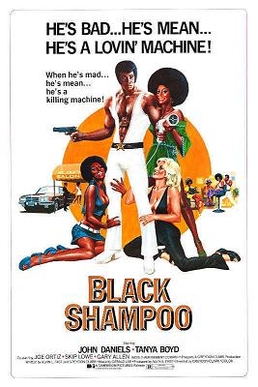
The TSL Grindhouse: Black Shampoo (dir by Greydon Clark)


The 1976 film, Black Shampoo, tells the story of Mr, Jonathan (played by an expressionless actor named John Daniels).  Mr. Jonathan is the hottest hairstylist on the Sunset Strip.  Rich women flock to his salon so that Mr. Jonathan can do their hair and, as the first scene in the film makes clear, do a lot more as well.  Black Shampoo begins with a wash and rinse that soon leads to Mr. Jonathan’s client saying, “It is bigger and better!” while the singers on the film’s funk-heavy soundtrack tell us that, “He’s a real man.”

Mr. Jonathan is so popular that the women who come into his salon are visibly upset if they’re told that their hair will be done by Mr. Jonathan’s two associates, Artie and Richard.  “Artie doesn’t have the right equipment!” one woman exclaims while another complains, “My hair’s a mess …. I haven’t had my hair done in over a month.”  Fortunately, helping to keep the place running is Mr. Jonathan’s new administrative assistant, Brenda St. John (Tanya Boyd).  In fact, Mr. Jonathan could even see himself settling down with Brenda.

Unfortunately, Brenda is the ex-girlfriend of a white gangster named Mr. Wilson (Joe Ortiz).  And Mr. Wilson is determined to get Brenda back, even if it means sending two of his thugs down to Mr. Jonathan’s and messing the place up.  It’s easy for them to vandalize the salon and to harass Artie and Richard because Mr. Jonathan hardly ever seems to be there.  He’s always either visiting a client at home or taking part in a falling in love montage with Brenda.  When Brenda is kidnapped, Mr. Jonathan falls into a deep depression.  Eventually, though, Mr. Jonathan realizes that he has to rescue Brenda and retrieve the black book that proves that Mr. Wilson is a crime lord.  Fortunately, Mr. Jonathan is as handy with a chainsaw as he is with a hair blower.

Ugh.  This film …. I mean, to be honest, the movie seems like it’s going to be fun when it starts.  Yes, the acting is terrible and the dialogue is risible but it’s such a 70s film that I assumed it would be kind of fun.  And there are some enjoyably silly moments, like the whole falling in love montage.  But, as the film progresses, the violence and the film’s overall tone just gets uglier and uglier.  That, in itself, is not a problem.  In fact, you could argue that violence should be ugly because it’s violence.  But, in the case of Black Shampoo, too much of that ugly violence is played for titillation.  When Mr. Wilson threatens to sodomize a character with a curling iron, the film seems to take a certain delight in Mr. Wilson’s sadism.  The film is certainly not on the side of the poor guy who is being threatened.  Instead, it feels like the film is saying, “Do you think will show this happen or do you think will cut to another scene?  Keep watching to find out!”  It’s gross.

It would help if Mr. Jonathan were himself an engaging character but John Daniels’s performance in painfully dull.  He has a definite physical presence, though he definitely looks a lot better on the film’s poster than he does in the actual movie.  But, when he has to deliver dialogue or show emotion, he’s so awkward that it’s like staring at a brick wall and waiting for it to do something.  As a character, Mr. Jonathan should be someone who moves with a certain confidence and swagger.  John Daniels usually seems like he’s more busy trying not to look straight at the camera.

On the plus side, everyone’s hair looks beautiful.

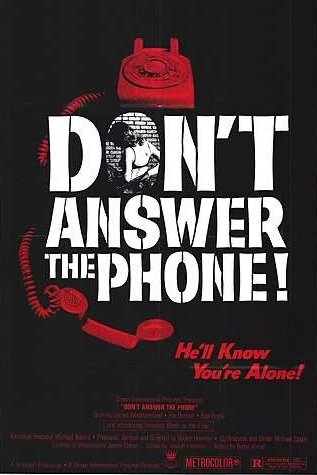
The TSL’s Daily Horror Grindhouse: Don’t Answer The Phone (dir by Robert Hammer)


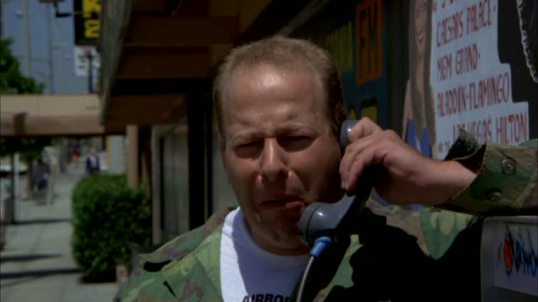
Nicholas Worth in Don't Answer The Phone

Nicholas Worth in Don’t Answer The Phone

AGCK!

As a self-described lover of grindhouse and exploitation films, I have seen my share of truly icky films.  But Don’t Answer The Phone, a 1980 mix of police procedural and serial killer horror, is in a class all by itself.  It is not only exceptionally icky but it’s distressingly effective as well.

After I watched Don’t Answer The Phone, I actually checked to make sure all the doors were locked.  Before I got into bed, I searched all the closets to make sure there wasn’t anyone hiding in there.  And, as I fell asleep, I found myself thinking that maybe I should follow the advise of both Arleigh and my sister.  Maybe it was time for me to finally get a gun of my own and learn how to use it.

Seriously, Bowman, I thought as I waited for sleep to come, you live in Texas.  It’s totally legal to carry a gun down here so you need to take advantage of the law and make you’re ready to blow any pervert losers away!  Even if you shot the wrong person, you’re cute.  The jury would never convict…

That’s the type of effect that Don’t Answer The Phone had on me.  It’s not necessarily a good film.  With one notable (and important) exception, most of the acting is terrible.  The film’s few attempts at intentional humor largely fall flat.  Even with a running time of only 94 minutes, Don’t Answer The Phone feels overlong and full of unneeded padding.  And yet, this is a very effective film.  It did freak me out, largely because it was so crude and heartless.  It strikes at the most primal fears of the viewer, that feeling that — even within the security of our own home — we may not truly be safe.

As Don’t Answer The Phone opens, Los Angeles is a city being stalked by a madman.  That, in itself, is not surprising.  Just taking a quick look at Wikipedia will reveal that Los Angeles has been home to a large number of serial killers.  In fact, if there is anything shocking about Don’t Answer The Phone, it’s the suggestion that Kirk Smith (played by Nicholas Worth) is the only serial killer in town.

Who is Kirk Smith?  He’s an overweight, bald photographer who always wears an army jacket and is obsessed with candles, body building, and strangulation.  He also enjoys calling up a local talk show host, Dr. Linsday Gale (Flo Gerrish).  (One wonders if Dr. Gale’s name was specifically meant to make the viewer think of The Wizard of Oz.)  “Hello,” he says in an outrageously fake accent, “this Ramon!”  He tells Dr. Gale that he has frequent headaches and bad urges.  When he’s not pretending to be Ramon, Kirk can usually be found staring at himself in a mirror and yelling, “Do I measure up, Dad!?”

Kirk is killing women across Los Angeles and it looks like he might never be caught because Don’t Answer The Phone features some of the most incompetent cops ever!  These are the type of cops who smirk at the victims and shoot anyone who doesn’t get on the ground fast enough.  These are the type of cops who open fire and then say, “Adios, creep.”  Civil liberties!?  BLEH, THESE COPS DON’T HAVE TIME FOR YOUR RIGHTS!  Of course, they do end up shooting and killing the only witness who can identify Kirk Smith as the murderer.  Whoops!

If there’s anything that sets Don’t Answer The Phone apart from all the other serial killer films, it’s the performance of Nicholas Worth.  Far more than the slick and erudite serial killers who dominate contemporary thrillers, Nicholas Worth is a frighteningly believable lunatic.  He’s scary because we’ve all seen his type wandering the streets.  We’ve all felt his stare linger for a few seconds too long and we’ve all had the same feeling of dread when we saw him approaching us.  Reportedly, Worth did a lot of research on actual serial killers before taking on the role of Kirk Smith and his performance is terrifying because it is so real.

It’s icky to watch but, at the same time, it do serve to remind us that there are real life Kirk Smiths out there.

Agck!  Seriously, it makes me shake just thinking about it.

I’m getting a gun…

DAtP