The Films of 2020: Hillbilly Elegy (dir by Ron Howard)


Oh, Hillbilly Elegy.

This is a film that I think a lot of people expected to be an Oscar contender because it was directed by industry favorite Ron Howard, it was based on a genuinely moving best seller, and the cast included Amy Adams and Glenn Close, two actresses who are more than overdue for their first Academy Award.  I don’t think anyone expected it to win much, largely because Ron Howard isn’t exactly the most groundbreaking director working in Hollywood, but it was still expected to be contender.

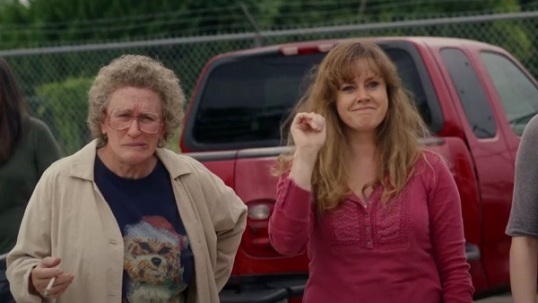
Even before it was released, there were a few signs that Hillbilly Elegy might not be the award-winning film that some were expecting.  The first images from the film featured Glenn Close and Amy Adams looking like characters from some sort of ill-conceived SNL sketch.  Then the trailer came out and it was so obviously Oscar bait-y and heavy handed that it was hard not to suspect that the film was trying just a bit too hard.  By the time the film itself finally premiered in November, I think a lot of people were specifically waiting for their chance to skewer it.

Make no mistake about it, Hillbilly Elegy deserves a certain amount of skewering.  Its a bit of a tonal mess and, far too often, it feels as if Ron Howard is inviting us to gawk at the film’s characters as opposed to showing them any sort of real empathy.  Those critics who have claimed that the film occasionally feels like “poverty porn” have a point.

And yet, despite all of those legitimate complaints, I would argue that the film is partially redeemed by the performance of Glenn Close.  Close plays Meemaw, who always seems to be carrying a lit cigarette and who has no hesitation about threating to beat the Hell out of her children and her grandchildren.  Meemaw lives in a cluttered house that probably reeks of smoke.  The TV is almost always on.  Meemaw is a fan of Arnold Schwarzenegger.  If you’ve ever wanted to hear Glenn Close say, “Hasta la vista, baby,” this is the film for you.  Meemaw is a somewhat frightening character (during one flashback, she sets her drunk husband on fire) but she’s also the most caring character in the film.  When it becomes obvious that her drug addict daughter, Bev (Amy Adams), is incapable of taking care of J.D. (played by Owen Aszatlos as a teen and Gabriel Basso as an adult), Meemaw essentially kidnaps J.D. and take him home with her.  Close’s performance is undeniably theatrical but it works.  She communicates that underneath all the bluster and the profanity and the anger and the cigarette smoke, Meemaw truly does love her family.  Glenn Close transcends the film’s flaws and brings some real heart to the story.

Hillbilly Elegy opens with J.D. as a student at Yale Law School, hoping to get accepted for a prestigious summer internship.  Meanwhile, all the other Ivy Leaguers treat J.D. like some sort of alien on display because he’s originally from Kentucky, he served in the army, and he went to a state school.  Though ambitious and intelligent, J.D. still feels likes an outsider.  When he goes to a banquet and discovers that he’ll be required to use different forks throughout the meal, he calls his girlfriend (Frieda Pinto) and gets a quick lesson on which fork to use when.

Unfortunately, before the meal even starts, J.D. gets a call from his sister, Lindsay (Haley Bennett), telling him that Bev has overdosed on heroin and is at the hospital.  J.D. has to drive all the way to Ohio so that he can try to get his mother into a drug rehab.  Because Bev doesn’t have medical insurance and would rather just stay with her good-for-nothing boyfriend, that turns out to be a bit more difficult than J.D. was anticipating.  The film becomes a race against time to see if J.D. can get his mom taken care of and still make it back to Connecticut so that he can interview for a prestigious internship.  Along the way, there are frequent flashbacks to Meemaw telling the young J.D. that he can be something better than just a hillbilly.  All he has to do is try and not give up.

By structuring his film as a series of flashbacks, Ron Howard ensures that there’s really not any suspense about whether or not J.D. is going to be able to escape from Appalachia.  Since we’ve already seen that the adult J.D. is going to be end up going to Yale, it’s hard to get worried when we see the teen J.D. smoking weed and hanging out with a bunch of losers.  We know that J.D. is going to get over his adolescent rebellion and get his life straightened out.  The film tries to create some tension about whether or not J.D. is going to be able to make his internship interview but, again, J.D. is going to Yale and living with Frieda Pinto.  From the minute we see J.D., we know that he’s going to be just fine regardless of whether he gets that internship or not.  In fact, his constant worrying about missing his interview starts to feel a bit icky.  While Bev is dealing with her heroin addiction, Ron Howard is focusing on J.D. driving back to Connecticut as if the audience is supposed to be saying, “Oh my God, has he at least reached New Jersey yet!?”  This is the type of storytelling choice that could only have been made by a very wealthy and very comfortable director.  It reminded me a bit of The Post and Steve Spielberg’s conviction that, when it came to the decision to publish the Pentagon Papers, audiences would naturally be more interested in the owner of the newspaper than the people who actually did the work breaking the story.  Here, Howard seems to be saying, “Yes, Bev might overdose and die having never reconciled with her son but the real tragedy is that J.D. might have to settle for his second choice as far as prestigious summer internships are concerned.”

Along with the story’s structural issues, the film also suffers because the usually wonderful Amy Adams is miscast as Bev.  Adams acts up a storm as Bev but the performance itself a bit too obvious and on-the-surface.  While Glenn Close disappears into the role of Meemaw, you never forget that you’re watching Amy Adams playing a character who is a bit more troubled than the usual Amy Adams role.  You don’t think to yourself, “Oh my God, Bev is losing it.”  Instead, you think, “Amy Adams sure is yelling a lot in this movie.”  Somehow, Hillbilly Elegy makes Amy Adams feel inauthentic, which is something that, before I watched this film, I wouldn’t have believed to be be possible.

Aside from Glenn Close’s performance, Hillbilly Elegy doesn’t quite work and that’s a shame because I do think that a good film could have been made from Vance’s book.  Unfortunately, Ron Howard doesn’t bring any sort of grittiness to the film’s depiction of what it’s like to be poor and forgotten in America.  Instead, the film feels just a bit too slick.  It attempts to be both a film about poverty and a crowd pleaser.  When the movie should be showing empathy for its characters, it puts them on display.  When it should be challenging the audience, it pats us on the back as if we should feel proud of ourselves merely because we spent two hours watching J.D. and his family.  The film just doesn’t work.  No wonder Meemaw prefers watching The Terminator.
Embracing the Melodrama Part II #111: Slumdog Millionaire (dir by Danny Boyle)


Slumdog_millionaire_ver2A few thoughts on the 2008 winner for best picture, Slumdog Millionaire:

First off, whenever I think about Slumdog Millionaire, it’s impossible for me not to think of that episode of The Office where Holly and Michael do an homage to the film at the Dunder Miflin company picnic and, along with traumatizing all of the children in the audience, they also manage to accidentally reveal that half of the employees at the picnic are about to get laid off.  If you need to know just how successful Slumdog Millionaire was here in the United States, just consider that it was popular enough to be parodied by Michael Scott.

Secondly, as I sit here thinking about what I want to say about the film itself, I find myself wondering if it’s really necessary for me to rehash the film’s plot.  I mean, everyone’s seen this movie, right?  It was released 7 years ago.  It won a bunch of Oscars.  It’s on cable constantly!  I mean, everyone already knows what happens, right?

Oh, really?  Okay, apparently there’s one person out there who has never seen Slumdog Millionaire.

For his benefit, I will reveal that Slumdog Millionaire is a British-made film about India.  Jamal (Dev Patel) is an 18 year-old telemarketer, who works from India and calls people in Scotland, reading from a script and saying things like, “I really love Sean Connery.”  When Jamal is selected to compete on the Indian version of Who Wants To Be A Millionaire, he shocks both the audience and the show’s producers by getting every answer right.  However, before he can answer the final question and potentially become a millionaire, he is taken into a backroom and tortured by the police, who are convinced that a “slumdog” like Jamal couldn’t possibly know all the answers.  As Jamal explains how he knew each answer, the film flashes back to Jamal’s childhood in the slums of Bombay.

It’s during these flashbacks that we see how Jamal — and thousands of other poor children like him — were forced by local gangsters to work as beggars.  (In one extremely harrowing scene, a child is blinded specifically so he’ll be a more sympathetic beggar.)  While Jamal eventually escapes this life, his brother Salim (Madhur Mittal) and his childhood love, Latika (Freida Pinto) remain under the power of a cruel crime boss (Mahesh Manjrekar).

So, that’s a relatively spoiler-free plot outline of Slumdog Millionaire.  You’re welcome.

Now, personally, I love Slumdog Millionaire but a lot of people don’t.  It seems to be one of those films that always gets mentioned when certain people talk about unworthy Oscar winners.  Some of that is because Slumdog Millionaire won best picture the same year that The Dark Knight was not even nominated.  In the eyes of some, being upset over the snubbing of The Dark Knight means that you’re also required to insanely resent every film that was not snubbed.  (Looking in your direction, Sasha Stone…)  But even more of the anti-Slumdog sentiment seems to come from the fact that the plot of Slumdog Millionaire revolves around an episode of Who Wants To Be A Millionaire.  They feel that Slumdog Millionaire is essentially a feature-length commercial for a game show.

However, I think those people are overlooking one very important detail.  In Slumdog Millionaire, How To Be A Millionaire is not portrayed in the most positive light.  The whole plot of the film, after all, is that, as a result of doing well on the show, Jamal was taken into a dank room and tortured!  You have to wonder what went on behind the scenes on the American version of the show.

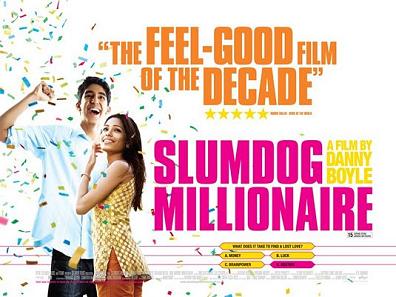
The film’s poster refers to Slumdog Millionaire as being “the feel good film of the decade.”  I don’t know if I’d agree with that description.  It’s a fun film to watch because Danny Boyle is one of those hyperactive directors who can make anything fun.  But, at the same time, Slumdog Millionaire is a pretty dark film.  Happy ending or not, the majority of the film is about children living in extreme poverty and being exploited by rich sadists.

For those who would complain that Slumdog Millionaire gets a bit too melodramatic for its own good — well, can you ever really be too melodramatic?  Along with everything else, Boyle meant for Slumdog Millionaire to serve as an homage to the famously melodramatic cinematic conventions of Bollywood and he largely succeeds.

And, of course, there’s the final dance number!

Seriously, how can you note love that?

http://www.youtube.com/watch?v=vNk2pG7agYE

Quick Film Review: Immortals (dir. by Tarsem Singh)


Perhaps I’m jaded and spoiled by movies like Jason and the Argonauts and games like God of War.

I’m pretty sure that in an alternate dimension somewhere, audiences are sitting in the theatre and loving the hell out of Immortals. Maybe in some ways it’s actually good, but I can’t see them. At best, the film acts a great demo reel for Henry Cavill, who audiences will see as Superman sometime next year. For that reason, and perhaps Mickey Rourke’s Hyperion, Immortals is worth a peek. Even then, you may want to have someone take you to the movie, rather than pay for it yourself. Let’s put it this way. I spent more time on my iPhone with the brightness dimmed during the movie than I did actually watching it, and that’s a rarity for me. You’re better off waiting for the Netflix Edition. Everything you see in the trailer is basically the film in a nutshell.

The only other thing it really does have going for it is the 3D, which actually happens to be pretty good for the half hour that you can see it (and perhaps that’s just me, because it feels like it fades over time). The film does feel as if it were primarily filmed in 3D, and boasts some awesome visuals, but the story is a little jumbled. I won’t deny that Tarsem Singh has a really fantastic eye for painting a scene from The Cell to this point, but without sharp writing there’s something lost in the translation. It’s like watching David Fincher when he was still partnered with Darius Khondji on Seven or Spielberg with Kaminski in Minority Report. You can make pretty pictures, but there has to be some kind of meat and potatoes to it for the audience. That’s just how I felt here.

Eons ago, you once had mortals and you had gods. Zeus, Poseidon, Athena, Apollo, Dionysus, Aphrodite, etc. In Immortals, the gods learned that they had the ability to kill one another and as a result, there were a number of wars.  Enter Hyperion, who loathes the gods and wants them destroyed. In order to do this, he has to unleash the Titans, who were once servants of the gods but were punished for their treachery and sealed away in a special cage that can only be unlocked with an item called the Epirius Bow (which was one of the elements I truly enjoyed).

Our hero, Theseus (Cavill) lives a quiet life with his family when Hyperion’s forces attack. In the process, he witnesses his mother’s death at the hands of Hyperion himself and swears vengeance. Captured and left for dead with a number of others, he meets a mystic named Phaedra (played by Freida Pinto, who seems like she may be playing the same role emotionally that she did in Rise of the Planet of the Apes). Phaedra provides him with visions that allow him to reach the Bow.

Lead by Zeus, the gods watch all of this from Olympus, but are unable to interfere in the affairs of mortals on pain of death. These sequences (when they do happen) are the ones that you’re seeing in the trailers for the most part. Oceans rise and bad guys are cut down so fast that the first hardly has a chance to fall before the ninth one is hit. It’s amazing to see, it really is, but it’s been done before in movies as old as Jet Li’s The One. The film doesn’t lack in action, and in that, there’s a plus. What I had personally hoped for was something akin to giants or mythical creatures. Even though it was geared for teens, last year’s Percy Jackson and the Olympians offered more of a mystical element than Immortals did for me. It wouldn’t have hurt to have undead warriors or harpies or something. For all the money spent in effects, everything in this film seemed to be grounded in human based actions.

All of this culminates into a huge 300 like battle, right down to the narrow passageway that is used as an arena of battle. Theseus rallies his troops that are ready to retreat with a speech that’s helped along with the banging of shields. It was nice, but again, it wasn’t anything terribly new – “They’re only human!!” *clack clack clack* “We can beat them!” *clack clack clack* “For the children!!” *clack clack clack*

“And a tighter script!” I wanted to yell with a raised fist. “And maybe a refund!”

As for the audience, they seemed okay with it. There is a love scene which I don’t think younger audiences are ready for, but it was done in such a way that the “fade to black / open to the following morning” shot doesn’t let things get too far, visually.

When it gets to video, I may see Immortals again (because it is visually beautiful), but you’re better off treating yourself curling up somewhere and reading Homer’s The Odyssey for a while and letting your imagination fill in the pieces. It’s a okay film if you don’t ask for more than what it’s giving you.

Rise of the Planet of the Apes: Trailer


The franchise which seemed to have been left for dead by Tim Burton’s attempt to reboot it in 2001 looks to try and make another go at it again ten years later. Tim Burton will not be anywhere near this reboot and instead will be in the hands of British newcomer Rupert Wyatt.

Rise of the Planet of the Apes (originally called Rise of the Apes which I actually prefer) looks to reboot the franchise by taking the origjnal Conquest of the Planet of the Apes ffrom 1972 and using that as the foundation for this reboot’s plot. It will star his Highness himself, James Franco, with Peter Jackson-regular Andy Serkis playing the role of ape leader, Caesar.

This film seems to have the full backing of Jackson’s WETA Digital to create all the apes in the film digitally. There won’t be any prosthetics and make-up work with this film unlike the previous ones. While some may think this is a bad idea I actually think WETA Digital’s work in creating total CG-characters in the past pretty much heads above other FX-shops (and I include Industrial Light & Magic). From the trailer the apes look quite realistic and even Caesar himself look very real.

Time and the film’s release will tell if this reboot will have a better reception than Tim Burton’s film. I, myself, am looking forward to it since of all the Apes film of the past it was always Conquest that remained my favorite of all of them.

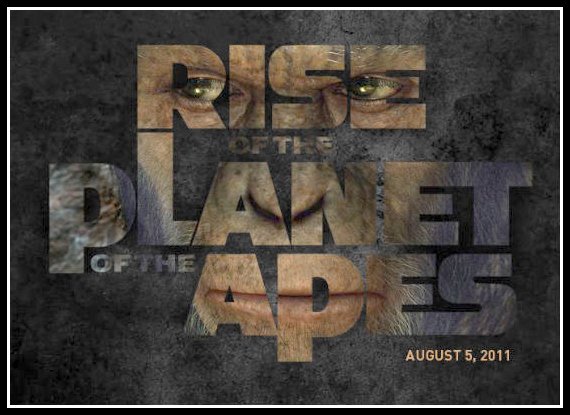
Rise of the Planet of the Apes is set for an August 5, 2011 release.