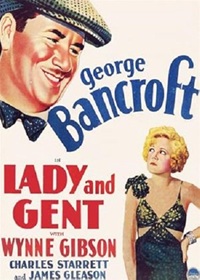
 When veteran prize fighter Stag Bailey (George Bancroft) gets cocky and doesn’t bother to properly train for the big fight, he is knocked out by a young up-and-comer named Buzz Kinney (John Wayne). Stag’s manager, Pin (James Gleason), had all of his money riding on Stag winning. Now broke and with the mob after him, Pin tries to steal the cash from the boxing arena and ends up getting shot by a security guard. Stag and his girlfriend, Puff (Wynne Gibson), take in Pin’s young son, Ted, and they devote themselves to raising him. Years later, Ted (Charles Starrett) wants to become a prizefighter but Stag and Puff, who know what years of getting punched in the head can do to someone, try to convince him to go to college instead.
This boxing film is of interest to western fans because of some of the faces in the cast. This was an early John Wayne role and he’s only seen in the ring and then in one brief scene where he confronts Stag and Puff in a bar. Wayne still plays an important role, though, because Buzz’s transformation from being a fresh-faced boxer to being a bitter, punch-drunk bully serves as a warning for what waits for Ted if his adoptive parents can’t keep him out of the fight game. Charles Starrett, of course, would go on to find greater fame as the Durango Kid.
Otherwise, Lady and Gent is a standard pre-code melodrama. It’s a little more realistic than some of the other boxing films that came out in the 30s. Boxing is portrayed as a dirty business that leaves its participants with struggles that all of the prize money in the world can’t make up for. Puff sacrifices her carefree life to raise Ted but it’s worth it in the end. You can tell this was a pre-code film because Stag and Puff are a couple but they only decide to get married so they can adopt Ted.
George Bancroft was a star in the late 20s and early 30s but eventually, he transitioned to character parts. He retired from acting 1942 and became a full-time rancher. One of his final films was 1939’s Stagecoach, starring his Lady and Gent co-star, John Wayne.
 Through the Shattered Lens