Halloween Havoc!: SON OF DRACULA (Universal 1943)


gary loggins's avatarcracked rear viewer


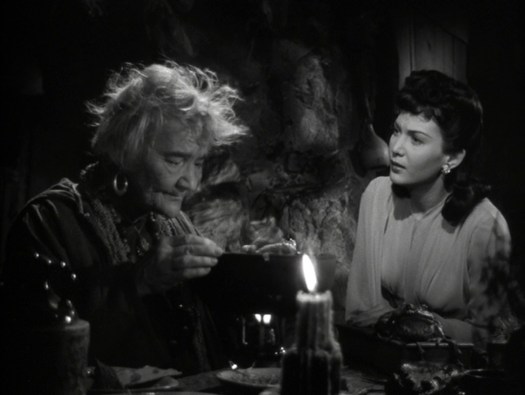
Director Robert Siodmak is remembered today for his dark excursions into the world of film noir: THE SUSPECT, THE KILLERS , CRY OF THE CITY, CRISS CROSS . His first entry in the genre is generally recognized as 1944’s PHANTOM LADY , but a case could be made for SON OF DRACULA, Siodmak’s only Universal Horror that combines elements of both genres into what could best be described as supernatural noir.

A train pulls into the station in a sleepy Louisiana town. Frank Stanley (Robert Paige) and Dr. Brewster (Frank Craven ) are there to meet Count Alucard, invited for a visit by Kay Caldwell (Louise Albritton), Frank’s fiancé, who has long been interested in the occult. Alucard isn’t aboard, but his trunks are, and Brewster notices Alucard spelled backwards reads as Dracula. The trunks are delivered to Kay’s family plantation, Dark Oaks. The scene shifts, and…

View original post 729 more words

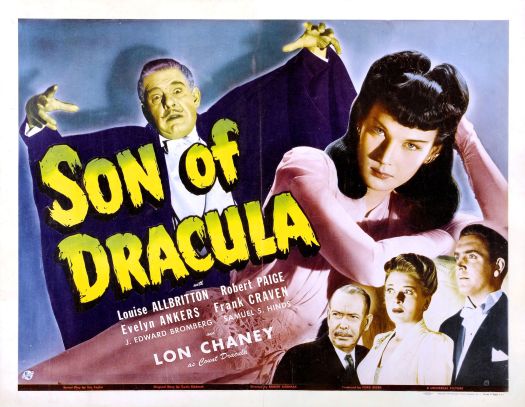
Horror Film Review: Son of Dracula (dir by Robert Siodmak)


son_of_dracula_movie_poster

Did you know that Count Dracula had a son?

Well, maybe he did or maybe he didn’t.  It all depends on how you interpret the 1943 film, Son of Dracula.  In Son of Dracula, Lon Chaney, Jr. plays a vampire named Count Alucard.  I get the feeling that it’s supposed to be a shocking moment when it’s pointed out that Alucard is Dracula spelled backwards but, since the movie is called Son of Dracula, I would think that most people would have already figured out the connection.

That said, when Alucard reveals that his true name is Dracula, he seems to be suggesting that he is the original Count Dracula.  And yet the name of the film is Son of Dracula.  At one point, two characters speculate that Alucard is a descendant of the original, just to be corrected by his bride.  “He is Dracula!” she announces.  Then again, she could just be bragging.  If you’re going to marry a Dracula, wouldn’t you rather marry the original than a descendant?

If he is the original Dracula, you do have to wonder why he’s still alive.  Since the film is a part of the Universal Dracula series, you have to wonder how he managed to survive being both staked by Van Helsing and having his body cremated by his daughter in Dracula’s Daughter.  You also can’t help but notice that Alucard doesn’t bear much of a resemblance to Bela Lugosi. nor does he have a European accent.  Instead, Alucard looks a lot like Lon Chaney, Jr.  Chaney does not make for the most convincing vampire.  As an actor, Chaney tended to project a certain “likable but dumb lug” quality that worked well for The Wolf Man and as Lenny in Of Mice and Men but it doesn’t quite work when he’s cast as a suave, Hungarian vampire.

Anyway, Son of Dracula finds Count Alucard in New Orleans at the turn of the century.  He has specifically moved to the Deep South so that he can be with Katherine Caldwell (Louise Allbritton), a young woman who is obsessed with the occult.  Katherine secretly marries Alucard.  When her former boyfriend, Frank (Robert Paige), finds out about the marriage he decides that the best way to handle way things would be to get drunk and shoot the count.  Unfortunately, since the Count is a vampire, the bullet passes through him and kills Katherine instead.

Or does it!?

Probably the most interesting thing about Son of Dracula is that it presents Alucard as being manipulated by a mortal.  Usually, Dracula is the one doing the manipulating but in Son of Dracula, it’s suggested that a clever mortal can manipulate the undead jut as easily.  GO KATHERINE!

Anyway, Son of Dracula is okay.  It has some steamy deep south atmosphere and it’s fun in a campy, Universal sort of way.  It has some historical significance because it was apparently the first film to actually feature a vampire transforming into a bat onscreen.  For the most part, though, it’s a film that will best be appreciated by Universal horror completists.

That said, I kind of like the fact that nobody in the film could figure out that Alucard is Dracula spelled backwards.  That was cute.

The Fabulous Forties #28: Jack London (dir by Alfred Santell)


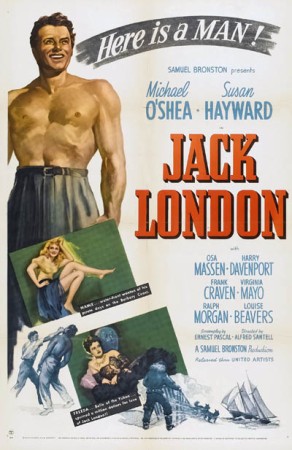
Jack-London-1943

The 28th Film in Mill Creek’s Fabulous Forties box set was a 1943 biopic about the writer, Jack London.  Not surprisingly, the title of the film was Jack London.

Now, I should start this review off by mentioning that I know very little about Jack London.  I don’t think that I have ever read any of his short stories or his novels.  I know that he wrote a novel called White Fang but that’s largely because there’s been so many different film versions of the book.  (Long before directing Zombi 2, even Lucio Fulci made a version of White Fang.)  Here’s what I do know about Jack London:

  1. He was a prominent writer at the turn of the century.
  2. He was reportedly an alcoholic.
  3. He was a Socialist who even ran for mayor of Oakland, California on the party’s ticket.
  4. He was an atheist.
  5. In 1916, depending on the source, he either committed suicide, died of alcohol poisoning, or simply passed away as the result of 40 years of hard living.

Of those 5 facts, 4 are totally ignored in Jack London.  The film does acknowledge that Jack London eventually became a prominent writer, even going so far as to open with stock footage of a U.S. warship being named after him.

As for his alcoholism, we never see London drunk.  Indeed, the film’s version of Jack London is so earnest that it’s hard to believe he’s ever had a drink in his life.

As for his Socialism, we are shown that London grew up in a poor family.  When, after serving at sea, he takes a writing class, he argues with a professor over London’s desire to write about the poor.  However, we never hear London express any specific ideology.  We certainly don’t see him running for mayor of Oakland.

As for his atheism — yeah right.  This film was made in 1943!  There’s no way that Jack London was going to be portrayed as talking about why he didn’t believe in God.

As for his death — well, Jack London ends with the writer very much alive.  There’s not even a title card informing us that London eventually died.

Instead, Jack London is much more concerned with Jack (played by Michael O’Shea) dealing with the Japanese.  Oh sure, we get some scenes of Jack London watching a shootout and breaking up a bar fight in Alaska.  And Susan Hayward shows up as Jack London’s always supportive wife.  (For that matter, Louise Beavers also shows up as Jack London’s always supportive house keeper.)

But, in the end, the majority of the film features Jack London as a war correspondent covering the turn of the 20th century war between Russia and Japan.  When he’s captured by the Japanese, he observes the harsh way they treat prisoners and is shocked when he witnesses several prisoners being ruthlessly executed.  When he talks to a Japanese commandant, he’s outraged as the commandant explains how the Empire of Japan is planning to take over the world.  When Jack finally gets back to America, he’s less concerned with writing White Fang and more concerned with warning the American people to remain vigilant…

Jack London is basically wartime propaganda disguised as a biopic.  The entire point of the film seems to be that if Jack London was still alive, he would want the men in the audience to enlist and the women to buy war bonds.  None of it is subtle and, beyond its value as a time capsule of how Americans viewed the Japanese in 1943, none of it is particularly interesting as well.

In the end, Jack London plays out like one of those earnest but dull educational films that tend to show up on PBS when no one’s watching.

Lisa Reviews an Oscar Nominee: Our Town (dir by Sam Wood)


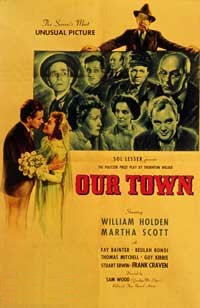
Original_movie_poster_for_the_film_Our_Town_(1940_film)

(SPOILERS BELOW!  THE END OF THIS FILM WILL BE REVEALED!  I will also be revealing who played George Gibbs but that’s probably not as big a spoiler.  It depends how you look at it.)

I was only 15 years old when I first read Our Town.  Because I was a theater nerd, I knew a little about the play.  For instance, I knew it took place in a small town.  I knew that it was narrated by a character known as the Stage Manager.  I knew that the play was meant to be performed on a bare stage, with no sets or props.  What I did not know, as I innocently opened up that booklet, is that Our Town is probably one of the most traumatically depressing plays ever written.

When the stage manager appears at the start of the play and talks about the town of Grover’s Corner, he lulls you into believing that you’re about to see a sentimental, comedic, and old-fashioned celebration of small town life.  We meet the characters and they all seem to be quirky in a properly non-threatening way.  Joe Crowell shows up delivers a newspaper to Doc Gibbs.  The stage manager mentions that Joe will eventually grow up to attend to M.I.T.

“Awwwww!  Good for Joe!” the audience says.

And, the Stage Manager goes on to inform us, as soon as Joe graduates, he will be killed in World War I, his expensive education wasted.

Okay, the audience thinks, that was a dark moment but this play was written at a time when World War I was still fresh on everyone’s mind.  Surely the rest of the play will not be quite as dark…

And fortunately, George Gibbs and Emily Webb show up.  They’re young, they’re likable, and they’re in love!  George and Emily get married and they’re prepared to live a long and happy life in our town!  Good for them!  YAY!

And then Act III begins…

Oh my God, Act III.  Act III begins with almost everyone dead.  Emily died in child birth so she hangs out at the local cemetery and talks to all the other dead people, the majority of whom only have vague memories of their former lives.  Emily relives the day of her 12th birthday and discovers that it’s too painful to remember what it was like to once be alive.  Emily asks the Stage Manager if anyone truly appreciates life.  The Stage Manager replies, “No.”  In the world of the living, George Gibbs sobs over his wife’s grave….

And the play ends!

OH MY GOD!

Seriously, reading Our Town was probably one of the most traumatic experiences of my life!

The 1940 film version of Our Town is a little less traumatic because it changes the ending.  In the film version, Emily doesn’t die.  She nearly dies while giving birth to her second child and the entire third act of the play is basically portrayed as being a near-death hallucination.  But, in the end, she survives and she comes through the experience with a new found appreciation for life.

And it’s certainly the type of happy ending that I was hoping for when I first read the play but, as much as I hate to admit it, the story works better with Emily dying than with Emily surviving.  The play presents death as being as inevitable as life and love and it makes the point that there’s nothing we can do to truly prepare for it.  By allowing Emily to live, the film gives us a ray of hope that wasn’t present anywhere else in Our Town.  The happy ending feels inauthentic.  If Emily could live then why couldn’t Joe Crowell?  For that matter, why did Emily’s younger brother have to die of a burst appendix on a camping trip?

But, other than the changed ending, Our Town is a pretty good adaptation of the stage play.  While the film features an actual set (as opposed to the bare stage on which theatrical versions of Our Town are meant to be performed), director Sam Wood does a good job of retaining the play’s surreal, metatheatrical style.  Making good use of shadow and darkness, Wood and cinematographer Bert Glennon made Grover’s Corner seem like a half-remembered memory or a fragment of a barely cohesive dream.

Frank Craven, who originated the role on Broadway, is properly dry as the Stage Manager and, in the role of Doc Gibbs, Thomas Mitchell is so sober and respectable that it’s hard to believe that, in just 6 years, the same actor would play the delightfully irresponsible Uncle Billy in It’s A Wonderful Life.  Emily and George are played by Martha Scott and an impossibly young William Holden, both of whom give wonderfully appealing performances.

With the exception of that changed ending, Our Town is a worthy adaptation of a classic play.  It was nominated for Best Picture but lost to another literary adaptation, Alfred Hitchcock’s Rebecca.