The Films of Dario Argento: The Stendhal Syndrome


The Stendhal Syndrome is a real thing.

First noted by the author Stendhal, Stendhal Syndrome is something that happens when one is confronted by a sight that they never expected to see in person.  Usually, it’s a work of great art that triggers the condition and the viewer becomes so overwhelmed by the sight of it that they’re left disorientated and even dizzy.  People have reported it happening while visiting museums or historical cities.  Recently, a few teenagers made the news when they claimed to have felt the syndrome’s symptoms while at a Taylor Swift concert.

I know that it’s a real thing because I’ve actually experienced Stendhal Syndrome.  I was in Florence, the summer after I graduated from high school.  One minute, I was fine and even feeling a little bratty, as one does when they’re 18 and they have their entire future ahead of them.  But then I looked up at the sky and I saw the skyline of Florence, with its mix of the ancient and the modern and I suddenly became aware that I was in one of the oldest cities in the world and that I was standing on a street that had existed for centuries and I was looking at buildings and statues and paintings that most people would never get a chance to see in person and suddenly, the entire world seemed to be spinning around me.  I had to actually sit down for a few minutes to catch my breath because I was so overwhelmed with emotion.  My sisters assumed I was having an asthma attack but, even then, I understood that I was feeling something far different.  At that moment, history become very real for me and I understood that I existed in the same universe as every great artist and writer.  We were all a part of the same existence.

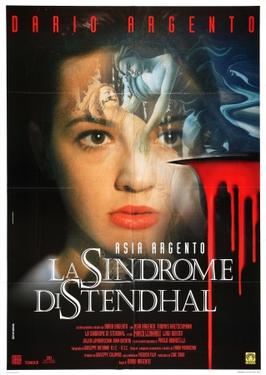
Dario Argento’s 1996 film, The Stendhal Syndrome, also takes place in Florence and features Asia Argento as Anna Mani, a police detective who is sent to the city to capture a serial killer.  When Anna visits a museum, she is overwhelmed by what she sees.  When she looks at Botticelli’s The Birth of Venus, she hears the wind that blows Venus’s hair.  When she views Bruegel’s Landscapes With The Fall Of Icarus she, perhaps significantly, becomes Icarus and flies through the air before crashing into the water below, where she shares a passionate kiss with a fish.  In the museum, Anna faints.  She drops her purse, giving Alfredo Grossi (Thomas Kretschmann) time to not only steal her gun but also the key to her hotel room.

Dazed and not even sure of who she is, Anna returns to her hotel.  A copy of Rembrandt’s The Night Watch turns into a doorway, which she steps through.  Finding herself on a rainy city street, Anna is reminded that she’s a detective and that she’s in Florence to catch a vicious killer.  When Anna steps back into her room, she discovers that she’s not alone.  Alfredo grabs her, rapes her, and abducts her.  Anna manages to escape and runs through the streets of Florence while a naked and blood-covered Alfredo screams in the night, which is one of the most disturbing scenes that Dario Argento has ever given us.  Alfredo continues to stalk Anna while Anna goes through some changes herself, buying a blonde wig and pursuing a relationship with a French art student (Julien Lambroschini).

The Stendhal Syndrome was the first of Argento’s film to feature CGI, not just in the scenes in which Anna enters the paintings but also in scenes where were literally follow the pills that she’s taken down her throat and where a bullet is seen to enter the face of one of Alfredo’s victims.  (Alfredo looks through the resulting bullet holes and winks at Anna on the other other side.)  Sometimes, the CGI is effective and sometimes it’s a bit too cartoonish for its own good.  At its most effective, the CGI inspires us to wonder if Anna is seeing reality or if she’s still trapped in her Stendhal Syndrome-inspired fantasy world.  The scene where disturbing graffiti comes to life may not exactly look real but it’s still undeniably effective.  At other times, the special effects just come across as being a bit self-indulgent on Argento’s part.

The film is at its best when it concentrates on the cat-and-mouse game between Anna and Alfredo.  As played by Thomas Kretschmann, Alfredo is one of the most terrifying characters to ever appear in an Argento film, a handsome and seemingly charming man who is actually fueled by pure evil and hate.  Alfredo is a villain who takes a definite pride in his ability to hide his true nature from the rest of the world.  At first, Anna seems almost too physically frail and emotionally open to be believable as a police detective but she soon proves herself to be far tougher than anyone realizes.  Anna, it turns out, has secrets of her own.  Shot roughly around the same time that Asia Argento was being victimized by Harvey Weinstein, the scenes where Alfredo attacks Anna are difficult to watch, as they should be.  Dario Argento took a lot of criticism (particularly from his former partner, Daria Nicolodi) for casting his daughter in a role where she is assaulted but the film itself is fully on Anna’s side.

The second half of the film loses its way a bit, though I can’t go into too much details without spoiling the plot.  Several of the first half’s intriguing ideas are abandoned.  Asia Argento gives a strong performance during the second half of the film, one that features some of her bravest and most revealing work.  That said, despite the strength of Asia’s performance, many of Anna’s actions still don’t make sense no matter how much the film tries to convince us that they do.  That said, the final scenes still carries an impact.

In the end, the film uses Stendhal Syndrome as a gimmick.  If you want to see a realistic film about Stendhal Syndrome, you’re probably out of luck because it’s not a condition that’s easy to capture cinematically.  But, as a thriller, The Stendhal Syndrome holds up well.  This is an uneven film but ultimately, what does work outweighs what doesn’t.
The (Reviewed) Films of Dario Argento:
  1. The Bird With The Crystal Plumage
  2. Cat O’Nine Tales
  3. Four Flies on Grey Velvet
  4. Deep Red
  5. Suspiria
  6. Inferno
  7. Tenebrae
  8. Phenomena
  9. Opera
  10. Two Evil Eyes
  11. Trauma

Spring Breakdown #1: Midnight Express (dir by Alan Parker)


Since it’s currently Spring Break, I figured that I would spend the next two weeks reviewing films about people on vacation.  Some of the films will be about good vacations.  Some of the films will be about bad vacations.  But, in the end, they’ll all be about celebrating those moments that make us yearn for the chance to get away from it all.

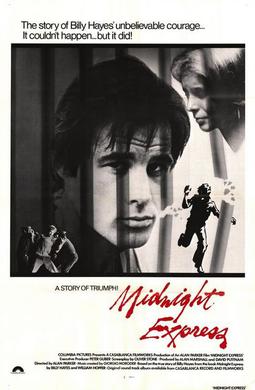
Take Midnight Express, for instance.  This 1978 film (which was nominated for six Oscars and won two) tells the story of what happens when a carefree college student named Billy Hayes decides to spend his holiday in Turkey.

When the film begins, Billy Hayes (played by Brad Davis), is at an airport in Turkey.  He’s preparing to return home to the United States.  His girlfriend, Susan (Irene Miracle), informs him that Janis Joplin has just died.  When Billy responds by making a joke, Susan accuses him of not taking anything seriously.  What Susan doesn’t realize is that Billy actually has a lot on his mind.  For one thing, he’s got several bricks of hashish taped around his waist.  He purchased it from a cab driver and he’s planning on selling it to his friends back in the United States.  Unfortunately, Billy’s not quite as clever as he thinks he is.  Because of recent terrorist bombings, the Turkish police are searching everyone before they board their plane.  Billy finds himself standing out in the middle of the runway with his hands up in the air, surrounded by gun-wielding Turkish policemen.

Billy finds himself stranded in a country that he doesn’t understand, being interrogated by men whose language he cannot speak.  An enigmatic American (Bo Hopkins) shows up and assures Billy that he’ll be safe, as long as he identifies the taxi driver who sold him to the drugs.  Billy does so but then makes the mistake of trying to flee from the police.  In the end, it’s the American who captures him and, holding a gun to Billy’s head, tells him not to make another move.

Soon, Billy is an inmate at Sağmalcılar Prison.  He’s beaten when he first arrives and it’s only days later that he’s able to walk and think clearly.  He befriends some of the other prisoners, including a heroin addict named Max (John Hurt) and an idiot named Jimmy (Randy Quaid).  Billy watches as the prisoners are tortured by the fearsome head guard (Paul L. Smith) and listens to the screams of inmates being raped behind closed doors.  After being told that his original four-year sentence has been lengthened to a 30-year sentence, Billy starts to degenerate.  When Susan visits, Billy end up pathetically masturbating in front of her.  When another prisoner taunts Billy, Billy bites out the man’s tongue, an act that we see in both close up and slow motion.  If Billy has any hope of regaining his humanity, he has to escape.  He has to catch what Jimmy calls the “midnight express…..”

Midnight Express is a brutal and rather crude film.  Though it may have been directed by a mainstream director (Alan Parker) and written by a future Oscar-winner (Oliver Stone), Midnight Express is a pure grindhouse film at heart.  There’s not a subtle moment to be found in the film.  The camera lingers over every act of sadism while Giorgio Moroder’s synth-based score pulsates in the background.  When Billy grows more and more feral and brutal in his behavior, it’s hard not to be reminded of Lon Chaney, Jr. turning into The Wolf Man.  The film may be incredibly heavy-handed but it’s nightmarishly effective, playing out with the intensity of a fever dream.

As for the cast, Brad Davis wasn’t particularly likable or sympathetic as Billy.  On the one hand, he’s a victim of an unjust system, betrayed by his own country and tortured by another.  On the other hand, Billy was an idiot who apparently thought no one would notice all that hash wrapped around his chest.  That said, Davis’s unlikable screen presence actually worked to the film’s advantage.  If you actually liked Billy, the film would be unbearable to watch.  Before Davis was cast, Dennis Quaid and Mark Hamill were both considered for the role.  If either of those actors has been cast, Midnight Express would be too intense and disturbing to watch.  For instance, it would be depressing to watch Dennis Quaid rip a man’s tongue out of his mouth.  You would be like, “No, Mr. Quaid, you’ll never recover your humanity!”  But when Brad Davis does it, you’re just like, “Eh.  It was bound to happen sometime.”

For more effective are John Hurt and Bo Hopkins.  Hurt and Hopkins both have small roles but they both make a big impression, if just because they’re the only two characters in the film who aren’t either yelling or crying all of the time.  While everyone else is constantly cursing their imprisonment, Hurt is quietly sardonic.  As for Hopkins, we’re supposed to dislike him because he’s with the CIA and he sold out Billy.  But honestly, no one made Billy tape all that hash to his chest.  Finally, you’ve got Randy Quaid and Paul L. Smith, who both glower their way through the film.  Smith is wonderfully evil while Randy Quaid is …. well, he’s Randy Quaid, the loudest American in Turkey.

Midnight Express was such a success at the box office that it caused an international incident.  There’s not a single positive Turkish character to be found in the entire film and it’s impossible not to feel that the film is not only condemning Turkey’s drug policies but that it’s also condemning the entire country as well.  The Turkish prisoners are portrayed as being just as bad as the guards and even Billy’s defense attorney comes across as being greedy and untrustworthy.  Watching the film today can be an awkward experience.  It’s undeniably effective but it’s impossible not to cringe at the way anyone who isn’t from the west is portrayed.  In recent years, everyone from director Alan Parker to screenwriter Oliver Stone to the real-life Billy Hayes has apologized for the way that the Turkish people were portrayed in the film.

Despite the controversy, Midnight Express was a huge box office success and it was nominated for best picture.  It lost to another controversial film about people imprisoned in Asia, The Deer Hunter.


Italian Horror Showcase: Tentacles (dir by Ovidio G. Assonitis)


Okay, tell me if this sounds familiar.

There’s a beachside resort town, one whose survival is pretty much dependent upon tourists and big business.  If you give the tourists a reason to not show up, the town dies.  If you give big business a reason to build their factories and their underground tunnels somewhere else, the town dies.

Unfortunately, something bad is happening in this little town.  People are going in the water and they’re never returning.  It appears that they’re being killed by some sort of giant sea monster, even though the authorities swear that it’s simply impossible.  The town’s leaders are putting pressure on the sheriff to cover up the crimes.  A scientist shows up and thinks that everyone he meets is an idiot.

It’s not safe to go in the water but people keep doing it!

Now, you may be thinking that it sounds like I’m describing the plot of Jaws but actually, I’m talking about an Italian film called Tentacles.  Released in 1977, Tentacles was one of the many films that was directly inspired by the success of Spielberg’s film.  Jaws was such a phenomenal success that it was ripped off by filmmakers across the world.  That said, of all the people ripping off Spielberg’s film, the Italians brought an undeniable and frequently shameless flair to the Jaws knockoffs.

Tentacles is a bit different from other Italian Jaws films in that, this time, the threat does not come from a shark.  Instead, it comes from a giant octopus!  That’s actually a pretty good twist because, in real life, an octopus is actually more dangerous than a shark.  Not only are they bigger and considerably smarter than most sharks but if they get enough of their eight arms around you, they can literally squeeze you to death!  I mean …. agck!  Say what you will about sharks, I imagine getting eaten by one would suck but at least it wouldn’t take long to die.  Whereas if an octopus gets you, you would actually be aware of it squeezing you to death and oh my God, I’m never getting in the water.

Anyway, in Tentacles, the octopus is snatching babies off of piers and sailors off of boats and it’s using its octopus powers to rip their skin from their bones.  It also attack scuba divers by firing ink at them.  The sheriff (Claude Akins) says that it’s nothing to worry about but Ned Turner (John Huston), a hard-boiled reporter, thinks that there’s a story here.  Ned’s in town visiting his sister (Shelley Winters).  She has a ten year-old son who enjoys sailing.  Uh-oh….

Henry Fonda shows up for a few very brief scenes, playing the head of a company that built the underwater tunnel that somehow mutated the octopus.  Fonda looks incredibly frail in his scenes (and apparently, he filmed his part while recovering from heart surgery) but his performance in Tentacles still isn’t as cringe-inducing as his performance in The Swarm.

Also showing up is a marine biologist named Will Gleason (Bo Hokpkins).  Fortunately, Gleason owns two killer whales so, after the octopus kills his wife, Gleason sends out the orcas to track it down.  Before doing so, he gives them a pep talk.  Apparently, killer whales respond to positive reinforcement.

Tentacles is unique in that it’s an Italian production that managed to rope in a few well-known American actors.  It’s an odd film to watch because, on the one hand, the film is full of risible dialogue and it’s painfully slow whenever the octopus isn’t attacking anyone and no one really seems to be that invested in any of their characters.  (When the octopus kills a baby, the actress playing the baby’s mother underacts to such an extent that the scene becomes almost surreal.)  This isn’t like Jaws, where you actually care about Brody, Quint, Hooper, and the Kintner boy.  On the other hand, the octopus itself is actually kind of frightening so, on that very basic level, the film works.

In the end, Tentacles is one of the lesser Jaws rip-offs but you’ll never forget that octopus.


The TSL’s Daily Horror Grindhouse: The Sweet House of Horrors (dir by Lucio Fulci)


Mary and Roberto Vivaldi (played by Lubka Lenzi and Pascal Persiano) would appear to have a perfect life, perhaps because they do.  They’re young.  They’re attractive.  They’re in love.  They’re rich.  They have a really nice house and they have two children, a boy and a girl.  What could go wrong, right?

Well, they could come home from a party and discover that their house is being burglarized.  And the burglar could then proceed to graphically and viscously murder them, smashing in Robert’s head and, since this is a Lucio Fulci film, popping out Mary’s eye.  In fact, the opening murder is so graphic and so disturbing that it’s somewhat surprising to learn that this movie was made for television.

Of course, what’s even stranger is that the rest of the film is oddly tame, particularly for a Fulci film.  Perhaps they only had enough money in the budget for one graphic gore scene.

Anyway, the parents are now dead and the children are now orphans.  At the funeral, the children shock everyone by playing and laughing.  However, a few seconds later, they’re standing over the grave and crying.  Some people would call this an inconsistency but I think it’s the most realistic part of the film.  When you lose someone who you love, you do strange things.  There is no one proper way to grieve.  As someone who suffered through his share of personal tragedy, this was something that Fulci probably understood.

The parents may be dead but they’re not gone!  Instead, they’re haunting the house.  The children are overjoyed but their new guardian, Aunt Marcia (Cinzia Monreale, who was Emily in Fulci’s The Beyond) is not.  Marcia freaks out upon realizing that the house is haunted and it certainly doesn’t help that she’s attacked by a gigantic fly in the attic.  Her husband, the incredibly dense Carlo (Jean Christophe Bretigniere), doesn’t think anything strange is happening.  Still, Carlo does agree that it would be a good idea to sell the house and move the children elsewhere.

Nope!  The parents have no intention of letting that happen!  Of course, the dead parents main concern to kill the man who killed them but, once he’s dead (it doesn’t take that long), they’re free to spend their time pushing a real estate agent down a flight of stairs, harassing Marcia and Carlo and eventually causing an exorcist’s hand to melt.

If you’re getting the feeling that both the dead parents and the living children are pretty obnoxious, that’s because they are.  I mean, it’s one thing to not want to be separated.  That’s something we can all relate to.  It’s another thing to melt a man’s hand and then laugh about it.  Add to that, neither Marcia nor Carlo come across as being particularly villainous.  It’s not like they’re planning on murdering the kids for their inheritance or sending them to a Dickensian orphanage or anything like that.  They just want the kids to stop conducting black magic ceremonies and they want to live in a house that isn’t haunted.  No matter how much sympathy you may have for the parents or the kids, it’s hard to deny that Marcia and Carlo aren’t being all that unreasonable.

(It also doesn’t help that the film ends with the suggestion that the dead parents can stay with the kids regardless of whether the house is sold or not.)

And yet, I can’t help but like The Sweet House of Horrors.  Even though it doesn’t make much sense and it’s hampered by a low-budget (just check out the floating flames that represent the dead parents), there’s a sincerity to The Sweet House of Horrors.  The parents really do seem to love their obnoxious children and the film actually does provide some insight regarding the way that children use imagination to deal with grief.  Like many of his later film, The Sweet House of Horrors is hit-and-miss but Lucio Fulci still comes up with a few good visuals, suggesting that his heart may have been in this film in a way that it wasn’t in some of the other films he made during the final years of his storied career.  Just the fact that The Sweet House of Horrors tells such an openly sentimental story makes it unique in Fulci’s filmography.

The Sweet House of Horrors cannot be compared to such Fulci classics as The Beyond, The House By The Cemetery, The Black Cat, or Zombi 2.  But still, it’s an interesting little film and provides a hint that, even during his decline, Fulci still possessed some of the talent that made his earlier films so iconic.

the-sweet-house-of-horror-1989-movie-1