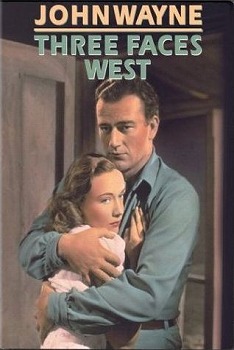
Three Faces West (1940, directed by Bernard Vorhaus)


When a small farming community in the Dakotas gets hit by an outbreak of the flu, farmer and community leader John Phillips (John Wayne) invites a Dr. Karl Braun (Charles Coburn) to come and be the town’s doctor.  A refugee from Austria, Dr. Braun arrives with his daughter, Leni (Sigrid Gurie).  At first, Leni is not happy living in the heart of the Dust Bowl but then she falls for John Phillips. However, Leni is still mourning his ex-fiancé (Roland Varno), who Leni and Braun believe sacrificed his life to help them reach America.

Eventually realizing that the town cannot prospers in the heart of the Dust Bowl, John suggests that everyone pack up and move to Oregon.  Almost everyone agrees and the one person who wants to go to California gets his van driven off the side of the road.  But Leni and Dr. Braun still take a detour to San Francisco because it turns out that Leni’s ex is not dead after all.  She and her father meet up with him and discover, to their horror, that he has become a fully committed Nazi.

This is an interesting change-of-pace for John Wayne.  Though the film is a western (and even features its own version of wagon train), it’s set in what was then contemporary times and it deals with issues like the Great Depression and the rise of Nazism in Germany.  The times may be hard but John Wayne isn’t going to let his community fall apart and, even more importantly, he’s not going to give up his beliefs or his ideals.  Even though the movie was made at a time when the United States was still officially neutral, the film is strongly anti-Nazi.  John Wayne, giving a strong performance, stands in for America while those who would collaborate with or make excuses for the Nazis represented by the weaselly Roland Varno.  Leni’s ex-fiancé had no problem selling out his beliefs and embracing Nazism.  Naturally, Leni and her father have no problem telling him off and then rejoining John Wayne in Oregon.  The United States may have officially been neutral but this movie had no problem letting everyone know where it stood.

Lisa Marie Reviews An Oscar Nominee: In Old Chicago (dir by Henry King)


One of the ten films to be nominated for Best Picture of 1937, In Old Chicago tells the story of the O’Leary family.

When we first meet the O’Learys, they’re riding across the Illinois frontier in a covered wagon.  After patriarch Patrick O’Leary (J. Anthony Hughes) is killed in a freak accident, Hazel O’Leary (Alice Brady) decides to settle in the bustling town of Chicago.  Hazel and her three sons build a life for themselves in a poor, largely Irish neighborhood known as the Patch.  Hazel makes a living as a laundress and soon, her home is big enough for her to take in a cow named Daisy.  Better not put that lantern too close to Daisy, Mrs. O’Leary….

As for the O’Leary boys, they all build a life of their own in 19th century Chicago.

Free-spirited Dion (Tyrone Power) hangs out in the saloon owned by sinister Gil Warren (Brian Donlevy) and, to his mother’s consternation, he falls for a singer named Belle (Alice Faye).  Eventually, Dion and Belle open up their own saloon and go into competition with Warren.  Dion soon emerges as one of the leaders of the Patch, a rogue with a charming smile and zero ethics but a total love for his family.

The youngest, Bob (Tom Brown), falls in love with a German immigrant named Gretchen (June Storey).  Bob asks Gretchen to marry him while Mrs. O’Leary’s cow stares straight at camera.

Finally, the oldest of the O’Leary boys is Jack (Don Ameche).  Jack become a crusading lawyer and eventually, he runs for mayor on a reform ticket.  With Dion’s help, Jack is able to defeat Gil Warren.  But now that Jack is mayor, he immediately sets his sights on tearing down the Patch and, in his words, “starting over.”

In Old Chicago has a two-hour running time and a lot happens in those two hours.  Not only is there all the drama between the brothers but also there’s a handful of production numbers featuring Alice Faye.  (Considering that she’s performing at a saloon in the slums of Chicago, it’s impressive that Belle can put on such an elaborate show.)  Of course, anyone with a knowledge of history knows that every minute of In Old Chicago is building up to the moment when Mrs. O’Leary’s cow kicks over that lantern and all the wooden buildings in Chicago go up in flames.  In Old Chicago is an early disaster movie and, talented cast aside, the main reason that anyone will be watching will be for the recreation of the Great Chicago Fire.  As flames roar around them and cattle stampede through the streets, hundreds of extras run for their lives.  As Alice Brady, Tom Brown, and Alice Faye stare off to the horizon, the city of Chicago explodes in front of them.  Even today, the scenes of the city on fire are impressive.

As for the rest of the film, I enjoyed the melodramatic excess of it all.  The stars weren’t exactly the most dynamic actors of the 1930s but Tyrone Power and Don Ameche were both handsome and likable enough to carry the film and it’s easy to see why In Old Chicago was, at the time of its production, the most expensive film ever made.  It’s a big film, with ornate sets, hundreds of extras, and elaborate production numbers.  It’s entertaining, even though I did occasionally find myself growing impatient as I waited for the fire to finally start burning.

One thing this film is not is historically accurate.  Not only is it now generally agreed that Mrs. O’Leary’s cow was innocent of starting the fire but Mrs. O’Leary’s son was never mayor of Chicago.  It is true that Chicago caught fire in 1871 and that the mayor turned to General Philip Sheridan (played here by Sidney Blackmer) for help in both putting out the fire and keeping order in the streets.  For the most part, though, In Old Chicago is total fiction.  That didn’t bother me but then again, I don’t live in Chicago.

In Old Chicago was nominated for Best Picture of the Year but lost to The Life of Emile Zola.  However, Alice Brady won the Oscar for Best Supporting Actress.

Film Review: The Loves of Edgar Allan Poe (dir by Harry Lachman)


I have to admit that the 1942 film, The Loves of Edgar Allan Poe, turned out to be far different from what I was expecting.

Just based on the title, I was expecting it would be a highly fictionalized, borderline silly film about Edgar Allan Poe defeating his romantic rivals and winning the hand of the woman he loved while still finding time to write The Raven.  I figured that there would be at least a few gentlemanly fisticuffs, with Poe portrayed as a combination of Rhett Butler and Cary Grant.  Looking at the title, it was easy for me to imagine the film closing with Poe kissing his future wife and then looking straight at the camera.  “Quoth the Raven!” he would say and wink while romantic music swelled in the background…

But no.  The Loves of Edgar Allan Poe is actually a very conventional biopic.  With a running time of only 67 minutes, the movie often feels rather rushed but it still manages to include most of the better known details of Edgar Allan Poe’s short but eventful life.  (An ever-present narrator is always ready to fill us in on every thing that happens off-screen.)  The film doesn’t spend much time on what initially inspired Poe’s macabre imagination.  There’s a scene of Poe, as a child, standing on a desolate hill and looking at a raven perched in a dead tree.  With the exception of an extended section that deals with Annabel Lee, that’s about as deep as the movie is willing to get as far as Poe’s art is concerned.

When Poe grows up, he’s played by actor Sheppard Strudwick, who has a good mustache but never exactly comes across as being the type of tortured genius who would eventually end up both revolutionizing literature and drinking himself to death.  The majority of the film deals with Poe’s advocacy for copyright reform, which is an important issue but not exactly the most cinematic of concerns.  Poe survives college.  Poe tries to sell The Raven for $25.  Eventually, Poe marries Virginia Clemm (Linda Darnell) and her subsequent sickness and death leads to not only Poe’s greatest work but also his own tragic end.

Along the way, Poe meets both Thomas Jefferson and Charles Dickens.  Jefferson shows up long enough to tell a young Poe that he’s a good writer and that he needs to stop gambling.  Dickens meets Poe and encourages him to continue to advocate for better copyright laws.

It is known that Poe and Dickens actually did meet but did Poe also meet Thomas Jefferson?  Legend says that he did but no one knows for sure.   Here’s what we do know:

Poe attended the University of Virginia in 1826.  The University’s founder, former President Thomas Jefferson, was still alive in 1826 and would often invite promising students to Monticello.  Whether Jefferson was still doing that when Poe enrolled at the University of Virginia is questionable.  Jefferson died five months after Poe started his studies.

As for Dickens, Charles Dickens and Edgar Allan Poe admired each other’s writing and they met in Philadelphia during Dickens’s 1842 tour of North America.  No record has been kept of what they discussed, though some think that Dickens told Poe about his pet raven and perhaps inspired Poe’s best-remembered poem.  In the movie, they discuss copyright laws, which is nowhere near as much fun.

(When it comes to Poe’s meetings with both Jefferson and Dickens, it is perhaps best to remember the lesson of The Man Who Shot Liberty Valance and print the legend.)

The Loves of Edgar Allan Poe is a very short film and an obviously low-budget one as well.  When the presence of that somewhat pedantic narrator, The Loves of Edgar Allan Poe feels more like an educational special than a real movie.  It’s an okay introduction to Poe’s life but, ultimately, the best way to get to know Edgar Allan Poe is to sit down and start reading.