Retro Television Review: The American Short Story #12: The Man That Corrupted Hadleyburg


Welcome to Retro Television Reviews, a feature where we review some of our favorite and least favorite shows of the past!  On Saturdays, Lisa will be reviewing The American Short Story, which ran semi-regularly on PBS in 1974 to 1981.  The entire show can be purchased on Prime and found on YouTube and Tubi.

This week, we have an adaptation of a Mark Twain novella.

Episode #12: The Man That Corrupted Hadleyburg

(Dir by Ralph Rosenblum, originally aired in 1980)

In this loose adaptation of one of Mark Twain’s darkest novellas, Robert Preston stars as The Stranger.  When we first meet The Stranger, he’s looking down on the small town of Hadleyburg and it’s hard not to notice that he looks a lot like Mark Twain.  The Stranger explains that the people of Hadleyburg consider themselves to be honest and free of sin.  The town’s motto is “Lead us not into temptation!”  The Stranger has a plan to test them.

Riding into town, the Stranger stops at the home of Edward and Mary Richards (Tom Aldredge and Frances Sternhagen).  The Stranger gives them a sack that he claims is filled with $40,000 worth of gold bars.  The Stranger says that he was once a poor man and someone in Hadleyburg gave him $20 and some meaningful advice.  Now that’s he rich, he wants to pay back the person who helped him.  The Stranger explains that there is an envelope inside the sack.  In the envelope, the Stranger has written out the advice he was given by his benefactor.  The Stranger’s instruction is for the man who helped him to write out that advice and give it to Rev. Burgess (Fred Gwynne), who recently lost his church when the citizens of Hadleyburg tired of him calling them out for their hypocrisies.  The honest man who remembers the advice he gave the Stranger will be very rich as a result.  The Stranger then leaves.

News of the sack and the gold travels throughout town and eventually the rest of the nation.  The most powerful families in Hadleyburg, including the Richards family, receive a letter telling them that the advice given to the stranger was “You are far from being a bad man, go and reform.”  Burgess is soon swamped by notes, all featuring that same phrase.  At the town meeting, Burgess reads each note, revealing that everyone wrote down the same phrase and that none of the town leaders is as honest as they claim.

The Man That Corrupted Hadleyburg is one of Twain’s most stinging satires, featuring an ending that is surprisingly dark.  This adaptation takes a much lighter approach to the material, altering Twain’s ending to something much more gentle and friendly.  Unfortunately, changing the ending causes the adaptation to lack the bite of the original short story.  Twain’s portrayal of greed and guilt instead becomes a mild story about a quirky town that learns a lesson.  It’s well-acted, especially by Fred Gwynne, but this adaptation doesn’t honor Twain’s intentions.  It just doesn’t add up to much.

A Movie A Day #60: Outland (1981, directed by Peter Hyams)


outlandIt’s High Noon in space!

In the future, Marshal O’Neil (Sean Connery) has been hired, by Conglomerates Amalgamated, to enforce the law on a mining outpost that’s located on one of the moons of Jupiter.  Why are all the miners going crazy, taking off their spacesuits, and exploding?  Are they being hypnotized by that big red spot on Jupiter?  Or is the mining supervisor, Sheppard (Peter Boyle), forcing his workers to take amphetamines that cause them to have psychotic episodes?  O’Neil suspects the latter so Sheppard summons three intergalactic gunslingers to come and kill the marshal.  With no one, except for the outpost’s doctor (Frances Sternhagen), willing to stand behind him, O’Neil must stand up to three gunmen by himself.

The comparison between High Noon and Outland is obvious but the movie also owes much to Alien.  With its corrupt corporation, claustrophobic sets, and its blue-collar space workers, Outland seems like it could be taking place in the same movie universe as the Alien movies.  Like a lot of the films that Peter Hyams has directed, Outland is ambitious but slow.  It is never as much fun as something like Moon Zero Two.  The best thing about Outland is Sean Connery, convincingly cast as Gary Cooper in space.

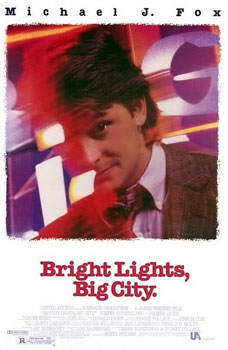
Embracing the Melodrama Part II #80: Bright Lights, Big City (dir by James Bridges)


Bright_Lights_Big_CityThe 1988 film Bright Lights, Big City is one of the many films from the late 80s in which Kiefer Sutherland plays a demonic character.  In this case, his character is so demonic that his name is — seriously, check this shit out — Tad Allagash.  Nobody named Tad Allagash has ever been a good guy!

Tad is the best friend of Jamie Conway (Michael J. Fox), an aspiring writer who has moved to New York City from some middle-America farm state and who now has a job as a fact checker at the New Yorker.  Jamie is still struggling to deal with both the death of his mother (played in flashbacks by Dianne Wiest) and the collapse of his marriage to Amanda (Phoebe Cates).  Tad helps out his depressed little friend by taking him out to the clubs and supplying him with so much cocaine that Jamie literally spends the entire film on the verge of having a geyser of blood shoot out from his powder-coated nostrils.

And the thing is, Tad knows that he’s not a good influence on Jamie’s life but he doesn’t care.  Whenever Jamie starts to get a little bit too wrapped up in his self-pity, Tad is there to make a tasteless joke.  Whenever Jamie tries to argue that he and Amanda aren’t really broken up, Tad is there to remind him that Amanda wants nothing to do with him.  Whenever Jamie starts to think that doing all of this cocaine is potentially ruining his life, Tad is there to cheerfully cut another line.  Tad makes no apologies for being Tad Allagash.  He’s too busy having a good time and it’s obvious that Sutherland’s having an even better time playing Tad.  As a result, Tad Allagash becomes the perfect antihero, the bad guy that you like despite yourself.

Unfortunately, Bright Lights, Big City isn’t about Tad Allagash.  You’re happy whenever Kiefer shows up but he doesn’t show up enough to actually save the film.  No, Bright Lights, Big City is the story of Jamie Conway and that’s why the film is a bit of a pain to sit through.  Despite having a great Irish name, Jamie Conway is one of the whiniest characters that I have ever seen in a film.  From the minute he first appears on screen and starts complaining about the failure of his marriage, you want someone to just tell him to shut up.  When he tells an alcoholic editor (Jason Robards) that his latest short story was autobiographical, you nod and think, “So, that’s why it hasn’t been published.”

Of course, since Jamie is the main character, everyone in the film feels sorry for him but he really is just insufferable.  There’s a lengthy scene where Jamie delivers a drunken monologue to a sympathetic coworker, Megan (played by Swoosie Kurtz).  And while Jamie goes on and on about how he first met Amanda and how their marriage fell apart (and how it was all her fault), poor Megan has to sit there and try to look sympathetic.  Personally, I would have kicked Jamie out of my apartment after the first minute of that whiny diatribe.  Megan has the patience of a saint.

There is some curiosity value to watching Michael J. Fox snort cocaine.  (I wonder if contemporary audiences shouted, “McFly!” as they watched Fox sniffing up the devil’s dandruff.)  But otherwise, Bright Lights, Big City is a relic of 80s cinema that can be safely forgotten.