Time has been getting the better of me so far this month, and I haven’t really been able to structure these posts in the order I’d initially intended. But while the songs I had in mind that require a bit more research go on hold, I offer you another taste of Belarusian folk/early music masterminds Stary Olsa.
I came across Дрыгула (Drygula) while I was posting up Dances, when I discovered that a number of their more recent songs were available for free download on their official website. Drygula is the title track to their 2009 release. To quote their website:
“This CD presents dance music from the late Middle Ages to early baroque, written in the Grand Duchy of Lithuania (Polacak Adversaria) and Western European countries. During these works’ performance, the instruments which correspond to their times are used.”
So according to the band, what you’re hearing here is uncompromised, authentic music of the Middle Ages. That is… pretty hard for me to believe, but who knows? Maybe 16th century Lithuania really was this awesome.
I want to say Стары Ольса (Stary Olsa) are my favorite non-metal folk band, but to be honest I have only heard two of their albums. That just might suffice. Stary Olsa formed in Belarus in 1999. Келіх кола (Loving Cup) is their first album, and they have released eight more since (of which I have only heard their first live album, Шлях (Šlach). It contains much of the same material.) So I can’t really speak for the band as a whole, but Loving Cup is easily one of the best albums in my entire musical collection. Their self-described style is “medieval”, though I don’t know if the Belarusian word they use, сярэднявечнай, carries precisely the same context (it is not a cognate). Their music lacks (to its advantage) a lot of the formalism I associate with western early music. (The average Drolls song will give you an idea of what I mean.) There’s something a lot more free-spirited about Stary Olsa’s sound, which lends it closer continuity with modern folk.
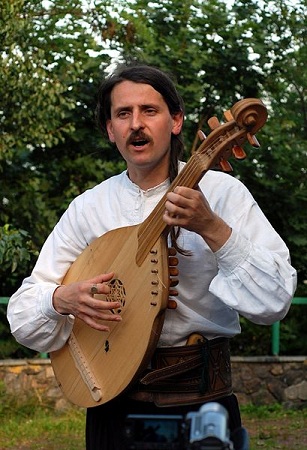
Part of that is an inevitable consequence of the most awesome instrument in the world: the bagpipe. (Did I say the whistle was my favorite just a few days ago? Ah well, close enough.) Stary Olsa do a wonderful job of going into thorough detail about the instruments and styles they employ on their official website. Unfortunately the English translations they provide are not very fluent. Stary Olsa employ three different variants of the Belarusian bagpipe, known as a duda. In the case of this song they also use some more contemporary instrumentation. I gather from what their site says that the flute is in fact a standard modern flute, or something close to it. They make no mention of the tambourine, but I have to wonder just how common an instrument that required metal could have been. The drum they use is likely an authentic medieval instrument, though I’m no good at guessing which. The hurdy gurdy has been known in Belarus since the late 16th or early 17th century, called there the колавая ліра, or “wheel lira”.
Танцы (Dances) is not my favorite Stary Olsa song though. There’ll be plenty more by them to come. In the meantime, you can check out a live recording of this song.
Here’s an obscure one for you. I don’t have much time to write today, so I’ll keep it short. Тарас Компаніченко (Taras Kompanichenko) is a Ukrainian early music and folk musician born in 1969. Wikipedia describes him as “an influential kobzar, bandurist, lutenist, lira player”, and I’ll leave those terms for you to investigate. The world of Ukrainian folk is vast, both unique in its own right and a major participant in the greater sphere of Eastern European music. It seems like over the last twenty years especially the former Soviet-dominated nations have exploded in a renaissance of music and tradition. If you like what you’re hearing here, dig around a bit for more. It might be hard to find at first, but when you learn where to look there’s a wealth of it out there.
Hungarian folk group Muzsikás have been around since 1973, but this song is much older. Dunántúli Friss Csárdások translates as “Transdanubian Fast Csárdás”, and “Csárdás” in turn refers to a Hungarian folk dance. It derives from an old Hungarian word for “tavern”.
It’s not always clear to me where exactly folk music comes from. Bands preserve it as best they can, but there aren’t exactly that many options for research. It’s not like we have a written record. What’s gone is gone. When the last village musician dies, hundreds, maybe thousands of years of musical tradition dies with him. With the aid of easy recording and generous grants, it is easy enough for what still remains today to be preserved (and more often than not exploited into that crime against culture we call ‘world music’), but at this point just how much is left? I don’t mean that to be rhetorical; I’d really like to know how modern folk and folk metal bands acquire their sources.
Dunántúli Friss Csárdások and the rest of the songs on this album are an exceptionally clear case. They result from the efforts of Béla Bartók (1881-1945), one of the earliest musicians to consciously recognize folk music’s peril and attempt to preserve it. Trained as a classical musician, from 1904 on he set his focus on Eastern European folk, not only transcribing it and incorporating it into his classical compositions, but also making over 1000 actual recordings, mostly between 1906 and the start of the war. A random example will more likely than not yield a bland 10 seconds of someone talking or humming, but after listening to twenty or so I found one that really impressed me:
Does Dunántúli Friss Csárdások and the rest of the Muzsikás album derive from one of Bartók’s field recordings, or from one of his original compositions based upon them? That I’m not sure about, but one could always just ask the band. Frankly I think it might be a bit more fun to dig through the full collection of Bartók recordings looking for them.
I’m going to keep it fairly friendly for these first few entries before I delve into the darker side of the scene. Today’s feature song is Tunteellinen Valssi by Karelian folk band Myllärit, appearing on their 1999 release In the Light of the White Night. Though this is the only album I have by them, the band have been around for quite some time. They first formed in 1992, and they have since released seven albums.
I am not particularly good at tracing older musical styles, and I don’t know if there’s any sort of precedent for waltzes in Finnish/Karelian tradition, but Tunteellinen Valssi and the album as a whole keep the instrumentation fairly local. In the Light of the White Night consists of a wide range of styles which nevertheless all fall within the broader category I’ve come to associate with Karelian folk. Unlike Poropetra, Myllärit have no ties to the metal scene to the best of my knowledge. I can only speak for one album, but from what I’ve read I gather they stick pretty consistently to traditional folk forms.
I think the majority of their songs are sung in Finnish, but their Finnish Wikipedia entry (yay Google Translate) claims that they also sing in Ingrian, a Finnic language only spoken by about 500 people in the Ingria region just south of Karelia. It always excites me to see modern folk and metal bands doing their part to preserve fading linguistic and cultural traditions.
October is a fine month for music. Everything from the cheesiest of black metal to the most ethereal of folk finds its home in a season which glorifies gore and the old gods together in a grand renunciation of conventional Christian values. I make an effort every year to present a sort of soundtrack to the season. Last year this amounted to a meager one post, but this go around I aim to do a song a day every day from now until the 31st.
The criteria will be two-fold: the song must be either dark, pagan, fantasy-oriented, or at least authentically folk; and I cannot have ever featured it on Shattered Lens before. It’s going to be an interesting ride. I feel at the moment completely out of touch with my music collection, and too hopelessly bereft of time to do anything about it. Musically, I spent the grand bulk of this year focusing on vgm. I must say the venture was eye-opening, and I have a much broader appreciation of video game music to show for it, but it’s a subject quite far from my typical focus. I will be putting my vgm series on hold for the month (it is incomplete anyway, and such a break will hopefully give me time to extend it), and focusing on music a bit more relevant to the season.
Today’s feature song is Tunturikukka by Finnish folk act Poropetra, taken from their self-titled 2004 demo release. While their full-length album features substantial rock influence, their demo is an outstanding example of uncompromised contemporary folk of the Finnish/Karelian variety. The band’s name is, according to Encyclopaedia Metallum, “the name of a mythological blue moose which travels through the sky”. Their founder, Juha Jyrkäs, has supposedly collaborated with folk metal legends Korpiklaani.
Tunturikukka is a track I’ve been keeping around for years now. I don’t recall when exactly I discovered the band, but I may have had it in my collection since the year of its release, and it still never fails to make an impression on me. I’ve always extracted a warm, sort of wintery vibe from the tune, and there’s something a bit reverent about it. From what I’ve read, I gather the lyrics pay ample homage to Finnish mythology, and on Tunturikukka most among the demo tracks I get a real sense of connection with the past.
I want to hop on the bandwagon. It would be a little silly for me to post my real top 10; for one thing, it would include four Krallice tracks. That aside, nearly everything I’d put on it I’ve either posted on this site as a Song of the Day or included in both my review of its album and my top albums post. So to make this a bit different from my past posts, I’m going to limit myself to one song per band, stick to stuff that I imagine might appeal to people who aren’t interested in extreme metal, and keep it on the catchy side. I’ll list a more honest top 10 at the end.
10. Powerwolf – Son of a Wolf (from Blood of the Saints)
As such, my tenth place selection is about as metal as it’s going to get. Powerwolf’s Blood of the Saints might be simple and repetitive, but it’s about the catchiest power/heavy metal album I’ve ever heard. It indulges the same guilty pleasure for me as Lordi and Twisted Sister–two bands that inexplicably pump me up despite being entirely tame. It also offers some amazing operatic vocals and Dracula keyboards, the cheesiness of which can be easily forgiven. Son of a Wolf might be one of the more generic tracks in a sense, but it’s the one most often stuck in my head.
9. Alestorm – Barrett’s Privateers (from Back Through Time)
The only thing I love more than traditional folk and sea chanties is folk punk and metal. When the latter covers the former, I’m in bliss. Alestorm are emerging as the sort of Dropkick Murphys of metal with all their covers lately, and I hope they keep it up. I loved Barrett’s Privateers before what you’re hearing ever happened, and the metal version delights me to no end.
8. The Decemberists – Rox in the Box (from The King is Dead)
The Decemberists really toned it down this year. Where The Hazards of Love could be described as an epic rock opera, The King is Dead sticks to simple, pleasant folk. But Colin Meloy thoroughly researches pretty much every subject he’s ever tackled, and The King is Dead pays ample homage to its predecessors. Rox in the Box incorporates Irish traditional song Raggle Taggle Gypsy with delightful success.
7. Nekrogoblikon – Goblin Box (from Stench)
With a keen eye towards contemporary folk metal like Alestorm and Finntroll, melodic death classics like In Flames and Children of Bodom, and much else besides, former gimmick band Nekrogoblikon really forged their own unique sound in the world of folk metal in 2011. At least half of the album is this good. Stench is the most unexpected surprise the year had to offer by far.
6. Korpiklaani – Surma (from Ukon Wacka)
Korpiklaani almost always end their albums with something special, and 2011 is no exception. The melody of Surma is beautiful, and Jonne Järvelä’s metal take on traditional Finnish vocals is as entertaining as ever.
5. Turisas – Hunting Pirates (from Stand Up and Fight)
I couldn’t find a youtube video that effectively captured the full scope of Turisas’s sound in such limited bitrates, but believe me, it’s huge. Go buy the album and find out for yourselves. Unlike Varangian Way, not every track is this good, but on a select number Turisas appear in their finest form. Adventurous, exciting, epic beyond compare, this band delivers with all of the high definition special effects of a Hollywood blockbuster.
4. The Flight of Sleipnir – Transcendence (from Essence of Nine)
Essence of Nine kicks off with a kaleidoscope of everything that makes stoner metal great, while reaching beyond the genre to incorporate folk and Akerfeldt-esque vocals. A beautifully constructed song, it crushes you even as it floats through the sky. I could imagine Tony Iommi himself rocking out to this one.
3. Boris – Black Original (from New Album)
From crust punk to black metal, there’s nothing Boris don’t do well, and 2011 has shown more than ever that there’s no style they’ll hesitate from dominating. I don’t know what’s been going on in the past few years with this popular rise of 80s sounds and weird electronics. I don’t listen to it, so I can’t relate. But if I expected it sounded anything nearly as good as what Boris pulled off this year I’d be all over it.
2. Tom Waits – Chicago (from Bad as Me)
Bad as Me kicks off with one of my favorite Tom Waits songs to date. It’s a timeless theme for him, but it feels more appropriate now than ever, and his dirty blues perfectly capture the sort of fear and excitement of packing up and seeking out a better life.
1. Dropkick Murphys – Take ‘Em Down (from Going Out in Style)
In a year just begging for good protest songs, Flogging Molly tried really hard and fell flat. Dropkick Murphys, another band you’d expect to join the cause, released perhaps their most generic album to date (still good mind you, but not a real chart topper). Take ‘Em Down is kind of out of place on the album, but it’s DKM to the core, and as best I can gather it’s an original song, not a cover of a traditional track. If so, it’s probably the most appropriate thing written all year. (The video is fan made.)
If you’re interested in my actual top 10, it runs something like this:
10. Falkenbach – Where His Ravens Fly…
9. Waldgeflüster – Kapitel I: Seenland
8. Liturgy – High Gold
7. Endstille – Endstille (Völkerschlächter)
6. Blut aus Nord – Epitome I
5. Krallice – Intro/Inhume
4. Liturgy – Harmonia
3. Krallice – Diotima
2. Krallice – Telluric Rings
1. Krallice – Dust and Light
And that excludes so many dozens of amazing songs that it seems almost pointless to post it.
I never did get around to writing a review of Bad As Me. It’s a shame, because it’s pretty damn good. The old man’s always been in a league of his own, and Tom’s seventeenth studio album feels no less legitimate than anything else he’s created. If anything it’s above average in his discography quality-wise, and that says a lot for someone who released his first album nearly 40 years ago. An entirely accurate representation of his style, here’s 13 anthems to homeless bums, trailer trash, vagabonds, and the starry-eyed refugees of an unforgiving society. I’ve been listening to the closing track, New Year’s Eve, on repeat ever since my deluxe edition pre-order showed up in the mail, and now’s a good day to pass it along.
It’s typical Tom fassion to make the joyous out of the bleak and vice versa. New Year’s Eve might not be as gut-wrenching as Christmas Card from a Hooker in Minneapolis, but it carries on his tradition of looking at the holidays from the perspective of those who’ve got little left in life to celebrate.
The door was open; I was seething
Your mother burst in; it was freezing
She said it looks like it’s trying to rain
I was lost; I felt sea sick
You convinced me that he’d left
You said keep talking, but don’t use any names
I scolded your driver and your brother
We are old enough to know how long you’ve been hooked
And we’ve all been through the war
and each time you score
someone gets hauled and handcuffed and booked
It felt like four in the morning
What sounded like fire works
Turned out to be just what it was
The stars looked like diamonds
Then came the sirens
And everyone started to cuss
All the noise was disturbing
And I couldn’t find Irving
It was like two stations on at the same time
And then I hid your car keys
And I made black coffee
And I dumped out the rest of the rum
Nick and Socorro broke up
And Candice wouldn’t shut up
Fin, he recorded the whole thing
Ray, he said damn you
And someone broke my camera
And it was New Years
And we all started to sing
Should auld acquaintance be forgot and never brought to mind
Should auld acquaintance be forgot for the sake of auld lang syne
I was leaving in the morning with Charles for Las Vegas
And I didn’t plan to come back
I had only a few things
Two hundred dollars
And my records in a brown paper sack
I ran out on Sheila
Everything’s in storage
Calvin’s right, I should go back to driving trucks
Should auld acquaintance be forgot and never brought to mind
Should auld acquaintance be forgot for the sake of auld lang syne
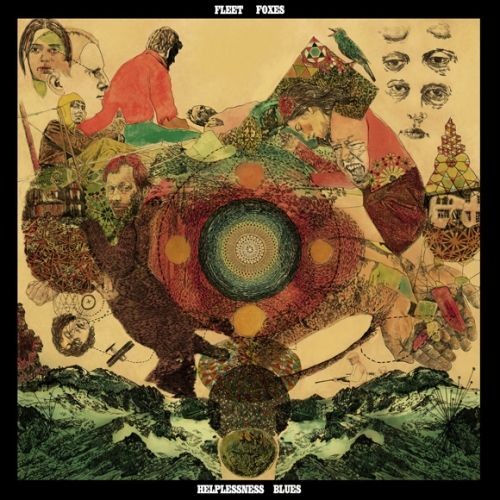
I’m sure nice things can be said about Helplessness Blues, the new album by Fleet Foxes. You won’t hear them here. The amount of praise and acclaim this album has received makes me want to puke, and it’s high time someone pointed out its potential mediocrity.
The confusion arises from the fact that their 2008 debut was brilliant. I was hoodwinked the same as everyone else up front, buying their new album without even downloading it first. The other misleading factor–the one I didn’t personally succumb to–is the fact that they’re still trying. I have no reason to believe Fleet Foxes did not attempt to create a good album. They aren’t sell-outs in the classic sense. Sure, it sounds like over the past three years they quit showering and traded an indie song-writing mindset for feelings-sharing stories around a campfire, but becoming a hippy is like contracting a deadly disease. That’s different from selling out.
When you desperately want an album to sound good and you know the band is still trying I guess it’s easy to ignore your ears and pretend you like it. But I’m a metal fan at heart; I don’t have to make apologies for a style I don’t obsess over. So let me quit immaturely bashing Helplessness Blues and get on with why I don’t like it.
Helplessness Blues
The vocal melodies aren’t melodic. Oh, that might be a mathematically false statement; I don’t concern myself with such things. But just listen to what’s going on in this song. I can’t think of any kind way of putting it; Helplessness Blues just consistently fails to resolve any of its melodies on appealing notes, and that’s 90% of the problem. Try to take this in context. After a half dozen listens today I started to kid myself into thinking the album was fairly decent (and I really have grown hopelessly fond of this particular song’s chorus), but it only took a listen to Ragged Wood and Blue Ridge Mountains to go “Oh, yeah, that’s what I meant” on the proof-read. This is Fleet Foxes we’re talking about. Their self-titled had some of the most subtly beautiful vocals I’ve ever heard, and they always, always rewarded the listener even at their most depressing points. By comparison, Pecknold sings all over the place on Helplessness Blues with no real guidance–without any real ear for making it all work. In a lot of cases there’s no resolution whatsoever. Listen from the transition at 2:50 on, then go listen to Blue Ridge Mountains, and I’m confident you’ll understand what I mean.
This isn’t the criticism. This is the problem. It opens the door for the criticism to come pouring in. See, from start to finish, certainly not just in this one instance, Helplessness Blues is a softy. It always chooses the path of least resistance, not the happy, upbeat resolve. That’s fine. But if you do nothing with it, then it’s also very boring. In order for Helplessness Blues to be an above-average album, if the choruses and focal melodies are not rewarding in their own right, then you have no choice but to ask how they play off their surroundings–how they fit in to the big picture productively. How do they serve to make this the album of the year contender so many sites consider it to be? Or if they don’t, then what makes it so great in spite of them?
It’s not the lyrics, that’s for sure. When they aren’t generic lines about being lonely or sad or having relationship issues, they’re often borderline nonsense. The song Lorelai especially stands out. Up until the chorus it hangs on the brink of greatness, and then he starts cooing “I was old news to you then, old news, old news to you then” over and over again ad nauseam to such a painful extent that you soon forget the song was about anything at all. Or take the second half of the song currently featured–the title track (long after the rubbish about the singer realizing he was not “unique among snowflakes”.) There’s nothing clever or creative about repeating “If I had an orchard, I’d work till I’m sore” a half dozen times. And it’s too odd and repetitive to be heartwarming. Sure, he throws in “And you would wait tables and soon run the store”. Like, we’d work hard for each other out of love and soon accomplish something, maybe, but I’m still thinking “An orchard? Really?” and wondering how many times he’s going to say the same strange thing over again. And then the end line, again musically unresolved and unsatisfying, “Someday I’ll be like the man on the screen,” might be intended as a twist, something thought-provoking, if the common association of celebrities with unauthentic lives can be applied, but the irritable melody doesn’t really incline me to put much thought into it, and in any case I’m still thinking “An orchard? Really?”
The lyrics on average are only insightful in that “I don’t get it” sort of way. That is, they only inspire those thoughtful enough to derive deep meaning out of just about everything and those thoughtless enough to think their inability to derive meaning out of something is a sign of its brilliance.
Someone You’d Admire
Not all of the lyrics are dull. Someone You’d Admire, for example, is decent enough. Perhaps if the song didn’t fall victim to my complaint about the melody I’d think it clever. And that’s what we’re looking for, right?: Something that makes the weak vocal melodies appropriate or makes the songs good in spite of them. Maybe if the lyrics were coupled with really good instrumentation it would all come together. But they aren’t. The dude’s just strumming basic chords on a guitar devoid of emotion. Oh, he alters the intensity a little here and there, but there’s never any fire in his strumming. It’s little more than variant degrees of volume. And that’s what you get with the bulk of the instrumentation on this album–moments that are loud and moments that are quiet, typically not transitioning so much as switching at random. Oh, and the ending is unresolved again.
The Cascades
The instrumental track The Cascades is a good example. The acoustic guitar in the first minute isn’t playing anything particularly melodic, and it doesn’t compensate with emotion. It’s just kind of there–the sort of bedroom recording I’d create in one take and delete soon after. Around 55 seconds something awesome happens, and for a brief moment the song feels like what I actually expected a new Fleet Foxes album to sound like, dreamy, beautiful, crea—wait, it’s over. By 1:18 it’s over, and it doesn’t even fade or transition. It just ends, and we’re solo acoustic guitar again. Oh wait, here, it’s coming back again at 1:35. Oh nevermind, it’s gone again at 1:45, erm, did this song just end?
The comings and goings, the ins and outs, whether it’s merely from quiet to loud and back again or from boring to beautiful and back again, it’s all borderline random. You never feel the transition. Nothing is natural. And with the average song clocking in at only about four minutes, there’s almost never time for something coherent to develop out of it all. Just like the vocal melodies, the instrumental dynamics pretty much never develop into or resolve on an appealing sound.
So their new approach to vocals is out. Their new approach to instrumentation is out. The lyrics demand more attention and aren’t sufficient to satisfy. Basically, none of their new ideas work. Not one, in the big picture. I will leave you with the one counterexample that I felt utilized them all successfully (perhaps in part because it’s not such a decisive break from their old material.) If the whole album was more like this next one, well, then I could really appreciate it:
The Plains/Bitter Dancer
Now I was being blatantly mean to the band in my introduction, and that’s quite unfair. If Helplessness Blues hadn’t gotten such rave reviews I would have been content to call it fairly uninspiring, harmless folk. As a pretty piss-poor musician myself, I have strong reservations against criticizing bands for the music they produce (at least if it doesn’t pretend to be awesome.) The frontman Robin Pecknold even so much as stated that he intended the album to be “less poppy, less upbeat and more groove-based.” He succeeded, for better or worse. There’s no sense in pointing out how direct yet subtle, uplifting and beautiful, the vocals and instrumentation all were (and unobtrusive the lyrics) on their self-titled release, if Helplessness Blues was expressly intended to be different. That it’s not what I wanted to hear is no excuse to slander them.
If I’m starting to sound apologetic now, make no mistake. I think Hopelessness Blues is pretty bad, and I would even absent the disappointment of expecting a repeat of 2008. I just want it to be clear that my accusative tone is a product of the Pitchfork and co “way to go champs, you were struggling but it paid off, 11/10” type reviews, not Fleet Foxes themselves. It didn’t pay off. It resulted in something dubious–something you might find a great deal of merit in–hell, something I hope you can appreciate a lot more than I can. But to think it’s unquestionably brilliant is just stupid. It’s ambitiously, recklessly experimental, and you can love it or hate it with equally good taste.
TrollfesT certainly aren’t for everyone, but I sometimes wonder whether a lot of people who criticize them even bother clicking play first. The biggest complaint I tend to see about TrollfesT is that they’re just a Finntroll ripoff. After all, they both have “troll” in their names. And they’re both bands. It must be a ripoff.
Undermålere (I am lead to believe this is a fan creation, not an official music video.)
Right. Well, now that you’re hearing this you’ve probably experienced more of the band than a lot of the people who’ve written negative reviews of them. What I think you get when you hear TrollfesT isn’t so much “another folk metal band” as a bunch of music students who’ve got some decent professional training but decided they enjoyed drinking and playing live more than grad school. TrollfesT is a clusterfuck of klezmer, Balkan and gypsy folk, and whatever else they were introduced to in musicology 101 and decided to incorporate. For better or worse.
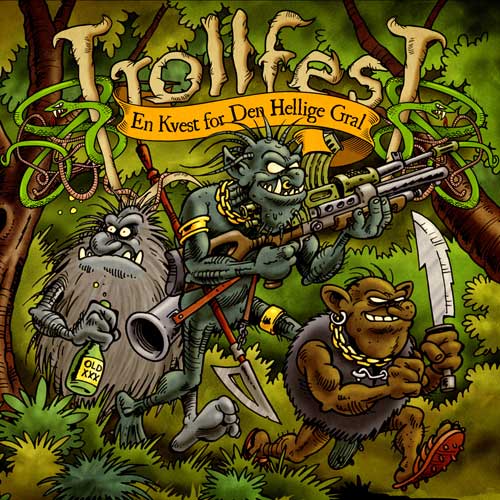
One thing you’re not going to hear on En Kvest for Den Hellige Gral, or on any of their other albums, is much of a folk/viking metal ethos. There’s a decent chance they’re more familiar with Taraf de Haïdouks than with Bathory (though they have as much of an awareness of metal as all the other styles they incorporate). Hell, they’re probably the least serious band that can be called folk metal. The lyrics are barely coherent gibberish. En Kvest for Den Hellige Gral isn’t in German or Old Norse or anything of the sort. It’s exactly what it sounds like: “The Quest for The Holy Grail” as written by someone a little bit slow, like say, a troll? I think it’s supposed to be consistently coherent enough to be understandable if you know Norwegian, but it’s not a real language.
Each release is a concept album, and while I can’t speak for this one they’ve come package in the past with a mini-comic telling the tale. It usually involves a bunch of imbecilic trolls going on an epic journey for booze (I’m sure the Holy Grail here is some self-replenishing tankard of ale) and pillaging, plundering, slaughtering Christians and all those other good light-hearted folk metal topics along the way. It’s never going to make a statement or push a particular world view, it’s just meant to be fun.
Die Verdammte Hungersnot
Far from being “Finntroll ripoffs”, the band is so unique that there’s nothing I can really compare this to besides their own past works. So what I have to say about En Kvest for Den Hellige Gral specifically will be, I guess, pretty brief. One thing I noticed was a lot of breaks in the folk side of their sound. You’ll find a lot more 30 second or so segments of straight-up metal on this album than on Villanden. That, to me, is a bad thing, because when they’re not playing folk or doing something weird they’re pretty generic.
On the plus side, the folk is largely a continuation of Villanden. That is, rather than the home-grown sort of sounds they used on their first two albums, they incorporate recognizable styles that you can have some fun trying to identify. The recording quality seems to have improved a bit too, which in their case I found kind of disappointing. Villanden’s raw sound gave it a sort of primitive feel that I thought complimented their style.
In a lot of ways it’s their most mature and diverse work, but it lacks some of their last album’s lasting appeal. The songs aren’t quite as catchy. The way the middle of Die Verdammte Hungersnot instantly sticks in your head was a bit more commonplace in the past. The vocals aren’t nearly as unique, and if it sounds all around more professional, well, that doesn’t necessarily work as well for their image. If Villanden was borderline insane, En Kvest for Den Hellige Gral is merely pretty weird.
Der Sündenbock Gegalte
That all being said, if you’re new to the band entirely and intrigued I recommend Villanden over this one. I have a love/hate relationship with it that extends way beyond my interest in anything else they’ve released. But En Kvest for Den Hellige Gral is still pretty good, and it’s a promising sign of things to come that they’ve continued to expand their sound.
 Through the Shattered Lens