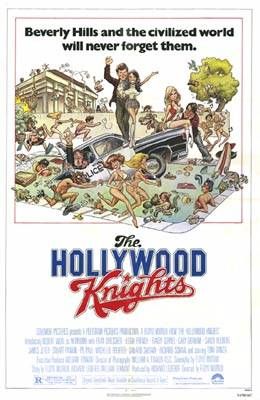
The Hollywood Knights (1980, directed by Floyd Mutrux)


Halloween Night, 1965.  While the high school holds a pep rally and the Beverly Hills Homeowners Association debate the best way to tackle the problem of juvenile delinquency, the Hollywood Knights hang out at Tubby’s Drive-In, their favorite burger joint.  The Hollywood Knights are a car club and a group of fun-loving rebels, determined to have a good time and to always humiliate Officers Clark (Sandy Helberg) and Bimbeau (Gailard Sartain).  In practice, this amounts to a lot of jokes about flatulence and Newcomb Turk (Robert Wuhl) mooning the cops every chance the he gets.  I’m hoping a stunt butt was used for the mooning shots.  If I had known watching Hollywood Knights would mean seeing Robert Wuhl’s bare ass a dozen times over 91 minutes, I wouldn’t have started the movie.

The humor is crude but the movie has a serious side, one that was cribbed from American Graffiti.  Duke (Tony Danza), a senior member of the club, is upset that his girlfriend (Michelle Pfeiffer, in her film debut) is working as a car hop.  He’s also sad that his buddy, Jimmy Shine (Gary Graham), is leaving in the morning for the Army.  Jimmy’s not worried about being sent to Vietnam because Americans are only being sent over there as advisors.  Hollywood Knights doesn’t end with a Graffiti-style epilogue but if it did, Jimmy would be the one who never came home.  The serious scenes work better than the comedy, due to the performances of Gary Graham, Michelle Pfeiffer, and Tony Danza.  I can’t believe I just said that either.  Danza, though he’s way too old to be playing a high school student, is actually really good in this movie.  Pfeiffer doesn’t get to do much but, from her first scene, it’s easy to see why she became a star.  The camera loves her and she brings her character to life, despite not having much screen time.

Unfortunately, the drama takes a back seat to a lot of repetitive humor.  The problem isn’t that the humor is crude.  One thing that has always been true is that, regardless of the year, teenage boy humor is the crudest humor imaginable.  Even back in prehistorical times, teenage boys were probably drawing dirty pictures on the walls of their caves.  The problem is that the humor is boring and Robert Wuhl is even more miscast as a high school student as Tony Danza was.  Fran Drescher plays a high school student with whom Turk tries to hook up.  Drescher, like Pfeiffer, comes across as being a future star in the making.  Robert Wuhl comes across as being the future creator of Arli$$.

The Hollywood Knights has a bittersweet ending, the type that says, “It’ll never be 1965 again.”  This movie made me happy that it will never be 1965 again.  1965 should have sued The Hollywood Knights for slander.  Hollywood Knights tried to mix the nostalgia of American Graffiti with the raunchiness of Animal House but it didn’t have the heart or creativity of either film.  At least some of the member of the cast went onto better things.
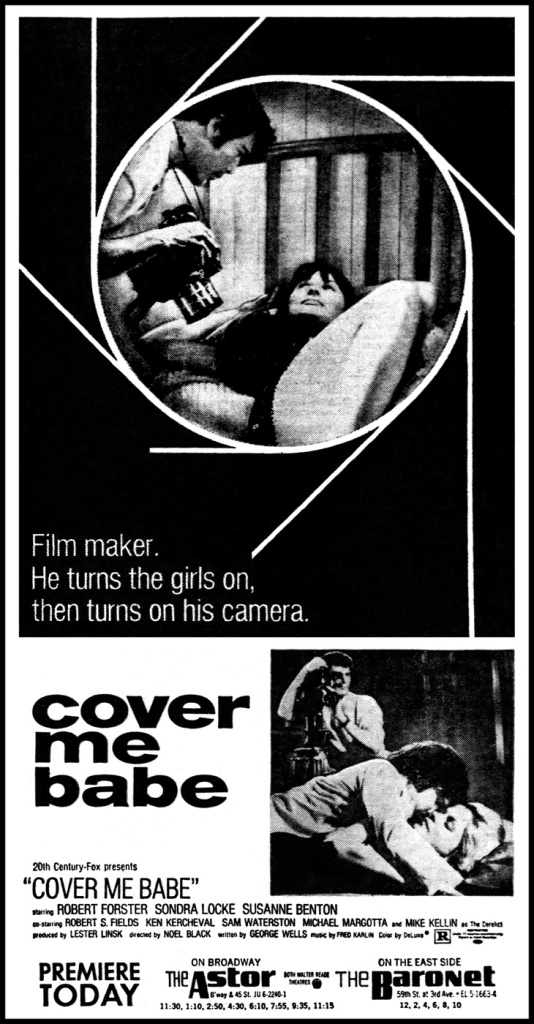
 

Film Review: Cover Me, Babe (dir by Noel Black)


I don’t know if I’ve ever come across a non-horror film that featured a more off-putting lead character than Tony, the protagonist of 1970’s Cover Me, Babe.

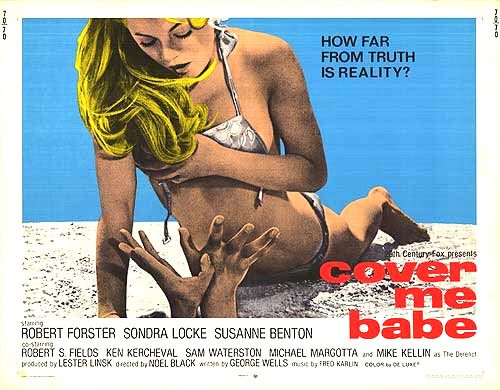
A film student, Tony (Robert Forster, even in 1970, who was too old for the role) aspires to make avant-garde films.  Everyone in the film continually raves about how talented Tony is.  The footage that we see, however, tends to suggest that Tony is a pretentious phony.  The film opens with footage of a student film that Tony shot, one that involves his girlfriend, Melisse (Sondra Locke) sunbathing in the desert and getting groped by a hand that apparently lives under the sand.  It was so self-consciously arty that I assumed that it meant to be satirical and that we were supposed to laugh along as Tony assured everyone that it was a masterpiece.  And, to be honest, I’m still not sure that Cover Me, Babe wasn’t meant to be a satire on film school pretension.  I mean, that explanation makes about as much sense any other.  (Hilariously enough, Tony’s film had the same visual style as the film-within-a-film around which the storyline of Orson Welles’s The Other Side of the Wind revolved.  At least in the case of Welles, we know that his intent was satirical.)

Tony is not only pretentious but he’s also a bit of a prick.  He treats Melisse terribly and he manipulates everyone around him.  He wanders around the city with his camera, filming random people and then editing the footage together into films that feel like third-rate Godard.  He answers every criticism with a slight smirk, the type of expression that will leave you dreaming of the moment that someone finally takes a swing at him.  Tony’s arrogant and he treats everyone like crap but, for whatever reason, everyone puts up with him because …. well, because otherwise there wouldn’t be a movie.  Of course, eventually, everyone does get sick of Tony because otherwise, the movie would never end.

A Hollywood agent (Jeff Corey) calls up Tony and offers to get him work in Hollywood.  Tony is rude to the guy on the phone.  Tony meets a big time producer who could get Tony work.  Tony’s rude to him.  Guess who doesn’t get a job?  Tony has to get money to develop his latest film from one of his professors so he’s rude to the professor.  Guess who doesn’t get any money?  Tony cheats on his loyal girlfriend.  Tony’s cameraman (played by a youngish Sam Waterston) walks out when Tony tries to film two people having sex.  By the end of the movie, no one wants anything to do with Tony.  Tony goes for a run on the beach.  He appears to be alienated and disgruntled.  We’re supposed to care, I guess.

The problem with making a movie about an arrogant artist who alienates everyone around him is that you have to make the audience believe that the artist is talented enough to justify his arrogant behavior.  For instance, if you’re going to make a movie about a painter who is prone to paranoid delusions and obsessive behavior, that painter has to be Vincent Van Gogh.  He can’t just be the the guy who paints a picture of two lion cubs and then tries to sell it at the local art festival.  You have to believe that the artist is a once-in-a-lifetime talent because otherwise, you’re just like, “Who cares?”  The problem with Cover Me, Babe is that you never really believe that Tony is worth all of the trouble.  The film certainly seems to believe that he’s worth it but ultimately, he just comes across as being a jerk who manipulates and mistreats everyone around him.

That said, from my own personal experience, a lot of film students are jerks who treat everyone them like crap.  So, in this case, I think you can make the argument that Cover Me, Babe works well as a documentary.  The fact of the matter is that not every film student is going to grow up to be the next Scorsese or Tarantino or Linklater.  Some of them are going to turn out to be like Tony, running along the beach and wondering why no one agrees with him about George Stevens being a less interesting director in the 50s than he was in the 30s.  As a docudrama about the worst people that you’re likely to meet while hanging out on campus, Cover Me, Babe is certainly effective.  Otherwise, the film is a pretentious mess that’s done in by its unlikable protagonist.  Everyone in the film says that Tony has what it takes to be an important director but, if I had to guess, I imagine he probably ended up shooting second unit footage for Henry Jaglom before eventually retiring from the industry and opening up his own vegan restaurant in Vermont.  That’s just my guess.

The poster has little to do with the film.