Clash of the Titans (1981, directed by Desmond Davis)


High atop Mt. Olympus, Zeus (Laurence Olivier) and his fellow Gods look down on Earth and jealously manipulate its citizens.  When Zeus impregnates Danae (Vida Taylor), the daughter of the King of Argos, she and her son Perseus (Harry Hamlin) are banished to sea.  Zeus responds by ordering Poseidon (Jack Gwillim) to release the Kraken.

Years later, when Callibos (Neil McCarthy), the son of the Goddess Thetis (Maggie Smith), destroys all but one of Zeus’s flying horses, Zeus transformer Callibos into a tailed monster.  Thetis tries to get her revenge by having Callibos kill Perseus but instead, Perseus chops off Callibos’s hand, comes to possess Pegasus, the last of the flying horses, and also wins the right to marry Andromeda (Judi Bowker).

At the wedding, Cassiopeia (Sian Phillips) declares Andromeda to be even more beautiful than Aphrodite (Ursula Andress).  Big mistake.  Aphrodite demands that Andromeda by sacrificed to the Kraken.  Along with Pegasus, Ammon (Burgess Meredith), Thallo (Tom Pigott-Smith), and robot owl, Perseus goes on a quest to get the snake-haired head of Medusa so he can turn the Kraken into stone.

There’s a lot that I love about Clash of the Titans, from the Ray Harryhausen’s stop-motion special effects to the blind witches who pass one eyepiece among them to Burgess Meredith’s performance as Ammon.  I even like the robot owl.  But the thing that has always made the biggest impression on me is that Mt. Olympus is portrayed as having a shelf that holds a figurine for every human in the world.  The Gods casually move the pieces around and transform them on whims.  Of all the films that have been based on Greek mythology, Clash of the Titans is one of the few that really captures the idea of the Gods essentially being a bunch of petty and jealous libertines who view humans are just being their playthings.

Let’s not overthink Clash of the Titans, though.  The main appeal of Clash of the Titans is that it’s just a good, old-fashioned adventure movie.  In this age of CGI and humorless heroes, it’s hard not love the film’s mix of old-fashion stop-motion animation, strong characters, and occasional moments of humor.  (I like the owl and I won’t apologize for it.)  Also, Medusa has appeared in a lot of movie but she’s never been scarier than in this movie.  Who can forget the yellow glow of her eyes, followed by men turning to stone?  Who can forget the hiss of her tail or the moment when Perseus waits to strike while trying not to look into her eyes?  Beyond Medusa, who can forget the Kraken rising from the sea or the blood of Callibos giving birth to giant scorpions?  Without CGI, Clash of the Titans still captures the feel of living in a different time and a different land.  Clash of the Titans brings mythology to life in a way that few other films have been able to,

I loved the original Clash of Titans when I was a kid.  I rewatched it last month and I happy to say that I love it still.
Horror Film Review: Eye of the Devil (dir by J. Lee Thompson)


If you thought Bohemian Rhapsody was overedited, you wait until you see the 1966 British horror flick, Eye of the Devil.

Seriously, I lost track of average number of of cuts that were used in each scene.  It was like, “There’s Deborah Kerr!  There’s Deborah Kerr from another angle!  There’s Donald Pleasence staring at something!  There’s David Hemmings in a corner.  There’s Deborah Kerr again!  There’s an overhead shot of the entire room!  Hemmings again, staring off to the left.  Now, a different shot of Hemmings staring off to the right.  Pleasence!  Kerr!  Hemmings!  There’s Sharon Tate, was she there the whole time?  Another overhead shot.”  All in five minutes.

Now, I will admit that the frantic editing style was a bit more effective in Eye of the Devil than in Bohemian Rhapsody, if just because Eye of the Devil was meant to be a bit of a filmed dream.  The whole movie was set up to be a surreal journey into the heart of French darkness so the disorientating visual style was effective, even if it did kind of give me a headache while I was watching it.

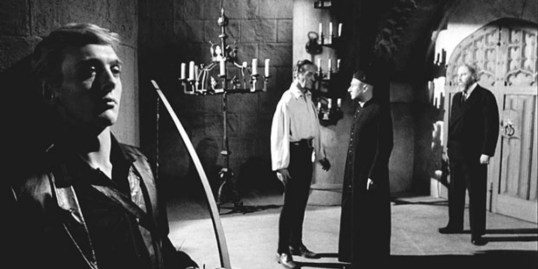
In the film, Deborah Kerr play Catherine, who is the wife of Philippe (David Niven), who owns a vineyard and who is perfectly charming and David Niven-like until he returns to the vineyard.  Then he suddenly becomes withdrawn and cold.  It turns out that the vineyard is struggling a bit.  It’s the dry season, which I guess is a bad thing when you’re making wine.  While Philippe tries to keep morale up among the peasants, two siblings — Christian (David Hemmings) and Odile (Sharon Tate) — wander around the castle.  Christian carries a bow and arrow and seems to be kind of arrogant.  Odile smiles enigmatically and turns frogs into doves.  Meanwhile, Donald Pleasence plays the vineyard priest, who appears to believe that something drastic needs to be done to reverse the dry season.

Soon, Catherine is stumbling across strange ceremonies and discovering that no one seems to care about her concerns that Christian and Odile are going to be a bad influence on the children.  She’s especially upset when Christian points an arrow at her.  Philippe, meanwhile, just laughs off her concerns.  Obviously, it was just a joke! he says.

Eye of the Devil is about as enjoyably pretentious as a British film from 1966 can be.  It’s not just that the movie is edited to the point of chaos.  It’s also that characters have a bad habit of going off on discussions about relationship between magic and reality.  And yet, it’s so pretentious and so silly and so overdirected that you can’t help but love it.  It’s just such a film of its era that it’s impossible not to get something out of it.  Add to that, Sharon Tate and David Hemmings share an otherworldly beauty as the two siblings.  Deborah Kerr shows that she could make even the silliest of situations of compelling.  David Niven is surprisingly effective as a non-charming character.  And then you’ve got Donald Pleasence, making enigmatic statements and showing off the intense stare that would later make Dr. Sam Loomis an icon of horror.

Eye of the Devil may be a mess but it’s a beautiful mess.

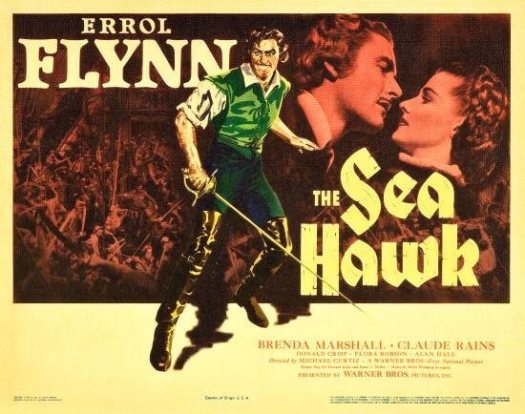
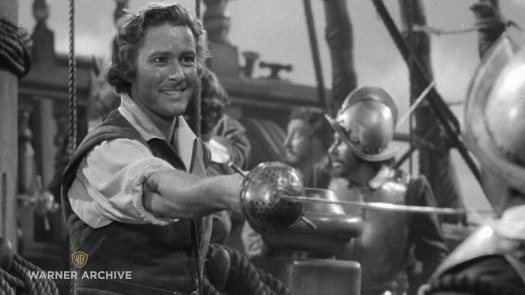
On Her Majesty’s Secret Service: Errol Flynn in THE SEA HAWK (Warner Brothers 1940)


gary loggins's avatarcracked rear viewer

Warner Brothers pulled out all the stops for their 1940 epic THE SEA HAWK. There’s dashing Errol Flynn swashbuckling his way across the Silver Screen once again, the proverbial cast of thousands, high seas action, romance, political intrigue, superb special effects, and a spirited score by Erich Wolfgang Korngold. The only thing missing that could’ve possibly made this movie better is Technicolor, but since Jack and his bros had already spent $1.7 million (equivalent to almost thirty million today) to produce it, why quibble?

Flynn is in fine form as privateer Geoffrey Thorpe, captain of the pirate ship Albatross, in service to Her Majesty Queen Elizabeth I. When they attack and plunder a Spanish ship carrying Ambassador Don Alvarez de Cordoba and his beautiful niece Maria, Captain Thorpe is reprimanded and told to lay off the Spanish. Spain, however, is building up their Armada with world conquest in mind, and…

View original post 603 more words

Embracing the Melodrama Part II #17: Good Time Girl (dir by David MacDonald)


Good-Time_Girl_FilmPoster

The 1948 film Good Time Girl is currently available on Netflix and I have to admit that, based on the name alone, I was expecting it to be another somewhat campy exploitation film about juvenile delinquency, something along the lines of Damaged Lives and Gambling With Souls.

And that’s certainly how the film began.  A troubled teenager named Lyla (Diana Dors) has been arrested and is sent to the juvenile court where the concerned Miss Thorpe (Flora Robson) tells Lyla that if she doesn’t change her ways, she could end up just like Gwen Rawlings.  Who is Gwen Rawlings?  That’s what we spend the rest of this short film finding out.

The film shows how Gwen (Jean Kent) was raised in an abusive household and how, at the age of 16, she ran way from home.  The first person she met was the handsome and charming Jimmy (Peter Glenville) who turns out to be a low-level gangster.  (His pinstrip suit and mustache give him away.)  Jimmy gets Gwen a job as a hat-check girl at a club run by the enigmatic Maxey (Herbert Lom).  Gwen meets and falls in love with a musician named Red (Dennis Price) but Red explains that he’s not only too old for her but he’s married as well.  Soon, Gwen is living with Jimmy and Jimmy is regularly abusing her.  When Maxey sees that Jimmy has given her a black eye, he has Jimmy beaten up and fired.  Jimmy responds by slashing Maxey’s face and then framing Gwen for jewelry theft.

Gwen is sent to reform school, where she falls under the influence of the somewhat demonic Roberta (played, in a genuinely menacing performance, by Daniel Day-Lewis’s mother, Jill Balcon).  Reform school only succeeds in making Gwen tougher and angrier.  When a mini-riot breaks out in the cafeteria, Gwen takes advantage of the confusion and escapes.

Back on the streets and with the police searching for her, Gwen falls in with a succession of different criminals.  When she meets two military deserters, it leads to the type of tragedy that could just as easily befall Lyla if Lyla doesn’t change her ways.

This is one of those films where the worst possible thing that could happen always happens and, as a result, it’s all rather melodramatic.  But, as opposed to a film like Reefer Madness or Sex Madness, it never gets so melodramatic that it becomes implausible.  Instead, it’s actually a very watchable portrait of people living on the margins of acceptable society.  Director David MacDonald fills the screen with menacing images and the pace never lags.  The film is also full of great performances from character actors that you’ll probably recognize from countless Hammer horror films.  Herbert Lom is especially impressive as the quietly intimidating Maxey.

I wasn’t expecting much from Good Time Girl but it’s definitely worth watching.

http://www.youtube.com/watch?v=pO1wB-MMaKk