Scene That I Love: Vito Corleone and Johnny Fontane in The Godfather


Continuing our tribute to the great Marlon Brando, today’s scene that I love comes from The Godfather.

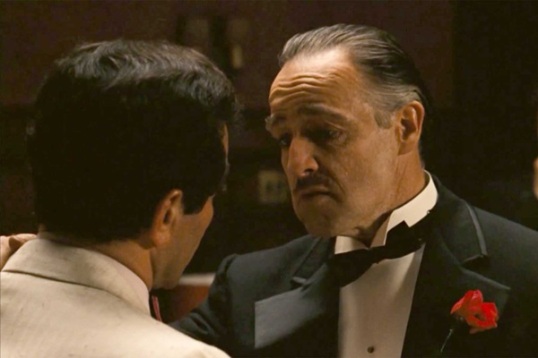
In this scene, a self-pitying Johnny Fontane (Al Martino) discusses his career problems with Marlon Brando’s Vito Corleone.  Johnny is losing his voice.  Johnny is up for a role in a big movie but he worries that the producer will never allow him to appear in the film.  Johnny says he doesn’t know what to do and he sheds a tear….

….and that’s not a smart thing to do when you’re talking to Don Corleone.

This scene contains some of the best moments of The Godfather.  Al Martino was a professional singer with little acting experience.  (While Johnny Fontane was a major character in Mario Puzo’s book, he only appeared in two scenes in the film version.  Coppola later said that he thought the Johnny Fontane chapters were so poorly written that he would have turned down the film if he had to include too much of the character.)  In order to get an effective performance out of Martino, Brando did not warn him that he would actually be slapping him.  During one take, Brando got so aggressive that he knocked off Martino’s toupee and caused Robert Duvall to start laughing.  It was all worth it, though.  Martino was thoroughly convincing as Johnny Fontane and Marlon Brando won (but did not accept) his second Oscar for Best Actor.

4 Shots From 4 Films: Special Marlon Brando Edition


4 Or More Shots From 4 Or More Films is just what it says it is, 4 shots from 4 of our favorite films. As opposed to the reviews and recaps that we usually post, 4 Shots From 4 Films lets the visuals do the talking!

One hundred years ago and on this date, Marlon Brando was born in Omaha, Nebraska.  One of the greatest of American actors and one of the main reasons why so many young actors became enamored with the Method, Marlon Brando played many roles in our culture.  When he was young, he was a Broadway bad boy.  When he went out to Hollywood, he became a legitimate movie star.  In the 60s, he was a cautionary tale as his career suffered a series of notorious flops.  In the 70s, he made a comeback and, in during the final years of his career, he was as known for his eccentricities as for his talent.  It’s a shame that those eccentricities overshadowed Brando as an actor.  When he wanted to be, he was one of the best to ever appear on stage or in the movies.

In honor of the wonderful, tragic, and talented Marlon Brando, it’s time for….

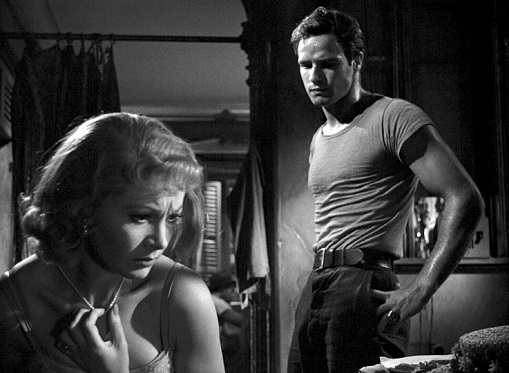
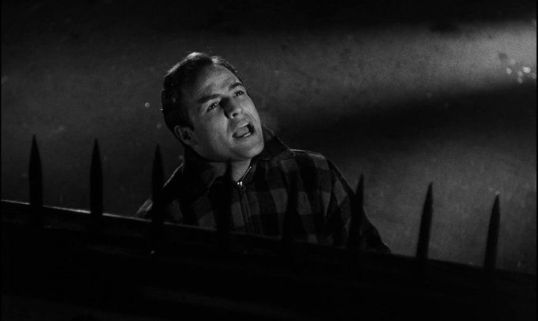
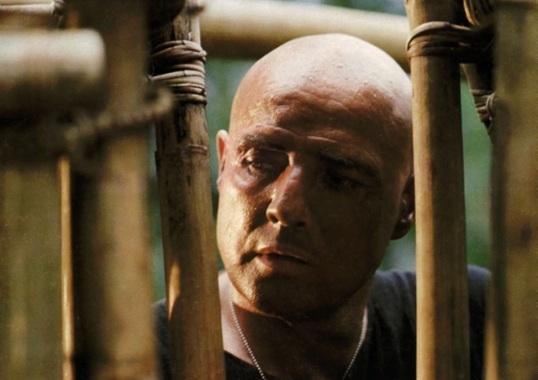
4 Shots From 4 Marlon Brando Films

A Streetcar Named Desire (1951, dir by Elia Kazan, DP: Harry Stradling)

On The Waterfront (1954, dir by Elia Kazan, DP: Boris Kaufman)

The Godfather (1972, dir by Francis Ford Coppola, DP: Gordon Willis)

Apocalypse Now (1979, dir by Francis Ford Coppola, DP: Vittorio Storaro)

Film Review: Hitler — Beast of Berlin (dir by Sam Newfield)


1939’s Hitler — Beast of Berlin opens with a shot of Nazi stormtroopers marching down a Berlin street.  As they pass, every civilian stands and gives them the stiff-armed Nazi salute.  A couple sitting in a park does it.  A woman pushing a baby carriage does it.  A group of children do it.

Despite outward appearances, not everyone in Berlin is a supporter of Hitler or the Nazis.  Hans Memling (Roland Drew) is an intellectual and a veteran of World War I.  He knows that Germany’s economic policies are, in fact, making the country weaker.  He knows that Hitler is determined to provoke a war that Germany cannot win.  Prophetically, Hans speaks of the risk of German citizens being forced to fight in a war that is only being fought on behalf of Hitler’s ego.  He warns that Berlin and Germany will be destroyed if Hitler is not stopped.

Along with a group of other dissidents, Hans prints an underground newspaper, one that presents the truth about what is happening in Germany.  Working with him, among others, is his brother-in-law, Karl (Alan Ladd, in an early role) and a priest named Father Pommer (Frederick Giermann).  Their contact in the Gestapo is Alfred Stahlhelm (played by Hans Heinrich von Twardowski, a German actor who escaped Germany when Hitler came to power).  Stahlhelm is an alcoholic who fears that he will accidentally slip up when he’s drunk.  As he explains it, a member of the Gestapo is expected to drink and visit brothels when he is off-duty.  If he doesn’t, he will be immediately suspected of insubordination.

When the Gestapo does come for Hans’s operation, Hans finds himself separated from his wife (Steffi Duna) and imprisoned.  The only thing that keeps Hans alive is that the camp commandant is an old friend from World War I.  Hans can only watch as his allies are either executed or forced, after torture, to declare their loyalty to Hitler.  When Hans is finally given an opportunity to escape, he must decide whether to flee to Switzerland or to remain in Germany and continue to fight the Nazi regime.

The most interesting thing about this film is that it was made in 1939 and released into theaters a month after Germany invaded Poland.  The film was released at a time when America was still officially neutral and when isolationism was still a popular policy.  It was released at a time when many Americans were still dealing with the trauma of World War I and, as such, felt that Europe should be left alone to deal with its conflicts on its own.  As such, the film struggled with both the enforcers of the Motion Picture Production Code but also with local censors who felt that the film might offend the German communities within their towns.  James G. Stahlman, editor of the Nashville Banner, was moved to write an editorial calling for the film to be banned because it might inspire audiences to want to go to war with Germany.  Despite all that, Hitler — Beast of Berlin did well at the box office, though many theater owners chose to advertise it as being titled either Beast of Berlin or The Goose Steppers.

Seen today, parts of the film seem naive.  Despite the film being fervently and unapologetically anti-Nazi, it is still obviously a film made at a time when the full depravity of the Nazi regime had not yet been revealed.  The scenes in the concentration camp feel as if they could have been lifted from any 1930s prison film and they certainly come nowhere close to depicting what we now know was actually happening.  Indeed, the film barely acknowledges the anti-Semitism that lay at the heart of Nazi ideology.  But the film does do a good job of portraying life in a society where no one can be trusted and where simply saying the wrong word can lead to prison, torture, and even worse.  The film captures the fear and paranoia of living under a dictatorship and certainly, it deserves credit for calling out the Nazis and their leaders by name.  At a time when many people were living in denial about what was happening in Europe, this film took a clear and firm stand.  In 1939, the film may have been called “propaganda” but today, it feels like prophecy.  Everything that Hans predicts in this film would come to pass in reality.  The film was a warning that was heeded too late.

Here’s The Exclusive IMAX Trailer For Kingdom of the Planet Of The Apes


Another Planet of the Apes film?

Indeed!  And here’s the exclusive IMAX trailer for Kingdom of the Planet of the Apes which …. I mean, it might be good.  The trailer is effective.  The other Planet of the Apes films have largely been good, except for the one Tim Burton did.  (Even the bad ones — like Battle For The Planet of the Apes — have been oddly entertaining.)  That said, Andy Serkis was really the heart and soul of the whole reboot and he’s not in this one.  On the plus side, the great Kevin Durand is in this film and if anyone was ever meant to be play a tyrannical warlord who takes over a post-apocalyptic Earth, it’s Kevin Durand.

Anyway, here’s the trailer!

Scenes That I Love: Alec Guinness In The Bridge on The River Kwai


The great Alec Guinness, one of the best actors of all time, was born 124 years ago on this date.

Today’s scene of the day comes from the film that won Guinness the Oscar for Best Actor, 1957’s The Bridge on the River Kwai.  In that film (which was one of many that Guinness made with director David Lean), Guinness plays Col. Nicholson, a British POW who is tasked, by the Japanese, with building a bridge.  Though many of his men claim that it will mean collaborating with the enemy, Col. Nicholson feels that the bridge should be a symbol of British ingenuity.  As Nicholson explains it, the bridge will show what the British are capable of doing, even under the most trying of circumstances.  Eventually, Nicholson’s obsession with showing up his captors by constructing the perfect bridge blinds him to everything else that is going on.

In this scene, Nicholson reveals just how obsessed he has become.  It’s a phenomenal piece of acting from Guinness, an actor who — up until the film — was largely known for his comedic performances.

Film Review: Conspiracy (dir by Frank Pierson)


The 2001 film, Conspiracy, takes place at a villa on the outskirts of Berlin.  It’s a lovely villa and, as we can see during the film’s opening moments, it’s about to play host to a meeting of very important people.

The date is January 20th and the year is 1942.  Having conquered much of Europe, Nazi Germany is now at war with the Allies.  Reinhard Heydrich (Kenneth Branagh), the young chief of the Reich Security Main Office and the man who many feel will eventually succeed Adolf Hitler as the leader of the Third Reich, has been directed to call a conference so that he and his deputy, Adolf Eichmann (Stanley Tucci), can “discuss” ways to solve “the Jewish question.”  One-by-one, representatives of the Reich’s bureaucracy show up at the villa.

At the start of the meeting, the men discuss various ways to force the Jews out of Germany and all of the occupied territories.  The men chose their words carefully, speaking in euphemisms and doing their best to sound like concerned government officials.  The men know what they’re talking about but they still seem to feel the need to avoid coming right and saying it.  As they talk, it becomes clear that everyone is trying to stay in Heydrich’s good graces while, at the same time, avoiding the fact that they understand the truth about what Germany is doing.  It’s not until halfway through the meeting that Heydrich and Eichmann reveal that Germany’s policy has already been determined and that concentration camps with gas chambers have already been designed and built.  The meeting is less about discussing the policy and more about getting each man at the meeting to sign off on it.  The unspoken subtext is that each man is being tested to determine who will support (and, if need be, help to cover up) the Final Solution and who will have to be otherwise dealt with.

Based on the actual minutes of the meeting, Conspiracy is film that is perhaps even more important now than when it was first released.  It’s a film that explores not only the banality of evil but also seeks to answer the question of why no one in Hitler’s government forcefully objected to the Final Solution.  (Many, of course, claimed not to know what was going on.  This film reveals just how little credibility that claim had.)  Some of the men go along because they understand not going along would mean the end of their careers and maybe their lives.  Some of the men agree because, as members of the military, they believe in supporting their country’s leadership, regardless of what that leadership represents.  Some of the men agree because they want to stay in Heydrich’s good graces.  These men represent a society where anti-Semitism is so normalized that it is accepted as a given and, while some of the men are not as outspoken in their prejudice as the others, it’s clear that all of them view the Jewish people as being a unique problem.  Those who do raise concerns do so only out of worry of what will happen to them if the rest of the world discovers what Germany is planning.  Heydrich insists that there is no need to worry because Germany will win the war.  Some of the men at the Conference are clearly not convinced of Germany’s pre-destined victory but not a single one has either the morality or the courage to refuse to endorse the Final Solution.  The film ends with a series of title cards, letting us know what became of the men who attended the Wannsee Conference.  Heydrich was assassinated during the war.  Eichmann fled to South America and hid there until he was captured by Israel in 1960.  Many of the men were executed for war crimes but a surprising number of them were either acquitted or never put on trial and went to live peacefully after the war.

Well-directed by Frank Pierson, Conspiracy has a distinguished cast who brings the historical characters to terrible life.  It’s one thing to read about what was said and planned at the Conference.  It’s another thing to actually hear those words spoken aloud and it’s a reminder that the evil of the Holocaust was not an accident nor was it something that took its perpetrators by surprise.  It was something that meticulously planned by human beings who were fully aware of what they were doing.  Kenneth Branagh makes for an arrogant and intimidating Heydrich while Stanley Tucci plays Eichmann as being the type of bureaucratic robot who is incapable of seeing human beings as anything more than just dwindling numbers on a report.  Colin Firth and David Threlfall make strong impressions as two of the more weary members of the Conference, as does Ian McNeice in the role of the type of crude, career-driven government functionary who has survived by pretending to be dumb.

At a time when anti-Semitism is on the upswing and Holocaust denialism is being mainstreamed, Conspiracy is an important film.  When others say that the Holocaust didn’t happen or that it doesn’t matter, Conspiracy defiantly says, “Yes, it did and yes, it does.”

Monday Live Tweet Alert: Join Us For Desperately Seeking Susan!


As some of our regular readers undoubtedly know, I am involved in hosting a few weekly live tweets on twitter and occasion ally Mastodon.  I host #FridayNightFlix every Friday, I co-host #ScarySocial on Saturday, and I am one of the five hosts of Mastodon’s #MondayActionMovie!  Every week, we get together.  We watch a movie.  We snark our way through it.

After we finish up this week’s #MondayActionMovie on Mastodon, we will be hopping over to twitter where #MondayMuggers will be showing 1985’s Desperately Seeking Susan!  The film is on Prime and it starts at 10 pm et!

It should make for a night of fun viewing and I invite all of you to join in.  If you want to join the live tweets, just hop onto Mastodon, pull up Starship Troopers 3 on YouTube, start the movie at 8 pm et, and use the #MondayActionMovie hashtag!  Then switch over to twitter, pull Desperately Seeking Susan up on Prime, and use the #MondayMuggers hashtag! 

Enjoy!

Concert Film Review: ABBA: The Movie (dir by Lasse Hallstrom)


The 1977 film, Abba: The Movie, is really two movies in one.

One of the movies, and the one that will probably most appeal to fans of the group, is a cinema verité-style look at ABBA touring Australia.  This part of the movie not only features the band playing their best-known songs in concert but it also features some behind-the-scenes footage of the members of ABBA trying to enjoy their time Australia.  They struggle to adjust to Australian culture and the English language.  Agnetha Fältskog complains about the way the tabloids focus on her body as opposed to her singing.  The emphasis is on the members of ABBA being down-to-Earth and friendly professionals who love making music but who, even more importantly, love hanging out together and making their fans happy.

The second movie is about an Australian DJ named Ashley Wallace (Robert Hughes) who is ordered to get an interview with ABBA before they leave the continent.  It won’t prove easy.  For one thing, Ashley really isn’t sure who ABBA is, beyond knowing that they’re a famous pop band.  (Ashley’s musical tastes seem to learn towards country and western.)  Secondly, ABBA is always surrounded by a mob of fans and bodyguards and it’s very difficult to get close enough to even ask them for an interview.  Third, ABBA distrusts reporters, especially after the tabloids print a bunch of salacious articles about Agnetha.  Fourth, Ashley is an idiot.

Seriously, Ashley is his own worst enemy.  If ABBA heads to the west, you can be sure that Ashley will catch the next train heading east.  Even when Ashley does finally manage to talk to ABBA’s manager and schedule an interview, he ends up oversleeping and missing his appointment!  Seriously, just think about this.  Ashley has been told that his entire future depends on getting an interview with ABBA, a task that soon proves to be nearly impossible.  Then, when Ashley finally manages to get a chance to conduct this all-important interview, it doesn’t occur to him to set his alarm to wake him up early.  There’s a word for that type of behavior and that word is “stupidity.”

As he struggles to get some time with ABBA, Ashley also takes time to interview people on the street about the opinion of ABBA.  Surprise!  Almost everyone loves ABBA!  I guess that’s to be expected, considering that the movie is named after them.  It would probably be counter-productive to have Ashley interview a bunch of people who can’t stand ABBA and would rather be listening to Led Zeppelin.  (There are a few people who tell Ashley that they don’t like ABBA but they’re all losers.)  Ashley spends so much time talking to people who love ABBA that he soon comes to love ABBA and appreciate their music as well.  He even has a series of fantasy and daydreams.  He imagines that the two men in ABBA are his best friends.  He dreams of being loved by the two women in ABBA.  Through Ashley, the audience is provided a view of how one goes from being indifferent to being a fan.

But most viewers won’t care about Ashley.  They’ll be watching for ABBA.  The performances are strong.  The members of the band seem to truly enjoy being on stage and interacting with their fans.  Interestingly, the members of ABBA are likable but a bit bland off-stage.  They’re people who truly come alive when they’re performing but who are much more subdued and down-to-Earth offstage.  Indeed, it almost seems as if Ashley is wasting his time trying to get an interview.  In this film, to watch ABBA perform on stage is to know all that you need to know.

Monday Live Tweet Alert: Join us for Starship Troopers 3!


As some of our regular readers undoubtedly know, I am involved in hosting a few weekly live tweets on twitter and occasionally Mastodon.  I host #FridayNightFlix every Friday, I co-host #ScarySocial on Saturday, and I am one of the five hosts of Mastodon’s #MondayActionMovie!  Every week, we get together.  We watch a movie.  We snark our way through it.

Tonight, for #MondayActionMovie, the film will be 2008’s Starship Troopers 3, selected and hosted by Sweet Emmy Cat!

 It should make for a night of fun viewing and I invite all of you to join in.  If you want to join the live tweets, just hop onto Mastodon, pull up Starship Troopers 3 on YouTube, start the movie at 8 pm et, and use the #MondayActionMovie hashtag! The live tweet community is a friendly group and welcoming of newcomers so don’t be shy. 

Scenes That I Love: “Good Mornin'” from Singin’ In The Rain


Today would have been the 92nd birthday of the great Debbie Reynolds.

Today’s scene that I love comes from the 1952 classic, Singin’ In The Rain.  In this scene, Debbie performs the song Good Mornin’ with Gene Kelly and Donald O’Connor.