Happy Birthday Robert Mitchum: OUT OF THE PAST (RKO 1947)


gary loggins's avatarcracked rear viewer

out3

One of my favorite actors, the laconic, iconic Robert Mitchum was born August 6, 1917 in Bridgeport, Connecticut. Rugged Robert had a wandering spirit, riding the rails in the days of the Depression, and even did time on a Georgia chain gang. Mitchum eventually ended up in California , and was bitten by the acting bug. After small roles in Laurel & Hardy comedies and Hopalong Cassidy oaters, Mitchum got noticed in a series of B-Westerns based on the novels of Zane Grey. His big break came as a tough sergeant in 1945’s THE STORY OF G.I. JOE, which he received an Oscar nomination for Best Supporting Actor. But the role that made him a star was world-weary private eye Jeff Bailey in the film noir classic OUT OF THE PAST.

We meet Bailey running a gas station in the small town of Bridgeport, California (an homage to Mitchum’s hometown, perhaps?) He has a mute…

View original post 758 more words

Bad Blonde: TOO LATE FOR TEARS (1949)


too_late_for_tears_dvd

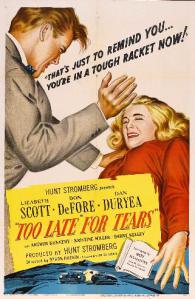
I just finished viewing the 1949 feature TOO LATE FOR TEARS on TCM. The title may sound like a weepy tearjerker, but this is film noir dynamite. Once incomplete due to falling into public domain, the UCLA Film & Television Archive have restored it to its black & white glory. I’d never seen this one before, and it was time well spent. It’s based on a Saturday Evening Post serial by screenwriter Roy Huggins, who later went on to produce television classics like MAVERICK, RUN FOR YOUR LIFE, and BARETTA. TOO LATE FOR TEARS can hold it’s own with the better known noirs of the era.

Alan and Jane Palmer are driving down a lonely LA highway when a satchel is tossed in their car by another driver. They discover the bag’s loaded with cold, hard cash. They’re chased by the intended party, but manage to elude them. When the couple opens the bag at their apartment, Jane’s money lust is palpable. See, she was married once before to a man who committed suicide when he lost his fortune. Jane yearns to return to the easy life and sees this cash as a way out. Sensible Alan argues they should turn it over to the cops, but greedy Jane persuades him to stash it in a train station locker for a week, until cooler heads can prevail.

While Alan’s at work, Jane gets a visit from slimeball Danny who says he’s a cop. After nosing around a bit, he tells her he’s the guy the bag was intended for and threatens her. Not willing to give up her claim on the dough, Jane entices the bum into helping get the money in exchange for half. Danny goes along and agrees to meet her at the lake. Alan and Jane go on a fateful boat ride, where she shoots her husband and has Danny switch clothes with the corpse. Then they tie an anchor to him and drop the poor sap at the bottom of the lake. Jane creates an elaborate ruse to convince everyone that Alan’s run off. But Alan’s little sister Cathy has her doubts, and grows suspicious. An old Army buddy of Alan’s named Don drops by to visit his pal. But Don’s not what he seems to be (no one is in this movie!). Jane plots with Danny to poison little sister and get her out of the way. Instead, Danny ends up poisoned by duplicitous Jane. She ends up hightailing it with the loot to Mexico. Jane’s really living it up on her ill-gotten gains, until Don shows up and the truth is revealed…..

late 1

The ending’s a doozy, and Jane gets her final comeuppance in the film’s climax. TOO LATE FOR TEARS is all about crosses and double-crosses, greed, lust, and murder. The cast is full of dependable actors. Lizabeth Scott stars as Jane, the ultimate femme fatale. Scott got her big break in DEAD RECKONING (with Humphrey Bogart), and went on to film noir stardom in I WALK ALONE, DARK CITY, and THE RACKET. She even played opposite Elvis in LOVING YOU. Dan Duryea (Danny) has long been one of my favorite actors. His sleazy touch can be seen in SCARLET STEET (a real gem), LARCENY, CRISS CROSS, and WINCHESTER ’73. Don Defoe (Don), usually cast as the lead’s sidekick, is more recognizable for the sitcoms OZZIE & HARRIET and HAZEL. Always dependable Arthur Kennedy doesn’t make it through the first third of the movie, but is fine as straight laced Alan. If you don’t blink, you’ll spot Denver Pyle, Billy Halop of the Dead End Kids, and MICKEY MOUSE CLUB host Jimmy Dodd in small uncredited roles.

                    TooLateForTears03_0

Byron Haskin was a top cinematographer and headed Warner Brothers’ special effects department before turning to directing in the late 40s. He keeps a tight reign on this one, but is best known for his work in science-fiction films like WAR OF THE WORLDS, CONQUEST OF SPACE, ROBINSON CRUSOE ON MARS, and the 60s TV anthology THE OUTER LIMITS. TOO LATE FOR TEARS, despite the sappy title, is a great little piece of filmmaking. Independently produced by Hunt Stromberg (RED DUST, THE THIN MAN) and originally released through United Artists, this is a movie that will satisfy any film noir buff. Thank you UCLA for your continued work in saving these lesser known pieces of  Hollywood history. And as always, thanks to TCM for giving us all the privilege of watching them again and again.

Quick Review: L.A. Noire


It was a dark and stormy night, the scent of blood in the rain, and I found myself huddled in front of my XBox. 
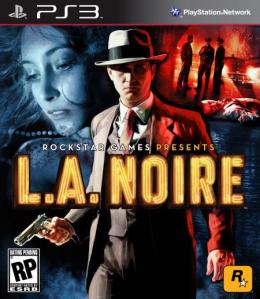
In the gaming world, bringing out a new IP can be tricky. If you have a great design team and a fantastic story, sometimes players will gravitate to it. Ubisoft’s Assassin’s Creed and Rocksteady/Eidos/WB’s Batman: Arkham Asylum are great examples of a new IP that actually managed to stand on it’s own. EA’s Mirror’s Edge, though one of my favorite games, didn’t garner enough interest to keep EA/Dice from shelving any possible sequels. I believe the problem with Mirror’s Edge was that it was a niche game. If you loved parkour/freerunning and dealing with puzzles, it was a fantastic game. If you were nauseated by first person movement, you never touched it.

And this is the danger that Rockstar’s L.A. Noire faces. It’s a detective story, and it’s going to be hard pressed to pull the Halo and Call of Duty shooter crowd (myself included) into its web. Unlike other Rockstar Games, you don’t spend too much time trying to cause mayhem to the city or roaming around. You can play in the sandbox, sure, but you also have a purpose in trying to stop crime. In a sense, you could compare it to the Spider Man games, sans web shooters and sticky fingers/feet. Know this, if you don’t at least watch someone play this game or try it yourself, you are seriously missing out on something grand.

Let me repeat: “You are seriously missing out on something grand, if you don’t at least try it.”

In L.A. Noire, you play Cole Phelps, fresh out of WW II with a Silver Star and logically moving to a role of a officer in the L.A.P.D. Quick to make a name for himself, Cole takes the initiative to further his career by solving the crimes he comes across. This moves him through the ranks and brings him to some of the more high profile cases in LA during the 1940’s. You can move through five different styles of investigations, ranging from Homicide to Vice to Arson. The case system in L.A. Noire is very cool, and requires you to walk the perimeter of a crime scene to examine the clues that are around. The music in the game helps to let you know if you’re moving too far away from the crime scene (the music will stop playing), if you’ve stumbled onto a clue (a chime), or if you’ve managed to collect all of the clues in an area (an uplifting melody). What’s important to note is that gathering evidence isn’t as easy as picking up an object and adding it to your inventory. You have to sometimes turn the object around in Cole’s hands to make sure that he sees (he sees, not that you see) something of particular about it. It takes the Detective Mode of Batman: Arkham Asylum up a notch in that even you may find clues and info in both games, L.A. Noire lets you choose how to incorporate it in your interrogations. It would be interesting to see if Arkham City has a similar approach along the line. The Interrogation features of L.A. Noire introduces a new technology to Rockstar’s arsenal called MotionScan. This tech, similar to what was used in The Social Network allowed them to map the actors facial movements. This becomes a key part of the interrogations in that you can effectively ‘read’ a witness and tell if they are lying to you or possibly have some doubts to what they’re telling you. I haven’t seen anything like this since Intrigue! For the Commodore 64, so it’s pretty refreshing to encounter the system here.

The one problem I do have with L.A. Noire so far is that the Interrogation System (at least in one of the first 3 cases I handled) seemed to run in a loop. When I fouled up an Interrogation, I was forced to redo it until I got it right. I believe it was because of the case I was working on (it was literally the introduction to Interrogating), and that other cases may not do this. If all of the interrogations have that style, that could become a problem. The whole “do it until you get it right” is great in a game like Mirror’s Edge, but it would be nice to see a case slip from your fingers because you botched something.

You’ll also find a number of cameos from various actors in L.A. Noire. Keith Szarabajka (The Dark Knight) is the narrator of the story, and you’ll also run into Courtney Gains (Memphis Belle, The Burbs) and many others (including Fringe’s John Noble), which adds to this.

Of course, it wouldn’t be a Rockstar Game without the Sandbox to play in. The Sandbox here is Los Angeles, 1947. I can’t comment on how realistic it looks, as I’ve never been to L.A., but for the purposes of this game, it makes sense. From what I’ve played so far, it’s not as rich and picturesque as Red Dead Redemption, but it does definitely fit the atmosphere of a noir story. Shadowy corners, dark alleys, it’s done quite well. Add to that the music of the story, a mixture of Jazz and action paced tunes, and you’re pretty much in a detective story all your own. Overall, L.A. Noire breaks a lot of new ground in what it achieves. You won’t get the Grand Theft Auto experience in that you’ll go crazy shooting and crashing through the city, and it might not be for every audience out there, but for those who love detective stories or crime dramas, it’s a definite gem.

A Quickie From Lisa Marie: Subversive Commercials


At the risk of committing heresy, commercials (especially older commercials) fascinate me.  At their best, commercials are textbook exploitation films.  They’re designed to appeal to the audience’s most primal desires and, as a result, are often more truthful reflections of the society that created them than more “mainstream” works of art.  A good commercial is a 1-minute journey into the human subconscious.  (Of course, at their worst, commercials are just commercials, usually for medicines that have a ton of nasty side effects.)

I was recently searching through YouTube for banned or risqué commercials when I came across these Calvin Klein ads from the early 1990s.

I think I vaguely remember seeing one or two of these commercials when I was six or seven.  It may have been the one with the narcissist from Brooklyn because I remember my mom changing the channel as soon as that creepy voice started in with, “You’ve got a nice body.”  I can understand why she did because, if nothing else, these commercials give it out a really creepy vibe.

Supposedly (and I should admit that my source for this info. comes from a bunch of anonymous YouTube commentators), these commercials were pulled off the air and its easy to see why.  These commercials gave mainstream America what it wanted (good-looking, barely legal eye candy) but did so in a way that emphasized just how sordid most people’s fantasies really are.  The creepy and unseen “director” serves as the perfect representative of mainstream, middle-aged America.  (Just check out his confusion over the word “mosh” and his complete loss of composure when the one model refuses to fulfill his fantasy.)  By leaving the director off-screen, the commercials force the viewer into the role of director.  In the best exploitation tradition, these commercials tell the complacent viewer, “This is what the inside of  your head  really looks like.”  At the same time, it also told the young that if they wanted to get the attention of the mainstream establishment, the best way to do so was to tease and offer up implied promises that would never be kept.  Supposedly, a lot of people considered these commercials to almost be pornographic.  Personally, I prefer to think of them as being subversive in the style of a classic film noir.

While the unseen director is the perfect surrogate for the hidden desires of mainstream America, the models themselves all seem to have wandered out of a Larry Clark film, which is perhaps one reason why I worry about what happened to them after their “interviews.”  The first model — Blue-eyed Brandon from Kentucky — is especially cute and I hope he eventually caught the first bus back to Louisville.  He doesn’t look  to be cut out for the big city and I get the feeling that the narcissist from Brooklyn could kick his ass.  I also get the feeling that the older Italian woman ended up making “love on film” with the guy who ripped his shirt in half while the mosher probably ended up impregnating the airhead who wears 30 year-old jeans.  I also get the feeling that the mosher may have been the younger brother of the girl who says, “I won’t dance for you.”  (And good for her!) 

These commercials all feel authentic, even if you’re not quite sure what’s going on.  From the grainy film stock to the shabby studio to the disturbingly intrusive voice of the “director,” these commercials can make your skin crawl.  You watch and you wonder if anyone ever saw these models again after their audition.  Its hard not to suspect that they all ended up either buried in someone’s backyard or maybe on a boat heading to Aruba. 

At the same time, these commercials oddly enough do make you want to go out and buy jeans because, while all of the models appear to be doomed, at least they all look really good.  As a result, the commercials themselves become the ultimate example of the philosophy of “Live Fast, Die Young, and Leave a Good Looking Corpse”