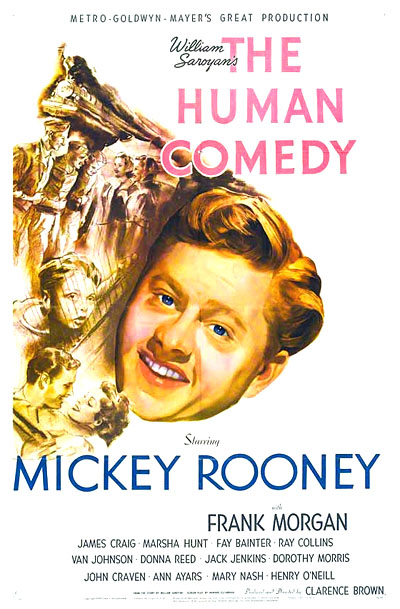
Lisa Reviews An Oscar Nominee: The Human Comedy (dir by Clarence Brown)


The-human-comedy-1943Thanks to TCM’s 31 Days of Oscar, I now have several movies on my DVR that I need to watch over the upcoming month.  Don’t get me wrong — I’m not complaining.  I’m always happy to have any reason to discover (or perhaps even rediscover) a movie.  And, being an Oscar junkie, I especially enjoy the opportunity to watch the movies that were nominated in the past and compare them to the movies that have been nominated more recently.

For instance, tonight, I watched The Human Comedy, a film from 1943.  Along with being a considerable box office success, The Human Comedy won on Oscar (for Best Story) and was nominated for four others: picture, director (Clarence Brown), actor (Mickey Rooney), and black-and-white cinematography.  The Human Comedy was quite a success in 1943 but I imagine that, if it were released today, it would probably be dismissed as being too sentimental.  Watching The Human Comedy today is something of a strange experience because it is a film without a hint of cynicism.  It deals with serious issues but it does so in such a positive and optimistic manner that, for those of us who are used to films like The Big Short and Spotlight, a bit of an attitude adjustment is necessary before watching.

And yet that doesn’t mean that The Human Comedy is a bad film.  In fact, I quite enjoyed it.  The Human Comedy is a time capsule, a chance to look into the past.  It also features a great central performance, one that was quite rightfully nominated for an Oscar.  As I watched Mickey Rooney in this film, I started to feel guilty for some of the comments I made when I reviewed Mickey in The Manipulator last October.
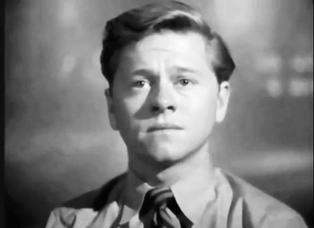
2Mickey Rooney in The Human Comedy

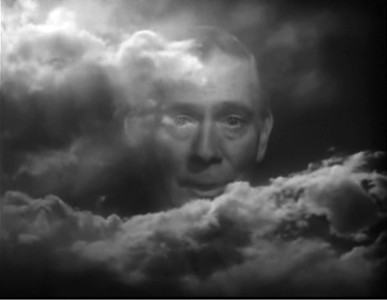
The Human Comedy opens with an overhead shot of the small town of Ithaca, California.  The face of Mr. McCauley (Ray Collins, who you’ll recognize immediately as Boss Jim Gettys from Citizen Kane) suddenly appears in the clouds.  Mr. McCauley explains that he’s dead and he’s been dead for quite some time.  But he loves Ithaca so much that his spirit still hangs around the town and keeps an eye on his family.  Somehow, the use of dead Mr. McCauley as the film’s narrator comes across as being both creepy and silly.
Matthew-clouds-400-387x300

But no sooner has Mr. McCauley stopped extolling the virtues of small town life than we see his youngest song, 7 year-old Ulysseus (Jack Jenkins), standing beside a railroad track and watching a train as it rumbles by.  Sitting on the cars are a combination of soldiers and hobos.  Ulysseus waves at some of the soldiers but none of them wave back.  Finally, one man waves back at Ulysseus and calls out, “Going home, I’m going home!”  It’s a beautifully shot scene, one that verges on the surreal.

That opening pretty much epitomizes the experience of watching The Human Comedy.  For every overly sentimental moment, there will be an effective one that will take you by surprise.  The end result may be uneven but it’s still undeniably effective.

The majority of the film deals with Homer McCauley (Mickey Rooney).  Homer may still be in high school but, with his older brother, Marcus (Van Johnson), serving overseas and his father dead, Homer is also the man of the house.  Homer not only serves as a role model for Ulysseus but he’s also protector for his sister, Bess (Donna Reed).   (At one point in the film, she gets hit on by three soldiers on leave.  One of them is played by none other than Robert Mitchum.)  In order to bring in extra money for the household, Homer gets a job delivering telegrams.
hqdefault

In between scenes of Homer in Ithaca, we get oddly dream-like scenes of Marcus and his army buddies hanging out.  Marcus spends all of his time talking about how much he loves Ithaca and how he can’t wait for the war to be over so he can return home.  One of his fellow soldiers says, “I almost feel like Ithaca is my hometown, too.”  Marcus promises him that they’ll all visit Ithaca.  As soon as the war is over…

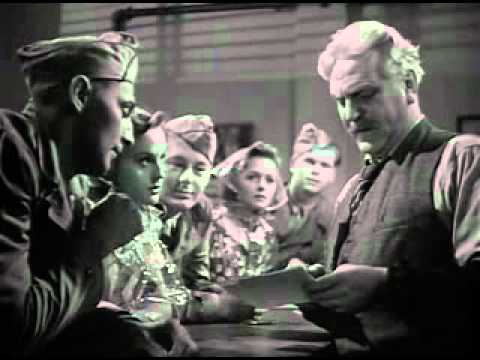
With World War II raging, Homer’s job largely consists of delivering death notices (and the occasional singing telegram, as well).  Telegraph operator Willie Grogan (Frank Morgan) deals with the burden of having to transcribe bad news by drinking.  Homer, meanwhile, tries to do his job with compassion and dignity but one day, he has to deliver a telegram to his own house…

The Human Comedy is an episodic film, full of vignettes of life in Ithaca and Homer growing up.  There’s quite a few subplots (along with a lot of speeches about how America is the best country in the world) but, for the most part, the film works best when it concentrates on Homer and Mickey Rooney’s surprisingly subdued lead performance.  By today’s standards, it may seem a bit predictable and overly sentimental but it’s also so achingly sincere that you can’t help but appreciate it.

The Human Comedy was nominated for best picture but it lost to a somewhat more cynical film about life during World War II, Casablanca.
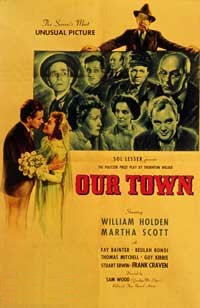
Lisa Reviews an Oscar Nominee: Our Town (dir by Sam Wood)


Original_movie_poster_for_the_film_Our_Town_(1940_film)

(SPOILERS BELOW!  THE END OF THIS FILM WILL BE REVEALED!  I will also be revealing who played George Gibbs but that’s probably not as big a spoiler.  It depends how you look at it.)

I was only 15 years old when I first read Our Town.  Because I was a theater nerd, I knew a little about the play.  For instance, I knew it took place in a small town.  I knew that it was narrated by a character known as the Stage Manager.  I knew that the play was meant to be performed on a bare stage, with no sets or props.  What I did not know, as I innocently opened up that booklet, is that Our Town is probably one of the most traumatically depressing plays ever written.

When the stage manager appears at the start of the play and talks about the town of Grover’s Corner, he lulls you into believing that you’re about to see a sentimental, comedic, and old-fashioned celebration of small town life.  We meet the characters and they all seem to be quirky in a properly non-threatening way.  Joe Crowell shows up delivers a newspaper to Doc Gibbs.  The stage manager mentions that Joe will eventually grow up to attend to M.I.T.

“Awwwww!  Good for Joe!” the audience says.

And, the Stage Manager goes on to inform us, as soon as Joe graduates, he will be killed in World War I, his expensive education wasted.

Okay, the audience thinks, that was a dark moment but this play was written at a time when World War I was still fresh on everyone’s mind.  Surely the rest of the play will not be quite as dark…

And fortunately, George Gibbs and Emily Webb show up.  They’re young, they’re likable, and they’re in love!  George and Emily get married and they’re prepared to live a long and happy life in our town!  Good for them!  YAY!

And then Act III begins…

Oh my God, Act III.  Act III begins with almost everyone dead.  Emily died in child birth so she hangs out at the local cemetery and talks to all the other dead people, the majority of whom only have vague memories of their former lives.  Emily relives the day of her 12th birthday and discovers that it’s too painful to remember what it was like to once be alive.  Emily asks the Stage Manager if anyone truly appreciates life.  The Stage Manager replies, “No.”  In the world of the living, George Gibbs sobs over his wife’s grave….

And the play ends!

OH MY GOD!

Seriously, reading Our Town was probably one of the most traumatic experiences of my life!

The 1940 film version of Our Town is a little less traumatic because it changes the ending.  In the film version, Emily doesn’t die.  She nearly dies while giving birth to her second child and the entire third act of the play is basically portrayed as being a near-death hallucination.  But, in the end, she survives and she comes through the experience with a new found appreciation for life.

And it’s certainly the type of happy ending that I was hoping for when I first read the play but, as much as I hate to admit it, the story works better with Emily dying than with Emily surviving.  The play presents death as being as inevitable as life and love and it makes the point that there’s nothing we can do to truly prepare for it.  By allowing Emily to live, the film gives us a ray of hope that wasn’t present anywhere else in Our Town.  The happy ending feels inauthentic.  If Emily could live then why couldn’t Joe Crowell?  For that matter, why did Emily’s younger brother have to die of a burst appendix on a camping trip?

But, other than the changed ending, Our Town is a pretty good adaptation of the stage play.  While the film features an actual set (as opposed to the bare stage on which theatrical versions of Our Town are meant to be performed), director Sam Wood does a good job of retaining the play’s surreal, metatheatrical style.  Making good use of shadow and darkness, Wood and cinematographer Bert Glennon made Grover’s Corner seem like a half-remembered memory or a fragment of a barely cohesive dream.

Frank Craven, who originated the role on Broadway, is properly dry as the Stage Manager and, in the role of Doc Gibbs, Thomas Mitchell is so sober and respectable that it’s hard to believe that, in just 6 years, the same actor would play the delightfully irresponsible Uncle Billy in It’s A Wonderful Life.  Emily and George are played by Martha Scott and an impossibly young William Holden, both of whom give wonderfully appealing performances.

With the exception of that changed ending, Our Town is a worthy adaptation of a classic play.  It was nominated for Best Picture but lost to another literary adaptation, Alfred Hitchcock’s Rebecca.

Embracing the Melodrama Part II #12: Jezebel (dir by William Wyler)


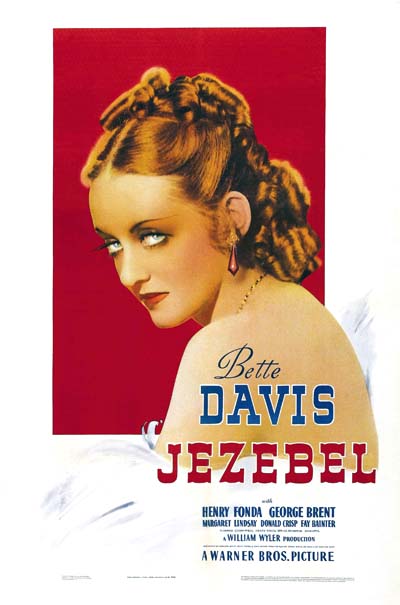
Jesebel_movieposterWe started out this day by taking a look at Bette Davis in Of Human Bondage so it seems only appropriate that today’s final entry in Embracing the Melodrama should be another film in which Bette Davis plays a potentially unlikable character who is redeemed by being the most interesting person in the film.

The 1938 best picture nominee Jezebel stars Bette Davis as Julie Marsden, a strong-willed Southern belle who lives in pre-Civil War New Orleans.  Julie is looking forward to an upcoming ball but is frustrated when her fiancée, boring old Pres (Henry Fonda), says that he has to work and declines to go shopping for a dress with her.  Impulsively, Julie does exactly what I would do.  She buys the most flamboyant red dress that she can find.

Back in the old South, unmarried women were expected to wear white to formal balls, the better to let everyone know that they were pure and innocent and waiting for the right man.  When Julie shows up in her red gown, it’s a scandal and, upon seeing the looks of shock and disdain on everyone’s faces, Julie wants to leave the ball.  However, Pres insists that Julie dance with him and he continues to dance with her, even after the orchestra attempts to stop playing music.

And then he leaves her.  At first, Julie insists to all who will listen that Pres is going to return to her but it soon becomes obvious that Pres has abandoned both Julie and Southern society.  Julie locks herself away in her house and becomes a recluse.

Until, a year later, Pres returns.  At first, Julie is overjoyed to see that Pres is back and she’s prepared to finally humble herself if that means winning back his love.  But then she discovers that the only reason that he’s returned to New Orleans is to warn people about the dangers of Yellow Fever.

Oh, and he’s also married.

To a yankee.

For the most part, Jezebel is a showcase for another fierce and determined Bette Davis performance.  It’s easy to be judgmental of a character like Julie Marsden but honestly, who doesn’t wish that they could be just as outspoken and determined?  It helps, of course, that the film surrounds Julie with a collection of boring and self-righteous characters, the type of people who you love to see scandalized.  Henry Fonda gives one of his more boring performances in the role of Pres while Margaret Lindsay, in the role of Pres’s Northern wife, is so saintly that she reminds you of the extremely religious girl in high school who would get offended whenever you came to school wearing a short skirt.  In a society as rigid, moralistic, and judgmental as the one portrayed in Jezebel, it’s impossible not to cheer for someone like Julie Marsden.

Add to that, I totally would have worn that red dress too!  In a world that insisted that all women had to act a certain way or look a certain way and think a certain way, Julie went her own way and, regardless of what boring old Pres may have thought, there’s a lesson there for us all.

When watching Jezebel, it helps to know a little about film history.  Bette Davis very much wanted to play Scarlett O’Hara in Gone With The Wind and was reportedly very disappointed when the role went to Vivien Leigh.  Depending on the source, Jezebel is often described as either being Davis’s audition for the role of Scarlett or as being a consolation gift for losing out on the role.  Either way, Jezebel is as close as we will ever get to seeing Bette Davis play Scarlett.  Judging from the film, Davis would not have been an ideal Scarlett.  (Whereas Gone With The Wind works because Leigh’s Scarlett grows stronger over the course of the film, Davis would have started the film as strong and had nowhere left to go with the character.)  However, Davis was a perfect Julie Marsden.