The Fabulous Forties #8: The Lady Confesses (dir by Sam Newfield)


Poster_of_the_movie_The_Lady_Confesses

After I watched The Red House, I watched the 8th film in Mill Creek’s Fabulous Forties box set, a 1945 film noir called The Lady Confesses.

Mary Beth Hughes plays Vicki McGuire, who is engaged to marry Larry Craig (Hugh Beaumont).  When we first meet Larry, he seems like a fairly normal guy.  He drinks too much but then again, this film was made in 1945 and it’s totally possible that Larry had yet to see The Lost Weekend.  Before getting engaged to Vicki, he was married to Norma Craig (Barbara Slater).  Norma disappeared seven years ago and has since been declared legally dead.  So, imagine everyone’s surprise when Norma suddenly turns up alive and knocking on Vicki’s front door!  Norma announces that there’s no way that she’s going to give up Larry.

Larry reacts to all this by going out and getting drunk.  He spends a while literally passed out at the bar and then, once he’s sobered up, he and Vicki go to visit Norma and try to talk some sense into her.  However, upon arriving at her apartment, they discover that Norma has been strangled!

The police automatically suspect Larry of being the murderer but he has an alibi.  He was drunk.  He was passed out at the bar.  And the only time he wasn’t at the bar, he was sleeping on a couch in the dressing room of singer Lucille Compton (Claudia Drake)…

Wait!  Larry was sleeping on another woman’s couch?  Well, Vicki isn’t necessarily happy to hear that but she still believes that her fiancée is innocent and she’s willing to do whatever it takes to clear his name, even if it means going undercover and working at a nightclub.  Vicki and Larry suspect that nightclub owner Lucky Brandon (Edmund MacDonald) is the murderer.  Can they prove it or, waiting around the next shadowy corner, is there another twist to the plot?

It’s not a spoiler to tell you that there’s another twist.  In fact, for a film that only runs for 64 minutes, there’s a lot of twists in The Lady Confesses.  The Lady Confesses is an entertaining film noir, one that gives B-movie mainstay Mary Beth Hughes a rare lead role.  As well, if you’ve ever seen an old episode of Leave It To Beaver, it’s quite interesting to see Hugh Beaumont playing a somewhat less than wholesome character.  Director Sam Newfield, who directed over 254 films during the course of his prolific career, keeps the action moving and provides a lot of menacing and shadowy images.

Though it may not be perfect (for one thing, we never learn why Norma disappeared in the first place), The Lady Confesses is a watchable and atmospheric film noir.  And you watch it below!


The Fabulous Forties #7: The Red House (dir by Delmer Daves)


40s

Last week, I started on my latest project — watching all 50 of the movies included in Mill Creek’s Fabulous Forties box set!  I started things off with Port of New York and then I was lucky enough to discover two excellent low-budget gems: The Black Book and Trapped.

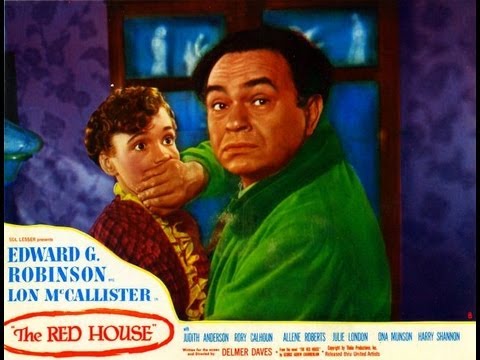
And now, we come the 7th film in the Fabulous Forties box set: 1947’s The Red House.

Redhouseposter

The Red House takes place is one of those small and seemingly idyllic country towns that always seem to harbor so many dark secrets and past crimes.  Everyone in town is friendly, cheerful, and quick to greet the world with a smile.

Well, almost everyone.

Pete Morgan (Edward G. Robinson) is the exception to the rule.  A farmer who moves with a pronounced limp, Pete lives on an isolated farm and refuses to have much to do with any of the other townspeople.  He lives with his wife, Ellen (Judith Anderson), and his niece, 17 year-old Meg (Allene Roberts).  Pete and Ellen are extremely overprotective of Meg.  Pete, especially, is always quick to tell her not to associate with any of boys in the town and not to enter the dark woods that sit next to the farm.  He tells her that there’s a red house hidden away in the woods and the house is haunted.  Going into the red house can only lead to death.

Despite Pete’s eccentricities, Meg is finally able to convince him to hire one of her classmates to help do chores around the farm.  Nath (Lon McAllister) is a good and hard worker and soon, even Pete starts to like him.  Meg, meanwhile, is falling in love with Nath.  However, Nath already has a girlfriend, the manipulative Tibby (Julie London), who cannot wait until they graduate high school so that she and Nath can leave town together.  When Nath starts to also develop feelings for Meg, Tibby responds by flirting with the local criminal, Teller (Rory Calhoun).

Though things seem to be getting better on the Morgan Farm, Nath eventually makes the mistake of admitting that, when he goes home, he takes a short cut through the old woods.  Pete angrily forbids Nath from entering the woods.  Of course, this has the opposite effect.  Soon, Nath and Meg are spending all day sneaking away into the woods so that they can look for the red house.

Once Pete learns of what they’re doing, he decides to hire Teller to keep them from even finding and entering the red house.  Needless to say, love, melodrama, murder, and tragedy all follow…

Despite the fact that the DVD suffered from a typically murky Mill Creek transfer, I enjoyed The Red House.  It’s one of those films that is just so over the top with all of the small town melodrama that you can’t help but enjoy it.  (If M. Night Shyamalan had been a 1940s filmmaker, he probably would have ended up directing The Red House.)  Nath and Meg were kind of boring but Julie London was a lot of fun as Tibby.  If I had ever starred in production of The Red House, I would want to play Tibby.

Plus, the film’s got Edward G. Robinson doing what he does best!  Robinson was an interesting actor, in that he could be both totally menacing and totally sympathetic at the same time.  He has some scary scenes as Pete but they’re also poignant because Robinson suggests that Pete hates his behavior just as much as Ellen and Meg.  Robimson was a powerhouse actor, the type who could elevate almost any film.

And that’s certainly what he does in The Red House!

red

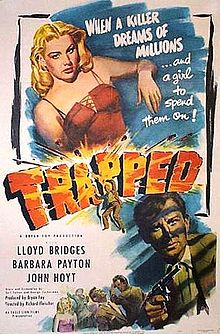
The Fabulous Forties #6: Trapped (dir by Richard Fleischer)


220px-Trapped_1949

After being disappointed with Guest In The House, I decided to go ahead and watch the sixth film in Mill Creek’s Fabulous Forties box set and I’m glad that I did.  1949’s Trapped turned out to be an entertaining little discovery.

Much like Port of New York, Trapped opens with documentary footage of the government at work and an official sounding narrator explaining to us that we are about to see a film about the hardworking agents of the Treasury Department.  In fact, the narrator goes on for so long about the Treasury Department that he starts to sound downright worshipful.  There’s nothing that the Treasury Department cannot do!  Who protects the President?  The Treasury Department!  Who tracks down counterfeiters?  The Treasury Department!  Who protects the coast?  The Coast Guard but guess what? The Coast Guard is actually a part of The Treasury Department!  The tone of the narration is so worshipful that it could almost pass for a Scientology recruiting film.  Just as only the Sea Org can protect us from Evil Lord Xenu, only the Treasury Department can stop phony money pushers!

Eventually, the narration ends and the actual movie begins.  Fortunately, the rest of Trapped more than makes up for that awkward introduction.  The film opens with a bunch of Treasury agents looking over a phony twenty-dollar bill.  The bill is almost perfect and the agents believe that it was printed using plates designed by one of the world’s greatest counterfeiters, Tris Stewart (Lloyd Bridges).  The only problem is that Stewart is in prison.  Obviously, someone else has gotten their hands on Stewart’s plates.

Stewart is upset that someone is getting rich off of his work.  So, he strikes a deal with the Treasury Department.  In return for being released, he will help them track down his plates.  The Treasury Department agrees and arranges for Stewart to “escape” during a phony prison break.

However, Stewart has plans of his own.  As soon as he’s out of jail, he knocks out his handler and escapes for real.  Tris is not only planning on tracking down his plates but he’s also going to go back into business printing and passing phony money.  He also reunites with his girlfriend, nightclub hostess Meg Dixon (Barbara Payton).

When he meets Meg, he discovers that she has a new admirer.  Johnny Hackett (John Hoyt) likes to hang out whenever Meg’s working.  Even though Johnny appears to have a thing for Meg, he and Tris still become friends.  Tris is even willing to bring Johnny in on the operation but, what Tris doesn’t realize, is that Johnny Hackett is actually Treasury agent John Downey (John Hoyt)…

Needless to say, violence, betrayal, and death follows.

Shot on location in some of the seediest parts of 1940s Los Angeles, Trapped is a fast-paced and exciting film noir.  (This is one of those films, like The Black Book, where shadows are literally everywhere.)  Lloyd Bridges (who, as a young man, could have passed for Kirk Douglas’s brother) gives a great performance as the charming but ultimately cold-hearted Tris Stewart while John Hoyt does a fairly good job as the conflicted Downey.  Barbara Payton, one of the more tragic figures from Hollywood’s Golden Age, does such a good job as Meg that it’s even more tragic to consider that, just a few years after making Trapped, her career would be destroyed by alcoholism and personal scandal and she would eventually end up as a homeless prostitute on Sunset Boulevard.

Trapped was a good discovery and you can watch it below!

The Fabulous Forties #5: Guest In The House (dir by John Brahm)


Guest_in_the_House_Poster

The fifth film in Mill Creek’s Fabulous Forties box set was 1944’s Guest In The House.  Before I get around to actually reviewing the film, there two important things that I need to share.

First off, according to the imdb, when Guest In The House was released into theaters, it ran a total of 121 minutes.  The version that was released on video — the version that I watched for this review — only runs 100 minutes.  Having watched the film, it’s hard for me to guess what could have been included in those 21 minutes.  There’s no major plot holes in the 100 minute version or any unanswered questions.  It’s hard for me to imagine that there could be anything in those 21 minutes that would have made Guest In The House a better film than the version that I watched last night.  If anything, even at just 100 minutes, the version that I saw still felt too long!

Secondly, Guest In The House was re-released several times.  At one point, the title was changed to Satan In Skirts!  That has got to be one of the greatest titles ever!  Seriously, Guest In The House is such a boring and mundane title.  But Satan in Skirts — I mean, that sounds like something that you just have to watch, doesn’t it?

Anyway, Guest In The House is about a guest in the house.  Shocking, right?  Evelyn (Anne Baxter, playing a character similar to her classic role in All About Eve) is a mentally unstable woman with a heart ailment and a morbid fear of birds.  She has recently become engaged to Dr. Dan Proctor (Scott Proctor) but she spends most her time writing nasty things about him in her diary.

Dan takes her to visit his wealthy Aunt Martha (Aline MacMahon).  Also staying at Martha’s is Dan’s older brother, an artist named Douglas (Ralph Bellamy).  Douglas is married to Ann (Ruth Warrick, who also played Kane’s first wife in Citizen Kane).  Also living at the house is Douglas’s model, Miriam (Marie McDonald).

(“I used to have to hire one model for above the neck and one model for below the neck,” Douglas explains as Miriam poses for him, “But you’re the whole package!”)

When Evelyn has a panic attack upon seeing a bird, Douglas calms her down by drawing a woman on a lampshade.  (Yes, that’s exactly what he does.)  This leads to Evelyn becoming obsessed with Douglas.  Soon, she is manipulating the entire household, trying to drive away Dan and Miriam while, at the same time, try to break up Douglas and Ann’s marriage….

So, does this sound like a Lifetime film to anyone?  Well, it should because Guest In The House is basically a 1940s version of almost every film that aired on Lifetime last year.  Normally that would be a good thing but, unlike the best Lifetime films, Guest In The House isn’t any fun.  It should be fun, considering how melodramatic the storyline is.  However, Guest In The House takes a prestige approach to its story, marking this as one of those films that was made to win Oscars as opposed to actually entertaining audiences.  Other than a few time when Evelyn imagines that she’s being attacked by invisible birds, the film never allows itself to truly go over-the-top.

Lovers of The Wizard of Oz might want to note that the Wicked Witch of the West herself, Margaret Hamilton, plays a maid in this film but, in the end, Guest In The House is mostly just interesting as a precursor to Anne Baxter’s performance in All About Eve.

The Fabulous Forties #4: Topper Returns (dir by Roy Del Ruth)


Topper_Returns_VideoCover

The fourth film in Mill Creek’s Fabulous Forties box set was 1941’s Topper Returns.  Topper Returns was the third (and final) film to be made about Cosmo Topper (Roland Young).  Cosmo Topper is an upper class and mild-mannered banker who likes to collect automobiles and who is married to the somewhat daffy Clara (Billie Burke).  Cosmo would seem to be a pretty normal guy, except for the fact that he can talk to dead people.  In the first Topper film, a ghost played by Cary Grant helped him to learn how to appreciate life.  In the second Topper film, Topper Takes A Trip, a ghost played by Constance Bennett helped to save Topper and Clara’s marriage.  And in this Topper film, a ghost helps …. well actually, the ghost doesn’t help Topper out at all.  Instead, Topper helps the ghost solve her own murder.

When Gail Richards (Joan Blondell) visits her friend Ann Carrington (Carole Landis) for the weekend, she has no idea just how weird things are going to get.  First off, while Gail and Ann are riding in a taxi to the big and foreboding Carrington mansion, a mysterious man in black shoots out the taxi’s tires.  Though the taxi crashes, both Gail and Ann survive and are able to hitch a ride from Ann’s neighbor, Cosmo Topper.

Once they get to the mansion, Gail meets Ann’s strange family.  Gail loves the mansion and who wouldn’t, seeing as how it is big and dark and full of secret passageways?  However, Gail makes the big mistake of switching beds with Ann.  Later that night, when that man in black sneaks into the bedroom and attempts to stab Ann to death, he ends up killing Gail instead.  When we next see Gail, she’s a ghost who can’t leave our world until her murder has been solved.

No worries!  Gail isn’t that upset about being a ghost.  In fact,  she seems to be rather amused by it all.  She floats right over to Topper’s house and demands that he come over and solve her murder.  After some initial reluctance, Topper agrees.  Topper sneaks into the Carrington mansion and gets to work searching for clues and attempting to solve the crime.  Needless to say, it involves a lot of family secrets, hidden rooms, and dark passageways.

Now, I should admit that I haven’t seen the first two Topper films so I don’t know how Topper Returns compares to them.  The majority of the reviews that I’ve read online seem to indicate that Topper Returns is widely considered to be inferior when compared to the first two films.  It is true, as a lot of other reviewers have pointed out, that Topper himself occasionally seems almost superfluous to the film’s plot.  At no point does he mention that he has a history of talking to ghosts and, if not for the fact that the film’s title is Topper Returns, it would be easy to believe that this film was the first appearance of the character.

But no matter!  I enjoyed Topper Returns, mostly because I’d like to think that if I was ever murdered and came back as a ghost, I would manage to have as much fun doing so as Joan Blondell appears to be having in the role of Gail.  Funny, likable, and quick-witted, Gail isn’t going to let a little thing like being dead keep her from having fun!  I also appreciated that the film has a nicely morbid streak.  Towards the end of the film, there’s a cheerful conversation between Gail and another ghost.  Gail mentions that, as soon as the murder has been solved, she can go to Heaven and “you can go to…”  Gail lets her voice trail off but still make a point of glancing down at the ground.

For a modern viewer, the most problematic part of Topper Returns is the character of Chauffeur, who is Topper’s African-American servant and who doesn’t even get a proper name even though he’s in about 80% of the movie.  On the one hand, Chauffeur is written as a total racist stereotype and, as written, the majority of his lines will absolutely make you cringe.  On the other hand, he’s also played by Eddie Anderson, a talented comedic actor who always played his servants in such a way as to suggest that they were actually a hundred times smarter than the white people they were working for.  Though you may not like the way the character is written, it is possible to appreciate the subversive subtext that Anderson brings to his performance (a subtext which, undoubtedly, was not present in the original script).  Anderson was best known for playing comedian Jack Benny’s sidekick and, at one point during Topper Returns, he announces that he’s sick of ghosts and that he’s going “return to Mr. Benny!”

Taken on its own 1941 terms, Topper Returns was an enjoyable old, dark house movie.  Watch it for Joan Blondell having the time of her afterlife.

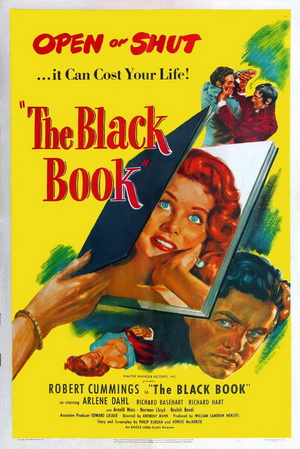
The Fabulous Forties #3: The Black Book (dir by Anthony Mann)


The_Black_Book_Poster

The third film in Mill Creek’s Fabulous Forties box set was 1949’s The Black Book, which was also released under the title Reign of Terror.

The Black Book takes place during the French Revolution.  It is, to quote Dickens, both the best of times and the worst of times.  Actually, mostly it’s just the worst of times.  The Black Book portrays revolutionary France as being a dark and shadowy country, one where the only things that hold the people together are paranoia and terror.  It’s a country where anyone can be executed at any moment and where power mad tyrants excuse their excesses by saying that they are only doing the people’s will.  Considering that the The Black Book was made in 1949, its vision of revolutionary France can easily been seen as a metaphor for Nazi Germany or Communist Russia.  Or perhaps even America at the start of the Red Scare.

(It’s probably not a coincidence that the Nazis also had a document known as the Black Book, one that listed everyone who was to be arrested and executed if Hitler succeeded in conquering Great Britain.)

Maximilien Robespierre (Richard Basehart, giving a disturbingly plausible performance that will make you think of more than a few contemporary political figures) is on the verge of having himself declared dictator of France.  Unfortunately, his little black book has disappeared.  Inside that black book is the name of everyone that he is planning to send to the guillotine.  If the book ever became public, then Robespierre would be the one losing his head.

Robespierre summons a notorious prosecutor named Duval (Robert Cummings) to Paris and gives him 24 hours to track down the book.  He gives Duval the authority to imprison and interrogate anyone in France.  He also informs Duval that, if the book is not found, Duval will be the next to lose his head.

However, what Robespierre does not know is that Duval is not Duval.  He is Charles D’Aubigny, a rebel against the Revolution.  Charles murdered Duval and took his place.  Now, Charles has to find the book without his own identity being discovered.  Not only do some of Robespierre’s allies suspect that Duval may not actually be Duval but some of Charles’s former allies also start to suspect that Charles may secretly be working for Robespierre, even as he claims that he’s trying to bring him down.  At times, even the viewer is unsure as to who is actually working for who.

Oh my God, this is such a good film!   In fact, it was so good that I was surprised that I hadn’t heard of it before watching it last night.  The chance to discover a hidden gem like The Black Book is the main reason why I continue to take chances on Mill Creek box sets.

The Black Book was definitely made on a very low-budget but director Anthony Mann (who is best known for directing several landmark westerns) uses that low-budget to his advantage.  There’s little spectacle to be found in this historical epic but then again, there was little spectacle to be found in the reign of terror.  This is a film that takes place in shadowy rooms and dark, almost claustrophobic streets.  It’s a historical film that looks and plays out like the most cynical of film noirs.  Despite the fact that all of these well-known French figures are being played by very American actors, the cast all does an excellent job of capturing the fear and desperation of people living under oppression.  The subtext of The Black Book was undoubtedly clear in 1949 and it’s just as clear today.  Fanaticism remains fanaticism, regardless of when it happened or what ideology is used to justify it.

There is a somewhat awkward moment towards the end of the film when a French army officer is asked for his name.

“Bonparte,” the officer replies, “Napoleon Bonaparte.”

“I’ll remember that name,” someone snarkily replies.

But, other than that one moment (which immediately made me think of Titanic‘s infamous “Something Picasso” line), The Black Book is an intelligent and effective thriller.  And because it’s in the public domain, you watch it below!


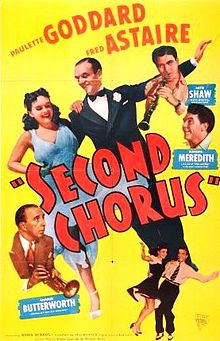
The Fabulous Forties #2: Second Chorus (dir by H.C. Potter)


I’m currently in the process of watching and reviewing all 50 of the films in Mill Creek’s Fabulous Forties DVD box set.  Yesterday, I got things started by reviewing Port of New York.  Today, I’m looking at the set’s 2nd film, 1940’s Second Chorus.

Second_Chorus_poster

As much as I love all of my Mill Creek box sets, watching Second Chorus reminded me of one of the drawbacks of watching a Mill Creek release.  Since Mill Creek specializes in films that have fallen into the public domain, a lot of their DVDs are more than a little rough.  The Mill Creek version was obviously transferred from a seriously deteriorated print.  As a result, the picture is often dark or blurry while the sound is occasionally iffy at best.  That’s a shame because Second Chorus is an entertaining little film.

In Second Chorus, Fred Astaire and Burgess Meredith both play college students.  (Burgess is the wacky one while Fred is … well, he’s Fred Astaire.  He’s confident, he’s suave, and he’s always ready to perform.)  Fred appears to be in his late 30s while Burgess looks closer to 50 but, fortunately, their age is meant to be a part of the joke.  Fred and Burgess have intentionally failed their final exams for seven years so that they can stay in school and continue to lead the college jazz band.  They are perennial college students and who hasn’t known a few of them?  (Apparently, in 1940, there was no such thing as academic suspension.)

When a debt collector comes looking for them (apparently, Burgess bought a set of encyclopedias that he never paid for), Fred manages to charm the collector’s secretary (Paulette Goddard) away from him.  Paulette agrees to serve as Fred and Burgess’s manager and even manages to get them a job with real-life band director Artie Shaw.  (Shaw plays himself and seems to be perpetually annoyed whenever he’s on screen.)  Will Fred finally accept some responsibility, act maturely, hold down a job, and maybe win the heart of Paulette Goddard?

Now, I should point out that, while I enjoyed Second Chorus, Fred Astaire apparently considered Second Chorus to be the worst film that he ever made.  While Second Chorus is definitely no Top Hat, I think that Fred Astaire was being a little too harsh in his assessment. The music is good, the dancing is fun to watch, and the plot … well, who really cares about the plot? It’s undoubtedly a silly film that has very little going on underneath the surface but Astaire and Meredith make for a surprisingly effective comedy team.

And while nondancer Paulette Goddard may not have had as effective a chemistry with Fred as Ginger Rogers (but then again, who did?), I still loved watching them perform the I Ain’t Hep To That Step But I’ll Dig It number.  This entire number was reportedly filmed in one take.  Goddard had little dance experience but it didn’t matter because her partner was Fred Astaire and Fred was so good that he could make anyone look like a natural.

Second Chorus is an entertaining little movie.  Just avoid the Mill Creek transfer.

The Fabulous Forties #1: Port of New York (dir by Laszlo Benedek)


40s

This last Christmas, along with several other wonderful and sexy gifts, I received The Fabulous Forties DVD box set.  Released by the good people at Mill Creek (who have yet to come across a single public domain film that they couldn’t repackage as being a classic), this box set contained 50 films from that wonderful decade.

Since my proclivity for serial reviewing is well-known, you’re probably not surprised that I’ve decided to watch and review all fifty of the films to be found in the Fabulous Forties box set.  And, once I’ve finished with the Fabulous Forties, I will move on to the Nifty Fifties, the Sensational Sixties, the Swinging Seventies, and the Excellent Eighties!  Since each box set contains 50 films, I will have watched and reviewed 250 films by the time this is all finished.  It might take a while but that’s okay.  Arleigh keeps us well-supplied with energy drinks here at the Shattered Lens bunker and I am determined to keep going until the job is done.

(And, if need be, there’s always Dexedrine…)

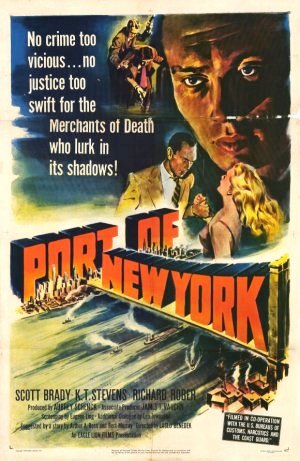
Let’s get things started with the first film in the box set, 1949’s Port of New York!

Port_of_New_York_(film)_poster

This low-budget, black-and-white film opens with a series of shots of cargo ships sailing into New York Harbor.  A narrator, speaking in the type of tone that one would usually associate with an old educational film, informs us that, every day, thousands of ships sail into New York Harbor.  Most of those ships are delivering important supplies and conducting important business.  However, occasionally, the harbor is used by drug smugglers.  (GASP!)  Fortunately, both the federal and the state government employ brave and honest men who will stop at nothing to battle the scourge of opium.

(And, fortunately, since this film was made in 1949, they can do whatever they want without having to worry about the Supreme Court getting in the way.)

If it’s not already apparent, Port of New York is a bit of a time capsule.  The drug smugglers are unambiguous in their villainy and the decency and honesty of law enforcement is taken for granted.  Port of New York was filmed on location in New York and I enjoyed getting a chance to see what New York looked like in 1949.

As for the film’s plot — well, it’s nothing surprising.  The port authority discovers that a shipment of morphine, which was meant to be delivered to a pharmaceutical company, has instead been stolen.  A million dollars worth of narcotics is missing and the U.S. Government is going to find it!  Meanwhile, Toni Cardell (K.T. Stevens) approaches a narcotics agent and says that she has information that could take down one of New York’s biggest gangster.  However, before she can tell all the she knows, Toni is murdered.

(The detective who failed to keep Toni from leaving his office and going off to get killed looks down at her body, shrugs, and says, “This one’s on me.”)

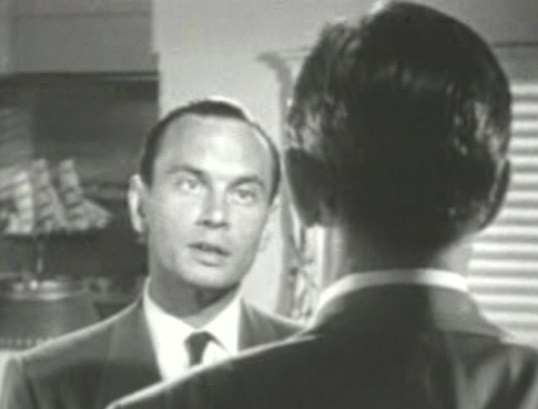
Who killed her?  That’s what Mickey Waters (Scott Brady) and Jim Flannery (Richard Rober) spend the movie figuring out.  However, we already know that Toni was murdered by her boyfriend, a suave gangster named Paul Vicola.  Paul is played, in his film debut, by Yul Brynner and he gives a charismatic performance, turning Paul into a memorable monster.  Brynner still had a full head of hair when he did this movie, though his hairline was definitely moving backwards.

Yul

Over the course of their investigation, Waters and Flannery discover that a second-rate comedian named Dolly Carney (Arthur Blake) is being supplied by Vicrola.  The scenes where they interrogate Dolly, who is going through withdraw, are some of the best in the film and are distinguished by Blake’s empathetic performance.  However, beyond those scenes, there’s really nothing surprising to be found in Port of New York.  It’s a thoroughly predictable police procedural that’s distinguished by the presence of Yul Brynner and not much else.  That said, the action in this 82-minute film moves quickly and I enjoyed it as a historical artifact.

Yul_Brynner_&_K.T._Stevens_Port_of_New_York_01