The Fabulous Forties #30: Cheers for Miss Bishop (dir by Tay Garnett)


cheers1

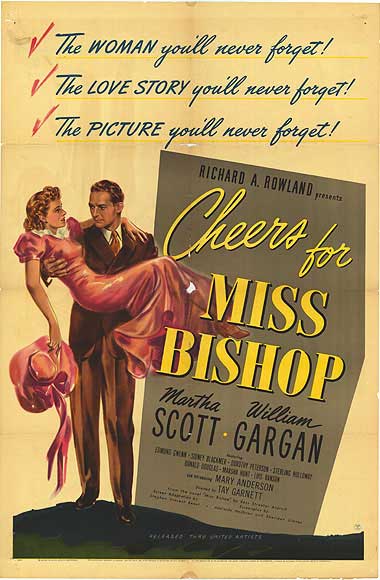
The 30th film in Mill Creek’s Fabulous Forties box set is the 1941 melodrama, Cheers For Miss Bishop.  Cheers For Miss Bishop is a bit like an Americanized version of Goodbye, Mr. Chips.  The story of Cheers For Miss Bishop, largely told via flashback, deals with a retired teacher who never quite got what she wanted out of life but still had a profound impact on all of her students.

The film opens with elderly Miss Bishop (played by Martha Scott) alone in her house.  The time is the 1930s and Miss Bishop is nearing retirement and somewhat bitter over ending her years having never married.  Prominent businessman Sam Peters (William Gargan) comes to the house and they start to recollect.  We flashback to the 1880s, when Miss Bishop was preparing to go to college and Sam was just the local grocery boy.  Sam was in love with Miss Bishop and, it’s suggested, that she loved him as well.  But she was determined to go to college whereas Sam was determined to go straight into business.

With the support of the kindly Prof. Corcoran (Edmund Gwenn, giving a performance that pretty much epitomizes what we mean when we call someone a kindly professor), Miss Bishop got a job teaching English at Midwestern College.  She was a popular teacher, one who not only inspired her students but who was also willing to stand up for them.  Eventually she met and became engaged to a local lawyer, Delbert Thompson (Don Douglas).  However, her heart was broken when Delbert ran off with another woman.  Years later, she fell in love with another professor (Sidney Blackmer), with the only problem being that he happened to be married.

But that’s not all that Miss Bishop had to deal with.  She also ended up adopting and raising Hope (Marsha Hunt) after Hope’s mother died in childbirth.  As she got older, she became frustrated when the younger college administrators demanded that she adapt with the times.  Miss Bishop also had to deal with her frequent romantic rival and cousin, the impulsive Amy (Mary Anderson).

Amy, I should mention, was my favorite character in Cheers For Miss Bishop, even though I don’t think that was the film’s intention.  Some of that is because Mary Anderson totally embraced the melodramatic potential of her character, often going totally over-the-top in a way that still seemed perfectly natural.  But there’s also the fact that Amy, as opposed to the often painfully inhibited Miss Bishop, had no boundaries.  She knew what she wanted and she went for it, without apology.  Amy may not have been a big role but she still dominated every scene that she appeared in.  Amy demanded attention and good for her!

That said, the title of the film is Cheers For Miss Bishop and not Cheers For Amy.  Ultimately, it’s a tribute to Miss Bishop and to teachers everywhere.  It’s an extremely predictable and sentimental film but it does what it does fairly well.  Occasionally, I got frustrated with Miss Bishop as a character (she was always so prim, proper, and respectable!  Plus, there’s a scene where she gives a student from North Carolina some trouble about his accent, saying that he needs to take her English class and, if you know how I feel about actors from up north trying too hard to sound like they’re from the South, you can imagine how I felt about that scene) but Martha Scott gave a good performance.  In the end, it’s a sweet little movie.  And you can watch it below!
The Fabulous Forties #29: Li’l Abner (dir by Albert S. Rogell)


Billie_Seward-Jeff_York_in_Li'l_Abner

The 29th film in the Fabulous Forties box set is a “comedy” from 1940, called Li’l Abner.

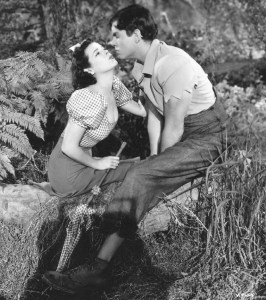
Li’l Abner takes place in rural America, which this film portrays as being the type of place where cousins get married and have children that end up raising pigs and marrying each other.  Everyone in the small town of Dogpatch is kind of an idiot but they appear to mean well.  There’s a huge amount of single, young women in town but apparently, there’s only one single, young man.  His name is Abner (Jeff York) and he’s called Little Abner because the people in town have a taste for irony and he’s not little at all.  In fact, he’s really tall and he’s also handsome and likable in a dumb sort of way.  Every woman in town wants to marry Abner but Abner has no desire to ever get married.  As Abner sees it, getting married means getting old and eventually dying.  He wants to have adventures in the real world as opposed to just staying in Dogpatch and doing nothing…

But then Clarence is sent down to Earth and shows Abner what life would be like if he had never been born … oh wait, sorry.  Wrong 1940s film.

Instead of being visited by guardian angel, Abner is misdiagnosed with a fake illness and he becomes convinced that he only has 24 hours to live.  How does he become convinced of this?  Do you really want to know?  Even more importantly, do I really want to tell you?  Seriously, this is really stupid.  Okay, Abner goes to see a barber but he thinks the barber is a doctor and the barber, as a joke, tells Abner that he’s going to die of a fake disease.  When Abner tells his parents that he’s going to die, his parents immediately realize what has happened but they decided to let Abner believe that he’s going to die because they really want him to get married and, if Abner’s on the verge of death, he’s more likely to propose to one of the many local girls who is pursuing him.

(Ladies, the lesson here is simple: If you want your commitment-phobic man to pop the big question, convince him that he’s got less than a day to live.)

Anyway, two different girls ask Abner to marry them and, since Abner thinks he’s going to be dead by morning, he says yes to both of them.  However, Abner then wakes up the next morning and, for a few brief moments, is convinced that he is dead and the heaven looks just like the Ozarks.  But then he realizes that no, he’s still alive.  And he’s engaged to two women!

AGCK!  Bigamy much?

Luckily, all of this happens on Sadie Hawkins Day.  On Sadie Hawkins Day, any single woman can marry any single man that she chooses.  So, Abner figures that he just has to wait around see which one of his two fiancées finds him first…

Or something like that.

To be honest, the plot of this one made absolutely no sense to me and I wasn’t shocked to discover that it was based on a comic strip.  Li’l Abner is only 72 minutes long but it still has more plot than the last few seasons of The Walking Dead.  (BAM!  Take that, quality television!)  Anyway, this movie was light-hearted and good intentioned but way too stupid for its own good.  Jeff York was likable in the role of Abner and silent film fans might want to watch it just because Buster Keaton shows up in a small role, playing a moonshine drinking Native American named Lonesome Polecat.

Otherwise, Li’l Abner is one of the more forgettable films in the Fabulous Forties box set.

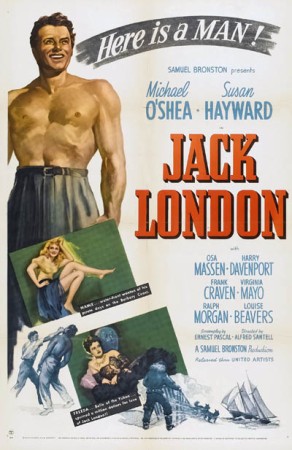
The Fabulous Forties #28: Jack London (dir by Alfred Santell)


Jack-London-1943

The 28th Film in Mill Creek’s Fabulous Forties box set was a 1943 biopic about the writer, Jack London.  Not surprisingly, the title of the film was Jack London.

Now, I should start this review off by mentioning that I know very little about Jack London.  I don’t think that I have ever read any of his short stories or his novels.  I know that he wrote a novel called White Fang but that’s largely because there’s been so many different film versions of the book.  (Long before directing Zombi 2, even Lucio Fulci made a version of White Fang.)  Here’s what I do know about Jack London:

  1. He was a prominent writer at the turn of the century.
  2. He was reportedly an alcoholic.
  3. He was a Socialist who even ran for mayor of Oakland, California on the party’s ticket.
  4. He was an atheist.
  5. In 1916, depending on the source, he either committed suicide, died of alcohol poisoning, or simply passed away as the result of 40 years of hard living.

Of those 5 facts, 4 are totally ignored in Jack London.  The film does acknowledge that Jack London eventually became a prominent writer, even going so far as to open with stock footage of a U.S. warship being named after him.

As for his alcoholism, we never see London drunk.  Indeed, the film’s version of Jack London is so earnest that it’s hard to believe he’s ever had a drink in his life.

As for his Socialism, we are shown that London grew up in a poor family.  When, after serving at sea, he takes a writing class, he argues with a professor over London’s desire to write about the poor.  However, we never hear London express any specific ideology.  We certainly don’t see him running for mayor of Oakland.

As for his atheism — yeah right.  This film was made in 1943!  There’s no way that Jack London was going to be portrayed as talking about why he didn’t believe in God.

As for his death — well, Jack London ends with the writer very much alive.  There’s not even a title card informing us that London eventually died.

Instead, Jack London is much more concerned with Jack (played by Michael O’Shea) dealing with the Japanese.  Oh sure, we get some scenes of Jack London watching a shootout and breaking up a bar fight in Alaska.  And Susan Hayward shows up as Jack London’s always supportive wife.  (For that matter, Louise Beavers also shows up as Jack London’s always supportive house keeper.)

But, in the end, the majority of the film features Jack London as a war correspondent covering the turn of the 20th century war between Russia and Japan.  When he’s captured by the Japanese, he observes the harsh way they treat prisoners and is shocked when he witnesses several prisoners being ruthlessly executed.  When he talks to a Japanese commandant, he’s outraged as the commandant explains how the Empire of Japan is planning to take over the world.  When Jack finally gets back to America, he’s less concerned with writing White Fang and more concerned with warning the American people to remain vigilant…

Jack London is basically wartime propaganda disguised as a biopic.  The entire point of the film seems to be that if Jack London was still alive, he would want the men in the audience to enlist and the women to buy war bonds.  None of it is subtle and, beyond its value as a time capsule of how Americans viewed the Japanese in 1943, none of it is particularly interesting as well.

In the end, Jack London plays out like one of those earnest but dull educational films that tend to show up on PBS when no one’s watching.

The Fabulous Forties #27: Sundown (dir by Henry Hathaway)


40s

You may remember how, back in April, I started on a mission to review all 50 of the films included in Mill Creek’s Fabulous Forties box set.  I actually got off to a pretty good start and, by the end of the month, I was about halfway through.  Yay me!

However, then the month of May began.  And May turned out to be a very, very busy month.  As I sit here writing this, it’s been 27 days since I last posted a Fabulous Forties review.  That review was …. well, I can’t even remember what it was.  After I post this, I’ll click on this link to find out.

However, things have calmed down a bit and now I can go ahead and finish up the Fabulous Forties box set.  And that’s a good thing because, between me and you, I am more than ready to move on to the Nifty Fifties box set!

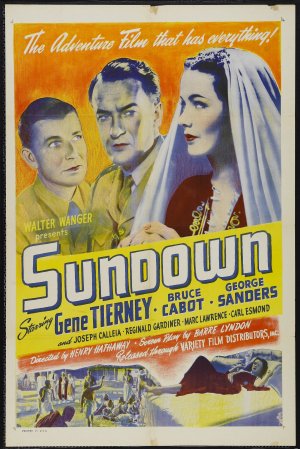
Anyway, without further ado, let’s consider the 27th film in Mill Creek’s Fabulous Forties, 1941’s Sundown!

Poster_of_the_movie_Sundown

Sundown was released by United Artists in 1941.  It’s a propaganda film, telling the story of British soldiers in North Africa and their attempts to both maintain the peace among the natives and to keep the Axis powers from arming the local rebels.  Bruce Cabot is the experienced soldier who knows how things work in Africa.  George Sanders is the new commander who is a bit more by-the-book.  At first, you think that the film is going to be dominated by the rivalry between Sanders and Cabot but actually it’s not much of a rivalry.  For the most part, they get along just fine and I guess that’s to be expected considering that the film was made at a time when the emphasis was on everyone remaining unified against the Nazis.

Speaking of the Axis powers, they’re always in hovering in the shadows of the film but it’s rare that we actually see any enemy soldiers.  Perhaps this is because the film was made at a time when the United States was technically neutral.  Joseph Calleia plays a prisoner of war who has rejected fascism and instead just wants to sing opera and cook for Sanders and Cabot.  Calleia’s character is specifically identified as being an Italian.  If not for that (and the fact that the film was made in 1941), it would be just as easy to assume that Sanders and Cabot were fighting the French or maybe the Russians.

There’s an enemy agent in one of the tribes and it’s up to Sanders and Cabot to figure out who.  Helping them out is the local big game hunter, played by Harry Carey.  And, on top of that, there’s also a mysterious native woman played by Gene Tierney.  Gene Tierney is totally miscast but that adds to this film’s odd charm.

And, for modern viewers, it definitely is an odd charm.  I watched Sundown twice and I’m still not sure exactly what happened in the film.  Sundown is one of those films that doesn’t so much have a plot as it just has a lot of scenes that kind of tell a story, assuming that you have the patience and concentration to figure out how they all link together.  Between Cabot’s roguish smile, Sanders’s stiff upper lip performance, Calleia’s enjoyable overacting, and Gene Tierney’s otherworldly beauty, Sundown is unexpectedly dream-like.  The film even features a sudden sermon in which a clergyman (Sir Cedric Hardwicke) exhorts everyone to fight.  The clergyman is never seen again.

Sundown was a strange movie, one that I often found myself struggling to follow.  It was also apparently a box office bomb, though it did receive 3 Oscar nominations.  One of those nominations was for Charles Lang’s cinematography and it was definitely deserved.  Even the version I saw (which suffered from a typically poor Mill Creek transfer) was still impressive to look at.

The Fabulous Forties #26: The Way Ahead (dir by Carol Reed)


The_Way_Ahead_VideoCover

The 26th film in Mill Creek’s Fabulous Forties box set was the 1944 British film, The Way Ahead (or, as it was retitled when it was released in America, The Immortal Battalion).

Directed by Carol Reed (who was five years away from directing the great The Third Man), The Way Ahead is a British propaganda film that was made to boost the morale of both a weary British public and the army during the final days of World War II.  Usually, when we call something propaganda, it’s meant as a term of disparagement but The Way Ahead is propaganda in the best possible way.

The film follows a group of British soldiers, from the moment that they are conscripted through their training to their first battle.  (In many ways, it’s like a more refined — which is another way of saying “more British” — version of Gung Ho!)  As usually happens in films like this, the newly conscripted soldiers come from all sections of society.  Some of them are poor.  Some of them are rich.  Some of them are married.  Some of them are single.  In fact, when the film first begins, the only thing that they all have in common is that they don’t want to be in the army.

As they begin their training, they resent their tough sergeant, Fletcher (William Hartnell), and are upset that Lt. Jim Perry (David Niven, giving a very likable performance) always seems to take Fletcher’s side in any dispute.  However, as time passes by, the soldiers start to realize that Fletcher is looking out for them and molding them into a cohesive unit.  Under his training, they go from being a group of disorganized and somewhat resentful individuals to being a tough and well-organized battalion.

Though they’re originally skeptical that they’ll ever see combat, the battalion is eventually sent to North Africa.  However, their ship is torpedoed and, in a scene that remains genuinely impressive even when viewed today, the men are forced to abandon ship while explosions and flames light up the night sky.  By the time that they do finally reach North Africa, they are more than ready to fight…

The Way Ahead plays out in a semi-documentary fashion (it even features a narrator who, at the end of the film, exhorts the audience to stay firm in their commitment) and it’s a fairly predictable film.  If you’ve ever seen a war film, you’ll probably be able to predict everything that happens in The Way Ahead.  That said, The Way Ahead is a remarkable well-made and well-acted film.  The cast is well-selected (and features a lot of familiar British characters actors, some making their film debut) and David Niven is the perfect choice for the mild-mannered but firm Lt. Perry.  Even though I’m not a huge fan of war films in general, I was still impressed with The Way Ahead.

And you can watch it below!

The Fabulous Forties #25: Jungle Man (dir by Harry L. Fraser)


40s

About a month ago, for reasons that I’m sure made sense at the time, I decided it would be fun to watch and review all 50 of the films included in Mill Creek’s Fabulous Forties box set.  If you know anything Mill Creek box sets, then you won’t be surprised to learn that the majority of these 50 films are public domain B-movies.  A few of them have been good, a few of them have been bad, and a few of them have been forgettable.

I have to admit that, as much as I love watching old movies, there’s a part of me that’s more than ready to move onto the next Mill Creek box set, the Nifty Fifties.  But, before I do that, I have to finish up the Forties.  Fortunately, I just watched the 25th film included in the Fabulous Forties and I am happy to say that I am now halfway done with this project!  Yay!

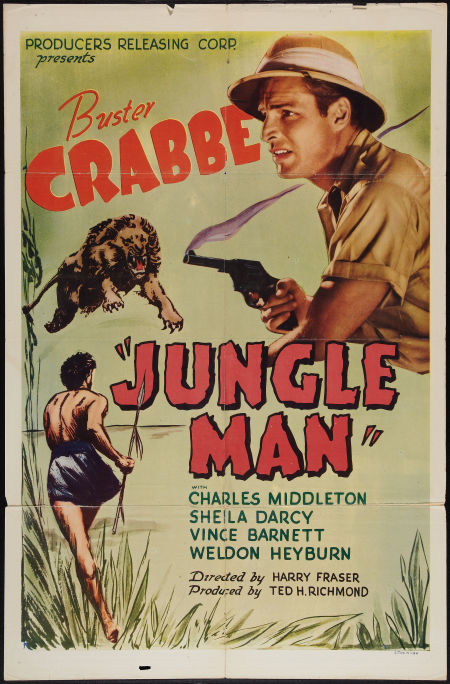
As for the film itself, it’s a 63-minute film from 1941.  Though it was later retitled Drums of Africa, it was originally called Jungle Man.

Jungle Man

As for what Jungle Man is about … well, it’s mostly about stock footage.

There is kind of a plot.  Wealthy Bruce (Weldon Heyburn) and his friend Alex (Robert Carson) want to go to Africa so that they can see the legendary City of the Dead.  Bruce’s fiancée, Betty (Sheila Darcy), decides to accompany them because she wants to visit her brother (Charles Middleton), a missionary.  Once they get to Africa, they also meet a doctor (Buster Crabbe) who is trying to find a cure for a fever that is wiping out the native population.

But really, the plot is mostly just an excuse for stock footage.  We watch as our explorers walk down a jungle trail.  Someone says, “Look up in that tree!”  We cut to grainy footage of a monkey in a tree.  Cut back to everyone looking upward.  Cut back to that monkey in the tree.  Suddenly, we hear a roar on the soundtrack.  Cut to slightly less grainy footage of a tiger running through a field.  Cut back to the explorers saying, “Look out, tiger!”  Cut back to the monkey climbing up higher in the tree.

(Of course, tigers don’t live in Africa but that’s just the type of film this is!)

Even when our heroes finally reach the City of the Dead, we don’t actually see them walking around the city.  Instead, we see them staring into the distance and then immediately cut to some still shots of what Wikipedia identifies as being Cambodia’s Angkor Wat.  Of course, no attempt is really made to match any of the shots.  If Jungle Man was made today, they could just CGI the Hell out of it.  But since it was made in 1941, audiences had to suspend their disbelief and accept shots that didn’t particularly match up with any other shots and a storyline that was pretty much determined by whatever stock footage the producers had available.

On the plus side, it’s only 60 minutes long and some of the stock footage is fun, particularly if you like cute monkeys or fierce tigers.  For the most part, it’s silly but inoffensive.

And you can watch it below!
http://www.youtube.com/watch?v=IUz4Vvay7so

(I should admit that, as I watched it, I kept thinking about those GEICO commercials where Jane and Tarzan are lost in the jungle and Tarzan refuses to ask for directions.  “Tarzan know where Tarzan go.”  “No, Tarzan does not know where Tarzan go.  Excuse me, do you know where the waterfall is?  The waterfall?”)

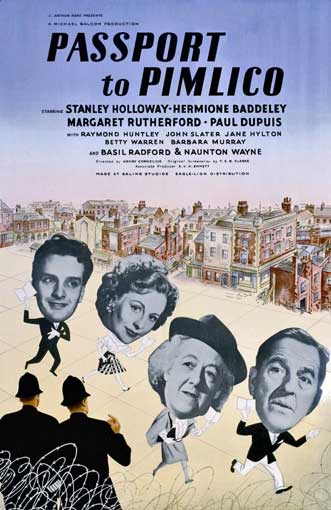
The Fabulous Forties #24: Passport to Pimlico (dir by Henry Cornelius)


Passport_to_Pimlico_film

The 24th film in Mill Creek’s Fabulous Forties box set was the 1949 British comedy, Passport to Pimlico!  Even though Passport to Pimlico is very much a British film (for instance, I had to use Wikipedia to discover the Pimlico is a neighborhood in London) and definitely a product of its time, it’s still a film that felt very relevant to some of the things that all of us in America are dealing with today.  If nothing else, Passport to Pimlico is definitely more memorable than Freckles Comes Home.

Passport to Pimlico opens in London.  World War II may be over but the city is still in the process of rebuilding.  War-time rationing is still in effect and all the residents of Pimlico regularly have to deal with the endless red tape of bureaucracy.  As well, there’s still unexploded German bombs littered around the neighborhood.  When a group of local children accidentally blow one of those bombs up, it leads to the discovery of a previously hidden cellar.  Inside the cellar is everything you could hope to find in a mysterious room: artwork, jewelry, and coins.  There’s also a parchment from the 15th Century, in which the king of England ceded the neighborhood to the final Duke of Burgundy.  Because no one knew that the charter existed, it has also never been revoked.  As a result, all of the citizens of Pimlico are actually citizens of dukedom of Burgundy.

That means two things: First off, the citizens are legally required to live under the laws of Burgundy, despite the fact that the dukedom no longer exists and those laws haven’t been changed since the 1400s.  Secondly, the neighborhood is no longer governed by the restrictive bureaucracy of postwar Britain.  In short, Pimlico — or Burgundy, as it is now called — is a free and independent state.

Soon, the nation of Burgundy is being overrun by greedy businessmen and enthusiastic shoppers.  The British respond by surrounding Burgundy with barbed wire and announcing that no one may cross the border.  The Burgundians react by demanding that anyone riding the underground through their country have a passport or run the risk being kicked off the train.

And things only escalate from there.  The British government is desperate to put Burgundy in its place while the citizens of Burgundy are determined to maintain their independence.  If Passport to Pimlico were made today, this is probably one of those situations that would either end in tragedy or with everyone learning not to question the whims of the government.  Fortunately, Passport to Pimlico was made in 1949 and, as a result, it is a genuinely warm-hearted comedy that celebrates both individual freedom and patriotism.

And really, it’s an enjoyable little film.  The cast is full of British character actors, all of whom deliver their dialogue with just the right amount of snark.  I enjoyed it and I have to admit that I related to it a bit.  As I look at America today and I think about what it’s going to be like in 2017 (regardless of who wins the presidential election because, let’s be honest, they all suck), there’s a part of me that would love a chance to get out of this country and be a Burgundian.

Seriously, come 2017, I’m seceding!

Until then, I guess I can just watch Passport to Pimlico.

The Fabulous Forties #23: Freckles Comes Home (dir by Jean Yarbrough)


Freckles_Comes_Home_FilmPoster

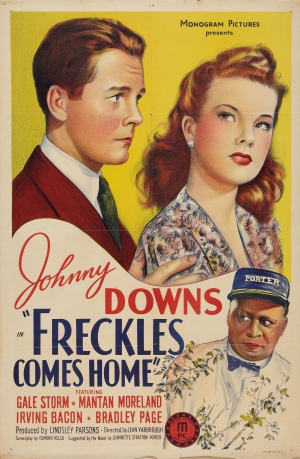
The 23rd film in Mill Creek’s Fabulous Forties box set was an hour-long “comedy” from 1942.  The name of the film was Freckles Comes Home and I have to admit that I’m struggling to come up with anything to say about it.  That’s the thing about these Mill Creek box sets.  Occasionally, you’ll come across a really good movie and, even more frequently, you’ll come across a really bad movie.  But often times, you find yourself watching filler.  If I had to guess, Freckles Comes Home was probably a movie that was made to act as the 2nd half of a double feature.  Not much money nor effort was put into it.  It’s not terrible and it’s certainly not good.  It’s just sort of there.

With a title like Freckles Comes Home, I was expecting this movie would be about a lost dog but it turns out that I was wrong.  Freckles (played by Johnny Downs) is a human being.  He’s returning home from college because a friend of his has inherited some real estate and isn’t sure what to do about it.  While sitting on the bus home, Freckles spends so much time talking about how much he loves his hometown that the man sitting next to him decides that maybe he’ll make that town his home as well.  Unfortunately, that man is Muggsy Dolan (Walter Sande).  As you would expect with a name like Muggsy, Dolan is a criminal on the run.

Back in town, Freckles attempts to convince his father not to build a road that will go through his friend’s property.  He also romantically pursues a childhood friend named Jane (Gale Storm), despite the fact that everyone insists that Jane can do better than Freckles.  (Personally, I was wondering why — in the year 1942 — a young man like Freckles wasn’t overseas, fighting for his country.  DON’T YOU KNOW THERE’S A WAR ON, FRECKLES!?)  Meanwhile, Muggsy is plotting to rob the town bank…

And then there’s Jeff (Mantan Moreland), who is the porter at the local hotel.  Jeff thinks that he has a machine that will allow him to find buried gold.  And since Jeff is an African-American in a 1940s film, it’s impossible to watch the way the movie treats him without cringing.  There’s a few scenes where Moreland, as an actor, subtly suggests that Jeff is smarter than the movie gives him credit for and certainly, Moreland’s performance is the most memorable in the film but that really doesn’t make the role any less demeaning.

Anyway, Freckles Comes Home was largely forgettable.  I assume that audiences in the 1940s may have enjoyed it (especially if it was included on a double bill with a more interesting movie) but, seen today, there’s just not that much to be said about it.  It exists, it’s something of a time capsule, and that’s pretty much all there is to say about it.

http://www.youtube.com/watch?v=GX4FzShQQ_I


The Fabulous Forties #22: Adventures of Gallant Bess (dir by Lew Landers)


Adventures_of_Gallant_Bess_FilmPoster

For nearly a month now, I’ve been making my way through the 50 films included in Mill Creek’s Fabulous Forties box set.  Like most Mill Creek box sets, the Fabulous Forties is full of public domain films.  Some of them are surprisingly good and some of them are surprisingly bad.  And then there are others that are somewhere right in the middle of bad and good.  These are films that may not be great works of cinematic art but, at the very least, they serve as a time capsule of the period in which they were made.

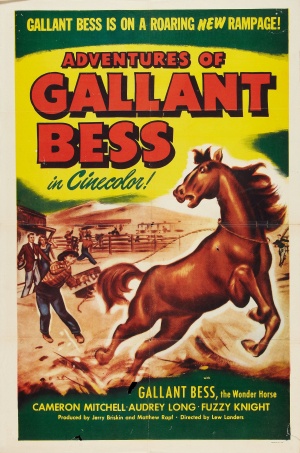
The 22nd film in the Fabulous Forties box set, 1948’s Adventures of Gallant Bess, is just such a film.  Obviously made to appeal to family audiences, Adventures of Gallant Bess tells a fairly predictable story.  Cowboy Ted Daniels (a youngish Cameron Mitchell) captures a wild mustang named Bess.  Ted and Bess soon become inseparable but, during a visit to the local town, Bess gets riled up and destroys a few cars.  Ted is told that he has to pay for the cars but he doesn’t have any money.  So, he enters the local rodeo.

However, the rodeo is operated by the evil Bud Millerick (James Millican) and Bud wants Bess for his own.  So, he arranges for Ted’s leg to be broken by a bull.  Injured and unable to work, Ted is forced to sell his beloved Bess to Bud.  Once Ted recovers, he discovers that Bud is abusing Bess and forcing her to perform in a demeaning rodeo show.  What’s a cowboy to do but steal back his horse?

You can probably guess everything that happens in Adventures of Gallant Bess just from reading the plot description but it’s still a pretty likable film.  Bess is a wonderful horse and there’s something oddly endearing about the obviously cheap sets and the often melodramatic performances.  Cameron Mitchell, of course, is best known for appearing in films like Blood and Black Lace, The Toolbox Murders, The Demon, The Swarm, and Space Mutiny, so it’s definitely interesting to see him playing a simple and honest cowboy here.

(It’s actually difficult to recognize Mitchell until he smiles.  Once you see that smirk, you know exactly who is playing Ted Daniels.)

Adventures of Gallant Bess was filmed in color, which was a big deal in 1948.  Seen today, it is so saturated with color (and so obviously filmed on sound stages) that the movie actually looks like a live action cartoon.  Seen today, it’s perhaps a little too easy to be dismissive of this old-fashioned film but I imagine that, in the 40s, it was quite a fun movie to watch.

And you can watch it below!

http://www.youtube.com/watch?v=7NjeXP9QqHk

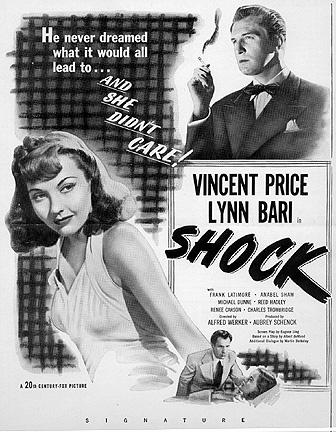
The Fabulous Forties #21: Shock (dir by Alfred L. Werker)


The 20th film in Mill Creek’s Fabulous Forties box set was Frank Capra’s Meet John Doe.  Since I had already watched and reviewed Meet John Doe for last year’s Shattered Politics series of reviews, I decided to skip forward to the next film.

That film turned out to be the 1946 psychological thriller, Shock (not to be confused with Mario Bava’s masterpiece of the same name).

Shock_movie_poster

Shock opens with a young housewife named Jane Stewart (Anabel Shaw) waking from a dream, getting out of bed, looking out a window, and seeing something rather serious happening in the house next door.  A man and a woman are arguing.  Though Jane doesn’t recognize the man, horror fans will immediately realize that he’s Vincent Price, without a mustache.  As Jane watches, the man beats the woman to death.  When Jane’s husband, Lt. Paul Stewart (Frank Latimore), returns home, he discovers that Jane is in a catatonic state.

Paul calls the local cranky physician, Dr. Harvey (Charles Trowbridge), to the house.  Dr. Harvey takes one look at Jane and announces, “She’s in shock!”  (YAY!  WE HAVE A TITLE!)  Paul looks confused so Dr. Harvey goes on to explain, “She’s had a great shock.”  Unfortunately, Dr. Harvey is not trained to deal with shock but he knows someone who is.  That man’s name is Dr. Richard Cross.

Soon Dr. Cross shows up and — OH MY GOD, IT’S VINCENT PRICE!  That’s right — Dr. Cross not only caused Jane’s shock but now he’s going to treat it!  Or is he?  Though Dr. Cross claims to be wracked with guilt over the murder, his nurse, Elaine Jordan (Lynn Bari), is less concerned about it.  In fact, since Elaine is also his mistress, she’s rather happy that Dr. Cross has murdered his wife.  Now, she just has to convince him to murder Jane before she recovers from her shock.

(Interestingly enough, Dr. Cross’s plan involves treating Jane with insulin shock therapy, which would seem to indicate that Dr. Cross has seen Dr. Kildare’s Strange Case too many times.)

I had high hopes for Shock, largely because of the presence of Vincent Price.  From what I’ve read, the box office success of Shock changed the course of Price’s career.  Before Shock, Price was a character actor who occasionally got a good supporting role.  After Shock, he was transformed into the horror icon who we all know and love today.  Shock was the first time that Price was cast in the type of mad scientist role that would later become his trademark.  For that reason, Shock has an important place in the history of cinematic terror.

But, unfortunately, Shock itself is kind of forgettable.  It’s pretty much your standard thriller, one that makes the mistake of revealing Price’s villainy from the start.  (It would have been far more effective if the film tried to shock us with the realization that Price is the bad guy.)  It’s always fun to watch Vincent Price in a movie but he actually gives a rather subdued performance here and, as a result, he’s not as much fun as he would be in his later films.  In other words, Shock is no House On Haunted Hill.

That said, Shock is definitely a piece of film history and, as such, it’s worth watching.  And here it is: