Lisa Marie Review An Oscar Nominee: The Bishop’s Wife (dir by Henry Koster)


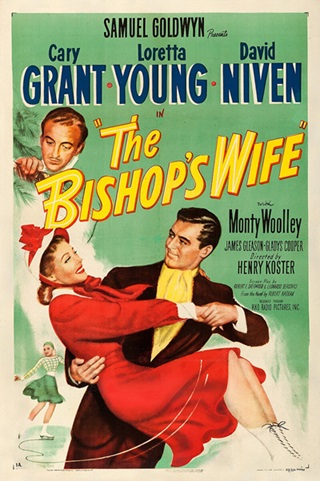
In 1947’s The Bishop’s Wife, Cary Grant stars as Dudley.

We first see Dudley walking down the snow-covered streets of a city that is preparing for Christmas.  He watches Julia Broughman (Loretta Young), the wife of the local Anglican bishop.  He stops to talk to Prof. Wutheridge (Monty Woolly), a secular humanist who is close to Julia and her husband, despite being irreligious himself.  Dudley seems to know all about the professor, even though the professor is not sure who he is.  The professor mentions that he was fired from a university because he was considered to be a “radical,” even though he has no interest in politics.  The professor says that the town’s church has seen better days, especially since the Bishop is more interested in raising money from the rich to build a grand new cathedral than actually meeting with the poor who need help.

The last person that Dudley visits is Bishop Henry Broughman (David Niven).  Dudley reveals to Henry that he’s angel and that he’s come in response to Henry’s prayers.  Henry has been frustrated in his attempts to raise money for a new cathedral.  Dudley has come to provide guidance.

With only the Bishop knowing the truth about Dudley, Dudley becomes a houseguest of the Broughmans.  The Bishop has become so obsessed with his new cathedral that he’s not only been neglecting his diocese but also his family.  While Dudley tries to show Henry what’s really important, he also helps Julia and her daughter Debby (Karolyn Grimes) to fit in with the neighborhood.  (Bobby Anderson, who played the young George Bailey in It’s A Wonderful Life, makes an appearance as a boy having a snowball fight who says that Debby can’t play because no one wants to risk hitting a bishop’s daughter with a snowball.)  The Bishop becomes jealous of Dudley and perhaps he should be as Dudley finds himself falling in love with Julia and considering not moving on to his next assignment.

(And now we know where Highway to Heaven got the inspiration for 75% of its episodes….)

The Bishop’s Wife is an enjoyable film, one that is full of not just Christmas imagery but also the Christmas spirit as well.  The Bishop finally realizes that his planned cathedral is more of a gift to his ego than to the men and women who look to him for guidance and comfort in difficult times.  David Niven is, as always, likable even when his character is acting like a jerk.  That said, this is pretty much Cary Grant’s show from the start.  Suave, charming, and gently humorous, Grant joins Claude Rains and Henry Travers in the ranks of great cinematic angels.  Never mind that Grant’s character is a bit pushy and has his own crisis of faith.  From the minute that Grant appears, we know that he’ll know exactly the right way to answer Henry’s prayers.

Cary Grant was not nominated for Best Actor for his performance here.  Undoubtedly, this was another case of Grant making it all look so easy that the Academy failed to realize just how good of a performance he gave.  Interestingly enough, The Bishop’s Wife was one of two Christmas films nominated for Best Picture that year, along with Miracle on 34th Street.  Both films lost to Gentleman’s Agreement.
Film Review: The Loves of Edgar Allan Poe (dir by Harry Lachman)


I have to admit that the 1942 film, The Loves of Edgar Allan Poe, turned out to be far different from what I was expecting.

Just based on the title, I was expecting it would be a highly fictionalized, borderline silly film about Edgar Allan Poe defeating his romantic rivals and winning the hand of the woman he loved while still finding time to write The Raven.  I figured that there would be at least a few gentlemanly fisticuffs, with Poe portrayed as a combination of Rhett Butler and Cary Grant.  Looking at the title, it was easy for me to imagine the film closing with Poe kissing his future wife and then looking straight at the camera.  “Quoth the Raven!” he would say and wink while romantic music swelled in the background…

But no.  The Loves of Edgar Allan Poe is actually a very conventional biopic.  With a running time of only 67 minutes, the movie often feels rather rushed but it still manages to include most of the better known details of Edgar Allan Poe’s short but eventful life.  (An ever-present narrator is always ready to fill us in on every thing that happens off-screen.)  The film doesn’t spend much time on what initially inspired Poe’s macabre imagination.  There’s a scene of Poe, as a child, standing on a desolate hill and looking at a raven perched in a dead tree.  With the exception of an extended section that deals with Annabel Lee, that’s about as deep as the movie is willing to get as far as Poe’s art is concerned.

When Poe grows up, he’s played by actor Sheppard Strudwick, who has a good mustache but never exactly comes across as being the type of tortured genius who would eventually end up both revolutionizing literature and drinking himself to death.  The majority of the film deals with Poe’s advocacy for copyright reform, which is an important issue but not exactly the most cinematic of concerns.  Poe survives college.  Poe tries to sell The Raven for $25.  Eventually, Poe marries Virginia Clemm (Linda Darnell) and her subsequent sickness and death leads to not only Poe’s greatest work but also his own tragic end.

Along the way, Poe meets both Thomas Jefferson and Charles Dickens.  Jefferson shows up long enough to tell a young Poe that he’s a good writer and that he needs to stop gambling.  Dickens meets Poe and encourages him to continue to advocate for better copyright laws.

It is known that Poe and Dickens actually did meet but did Poe also meet Thomas Jefferson?  Legend says that he did but no one knows for sure.   Here’s what we do know:

Poe attended the University of Virginia in 1826.  The University’s founder, former President Thomas Jefferson, was still alive in 1826 and would often invite promising students to Monticello.  Whether Jefferson was still doing that when Poe enrolled at the University of Virginia is questionable.  Jefferson died five months after Poe started his studies.

As for Dickens, Charles Dickens and Edgar Allan Poe admired each other’s writing and they met in Philadelphia during Dickens’s 1842 tour of North America.  No record has been kept of what they discussed, though some think that Dickens told Poe about his pet raven and perhaps inspired Poe’s best-remembered poem.  In the movie, they discuss copyright laws, which is nowhere near as much fun.

(When it comes to Poe’s meetings with both Jefferson and Dickens, it is perhaps best to remember the lesson of The Man Who Shot Liberty Valance and print the legend.)

The Loves of Edgar Allan Poe is a very short film and an obviously low-budget one as well.  When the presence of that somewhat pedantic narrator, The Loves of Edgar Allan Poe feels more like an educational special than a real movie.  It’s an okay introduction to Poe’s life but, ultimately, the best way to get to know Edgar Allan Poe is to sit down and start reading.

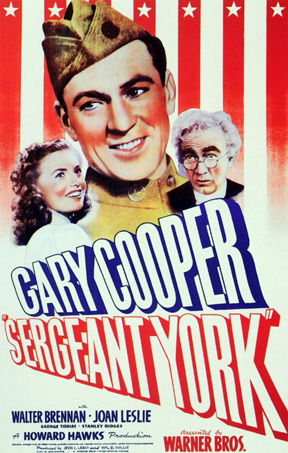
Lisa Reviews An Oscar Nominee: Sergeant York (dir by Howard Hawks)


Sergeant_York_1941_Poster

The 1941 film Sergeant York was the American Sniper of its day.  A biopic of Alvin York, one of the most decorated American soldiers of World War I, Sergeant York was not only a huge box office hit but it was a film that celebrated American patriotism in the type of unabashed fashion that you would never see in a film made today.  Though Sergeant York went into production at a time when the United States was officially pursuing a policy of international neutrality, it was released shortly before the Japanese attacked Pearl Harbor and, whether intentionally or not, Sergeant York served as a strong recruiting tool.  According to Wikipedia (and we all know that Wikipedia is never wrong), there were reports of young men going straight from the movie to the nearest military recruitment office.

Clocking in at nearly two and a half hours (and running at least 40 minutes too long), Sergeant York is two films in one.  The second half of the film deals with the military career of Alvin York (Gary Cooper), a plain-spoken and honest Tennessee farmer who, because of his strong religious beliefs, unsuccessfully attempts to register as a conscientious objector.  Forced into the Army, York is, at first, dismissed as a simple-minded hillbilly.  (His fellow soldiers are amused to discover that York doesn’t know what a subway is.)  However, to the shock of his commanding officers, he proves himself to be an expert marksman.  As he explains it, being from the country means that he’s been shooting a rifle his entire life.

On the basis of his skills as a marksman, York is given a promotion but he still says that he refuses to kill.  It’s not until his superior officer reminds him of the sacrifices that past Americans have made that York starts to reconsider his position.  Then, a gust of wind opens York’s bible to a verse about giving unto Caesar what is Caesar’s and York realizes that he can go to war and, if need be, he can kill.

And it’s a good thing that he can!  Because World War I is heating up and York may be the only guy around with the strength and confidence to single-handedly defeat and capture over 170 German soldiers.

The army section of Sergeant York is predictable but well-done.  As you’d expect from a film directed by Howard Hawks, a lot of emphasis is put on how the soldiers work together.  York is portrayed not as being super human but instead as just an honest man who is exceptionally good at his job.  There’s nothing surprising about the second half of Sergeant York but Hawks keeps the action moving and Cooper gives a good performance.

To be honest, I preferred the first half of the film, which examined York’s life before he joined the Army.  When we first meet Alvin York, he drinks too much, he fights too much, and he’s totally irresponsible.  It’s not until he falls in love with Gracie Williams (Joan Leslie) that York starts to change his ways.  The scenes of York in the backwoods of Tennessee had a lively feel to them and it was enjoyable to see Cooper play a somewhat disreputable character.  Cooper seemed to be having fun playing a ne’er-do-well and, in the scenes before York finds God, his bad behavior was a lot of fun to watch.

Considering its success at the box office, it’s not surprising that Sergeant York was nominated for best picture of the year.  While Gary Cooper won the Oscar for best actor, the award for Best Picture went to How Green Was My Valley.