Lisa Marie Reviews An Oscar Winner: Citizen Kane (dir by Orson Welles)


For some reason, certain people seem to feel the need to try to reduce what Orson Welles accomplished with 1941’s Citizen Kane.

In 1971, the famous film critic Pauline Kael published an essay called Raising Kane, in which she argued that screenwriter Herman J. Mankiewicz deserved the majority of the credit for Citizen Kane.  This was Kael’s shot at rival Andrew Sarris and his embrace of the auteur theory.  (1971 was the same year that Kael described Dirty Harry as being  a “fascist work of art” so I guess even the best film critics can have a bad year.)  David Fincher’s father, after reading Kael’s essay, wrote the screenplay for Mank, which not only made the case that Mankiewicz deserved the credit but which portrayed Orson Welles in such a negative fashion that you really did have to wonder if maybe Orson had owed old Jack Fincher money or something.  Herman J.  Mankiewicz himself always claimed that he deserved the majority of the credit for Citizen Kane but then he would, wouldn’t he?

The truth of the matter is that Mankiewicz did write the screenplay for Citizen Kane and he did base the character of Charles Foster Kane on William Randolph Hearst and the character of Kane’s second wife on Hearst’s mistress, Marion Davies.  There’s some debate over how much of the film’s narrative structure belongs to Mankiewicz and how much of it was a result of Welles rewriting the script.  Mankiewicz played his part in the making of Citizen Kane but he played that part largely because Orson Welles allowed him to.  Like all great directors, Welles surrounded himself with people who could help to bring his vision to life.  (That’s something that would think David Fincher, of all people, would understand.  Aaron Sorkin may have written The Social Network but the reason why the film touched so many is because it was a David Fincher film.)
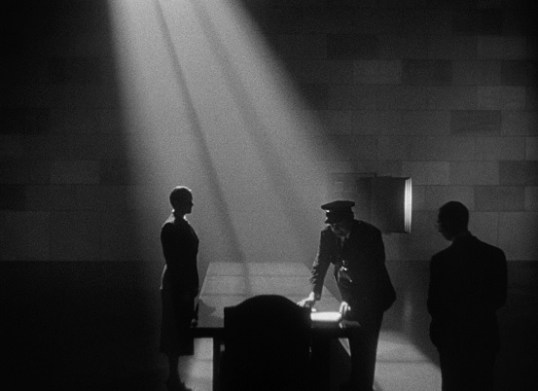
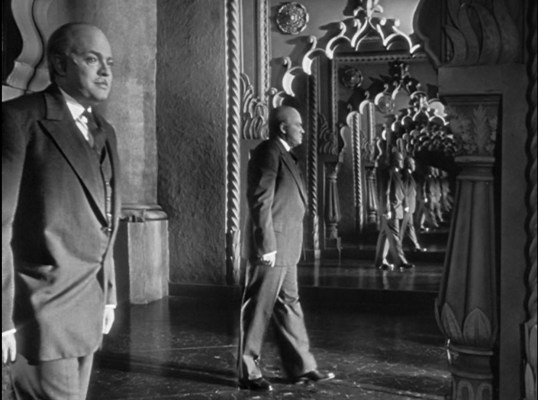
Make no mistake about it.  Citizen Kane is Orson Welles’s vision and Welles is the one who deserves the majority of the credit for the film.  The themes of Citizen Kane are ones to which Welles would frequently return and the cast, all of whom bring their characters to vivid life, is made up of largely of the members of Welles’s Mercury Theatre.  The tracking camera shots, the dark cinematography, and the satiric moments are all pure Welles.  As the Fincher film argues, Mankiewicz may have very well meant to use the film to attack Hearst for his personal hypocrisy and for opposing the political ambitions of Upton Sinclair.  If so, let us be thankful that Orson Welles, as a director, was smart enough to realize that such didacticism is often deadly dull.

And there’s nothing dull about Citizen Kane.  It’s a great film but it’s also an undeniably fun film, full of unforgettable imagery and scenes that play like their coming to us in a dream.  It’s a film that grabs your interest and proves itself to be worthy of every minute that it takes to watch it.  I was lucky enough to first see Citizen Kane at a repertory theater and on the big screen and really, that’s the best way to watch it.  It’s a big film that’s full of bigger-than-life characters who are ultimately revealed to be full of the same human longings and regrets as all of us.  As a young man, the fabulously wealthy Charles Foster Kane thinks that it would be “fun” to run a newspaper.  Later, he thinks that he’s found love by marrying the niece of the President.  He runs for governor of New York and, watching Welles in these scenes, you can see why FDR tried to recruit him to run for the Senate.  Welles has the charisma of a born politician.  When Welles first meets Susan Alexander (Dorothy Comingore) it’s easy to laugh.  The great man has just been splashed by a taxi.  Susan laughs but then winces in pain due to a tooth ache.  Later, Kane insists on trying to turn her into an opera star.  He runs a negative review written by his friend (Joseph Cotten) and then he promptly fires him.  As in all of Welles’s films, it’s all about personal loyalty.  Kane may betray his wife and the voters but he’s ultimately just as betrayed by those around him.  In the end, you get the feeling that Kane was desperately trying to not be alone and yet, that’s how he ended up.
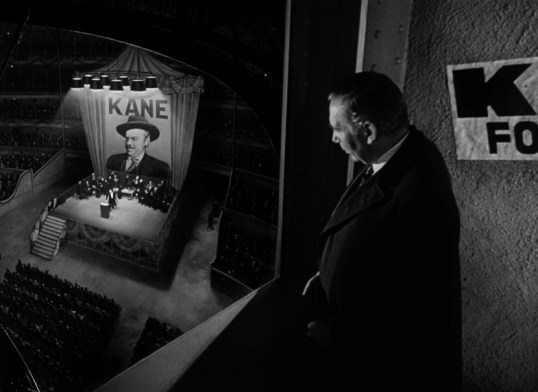
There are so many stand-out moments in Citizen Kane that it’s hard to list them all.  The opening — MIGHTY XANADU! — comes to mind.  The satirically overdramatic newsreel is another.  (Citizen Kane can be a very funny film.)  Joseph Cotten’s performance continues to charm.  Orson Welles’s performance continues to amaze.  Who can forget Agnes Moorehead as Kane’s mother or Everett Sloane as Mr. Bernstein, haunted by that one woman he once saw on a street corner?  Myself, I’ve always liked the performances of Ray Collins (as the sleazy but strangely reasonable Boss Gettys), Paul Stewart (as the subtly menacing butler), and Ruth Warrick (as Kane’s first wife).  Mankiewicz may have put the characters on paper but Welles is the one who selected the amazing cast that brought them to life.

Citizen Kane was nominated for nine Oscars and it won one, for the screenplay written by Welles and Mankiewicz.  Best Picture went to How Green Was My Valley.  When was the last time anyone debated who should be given credit for that movie?
From 1939, it’s Lionel Barrymore and Orson Welles in A Christmas Carol!


This radio production of A Christmas Carol was originally broadcast on Christmas Eve, 1939.  It’s not really Christmas unless you experience at least one version of Charles Dickens’s classic holiday tale and this version features not only Orson Welles providing the narration but Lionel Barrymore playing the role of Scrooge!

Other members of the cast included such well-known Welles’s associates as  Everett Sloane (Marley’s ghost), Frank Readick (Bob Cratchit), Erskine Sanford (Fezziwig) and George Coulouris (Ghost of Christmas Present).  Two years after this broadcast, Welles, Sloane, Sanford, and Coulouris would all appear in Citizen Kane.

For your listening pleasure, we offer up this journey to the past….

From 1939, it’s Lionel Barrymore and Orson Welles in A Christmas Carol!


This radio production of A Christmas Carol was originally broadcast on Christmas Eve, 1939.  It’s not really Christmas unless you experience at least one version of Charles Dickens’s classic holiday tale and this version features not only Orson Welles providing the narration but Lionel Barrymore playing the role of Scrooge!

Other members of the cast included such well-known Welles’s associates as  Everett Sloane (Marley’s ghost), Frank Readick (Bob Cratchit), Erskine Sanford (Fezziwig) and George Coulouris (Ghost of Christmas Present).  Two years after this broadcast, Welles, Sloane, Sanford, and Coulouris would all appear in Citizen Kane.

For your listening pleasure, we offer up this journey to the past….

30 Days of Noir #30: The Stranger (dir by Orson Welles)


“No, you must not miss the newsreels. They make a point this week no man can miss: The war has strewn the world with corpses, none of them very nice to look at. The thought of death is never pretty but the newsreels testify to the fact of quite another sort of death, quite another level of decay. This is a putrefaction of the soul, a perfect spiritual garbage. For some years now we have been calling it Fascism. The stench is unendurable.”

Those words were written in 1945 by director Orson Welles.  He was writing about the footage that had been filmed at the Nazi concentration camps during the final days of World War II.  These films not only revealed the crimes of the Third Reich but they also proved the existence of evil.  With World War II finally ended and Hitler dead, many people were eager to move on and forget about the conflict.  Many even claimed (and some continue to do to this very day) that the reports of the Nazi death camps were exaggerated.  Writing in his syndicated column for the New York Post, Welles told those doubters that the reports of the Nazi death camps were not exaggerated and that, unless people confronted the horrors of the Nazi regime by watching the newsreels and seeing for themselves, history would repeat itself.

A year later, Welles would use that documentary footage in a key scene of his 1946 film, The Stranger.  A government agent named Mr. Wilson (Edward G. Robinson) shows the footage to Mary Longstreet Rankin (Loretta Young), the daughter of a Supreme Court justice.  Wilson is hoping that, by showing her the footage, he’ll be able to convince her to help him bring a Nazi war criminal to justice.  Complicating things is that Wilson believe that the Nazi war criminal is Mary’s new husband, Professor Charles Rankin (played by Orson Welles, himself).

In this shot, the horrors of the Holocaust are literally projected onto Edward G. Robinson’s face, a reminder that is on us to prevent it from ever happening again.

Rankin’s real name is Franz Kindler.  One of the architects of the Holocaust, he escaped from Germany at the end of World War II and, after making his way through Latin America, he ended up in a small town in Connecticut.  He got a job at the local prep school, where he instructs impressionable young minds.  He also found the time to work on the town’s 300 year-old clock.

When we first see Kindler/Rankin, he’s walking out of the school and it’s obvious that all of his students love him.  Rankin has a quick smile, which he uses whenever he has to talk to Mary or any of the other townspeople.  However, that smile disappears as soon as he’s approached by another Nazi fugitive, Konrad Meinike (Konstantin Shayne).  Rankin assures Meinike that he’s merely biding his time until he can establish a Fourth Reich.  Meinike, meanwhile, announces that he’s found God and he suggests that Rankin should turn himself in.  Correctly deducing the Meinike is being followed by Wilson, Rankin promptly strangles his former collaborator and spends the rest of the movie trying to cover up his crimes.

Welles was best known for playing characters who had the potential for greatness in them but who were ultimately brought down by their own flaws.  Think about Charles Foster Kane or Harry Lime or the detective in Touch of Evil or even Falstaff in Chimes at Midnight.  The Stranger is unique as one of the few instances in which Welles played an outright villain.  Unlike Kane or Falstaff, there’s no greatness to be found in Rankin/Kindler.  He’s fooled the town into thinking that he’s a good man but, instead, he’s a soulless sociopath who is even willing to murder his wife if that’s what he has to do to protect his secret.  Franz Kindler is the Third Reich and, by having him thrive under a new name in America, Welles argues that the Nazi threat didn’t end just because Hitler killed himself in Berlin.

And that’s an important message.  It was an important message in 1946 and, I would argue, it’s an even more important message today.  Anti-Semitism is on the rise in both America and Europe, with activists on both the Left and the Right embracing the type of bigotry and conspiracy-mongering that previously allowed madmen like Adolf Hitler to come to power.  Just today, I read a story about a Jewish professor at Columbia who arrived at work on Wednesday, just to discover that someone had vandalized her office with anti-Semitic graffiti.  Watching The Stranger today, it’s important to remember that the Franz Kindlers of the world are still out there and many of them are just as good at disguising themselves as Charles Rankin as Kindler was.

The Stranger was Welles’s third completed film as a director.  It was a film that he reportedly agreed to direct in order to prove that he was capable of bring in a film on budget and ahead-of-schedule.  Because Welles was largely acting as a director-for-hire on this film, there’s a tendency to overlook The Stranger when discussing Welles’s films.  While that’s understandable, The Stranger is clearly a Welles film.  From the use of shadow to the skewed camera angles, the film has all of Welles’s visual trademarks.  Thematically, this is another one of Welles’s films about a man who is hiding a secret underneath his ordinary facade.

It’s a good film, with Welles giving an appropriately evil performance as Kindler and Loretta Young providing strong support as Mary.  That said, the film’s soul is to be found in Edward G. Robinson’s performance.  Robinson was born Emmanuel Goldenberg in Romania.  In 1904, his family fled to America after one of his brothers was attacked by an anti-Semitic mob.  As someone who had experienced anti-Semitism firsthand, Robinson brought a righteous fury to the role of Mr. Wilson.  Wilson isn’t just pursuing a fugitive in The Stranger.  Instead, he’s seeking justice for the six million Jews who were murdered by men like Franz Kindler.

The Stranger is an important film and it seems like the right film with which to end my 30 Days of Noir.  Noirvember is ending and so ends our 30-day walk through the shadowy streets of noir cinema.

Lisa Watches An Oscar Winner: The Best Years Of Our Lives (dir by William Wyler)


The_Best_Years_of_Our_Lives_film_poster

I’ve seen The Best Years Of Our Lives on TCM a few times.  There’s a part of me that always wishes that this film was dull, in the way that many best picture winners can be when watched through modern eyes, or in any other way overrated.  The Best Years Of Our Lives won the Academy Award for Best Picture of 1946 and in doing so, it defeated one of my favorite films of all time, It’s A Wonderful Life.  A part of me would love to be able to say that this was one of the greatest injustices of cinematic history but, honestly, I can’t.    The Best Years Of Our Lives is an excellent film, one that remains more than worthy of every award that it won.

Best_Years_of_Our_Lives_01_bar

The film deals with veterans returning home from World War II and struggling to adjust to life in peacetime.  That’s a topic that’s as relevant today as it was back in 1946.  If there’s anything that remains consistent about human history it’s that there is always a war being fought somewhere and the man and women who fight those wars are often forgotten and abandoned after the final shot has been fired.  The returning veterans in The Best Years Of Our Lives deal with the same issues that our soldiers have to deal with today as they return from serving in Iraq and Afghanistan.

The Best Years Of Our Lives follows three veterans as they return home to Boone City, Ohio.  As they try to adjust to civilian life, their loved ones struggle to adjust to them.

 Teresa Wright and Dana Andrews

Teresa Wright and Dana Andrews

Fred Derry (played by Dana Andrews) is a self-described former soda jerk.  (To be honest, I’m really not sure what a soda jerk was but it doesn’t sound like a very fun job.)  During the war, he was a captain in the air force.  He returns home with several decorations and few marketable skills.  During the war, he was good at bombing cities but there’s not much that can be done with that skill during peacetime.  Nearly penniless, Fred takes a job selling perfume at a department store.  He spends his days trying to control her temper and not give into his frustration.  At night, he’s haunted by nightmares of combat.

Teresa Wright and Virginia Mayo

Teresa Wright and Virginia Mayo

Meanwhile, his wife, Marie (Virginia Mayo), finds herself resenting the fact that Fred has come home.  She married him while he was in flight training and, as quickly becomes obvious, she’s less enamored of Fred now that he’s just another civilian with a low-paying job.  (She continually begs him to wear the uniform that he can’t wait to take off.)  The Best Years Of Our Lives is a film full of great performances but Virginia Mayo really stands out.  I have to admit that, whenever I watch this film, I find myself envious of her ability to both snarl and smile at the same time.

Teresa Wright, Myrna Loy, Fredric March, and Michael Hall

Teresa Wright, Myrna Loy, Fredric March, and Michael Hall

Al Stephenson (Fredric March) was a bank loan officer who served as an infantry sergeant.  (It’s interesting to note that the educated and successful Al was outranked by Fred during the war.)  Al returns home to his loving wife, Milly (Myrna Loy), his daughter Peggy (the beautiful Teresa Wright), and his son, Rob (Michael Hall).  At first, Al struggles to reconnect with his family and he deals with the tension by drinking too much.  Rehired by the bank, he approves a risky loan to a fellow veteran.  After the bank president (Ray Collins, a.k.a. Boss Jim Gettys from Citizen Kane) admonishes Al, Al gives a speech about what America owes to its returning veterans.

Meanwhile, Peggy has fallen in love with Fred.  When Milly and Al remind her that Fred is (unhappily) married, Peggy announces, “I am going to break that marriage up!”  It’s a wonderful line, brilliantly delivered by the great Teresa Wright.

Harold Russell

Harold Russell

Marriage is also on the mind of Homer Parrish (Harold Russell).  A former high school quarterback, Homer was planning on marrying Wilma (Cathy O’Donnell) as soon as he finished serving in the Navy.  During the war, he lost both his hands and now he’s returned home with metal hooks.  Homer locks himself away from the world.  When he finally does talk to Wilma, it’s to show her how difficult life with him will be.  Wilma doesn’t care but Homer does.

Harold Russell won an Academy Award for his performance here.  Russell was not a professional actor.  Instead he was a veteran and a real-life amputee.  Watching his performance today, it’s obvious that Russell was not an experienced actor but the natural charm that enchanted the Academy still shines through.

Harold Russell, Dana Andrews, and Fredric March

Harold Russell, Dana Andrews, and Fredric March

It’s been nearly 70 years since The Best Years Of Our Lives was first released but it remains a powerfully honest and surprisingly dark film.  All three of the veterans deal with very real issues and, somewhat surprisingly, the film refuses to provide any of them with the type of conventional happy ending that we tend to take for granted when it comes to movies made before 1967.  As the film concludes, Fred is still struggling financially.  Homer is still adjusting to life as an amputee.  Al is still drinking.   All three have a long road ahead of them but they’re all making progress.  None of them will ever be the same as they were before the war but, at the same time, they’re all working on making new lives for themselves.  They haven’t given up.  They haven’t surrendered to despair and, the film suggests, that is triumph enough.

The Best Years Of Our Lives is a great film and a great best picture winner.  It’s just a shame that it had to be released the same year as It’s A Wonderful Life.

http://www.youtube.com/watch?v=o_TJuLRjQCM