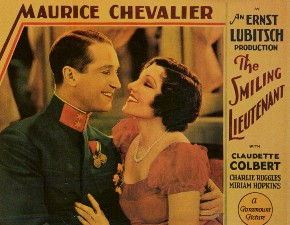
 Last night, I watched The Smiling Lieutenant, a musical comedy from 1931. I recorded it off of TCM as a part of the 31 Days of Oscar and I have to admit that I really was not expecting much. While I love old movies and I have a special place in my heart for pre-code movies and their obsession with lingerie and suggestive winks, I was concerned that The Smiling Lieutenant was a musical that was made at a time when the Hollywood studios were still figuring out how to use sound to tell a story. I worried that the film would be one of those extremely creaky and overly theatrical movies that you always run the risk of coming across whenever you explore the cinema of the early 30s.
But you know what? I was pleasantly surprised. The Smiling Lieutenant is an undeniably old-fashioned film and yes, there were a few scenes that felt a bit too stagey. Compared to what modern audiences are used to, some of the acting does seem stilted. This is a film that will demand a bit of adjustment on the part of the viewer. But, with all that in mind, The Smiling Lieutenant is still an enjoyable little movie.
The story is charmingly simple. In Vienna, Lt. Nikki von Preyn (Maurice Chevalier) is in love with Franzi (Claudette Colbert), the worldly and free-spirited orchestra leader. However, Nikki makes the mistake of winking at Franzi while in the presence of Princess Anna (Miriam Hopkins). When Anna takes offense, Nikki says that he was only winking because Anna is so beautiful. Anna immediately falls in love with Nikki and demands to marry him. She explains that if Nikki doesn’t marry her, she’ll marry an American suitor which would totally scandalize Vienna.
Doing his patriotic duty, Nikki marries Anna. However, Nikki still longs for the more experienced Franzi and spends his time pining for her. Realizing that her husband is in love with another woman, Anna confronts Franzi and this is exactly where, if this was a modern film, there would be either be a huge cat fight or Anna and Franzi would team up to destroy Nikki. However, since this is a 1931 pre-code film, Franzi realizes that Anna loves Nikki. As a result, Franzi decides to help her boyfriend’s wife win back his interest.
And how does Franzi do this? By giving Anna a makeover! As Franzi explains in song, it’s time for Anna to “jazz up (her) lingerie!”
The Smiling Lieutenant is an entertaining movie. I suppose that many would probably consider it to be the epitome of “fluff” but so what? I imagine that for audiences in 1931, a film like The Smiling Lieutenant provided a nice escape from the Great Depression and isn’t escape one of the best things that a good film can provide? Colbert, Hopkins, and Chevalier all give likable performances and, even 85 years after it was first released, it’s a fun little movie.
The Smiling Lieutenant was a huge box office hit and it was nominated for best picture of the year. However, it lost to Grand Hotel.
 Through the Shattered Lens