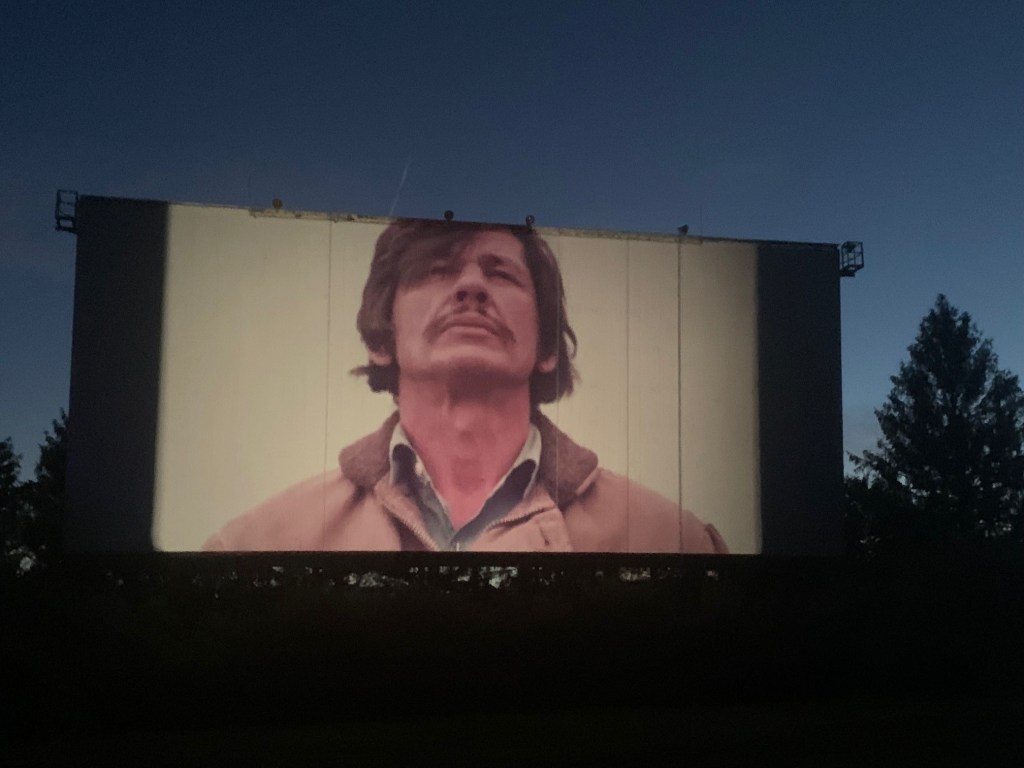
THE MECHANIC (1972) – Celebrate the New Year with one of Charles Bronson’s most iconic roles!


THE MECHANIC features an iconic performance by Charles Bronson, a performance that would represent a blueprint for the type of character he would play in many films…the strong, silent, unstoppable, man of action.  Bronson plays Arthur Bishop, a hit man with a gift for planning and executing his hits in a way that make the deaths look like natural deaths rather than murders.  Facing health issues and loneliness, he takes on a young protégé named Steve McKenna, played by Jan-Michael Vincent.  This upsets his bosses in the underworld because he takes on the apprentice without asking them.  Will they allow him to train up this new protégé and complete tag team hits going forward, or will they decide that Bishop is no longer worth the risk?          

I’ll start off by stating up front that I love THE MECHANIC.  The first Charles Bronson movie I ever owned on VHS was a nearly unwatchable, 2nd hand version of the film, but I still tried to watch it.  The first Charles Bronson movie I ever saw on the big screen was a beautiful 35mm print of the film at the Mahoning Drive-in theater in Lehighton, PA.  I also believe that this film has the best ending of any Charles Bronson film.  Needless to say, the following review will be full of praise, so if you’re looking for a real critical take on the piece, this is probably not the place to look!

To start off, THE MECHANIC has a uniquely amazing opening sequence.  The first 16 minutes of the film features hitman Bishop going through the mundane tasks of setting up a hit.  We watch him set up shop across the street from the mark, we watch him break into the mark’s apartment to rig the things needed to accomplish the hit, we watch him squeeze a wax ball, etc.  Bishop speaks no dialogue during these 16 minutes, and the only things we hear are the sounds of the soundtrack and the street.  Bronson’s unique screen presence makes it mesmerizing.  Could you imagine an action film trying this strategy in this day and age?   

Once Bishop has successfully completed the first hit, we’re introduced to Bishop’s world outside of what we’d observed during the opening sequence.  We meet Harry McKenna (Keenan Wynn), the “uncle-like” figure who has gotten himself in trouble with the organization.  We’re not surprised who’s given the job to eliminate this problem.  We meet Harry’s son Steve (Jan-Michael Vincent) who hits it off with Bishop at the funeral where their relationship really begins.  On a side note, the film’s script featured these two characters as gay men, and the sexuality element was going to be a major way that Steve would get close enough to Bishop to gain his trust.  That part of the script was changed to get Bronson and secure financing for the film.  Since that element is not part of the movie I’ll move on.  We meet a prostitute (Jill Ireland) who’s visited by Bishop.  This is a very interesting scene that gives us a strong insight into just how lonely Bishop is and also helps us understand why he’s open to the idea of bringing on an apprentice.  I think Jill Ireland is quite effective in her one scene.

Once the various characters are introduced, the film settles nicely into a mentoring relationship between Bishop & Steve.  The experienced hitman shares his knowledge, and we follow along with them as they complete various assignments.  The movie seems most interested in the relationship between the men, but this is an action movie, so we have a couple of very solid action sequences in the middle portion of the film, as well as the end.  Director Michael Winner, who directed Charles Bronson in six different films, stages these sequences extremely well, especially the sequence that ends the film in Naples, Italy.  We see necks snapped.  We see faces knuckle punched.  We see a motorcycle chase ending with a motorcycle flying off a cliff and exploding into a ball of flames upon impact.  We see boats exploding.  We see Bronson using my favorite weapon, the pump shotgun, with expert precision.  We see cars chasing each other along the Italian coast.  We see bombs being dropped out of moving cars with precision timing to blow up the cars behind them.  We even see a bulldozer pushing a moving car off the side of a cliff.  It’s some amazing stuff, with Bronson & Vincent appearing quite badass at times.  And then the ending, the ending that proves just how awesome Bishop truly is!  I won’t say anymore about that.  Just watch and enjoy! 

**BONUS CONTENT** – We dedicated an episode of the “This Week in Charles Bronson” podcast to THE MECHANIC. It was one of the most enjoyable episodes for me to record. If you’re interested in learning more about the film from a group of guys who love Charles Bronson, give it a listen!
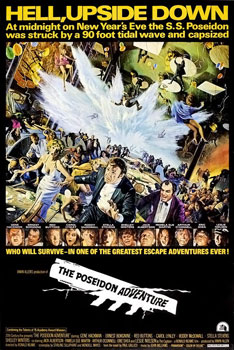
Embracing the Melodrama Part II #44: The Poseidon Adventure (dir by Ronald Neame)


PoseidonAdventure

A few years ago, when I first told Arleigh that I had recently watched the 1972 film The Poseidon Adventure, I remember him as being a bit shocked and amazed that I had made it through the entire film.  This was because Arleigh knows that I have a morbid obsession with drowning and that the mere sight of someone struggling underwater is enough to send me into a panic attack.

And The Poseidon Adventure is a film that is totally about drowning.  The majority of the cast drowns over the course of the film.  The few who survive spend all of their time trying not to drown.  The main villain in The Poseidon Adventure is the ocean.  The Poseidon Adventure is a film specifically designed to terrify aquaphobes like me.

And there are certain parts of The Poseidon Adventure that freaked me out when I first watched it and which continue to freak me out whenever I rewatch it.

For instance, just the film’s plot freaks me out.  On New Year’s Day, an ocean liner is capsized by a huge tidal wave.  With the boat upside down, a small group of survivors struggle to make their way up to the hull where, hopefully, they might be rescued.  That involves a lot of fighting, arguing, climbing, and drowning.

It freaks me out whenever I see the huge tidal wave crash into the bridge and drown Captain Leslie Nielsen.  That’s largely because it’s impossible for me to look at Leslie Nielsen without smiling.  (I’ve already written about my reaction to seeing him in the original Prom Night.)  When he suddenly drowns, it’s not funny at all.

It freaks me out when the boat turns over and hundred of extras are tossed around the ballroom.  I always feel especially bad for the people who vainly try to hold onto the upside down tables before eventually plunging to their deaths.  (Did I mention that I’m scared of heights as well?)

It freaks me out when Roddy McDowall plunges to his death because who wants to see Roddy McDowall die?  Whenever I see him in an old movie, he always come across as being such a super nice guy.  (Except in Cleopatra, of course…)  Plus, Roddy had an absolutely chilling death scream.  They need to replace the Wilhelm Scream with the Roddy Scream.

It freaks me out when survivor Shelley Winters has a heart attack right after swimming from one part of the ship to another.  Because seriously, Shelley totally deserved the Oscar nomination that she got for this film.

And it really freaks me out when Stella Stevens plunges to her death because I related to Stella’s character.  Stella was tough, she didn’t take any crap from anyone, and she still didn’t make it.  If Stella Stevens can’t make it, what hope would there be for me?

And yet, at the same time, The Poseidon Adventure is such an entertaining film that I’m willing to be freaked out.  The Poseidon Adventure was one of the first of the classic disaster films and it’s so well done that even the parts of the film that don’t work somehow do work.

For instance, Gene Hackman plays the Rev. Frank Scott, the leader of the group of survivors.  And Hackman, who can legitimately be called one of the best actors ever, gives an absolutely terrible performance.  His performance is amazingly shrill and totally lacking in nuance.  When, toward the end of the film, he starts to angrily yell at God, you actually feel sorry for God.  And yet, Hackman’s terrible performance somehow works perfectly for the film.  It’s such an over-the-top performance that it sets the tone for the whole film.  The Poseidon Adventure is an over-the-top film and, if Hackman had invested his character with any sort of nuance, the film would not have worked as well as it did.

And then there’s Ernest Borgnine, who plays Stella Stevens’s husband.  Borgnine spends the entire film arguing with Gene Hackman.  Whenever something bad happens, Borgnine starts acting like Edward G. Robinson in The Ten Commandments.  He never actually says, “Where is your God now!?” but it wouldn’t have been inappropriate if he had.  And yet, again, it’s exactly the type of performance that a film like this needs.

And finally, there’s that theme song.  “There has to be a morning after…”  It won an Oscar, defeating Strange Are The Ways Of Love from The Stepmother.  And is it a good song?  No, not really.  It’s incredibly vapid and, while it does get stuck in your head, you don’t necessarily want it there.  But you know what?  It’s the perfect song for this film.

The Poseidon Adventure is not a deep film, regardless of how many times Hackman and Borgnine argue about the role of God in the disaster.  It’s an amazingly shallow film about people drowning.  But it’s so well-made and so perfectly manipulative that you can’t help but be entertained.

The Poseidon Adventure totally freaks me out.  But I will probably always be willing to find time to watch it.

Embracing the Melodrama #28: The Towering Inferno (dir by John Guillermin)


The_Towering_Inferno_1974-500x300

I have a weakness for the old, all-star disaster movies of the 1970s.  It could be because those movies remind me of how fragile life really is and encourage me to make the most of every minute.  Or maybe it’s because I have my phobias and, by watching those movies, I can confront my fears without having to deal with a real-life tornado, hurricane, tidal wave, avalanche, or fire.

Or maybe I just have a weakness of glitz, glamour, and melodrama — especially when it involves a huge cast of stars and character actors.  Yes that’s probably the reason right there.

Case in point: the 1974 best picture nominee, The Towering Inferno. 

As is the case with most of the classic disaster films, The Towering Inferno is a long and big movie but it has a very simple plot.  The world’s tallest building — known as the Glass Tower — has been built in San Francisco.  On the night of the grand opening, a fire breaks out, trapping all the rich and famous guests on the 135th floor.  Now, it’s up to the fire department to put out the fire while the trapped guests simply try to survive long enough to be rescued.  Some will live, some will die but one thing is certain — every member of the all-star cast will get at least 15 minutes of screen time and at least one chance to scream in the face of the film’s still effective special effects.

628x471

As for the people trapped by the towering inferno, we don’t really get to know them or their motivations.  (Add to that, once the fire breaks out, everyone pretty much only has one motivation and that’s to not die.)  As a result, we don’t so much react to them as characters as we do to personas of the actors who are playing them.

Steve-McQueen-in-The-Towe-001

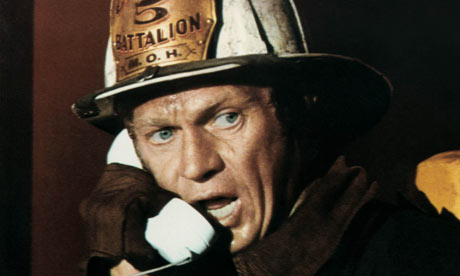
For instance, we know that Fire Chief O’Halloran is a fearless badass and a natural leader because he’s played by Steve McQueen.  McQueen brings a certain blue collar arrogance to this role and it’s a lot of fun to watch as he gets progressively more and more annoyed with the rich people that he’s been tasked with rescuing.

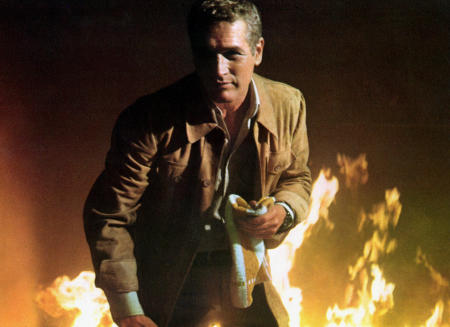
We know that architect Doug Roberts is a good guy because he’s played by Paul Newman.  Reportedly, Newman and McQueen were very competitive and, in this movie, we literally get to see them go-head-to-head.  And, as charismatic as Newman is, McQueen pretty much wins the movie.  That’s because there’s never a moment that O’Halloran isn’t in charge.  Doug, meanwhile, spends most of the movie begging everyone else in the tower to exercise the common sense necessary to not die.  (Unfortunately, despite the fact that he looks and sounds just like Paul Newman, nobody in the tower feels like listening to Doug.  If Towering Inferno proves anything, it’s that most people are too stupid to survive a disaster.)

paul-newman-inferno1

The tower’s owner, James Duncan, is played by William Holden so we know that Duncan may be a ruthless businessman but that ultimately he’s one of the good guys.  Holden gets one of the best scenes in the film when, after being told that people in the building are catching on fire, he replies, “I think you’re overreacting.”

Roger Simmons is Duncan’s son-in-law and we know that he’s ultimately to blame for the fire because he’s played by Richard Chamberlain.  Roger might as well have a sign on his back that reads “Doomed.”  The same can be said of publicity executive Dan (Robert Wagner) and his girlfriend, Lorrie (Susan Flannery).

The_Towering_Inferno_1974_Faye_Dunaway_Mike_Lookinland

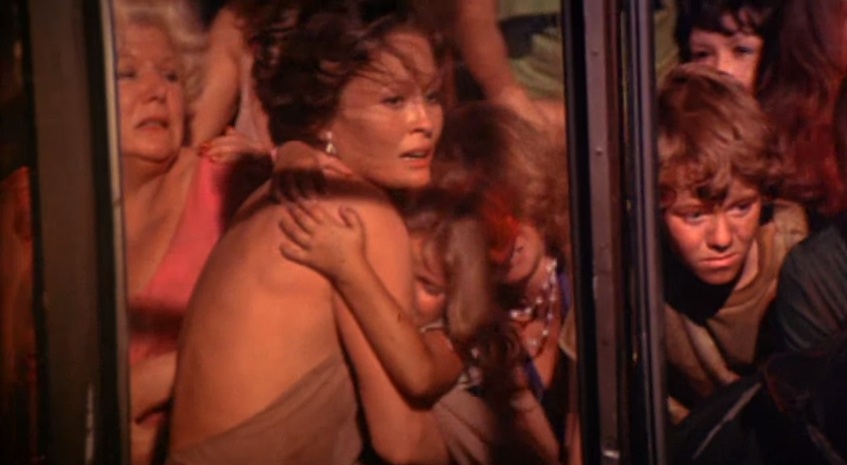
Faye Dunway is Susan.  She is Doug’s fiancée and she really doesn’t do much but she does get to wear a really pretty dress.  The same can be said of Susan Blakely, who plays Roger’s dissatisfied wife, and Jennifer Jones, who plays a recluse.  And good for them because if you’re going to be stuck in an inferno without much to do, you can at least take some comfort in looking good.

Then there’s Fred Astaire, who does not dance in this film.  Instead, he plays a kind-hearted con artist who ends up falling in love with Jennifer Jones.  Fred Astaire received his only Oscar nomination for his brief but likable performance in The Towering Inferno.

And finally, there’s the building’s head of security, Jernigan.  We know that he’s a murderer because he’s played by O.J. Simpson and … oh wait.  Jernigan is actually probably the second nicest guy in the whole film.  The only person nicer than Jernigan is Carlos, the bartender played by Gregory Sierra.

OJ

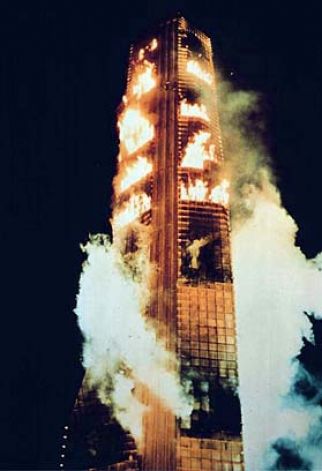
The real star of the film, of course, is the fire.  In the 40 years since The Towering Inferno was produced, there’s been a lot of advances in CGI and I imagine that if the film was made today, we’d be watching the fire in 3D and it would be so realistic that we’d probably feel the heat in the theater.  That said, the fire effects in The Towering Inferno are still pretty effective.  Now, I have to admit that I have a phobia (and frequent nightmares) about being trapped in a fire so, obviously, this is a film that’s specifically designed to work itself into my subconscious.  But that said, the scenes with various extras thrashing about in the flames are still difficult to watch.  There’s a scene where Robert Wagner and Susan Flannery find themselves trapped in a blazing reception area and it is pure nightmare fuel.

The Towering Inferno 9

The Towering Inferno is an undeniably effective disaster film.  At the same time, when one looks at the 1974 Oscar nominees, it’s odd to see The Towering Inferno nominated for best picture along with The Godfather Part II, Chinatown, and The Conversation.  Unlike those three, The Towering Inferno is hardly a great film.

But it is definitely an entertaining one.

toweringinferno2