Love on the Shattered Lens: Scenes From A Marriage (dir by Ingmar Bergman)


http://www.youtube.com/watch?v=K6qrTm_-U9Y

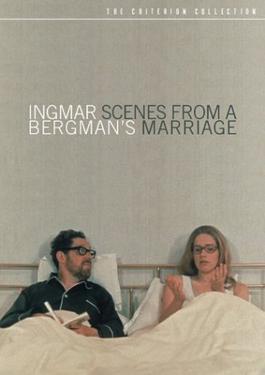
The 1973 film, Scenes From A Marriage, is a real endurance test.

That, in itself, shouldn’t be surprising.  It’s an Ingmar Bergman film, after all.  Bergman was one of the world’s great directors but the majority of his films did not exactly focus on happy themes.  Scenes From A Marriage is a nearly three-hour film in which two people — who start out as married and eventually end up as divorced — talk and talk and talk and talk.  They talk about work.  They talk about their relationship.  They talk about their married friends who are trapped in a loveless marriage.  They talk about their unsatisfactory sex life.  They occasionally mention their never-seen daughter.  The conversations are usually friendly and semi-affectionate but there’s a hint of tension running through every single one of them.  Whenever this couple talks about anything, it’s under a cloud of disatisaction and repressed anger.  Violence always seems like it could break out at any time and, at one point, it does.  (Of course, if 167 minutes seems like a long time to watch a marriage collapse, just consider that the film was an edited version of a four-and-a-half hour miniseries that originally aired on Swedish television.)

Scenes From A Marriage is regularly cited as being one of the best films about marriage ever made and also as one Bergman’s best films.  Personally, I think it’s a bit overrated but still, no one can deny the skill with which the film was made.  Though it may ultimately just be a reflection of the film’s roots as a television series, the film is full of probing close-ups.  When Marianne (Liv Ullmann) and Johan (Erland Josephson) discuss their life, the camera gives them no escape.  There’s no sudden jump cuts or fade outs to bring the conversation to an end and, as talky as the film may be, the awkward silences often tell us even more about what’s going on between these two.  Ullmann and Josephson both give excellent performances.  There’s an honesty to their anger and their disillusionment that will often leave you cringing but unable to look away.  When Marianne and Johan discuss why they’ve never had a satisfactory sex life, it’s a crushingly honest scene and neither Ullmann nor Josephson hold anything back.  When one of their conversations suddenly erupts into a violent fight, it’s scary, heart-breaking, and expected all at the same time.  We’ve spent so much time with these two characters that we feel as if we know them.  We can see what’s coming, even if they can’t.

If I’m not as enthusiastic for Scenes From A Marriage as some, it’s because I didn’t particularly like either Marianne or Johan.  I understood them.  I felt as if I knew them.  By the end of the film’s first scene, I could confidently tell you that Johan would probably vote for Mike Bloomberg while Marianne would send money to both Elizabeth Warren and Amy Klobuchar while joking about how, if it was good enough for The New York Times, it was good enough for her.  But ultimately, both Johan and Marianne come across as being a bit too smug and safely bourgeois, even after they realize that they’re “perfect” marriage isn’t perfect at all.  This is actually something that I’ve noticed about most films about divorce.  It’s rare that you ever seen a film centered around a working class divorce.  Instead, it’s almost always the members of the middle and upper classes, people who are relatively stable financially and who have a support system of liberal and sophisticated friends and family to fall back on.  In films like this, divorce is an issue where the concerns and sufferings are almost exclusively emotional.  I think a lot of this is because most films about divorce are made by directors who have just gone through their own divorce and they basically end up telling their own side of the story under the guise of fiction.  Ingmar Bergman admitted as much when he said that Scenes From A Marriage was based on both his two failed marriages and his own relationship with Ullman.  (Just last year, we had another example of this with Noah Baumbach’s Marriage Story, a film that owes more than a little debt to Bergman’s film.)   For all of the film’s technical skill and good performances, Scenes From A Marriage is still just two and a half hours of watching two less than likable people get a divorce.  By the end of the film, you’re just happy to be away from them.
International Horror Film Review: Hour of the Wolf (dir by Ingmar Bergman)


An Ingmar Bergman horror film?

Indeed.  Despite the fact that Bergman’s bleak imagery and existential themes undoubtedly influenced any number of horror filmmakers (Wes Craven’s Last House On The Left was essentially a remake of Bergman’s The Virgin Spring), the 1968 film, Hour Of The Wolf was Ingmar Bergman’s only official horror film.

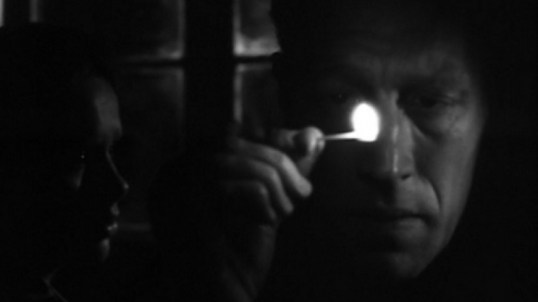
Of course, it’s also an Ingmar Bergman film, which means that it’s also a meditation on relationships, regret, the difficult of ever knowing what’s truly going on inside someone else’s head, and the artificiality of the artistic process.  It tells the story of a painter named Johan Borg (Max Von Sydow) and his pregnant wife, Alma (Liv Ullman) and their life on an isolated island.  Alma is worried about Johan’s feelings towards his former muse and ex-lover, Veronica Vogler.  Johan is haunted by nightmarish visions of menacing figures and the feelings that demons are pursuing him.

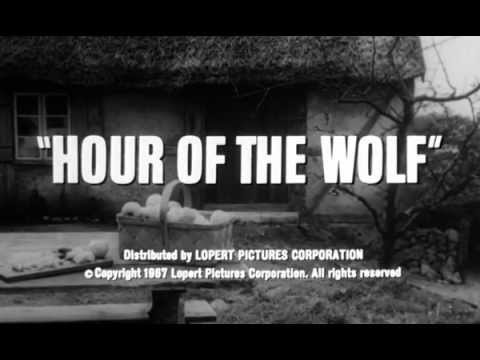
The film opens with a title card, informing us that the story that we’re about to see is true and that it’s an attempt to reconstruct the final days of Johan’s life before his mysterious disappearance.  Of course, as anyone who has seen enough found footage films can tell you, the title card is a lie and there never was a painter named Johan Borg, or at least not one who mysteriously vanished while living in an isolated house on an island.  Instead of being meant to convince us that we’re about to see a true story, the title card instead establishes that what we’re about to see can be considered to almost be a dark fairy tale.  The title card is the film’s way of saying, “Once Upon A Time…..”  It’s also a reminder that most fairy tales are considerably more grim than what those of us raised on Disney might expect.

(No coincidentally, the title Hour of the Wolf came from Swedish folk lore.  The Hour of the Wolf is the time between 3 and 5 in the morning, during which it is said that most births and deaths occur.)

While the opening credits flash by on a dark screen, we hear the sounds of men working and anyone who has any experience in theater will immediately realize that we’re listening to a set being built.  As the opening credits come to an end, we hear Bergman shouting out, “Action!”  Our next shot is Alma standing outside of the house that she shared with Johan.  Alma looks straight at the camera as she tells us that she still doesn’t know what happened to Johan.  She tells the unseen Bergman that she’s revealed to him everything that she knows.

It’s an interesting opening, one that reminds the audience that what they’re seeing is merely a recreation of what might have happened on Johan and Alma.  When Alma speaks to Bergman, there’s an interesting subtext to her words and her tone and one gets the feeling that Alma and the director are meant to have a history of their own.  It’s almost as if the film is saying that the story’s meaning can only be found in what we can’t see, in what’s going on behind the camera.  That seems especially true when you consider that, when Hour of the Wolf was filmed, Liv Ullman, who played the pregnant Alma, actually was pregnant with Bergman’s child and that Bergman himself later said that Johan Borg’s nightmares were recreations of Bergman’s own nightmares.  It’s perhaps a little too easy to imagine that the demons that inspire Johan’s art are the same demons that inspired Bergman’s films and that this film is both an apology to Ullman for his own neurotic tendencies and a tribute to her willingness to put up with him.

Hour of the Wolf is a bleakly effective film, one that works as both a dissection of an unstable relationship and a portrait of a man who may be losing his mind.  Von Sydow plays the haunted Johan as a charismatic but introverted artist, a troubled individual who can only truly express what’s happening in his mind through his art.  Indeed, Johan’s tragedy seems to be that the joy he gets from creating can only come from the pain that he suffers from imagining and dreaming.  Ullman is heart-breaking as she tries to keep her husband from succumbing to his own darkness while, at the same time, trying not to get sucked into the darkness herself.  About halfway through the film, Johan confesses to committing a shocking crime and, like Alma, you don’t know whether to believe him or to believe that he’s reached the point where he can’t tell the difference between reality and his nightmares.  Ullman plays the scene with the perfect combination of fear and sadness, sympathy and revulsion.  As for Von Sydow, he brings to life both the natural arrogance of an artist and the terror of someone who suspects that he has no control over his own existence.

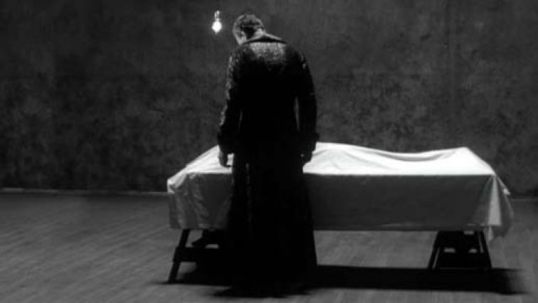
Visually, this film is bleak by even the standards of Bergman.  The black-and-white cinematography plays up not just the shadows of the night but also the brutal desolation of Johan and Alma’s life on the island.  It reminds us that Johan is an artist living in a world without color.  Bergman views Johan and Alma through a detached lens, recording the collapse of their lives but, at the same time, keeping his distance as if to protect the audience from getting trapped inside of Johan’s madness.

Hour of the Wolf may have been Ingmar Bergman’s only official horror film but it’s definitely an effective thriller, one that manages to explore both Bergman’s signature themes while also keeping the audience off-balance and wondering what might be lurking in the darkness.  It may not be one of Bergman’s “best-known” films but it’s definitely one for which to keep an eye out.

Cleaning Out The DVR #24: Cries and Whispers (dir by Ingmar Bergman)


Cries-and-Whispers-31

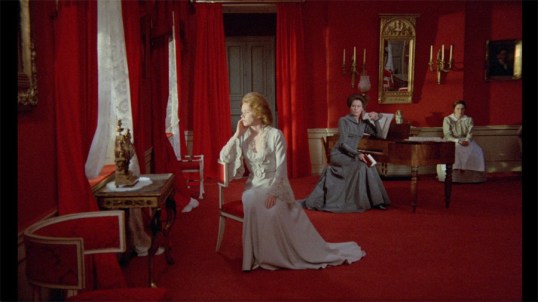
The time is the 19th century.  The country is Sweden.  The setting is a mansion that is decorated with red carpet, red walls, and almost blindly white statues.  But beyond that setting, the 1973 film Cries and Whispers is really set in the hearts and minds of four women.  One of them is selfless.  Two of them are bitter and uncaring.  And one of them is slowly dying.

Agnes (Harriet Andersson) is the one who is dying.  She spends her time laying in bed and screaming in pain.  A doctor (Erland Josephson) provides her with no hope and can only promise that the end will come soon and a priest (Anders Ek) coldly goes about planning for her funeral and offering up empty promises of a final reward.  Occasionally, through her diary and flashbacks to her youth, we get glimpses of who Agnes was before her life become dominating by her impending death.

Agnes’s sisters have come to the house to wait out her death.  Though they’ve arrived to provide comfort, neither is capable of it.  The youngest sister, Maria (Liv Ullman), was her mother’s favorite and has grown up to be coldly self-centered.  Through flashbacks, we see the details of her affair with Agnes’s doctor.  When Maria’s husband (Henning Moritzen) reacts to her infidelity by stabbing himself, Maria can only dispassionately watch.  Meanwhile, the oldest sister, Karin (Ingrid Thulin) has grown up to be bitter and sexually repressed.  In a truly shocking scene, Karin mutilates her vagina with a shard of glass and, after smearing the blood on her face, lies in bed and smirks at her husband.

In the end, only Anna (Kari Sylwan) can provide Agnes with any comfort.  Anna is Agnes’s maid.  Deeply religious and mourning the loss of her own daughter, only Anna is willing to reach out and hold Agnes while Agnes is in pain.  And, after Agnes dies, Anna seems to be the only one who shows any real grief.

There are depressing movies and then there’s Cries and Whispers.  Cries and Whispers is such an emotionally raw and dark movie that it was difficult for me to watch.  It’s also difficult to review because just thinking about the movie brings up so many emotions.  It’s just such a well-made and extremely painful movie.

It’s also an Ingmar Bergman film and that’s fortunate because Bergman somehow had an instinct for how to keep audiences watching even when the images on screen were amazingly painful.  Visually, Cries and Whispers is as beautiful as it is thematically cold.  By emphasizing the color red (not only is the entire house decorated in red but scenes often end by fading to red as opposed to black), Bergman makes the audience feel as if they truly have been transported into the human soul.  Red, after all, is the color of blood and life.

And really, Cries and Whispers is one of those films that makes you wonder what exactly the point of life is.  While the dream-like flashbacks give us clues as to how the three sisters became who they are, they also suggest that it really doesn’t matter.  In the end, regardless of whether they’re in love or alone or happy or sad, they’re all going to die and that’s going to be it.  All stories and issues will be left unresolved.

And, in the end, the best we can hope for is that someone like Anna will mourn us.

Cries and Whispers is one of the few foreign language films to be nominated for best picture.  It’s also the only Ingmar Bergman film to be so nominated (though Bergman had more success in the Best Foreign Language Film category).  It lost to The Sting, a far happier film.

http://www.youtube.com/watch?v=6Pw7FYex5pQ