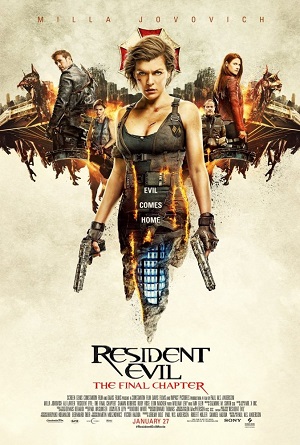
Horror Film Review: Resident Evil: The Final Chapter (dir by Paul W. S. Anderson)


Resident Evil: The Final Chapter?

Yeah, right.

There’s a long tradition of venerable horror franchises claiming that their latest installment is “the final chapter.”  The Friday the 13th franchise declared that the fourth part would be the final chapter and then promptly announced that part five would be a new beginning.  As long as a franchise is still making a profit, nothing truly ends.  Resident Evil: The Final Chapter basically admits that at the end of its final chapter, when one of the surviving characters literally announces that the mission is not over.

Anyway, Resident Evil: The Not-So Final Chapter will probably seem totally incoherent to anyone who has not watched the previous film.  To be honest, even though I’ve seen the other Resident Evil films, I always have a hard time working my way through the franchise’s dense mythology.  There are times when I suspect that, much like the Underworld films, the Resident Evil films were specifically designed to mess with my ADD.  That said, the Resident Evil franchise has never made a secret about being more concerned with spectacle and action than with narrative coherence.  If you’re the type who obsesses of the lack of logic and plausibility in a horror-action film based on a video game, then you’re not the right audience for Resident Evil.

The Final Chapter finds Alice (Milla Jovovich) right where the previous Resident Evil film left her, in the ruins of the White House.  The world is still zombiefied and monsterfied, all as a result of the nefarious work of the Umbrella Corporation.  Alice is contacted by the Red Queen (Ever Gabo Anderson), who explains that Alice needs to return to Raccoon City and invade the Hive before Umbrella releases yet another virus.  Alice travels back the Hive, which leads to several of Resident Evil‘s trademark, over-the-top action sequences.  Along the way, a lot of familiar faces pop up.  Alice is reunited with Claire (Ali Larter).  Dr. Alexander Isaacs (Iain Glen) shows up, explaining that the Isaacs who Alice killed a few movies ago was actually just a clone.  (No one ever dies in Resident Evil.  Instead, they just get cloned.)

Of course, Albert Wesker returns as well.  Ever since Resident Evil: Afterlife, Wesker has been played by a Canadian actor named Shawn Roberts.  Watching The Final Chapter, it took me only a few seconds to realize that Shawn Roberts also played Dean the Rapist in five episodes of Degrassi: The Next Generation.  That storyline, in which Dean raped Paige and it then took two years (and two seasons) for the case to go to trial just to end with Dean getting acquitted and smirking at Paige as he left the courtroom, remains one of Degrassi‘s most powerful storylines.  Roberts uses that same smirk while playing Wesker.

Paul W. S. Anderson returns to direct The Final Chapter.  Though Anderson seems to be destined to be best known as “that other director named Paul Anderson,” he’s actually pretty good when it comes to directing nonstop action.  (For the record, I thought Anderson’s Pompeii was a sadly underrated film.)  The Final Chapter is fun and silly as long as you don’t waste any time to thinking about it and Anderson keeps the action coming so quickly that you literally don’t have time to worry about whether or not the movie makes any sense.  The film’s prologue, in which a boy gets zombiefied on a cable car, was actually pretty exciting and a reminder of the visceral horror that it is at the heart of all zombie films.

Resident Evil: The Final Chapter was released in January and, despite some decidedly mixed review, it became the highest grossing film in the franchise.  In other words, this is definitely not the final chapter…
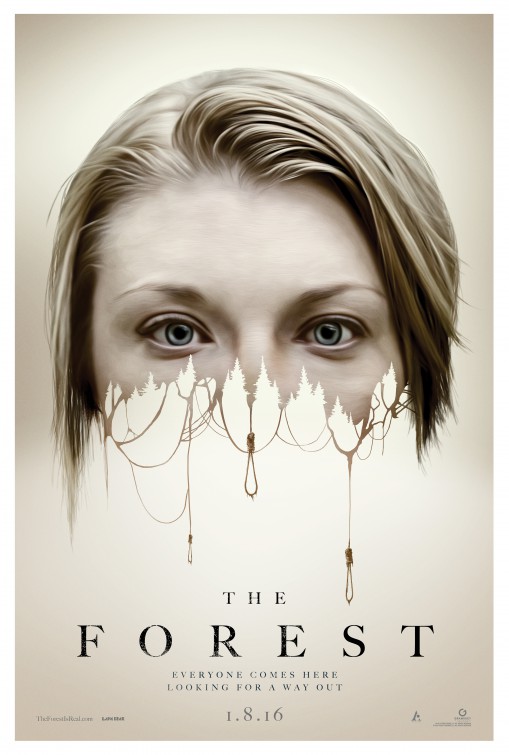
Horror Film Review: The Forest (dir by Jason Zada)


the_forest_poster

Why, as of late, have I been seeing so many movies about Aokigahara Forest?

Aokigarhara Forest is this location in Japan that’s right at the foot of Mt. Fiji and apparently, hundreds of people go there every year and commit suicide.  It happens so frequently that the location has been nicknamed “The Suicide Forest” and the problem has gotten so bad that the local authorities have even resorted to putting up signs that 1) ask people not to kill themselves and 2) reassure visitors that their problems will get better.

To me, that’s pretty depressing and not really something that should be glamorized or exploited.  I mean, this is an actual forest where real people — not fictional characters but real human beings — got to end their lives.  In fact, it’s been reported that local officials no longer publicly discuss the number of dead bodies that they find in the woods because they don’t want publicize Aokigahara’s reputation.

And yet, this year saw not one but two movies released about the Aokigahara Forest, both of which made a point of specifically saying that they were set in this very real location.  (Would I have been more comfortable with the films if they had been located in a fictional location where people go to commit suicide, even if that fictional location was obviously based on Aokigahara?  Probably.)  One was The Sea of Trees, a mawkish and sentimental mess from Gus Van Sant.  The other was The Forest.

Do you remember The Forest?  You might not because it came out in January and most of us were too busy trying to catch up on the Oscar nominees to waste much time with it.  Traditionally, the worst movies are released in January.  That’s especially true of horror movies.  I mean, let’s just be honest.  If a studio has a good horror movie, they’re going to release it in October and try to pick up on all the Halloween business.  When a studio has a bad horror movie, they’re going to dump it in January and hope that no one notices.

Anyway, The Forest came and went without a trace and now it’s making the rounds on HBO so you can watch it if you really want to.

The film stars Natalie Dormer as both Sara and her troubled sister, Jess.  Ever since their parents died in a mysterious car accident, Jess and Sara have had a strained relationship.  Jess witnessed their deaths but Sara did not.  By the film’s logic, this means that Jess starts dressing in black while Sara shakes her head in disapproval.  Anyway, Jess goes to Japan and disappears in the Aokigahara Forest.  Everyone tells Sara that Jess must be dead but Sara says that, since their twins, she can tell that her sister is still alive.

So, of course, Sara goes to Japan so that she can go search the forest for herself!  Now, since Sara is an American in Japan, we have to get at least one shot of her sitting in a taxi with all the lights of Tokyo reflected on the back windows.  Seriously, this shot appears in every single American movie made about Japan.

Sara goes to a bar and meets an American reporter.  His name is Aiden, he’s played by Taylor Kinney, and he’s not that interesting.  Aiden, Sara, and a guide (Yukiyoshi Ozawa) go into the woods and stuff happens.  I was tempted to say strange stuff happens but actually, none of it is that strange.  It’s pretty much exactly what you would expect to happen in a horror film set in the Suicide Forest.  By the time the mysterious schoolgirl showed up and started telling Sara not to trust anyone, I had pretty much lost interest.

I’m tempted to say that, at the very least, The Forest was atmospheric but … no.  I mean, there’s a lot of shots of shadowy trees and deserted tents and all of that but that’s all pretty much basic stuff.  That’s Horror 101.  I mean, even Grave Halloween, a 2013 SyFy film about the forest, managed to make the forest atmospheric.  So, no, I’m not having it.  There are too many good but underappreciated horror films out there for me to waste time making excuses for something like The Forest.

That’s The Forest.  It came out in January and, having watched it, I can see why.