Horror On The Lens: Son of Frankenstein (dir by Rowland V. Lee)


son_of_frankenstein_movie_poster

For those who might have a hard time keeping their Universal monster films straight, 1939’s Son of Frankenstein is the third Frankenstein film, following the original and Bride of Frankenstein.  It’s the first one to have been directed by someone other than James Whale.  It’s the one that features the one-armed policeman.  It’s the one that features Bela Lugosi as a vengeful grave robber named Ygor.  It’s also the final film in which Boris Karloff would play the monster.

And, on top of all that, it’s also a pretty good movie, one that holds up as both a sequel and stand-alone work!

Son of Frankenstein opens decades after the end of Bride of Frankenstein.  (How many decades is open for debate.  I’ve read that the film is supposed to be taking place in 1901 but there’s a scene featuring a 1930s-style car.  Let’s just compromise and say that the film is taking place in 1901 but someone in the village owns a time machine.  I think that’s the most logical solution.)  Henry Frankenstein is long dead, but his name continues to strike fear in the heart of Germans everywhere.  Someone has even tagged his crypt with: “Heinrich von Frankenstein: Maker of Monsters.”

Needless to say, everyone in the old village is a little uneasy when Henry’s son, Wolf von Frankenstein (Basil Rathbone) shows up at the castle.  In fact, they’re so uneasy that the local constable, Krogh (Lionel Atwill), pays Wolf and his family a visit.  Krogh explains that, when he was a child, the Monster ripped his arm out “by the roots.”  AGCK!

(That said, that really doesn’t sound like the Frankenstein Monster that we all know and love, does it?  I suspect there’s more to the story than Krogh is letting on…)

Wolf explains that he has no plans to bring the Monster back to life.  He then sets out to do just that.  Wolf wants to redeem Henry’s reputation and the only way to do that is to prove that Henry was not misguided in his quest to play God.  Helping Wolf out is Ygor (Bela Lugosi).  Ygor is a former blacksmith who was due to be hanged but, because of a malfunction with the gallows, he just ended up with a disfigured neck.

It turns out that Ygor happens to know where the Monster’s body is being hidden.  When Wolf brings the Monster back to life, he quickly discovers that Ygor’s motives weren’t quite as altruistic as Wolf originally assumed.  It turns out that Ygor wants revenge on the jury that sentenced him to death and now, he can use the Monster to get that revenge.

As for the Monster, he no longer speaks.  Instead, he just angrily grunts and he kills.  Whatever kindness he developed during the previous film was obviously blown up with Elsa Lanchester at the end of Bride of Frankenstein.  On the one hand, it’s fun to see Karloff as the monster.  On the other hand, it’s impossible not to regret that he doesn’t get to do much other than stumble around, grunt, and strangle people.  There are only two scenes where Karloff gets to show any real emotion and, in both cases, he does such a great job that you can’t help but regret that the monster is such a one-dimensional character in Son of Frankenstein.

But no matter!  Regardless of how the film uses (or misuses) the Monster, it’s still an entertaining 1930s monster film.  Basil Rathbone does a great job as the imperious but ultimately kindly Wolf von Frankenstein.  And Bela Lugosi’s natural theatricality makes him the perfect choice for Ygor.  To be honest, I actually think Lugosi does a better job as Ygor than he did as Dracula.  I know that’s blasphemy to some but watch the two films side-by-side.  Lugosi is clearly more invested in the role of Ygor.  Considering that Lugosi reportedly felt that he was mistreated in Hollywood, it’s tempting to wonder if some of his own anger informed his performance as the perennially mistreated and bitter Ygor.

Son of Frankenstein closed out the Karloff Frankenstein trilogy.  When Frankenstein’s Monster made his next appearance, he would be played by the same actor who later took over the role of Dracula from Lugosi, Lon Chaney, Jr.

(And interestingly enough, Lugosi would subsequently take over the role of the Monster from Chaney.  But that’ll have to wait for a future review…)
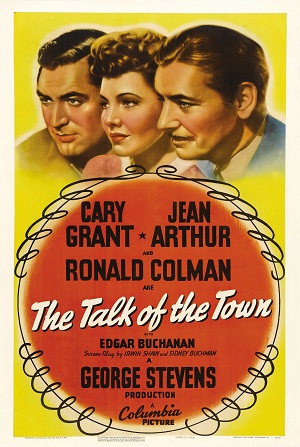
Cleaning Out The DVR, Again #4: The Talk of the Town (dir by George Stevens)


The_Talk_of_the_Town_dvd_cover

The fourth film on my DVR was the 1942 film, The Talk of the Town.  The Talk of The Town originally aired on TCM on March 20th and I recorded it because it was a best picture nominee.  As some of our regular readers undoubtedly know, it’s long been a goal of mine to watch and review every single film nominated for Oscar’s top prize.

The Talk of The Town is an odd little hybrid of comedy, melodrama, and a civics lecture.  Michael Lightcap (Ronald Colman) is a brilliant attorney and legal professor.  He’s been shortlisted for the Supreme Court and he’s also a widely read author.  In fact, he’s even rented a house for the summer, so that he may work on a book.  The owner of the house — teacher Nora Shelley (Jean Arthur) — will also be acting as his secretary.

As well-read as Prof. Lightcap may be, he’s also rather stuffy and out-of-touch with what’s going on outside of the world of academia.  He knows how the law should work but he has little understanding of how the law actually does work.  Fortunately, he gets a lesson in reality when he arrives at the house and eventually meets the gardener, Joseph (Cary Grant).  Joseph turns out to be surprisingly intelligent and very passionate about politics.  Lightcap and Joseph have many debates about whether or not the American legal system actually protects the working man.

What Lightcap doesn’t know is that Joseph is actually Leopold Dilg.  Leopold is a labor activist, the type who you always see in old documentaries, standing on a street corner and preaching about unions.  Leopold is also a fugitive.  He was accused of setting fire to a mill, a fire that apparently led to the death of the foreman.  Despite the fact that he loudly proclaimed his innocence, Leopold was arrested and prosecutors announced that they would seek the death penalty.  Convinced that he would never get a fair trial, Leopold escaped from jail and fled to Nora’s house.

Nora and Leopold went to school together.  They love each other, even though circumstances — mostly his political activism — conspired to keep them apart.  When Lightcap moves into the house, Nora and Leopold’s attorney, Sam (Edgar Buchanan), hope that they can convince him to take on Leopold’s case.  However, they also have to not only convince Leopold to reveal his true identity but also convince Lightcap to put his supreme court appointment at risk by defending a politically unpopular defendant.  Their solution is to trick Lightcap into falling in love with Nora and then convince him to take on the case for her.

However, Nora soons finds herself falling in love with Lightcap for real.  Who will she choose in the end?  Cary Grant or Ronald Colman?  Today, it seems like a pretty easy decision but apparently, in 1942, Columbia Pictures actually shot two different endings for the movie.

The Talk of The Town is an odd little movie.  For the most part, it’s a drama.  But it also has plenty of comedic elements, mostly dealing with the attempts to keep Leopold’s identity a secret.  In the end, it’s a little bit too preachy to really work as either a drama or a comedy.  That said, I still liked The Talk Of The Town because it made a strong case for the importance of due process, which is a concept that a lot of people take for granted.

(At the same time, The Talk of the Town was made in 1942 so you never have any doubt that Lightcap’s belief in the American legal system will eventually be vindicated.  With America having just entered World War II, 1942 was not a time for cynicism.  If Talk of the Town has been made in the 30s, it probably would have been a very different movie.)

Probably the best thing about Talk of the Town is the cast.  It may not be a great film but, when you’ve got Cary Grant and Jean Arthur in a scene together, it almost doesn’t matter.

The Talk of the Town was nominated for best picture but it lost to Mrs. Miniver.

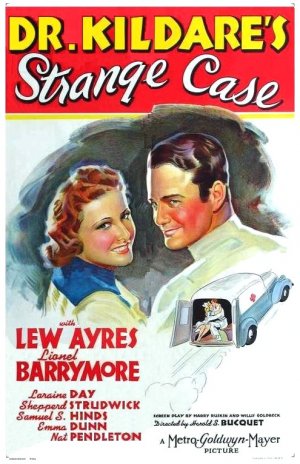
The Fabulous Forties #16: Dr. Kildare’s Strange Case (dir by Harold S. Bucquet)


Dr._Kildare's_Strange_Case_FilmPoster

The 16th film in Mill Creek’s Fabulous Forties box set was 1940’s Dr. Kildare’s Strange Case.  It’s about a doctor who investigates a medical case and wow, is it ever a strange case.

Apparently, there was a whole series of Dr. Kildare films that were released in the 30s and 40s.  I guess the films were the cinematic equivalent of a TV show like Grey’s Anatomy or ER or Children’s Hospital or… well, every medical show that’s ever shown up on TV since the beginning of time.  Dr. James Kildare (Lew Ayres) is a passionate young doctor who may break the rules but he gets results!  His mentor is Dr. Gillipsie.  Gillipsie is played by Lionel Barrymore and since the character is cranky and confined to a wheelchair, it was impossible for me to watch him without thinking about Mr. Potter from It’s A Wonderful Life.  Whenever Kildare went to him for advise, I kept expecting Gillipsie to glare at him and say, “You once called me a warped old man…”

Anyway, Dr. Kildare works in a hospital and, when he’s not silently judging everyone else that he works with, he’s busy silently judging the wealthy Dr. Lane (Sheppard Strudwick), a brain surgeon whose patients keep dying.  Kildare and Lane are also both in love with the same nurse, Mary Lamont (Laraine Day).  Mary wants to marry Kildare but Kildare would rather be poor and single than compromise his medical principles.  Lane, on the other hand, sends her a box full of silk stockings.  Plus, he’s rich!

Seriously, how is this even a competition?  Forget Kildare and marry Lane!

Except, as I mentioned earlier, all of Lane’s patients keep dying.  Is Lane incompetent or, as Kildare suggests, is it possible that brain surgery is just really, really hard?  I imagine it was even harder in 1940, when this movie was being made.  While Kildare and Lane are operating on brains, Dr. Gillipsie is still using leeches to suck sickness out of the poorer patients.

(You don’t actually see it happen in the movie but Gillipsie comes across as being a leech man.)

Anyway, eventually, Kildare has to cure a schizophrenic and it turns out that he can do this by putting the man into an insulin coma.  As is explained in great detail, forcibly putting a patient in a coma will cause that patient’s mind to go back to a reset point.  It’s kind of like how Windows sets up a restore point before doing a major update.

And that therapy sounds so crazy that you just know it had to be based in an actual practice.  I checked with Wikipedia and I was not shocked to discover that apparently Insulin Shock Therapy used to be a thing!

Anyway, Kildare’s gets into a lot of trouble for putting his patient into a coma and attempting to erase a huge part of his mind.  Will Kildare’s results vindicate his methods or will Gillipsie have to use leeches to suck the crazy out of the patient’s brain?

Watch the film to find out!  Or don’t.  Dr. Kildare’s Strange Case was directed by Harold S. Bucquet, who did a pretty good job with The Adventures of Tartu.  His direction here is flat and uninspired, which only serves to make this entire film feel like an old TV show.  I’m tempted to recommend the movie just because of the scene where it’s explained that insulin shock therapy causes patients to devolve so that they can re-evolve but otherwise, Dr. Kildare’s Strange Case is forgettable.

If you want to see it, you can watch it below!

http://www.youtube.com/watch?v=8UPFyrlNiGM

Or you can just watch this classic episode of Children’s Hospital!

http://www.youtube.com/watch?v=dpBjqgVaEbk