The Great Missouri Raid (1951, directed by Gordon Douglas)


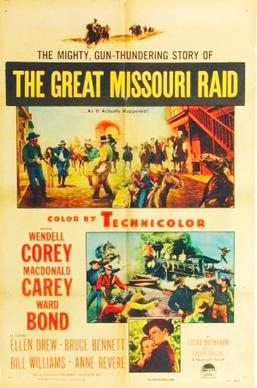
During the Civil War, brothers Frank (Wendell Corey) and Jesse James (Macdonald Carey) leave the family farm and fight as Confederate guerillas under the leadership of the infamous William Quantrill.  When the war ends with the Confederacy’s defeat, Frank, Jesse, and their friend Cole Younger (Bruce Bennett) return home to Missouri and discover that their town is being ruled over the tyrannical Major Towbridge (Ward Bond).  With their farms in ruin and having little opportunity to make honest money, the James Brothers and the Younger Brothers soon resort to robbing banks and trains.  It’s their revenge against not only the soldier occupying their land but also the bankers and land barons who have been taking advantage of their friends and family members.  The James-Younger Gang become heroes to economically oppressed people everywhere.

From the minute that they arrive home, Towbridge is determined to imprison the James brothers.  Not only does he distrust them because of their past with Quantrill but he also blames them for the death of his own brother.  Towbridge becomes so obsessed that he even leaves the army so that he can pursue Frank and Jesse as a private detective.  Even as it appears that Jesse might be on the verge of settling down and abandoning his criminal life, he still has to deal with unexpected visitors like the Ford brothers.

The story of Frank and Jesse James inspired several films, some of which were better than others.  Directed with a good eye for detail by Gordon Douglas, The Great Missouri Raid tells the familiar story with enough skill to be watchable but it never reaches the classic status of Walter Hill’s The Long Riders. 

The main problem is that both Wendell Corey and Macdonald Carey come across as being almost too civilized as the James brothers.  The film is obviously sympathetic to the James brothers and, as westerns tended to do in the 50s, it ignores some of the less heroic details of their lives of outlaws.  (The film, for instance, doesn’t mention that the James brothers were probably already outlaws before the Civil War started and it’s doubtful that a modern film would be as sympathetic to two men who left home to fight for the Confederacy.)  Usually, though, even the most sympathetic film portrayals of the James brothers still portray them as being the type of people who you wouldn’t necessarily want to meet while riding the trail.  Wendell Corey and Macdonald Carey play Frank and Jesse as being so nice that it’s hard to believe that they could have even rode with Quantrill, let along the Younger brothers.  They’re the most reasonable outlaws this side of the Mississippi.  Bruce Bennett and Bill Williams are more believable as the rough and tough Cole and Jim Younger.

Not surprisingly, the film is stolen by Ward Bond.  Bond usually played reasonable authority figures for John Ford and Frank Capra.  As Major Towbridge, though, he’s cast as a martinet who allows his obsession with James brothers to turn him into a fanatic.  For those who are used to only seeing Bond cast as a fair cop or a tough-but-fair military officer, his performance in The Great Missouri Raid is a revelation.

The Long Riders is the best movie about the James Gang but, for western fans, The Great Missouri Raid should be entertaining if not definitive.

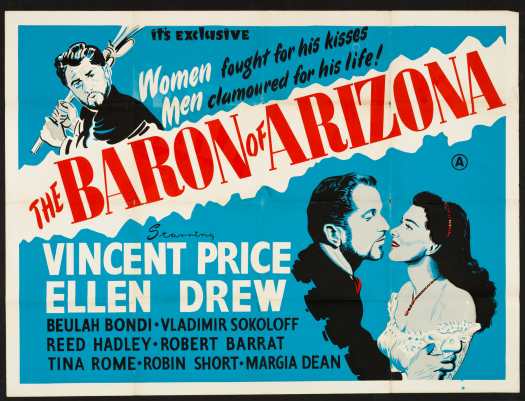
Monster Con: Vincent Price in THE BARON OF ARIZONA (Lippert 1950)


gary loggins's avatarcracked rear viewer

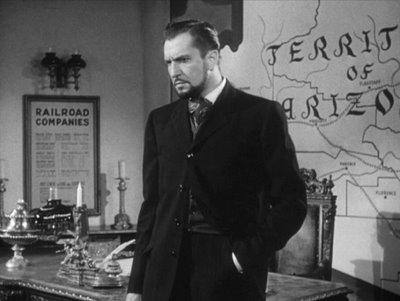
We all know and love Vincent Price for his creepy performances in horror films, from his demented Henry Jarrod in HOUSE OF WAX, to all those AIP/Roger Corman/Edgar Allan Poe shockers, to his turn as The Inventor in EDWARD SCISSORHANDS. But the actor was more than just a screen fiend, playing in many a filmnoir, comedies, costume swashbucklers, and even the Western genre. Our Man Vinnie got top billing in a strange little oater titled THE BARON OF ARIZONA, and as a bonus for film fans the director is a young tyro by the name of Samuel Fuller!

In this bloodless but gripping outing, Price plays James Addison Revis, a swindler, con man, and forger who  concocts an elaborate, grandiose scheme to gain control over the Arizona Territory in 1882. He begins his con game ten years earlier by grooming an orphaned waif named Sofia to later be…

View original post 545 more words

Jack in the Saddle: BUCK BENNY RIDES AGAIN (Paramount 1940)


gary loggins's avatarcracked rear viewer

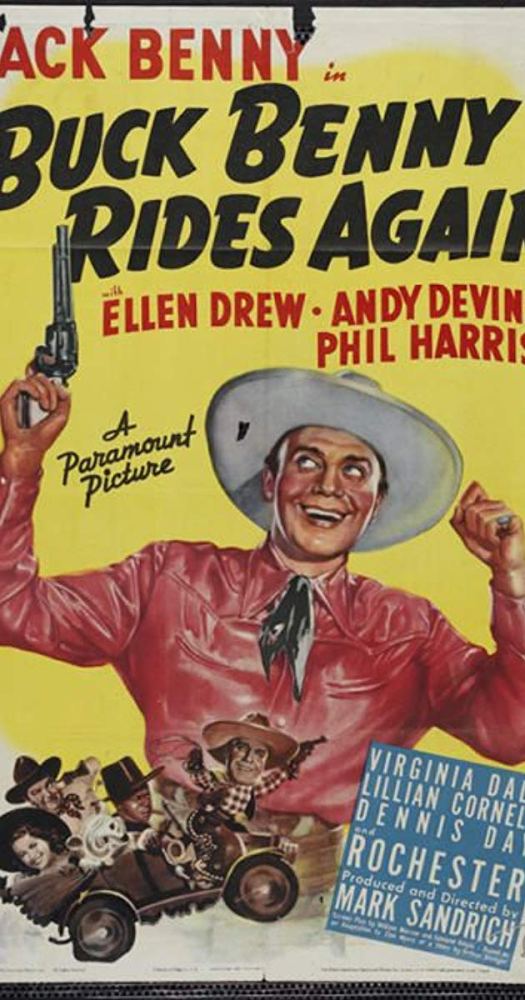
The gang’s all here in BUCK BENNY RIDES AGAIN – Jack Benny’s radio gang, that is! Eddie “Rochester” Anderson, announcer Don Wilson, band leader Phil Harris, comic actor Andy Devine, and crooner Dennis Day all show up for this fun-filled musical comedy romp directed by Mark Sandrich. Even Jack’s radio nemesis Fred Allen is heard (though not seen) cracking jokes at his rival’s expense!

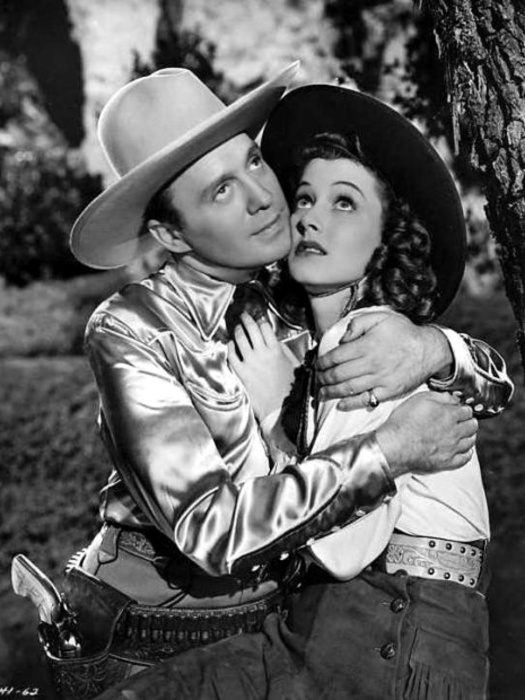
The movie plays like an extended sketch from one of Jack’s radio or TV programs, as the vain Jack falls for pretty Joan Cameron (Ellen Drew), one of a trio of singing sisters (the other two are Virginia Dale and Lillian Cornell) trying to break into show biz. They “meet cute” when Jack accidentally smashes into Joan’s taxi. Jack keeps flubbing his chances with Joan, who only goes for manly, rugged Western types (“I wouldn’t go out with him if he drove up in a sleigh…

View original post 381 more words

30 Days of Noir #29: Johnny O’Clock (dir by Robert Rossen)


The 1947 film, Johnny O’Clock, invites us to take a behind-the-scenes look at the sleazy and sordid world of casino management.  If that doesn’t intrigue you, just consider that the man character is named Johnny O’Clock.

Seriously, that’s a really kickass name.  I have to admit that, if my last name was O’Clock, I would be tempted to name my child Four Twenty.  But, that said, Johnny is a pretty good name too.  On the one hand, he’s got an all-American name like Johnny but he’s also got a last name — O’Clock — that promises mystery and danger.  Johnny O’Clock is also played by Dick Powell, who was always good at playing tough guys who had a heart of gold.  (Along with appearing in several noir films, Dick Powell was also the first actor to ever play the famed detective, Philip Marlowe.)

Johnny O’Clock is a partner in a casino with Guido Marchettis (Thomas Gomez).  Johnny and Guido are longtime business partners who find the future of their casino threatened when a hat-check girl named Harriet Hobson (Nina Foch) dies under mysterious circumstances.  Even though the crime scene was clearly set up to make it appear as if Harriet committed suicide, it doesn’t take Inspector Koch (Lee J. Cobb) long to figure out that Harriet was actually murdered.

Who killed Harriet?

Was it her boyfriend, Chuck Blayden (Jim Bannon)?  Chuck is a corrupt cop who has been trying to convince Guido to force Johnny out of the casino and instead hire Chuck instead.

Or is the murderer Guido’s wife, Nellie (Ellen Drew)?  Nellie used to be Johnny’s girlfriend and, as soon becomes obvious, she still has feelings for him.  When she attempted to give Johnny a romantic present, Johnny’s response was to give it to Harriet so that Harriet could return it.  Did Johnny’s rejection of Nellie push her over the edge and did she take her anger out on Harriet?

Or maybe the murderer was Guido.  Guido, after all, is a rather shady sort.  Maybe Harriet discovered something that she shouldn’t have.

Then again, you could also say the same thing about Johnny O’Clock….

Inspector Koch isn’t the only person determined to get to the truth!  Harriet’s sister, Nancy (Evelyn Keyes), also shows up and starts to investigate on her own.  Soon, she and Johnny are falling in love but Johnny knows that the situation is too dangerous for either him or Nancy to stick around the casino.  He starts to make plans to flee with her to South America but he’s got just a few things to do before they can leave….

Johnny O’Clock was the first film to be directed by Robert Rossen, who is often credited as being one of the most important filmmaers in development of American film noir.  A year after Johnny O’Clock was released, Rossen’s All The King’s Men would win best picture.  Rossen’s career was derailed when he was accused of being a communist and blacklisted in the 50s.  Like Elia Kazan, Rossen initially took the fifth but he later relented and “named names” to the House UnAmerican Activities Committee.  Though Rossen would later direct the Oscar-nominated The Hustler in 1962, it can be argued that Rossen’s career never recovered from either being blacklisted or from naming names.

Clocking in at 93 minutes, Johnny O’Clock is probably about 20 minutes too long and the murder mystery is never really as intriguing as you might hope it would be.  On the positive side, the casino is stylish and the cast is full of noir talent.  Dick Powell is a likable, if occasionally bull-headed, protagonist and Lee J. Cobb is well-cast as Inspector Koch.  (The film has some fun contrasting the glitz of the casino with the shabbiness of Koch.)  Burnett Guffey’s black-and-white cinematography gives the film a properly noirish look and, while the pace may be slow, the occasional bursts of action are well-handled.  The scene where Johnny is nearly the victim of a drive-by shooting is particularly exciting.  Johnny O’Clock is a flawed noir but the cast is good enough to hold the interest of fans of the genre.