Today would have been the 94th birthday of one of the greatest film stars of all time, Elizabeth Taylor!
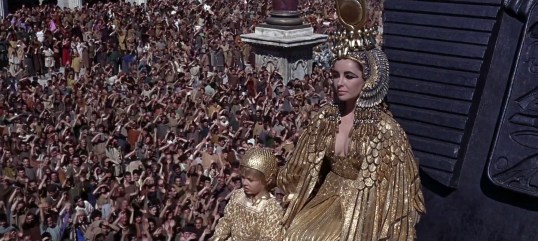
Today’s scene that I love comes from 1963’s Cleopatra. Cleopatra is often dismissed as the film that nearly bankrupted a studio but it’s enjoyable if you’re in the right mood and you’ve got four hours of free time. Elizabeth Taylor may not have been a historically accurate Cleopatra but who cares? It seems appropriate that the most glamorous woman of what was then the modern world played the most glamorous woman of the ancient world.
In this scene, Cleopatra arrives in Rome with all of the fanfare befitting the world’s most beautiful and powerful woman. Keep in mind that this scene was done in the days before AI. Every costume was real. Every extra was real. Everything about this scene was real.
4 Shots From 4 Films is just what it says it is, 4 shots from 4 of our favorite films. As opposed to the reviews and recaps that we usually post, 4 Shots From 4 Films lets the visuals do the talking!
Today is the birthday of one of the greatest films stars ever, Elizabeth Taylor! And you know what that means. It’s time for….
4 Shots From 4 Elizabeth Taylor Films
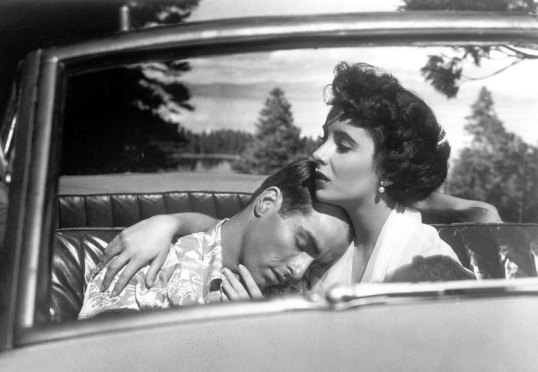
A Place in the Sun (1951, dir by George Stevens, DP: William C. Mellor)
Boom! (1968, dir by Joseph Losey, DP: Douglas Slocombe)
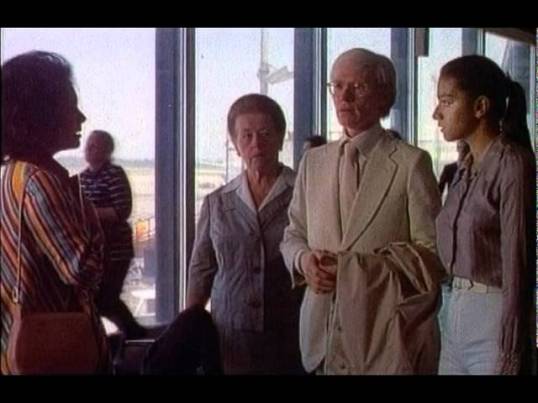
Night Watch (1973, dir by Brian G. Hutton, DP: Billy Williams)
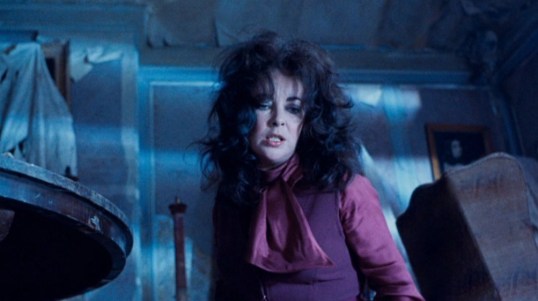
The Driver’s Seat (1974, dir by Giuseppe Patroni Griffi, DP: Vittorio Storaro)
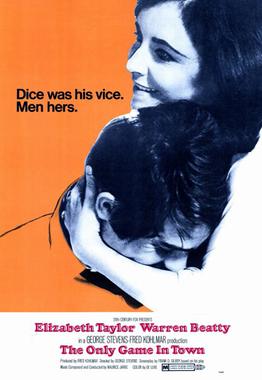
Fran Walker (Elizabeth Taylor) is an aging Vegas showgirl who has been abandoned by her married lover (Charles Braswell). A trip to a piano bar leads to her meeting pianist and gambling addict Joe Grady (Warren Beatty). Frank brings Joe home with her. Joe is trying to win $5,000 so he can leave Las Vegas and go to New York. Fran needs someone to keep her from going to back to her go-nowhere relationship. The two talk and talk. And talk.
Based on a play that closed after 16 performances, The Only Game In Town is memorable for being one of the most expensive theatrical adaptations ever produced. That’s because Taylor insisted on filming in Paris instead of Las Vegas. A set representing Fran’s tiny apartment (which is supposed to look cheap) was built on a Paris soundstage and the budget ballooned to a then unheard of $11,000,000. (By today’s standards, that would be a $90,461,391 budget for a film with two stars and only a handful of locations.) The Only Game In Town is also memorable for being the only film to feature both Elizabeth Taylor and Warren Beatty. Taylor and Beatty were actually close in age but Fran still seems to be several decades older than Joe. It was not the script’s intention but, due to the age difference, Joe comes across as being a gigolo. (Originally, Frank Sinatra was cast as Joe but he left while the sets were being made in France.) Finally, this was the final film to be directed by George Stevens, one of the great Golden Age directors who found himself struggling to keep up in a changing Hollywood. With its stagey set-up and it’s dialogue-heavy script, this film does not features Stevens’s best work.
The Only Game In Town was a huge flop when released, damaging Taylor’s already floundering career and making Beatty even more determined to eventually direct his own films. Seen today, Warren Beatty is actually pretty good in his role, even if he does come across as being too young. Elizabeth Taylor is not served well by any element of the film, from her matronly (but expensive) costumes or a script the encourages her to be shrill. The Only Game In Town was not one that anyone won.
4 Shots From 4 Films is just what it says it is, 4 shots from 4 of our favorite films. As opposed to the reviews and recaps that we usually post, 4 Shots From 4 Films lets the visuals do the talking!
Today is the birthday of one of the greatest films stars ever, Elizabeth Taylor! And you know what that means. It’s time for….
4 Shots From 4 Elizabeth Taylor Films
A Place in the Sun (1951, dir by George Stevens, DP: William C. Mellor)
Suddenly, Last Summer (1959, dir by Joseph L. Mankiewicz, DP: Jack Hildyard)
Cleopatra (1963, dir by Joseph L. Mankiewicz, DP: Leon Shamroy )
Boom! (1968, dir by Joseph Losey, DP: Douglas Slocombe)
Today would have been the 92nd birthday of one of the greatest film stars of all time, Elizabeth Taylor!
Today’s scene that I love comes from 1963’s Cleopatra. Cleopatra is often dismissed as the film that nearly bankrupted a studio but it’s enjoyable if you’re in the right mood and you’ve got four hours of free time. Elizabeth Taylor may not have been a historically accurate Cleopatra but who cares? It seems appropriate that the most glamorous woman of what was then the modern world played the most glamorous woman of the ancient world.
In this scene, Cleopatra arrives in Rome with all of the fanfare befitting the world’s most beautiful and powerful woman. Keep in mind that this scene was done in the days before CGI and — *shudder* — AI. Every costume was real. Every extra was real. Everything about this scene was real.
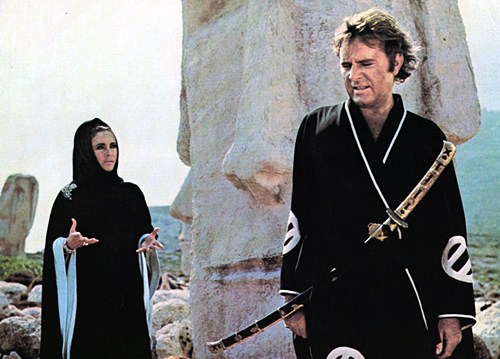
“Boom!” says poet Chris Flanders (Richard Burton) in the 1968 film of the same name. Boom, he goes on the explain, is the sound of life being lived. Every minute that we’re reminded that we’re still alive is a “Boom!” It’s the type of thing that 18 year-old artists say to get laid, though the film treats Chris’s comment with an almost supernatural reverence.
Chris has just shown up on an island that’s owned by Flora Goforth (Elizabeth Taylor), who is the richest woman in the world and who is apparently dying of one of those diseases that makes you lie in bed and yell a lot. Flora lives on the island with an entourage that includes a secretary named Miss Black (Joanna Shimkus) and a head of security named Rudi (Michael Dunn). Rudi is a dwarf and he dresses like a Nazi and often does a stiff-armed salute, just in case we missed the fact that he’s supposed to be a fascist. Why exactly Flora, who were supposed to sympathize with, would employ a Nazi, we never really find out. The film seems to think that there’s something extremely daring about casting a person of short statue as the head of Flora’s security though, ultimately, it’s about as profound as uttering “Boom!” every few minutes.
Anyway, Flora is dying but she’s also dictating her autobiography. It turns out that she’s rich because she married a lot of wealthy men, all of whom died and left her all of their money. Flora’s always in a bad mood but things improve a little when Chris mysteriously shows up on the island and starts saying, “Boom!” all the time. Flora and Chris have several conversations about life and the meaning of it all, the majority of which are full of obscure statements and half-baked attempts at being profound. The dialogue is pretentious but it’s also not very memorable, which is a shame. One can survive being pretentious but being forgettable is simply unforgivable.
Eventually, a friend of Flora’s shows up. Famed playwright Noel Coward plays The Witch of Capri, a flamboyant friend to the rich and famous. He loves to gossip and has a bitchy comment for every occasion. One could argue that Coward is merely playing himself, though one imagines that the real-life Coward could have also come up with a few genuinely witty lines. The Witch informs Flora that Chris has a habit of showing up at the bedside of rich women right before they die. Some people think that Chris is a gigolo while others believe Chris to be …. THE ANGEL OF DEATH!
(Dramatic music)
Which is it? Don’t worry, the answer is revealed by the end of the movie. Of course, it takes a while to get to the end. Boom! is two hours long but it feels much longer. Storywise, Boom! feels like it would be ideal as a 30-minute episode of some old anthology show but director Joseph Losey keeps the story moving at a very slow pace and there are so many dramatic pauses and unnecessary zoom shots that the film itself becomes a bit of an endurance test. Just when you think the movie is finally going to get moving, Chris says, “Boom!” or there’s an extreme close-up of Flora’s ring and everything slows down again.
Boom! is one of the many films that Richard Burton and Elizabeth Taylor made together in the 60s. Unfortunately, both actors are miscast in the lead roles. Flora is described as being old and sickly. Elizabeth Taylor was in her 30s and appeared to be in robust health during the shooting of the film. Chris Flanders is supposed to be in his 20s and a seeker of truth and enlightenment. Burton was in his 40s and looked like he was in his 60s. He spends most of the film looking and sounding as if he’s just come off a weekend bender, which makes him look all the more ludicrous when he hears the ocean and says, “Boom!”
On the plus side, the film is lovely to look at. Flora’s house is big and beautiful. The island scenery is gorgeous. Flora’s costumes are ludicrously ornate but still, they are what you would want to see an international movie star wearing in 1968. As such, the film is always nice to look at. In fact, perhaps the best way to watch Boom! is to turn down the sound so you don’t have to listen to any of the dialogue.
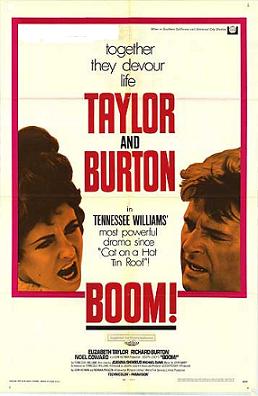
Boom! was based on a Tennessee Williams’s play called The Milk Train Doesn’t Stop Here Anymore. The filmmakers decided to change the name to Boom! and I really can’t blame them for that. This was Elizabeth Taylor’s third film to be based on a Tennessee Williams play. Unfortunately, it matched neither the critical nor the commercial success of Cat On A Hot Tin Roof or Suddenly, Last Summer.
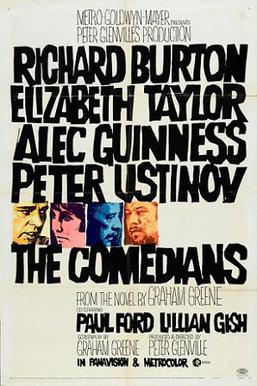
Richard Burton stars Mr. Brown (Richard Burton), a deeply cynical and world-weary Englishman who owns what passes for a luxury hotel in Haiti. Though Mr. Brown hopes to be able to sell the hotel and get out of Haiti, he is also having an affair with Martha (Elizabeth Taylor), the German wife of Pineda (Peter Ustinov), the ambassador from Uruguay. Mr. Brown tries to avoid politics, which it turns out is not easy to do when you’re living under a murderous regime.
Complicating Mr. Brown’s life is Major Jones (Alec Guinness), a retired British army officer who has come to Haiti to do business but who is promptly imprisoned when it’s discovered that he was invited to come to the island by a minister who was subsequently declared to be an enemy of the state. The fascist Captain Concasseur (Raymond St. Jacques) arrests Major Jones and Mr. Brown takes it upon himself to try to get Jones released. Unfortunately, Major Jones doesn’t quite understand how serious his situation is and he’s convinced the Haitians that he’s not only a brilliant military leader but that he can also arrange for them to receive a cache of weapons, which he claims he has hidden in a Miami warehouse.
Meanwhile, Mr. and Mrs. Smith (Paul Ford and Lillian Gish) have also arrived on the island, hoping to set up a vegetarian center in Haiti. (Mr. Smith even once ran for President of the U.S. as the candidate of the Vegetarian Party.) In many ways, Mr. and Mrs. Smith serve as a stand-in for clueless American activists, obsessing over minor issues while ignoring the larger problems that are right in front of their faces.
From the start, The Comedians establishes Haiti as being a dangerous place, a country where the people live in fear of the brutal police and where the poor struggle to survive day-to-day while their rulers live a life of luxury. It’s a place where political dissidents regularly disappear, though the police aren’t above murdering people in public as well. It’s a country where the State rules supreme, controlling the citizens through both fear and a fierce cult of personality. Rebels like Dr. Magiot (James Earl Jones) only want the country to be free but they know that, as long superpowers like America are supporting the regime, there’s little that the rebels can realistically hope to accomplish.
A major theme running through The Comedians is that the real suffering of the Haitian people is often overshadowed by the strategic concerns of the United States. Unfortunately, pretty much the same thing happens within the film itself. While there’s several black actors in supporting roles, the story focuses on the white characters and, as a result, it sometimes feels like the film’s message is less about the people being oppressed and more about how unfortunate it is that people like Brown, Jones, and the Smiths are being inconvenienced by it all. Like many similarly well-intentioned political films from the late 60s, The Comedians get so bogged down in all of the personal dramas that it loses sight of what’s actually the important part of the story. The film is often seems more interested in Brown and Martha’s affair than in the conditions that would lead to people like Dr. Magiot risking their lives to bring about change.
For the most part, it’s a well-acted film. Richard Burton’s natural self-loathing is put to good use and Alec Guinness has a few poignant scenes as a pathological liar who doesn’t realize how much trouble he’s actually in until it’s too late. (Guinness also has a scene where he wears blackface and pretends to be Burton’s maid. He does this in order to escape from the secret police and the film doesn’t treat it as being a joke but it’s still rather cringey to watch.) Elizabeth Taylor is miscast as Martha and her German accent comes and goes but Paul Ford and Lillian Gish do a good job playing clueless Americans. Perhaps the film’s strongest performance comes from Zakes Mokae, who doesn’t say much as a member of the secret police but who exudes menace every time that he’s on screen. Still, as well acted at it may be, the film is slowly paced and always seem hesitant about taking any position beyond a general sense that dictatorships are bad.
That said, there’s nothing wrong with reminding people that dictatorships are bad. That’s especially an important message today. The past few years have left me convinced that a lot of people secretly yearn for a dictatorship and would be willing to trade their freedoms for a false sense of security. Though the film may struggle dramatically, it’s still works as a warning about what true authoritarianism actually is.
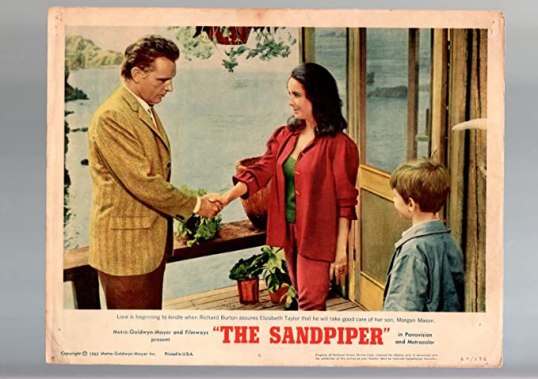
I recorded The Sandpiper that last time that it aired on TCM. This 1965 film is one of the many films that Elizabeth Taylor and Richard Burton made together after they fell in love during the making of Cleopatra. And while it’s true that Who’s Afraid of Virginia Woolf? won Taylor an Oscar and probably should have won one for Burton as well, the majority of the Taylor/Burton films were overproduced melodramas that often seemed as if they’d been rushed into production in order to capitalize on the couple’s tabloid popularity. Unfortunately, Virginia Woolf aside, neither Taylor nor Burton seemed to bring out the best in each other as actors.
The Sandpiper finds Taylor playing Laura Reynolds, an artist who lives in a California beach house with her young son, Danny (Morgan Mason). Laura is a free spirit who believes that everyone, including her son, should have the freedom to make their own choices. She is resistant to any and all authority. She’s a bohemian, a rebel, the type who doesn’t care what society has to say and who flaunts her refusal to follow the dictates of respectability. Good for her! However, she’s also Elizabeth Taylor, which means that she’s impossibly glamorous and even her “cluttered” beach house looks like it’s a hundred times more expensive than anything that anyone viewing the film will ever be able to afford. Though Taylor tries hard, there’s nothing convincingly bohemian about her.
Richard Burton plays Dr. Edward Hewitt, who runs the nearby Episcopal school. Dr. Hewitt is not a free spirit. Instead, he and his wife, Claire (Eva Marie Saint), very much believe in structure and playing by the rules. They believe in a traditional education and, when a judge orders Danny to be enrolled at their school, that’s what Hewitt plans to give him. This, of course, brings Hewitt into conflict with Laura. Both of them have differing ways of looking at the world and Laura is not a fan of religion in general. However, since they’re played by Burton and Taylor, they’re destined to fall in love and have a scandalous affair.
Dr. Hewitt is one of the many religious figures that Burton played throughout his career. In fact, Burton played so many alcoholic priests that I spent most of the movie assuming that Hewitt was an alcoholic as well. However, he’s not. He’s just Episcopalian. That said, Burton delivers every line of dialogue in his trademark “great actor” voice and every minute that he’s onscreen just seems to be full of self-loathing. Even before he cheats on his wife, Hewitt seems to hate himself. Of course, once Burton does start cheating on his wife, it only gets worse. The film presents Hewitt as being something of a hesitant participant, someone who knows that he’s doing the wrong thing but he simply cannot stop himself. Laura, meanwhile, is presented as being someone who is fully willing to break up a marriage to get what she wants. One gets the feeling that 1965 audiences probably just assumed they were watching the true story of how Taylor and Burton fell in love during the making the Cleopatra. That said, it’s all pretty tame. Just like Taylor, director Vincente Minnelli was too much of a product of the old Hollywood to truly embrace this story for all of its sordid potential.
If you’ve ever wanted to watch Charles Bronson debate religion with Richard Burton, this is the film for you. Bronson plays a sculptor and an atheist who upsets Hewitt by calling him “reverend.” Bronson is actually more convincing in the film than either Burton or Taylor, bringing a rough authenticity to his role. Whereas Burton and Taylor both seem to be going through the motions, Bronson comes across as if he actually has a personal stake in the film’s story. It’s not enough to save the movie, of course. Fortunately, a year later, Liz and Dick would be used to better effect in Who’s Afraid of Virginia Woolf?
The 1963 film, The V.I.P.s, is about a group of very important people who have all shown at Heathrow Airport at the same time, all in an effort to get the Hell out of England. They’ve all got their own individual reasons for wanting to leave the country but the important thing is that they all want to leave. Unfortunately, a fog has rolled onto the runway and the plane can’t take off. Because this film was made in 1963, all the passengers are allowed to leave the plane and wait, overnight, in a hotel.
Among the Very Important People:
Flamboyant film producer Max Buda (Orson Welles, playing a version of himself) needs to leave London before he receives a gigantic tax bill. Accompanying him is his latest discovery, Gloria Gritti (Elsa Martinelli). Max is the type who does things like barging into the plane’s cockpit and demanding to know why the pilots aren’t willing to risk crashing the plane. That may sound self-centered on Max’s part but Welles is such a charmer that you forgive him. Add to that, he’s trying to avoid paying taxes and that’s something that I can definitely get behind.
The Duchess of Brighton (Margaret Rutherford) is an eccentric but impoverished noblewoman who is going to lose her home if she doesn’t fly to Florida and take on a somewhat demeaning job. The Duchess is the type who struggles to find room in the overhead compartment for her ludicrous oversized hatbox. She’s never really been out in the real world before. Margaret Rutherford won an Oscar for her performance, which is occasionally amusing but never particularly subtle. (Have you seen Airport? Rutherford has the Helen Hayes role, basically.)
Lee Mangrum (Rod Taylor) is a businessman who is on the verge of losing his business. Miss Mead (Maggie Smith) is his secretary. Miss Mead is secretly in love with Lee, who somehow hasn’t noticed. We’re supposed to sympathize with Lee but he’s so incredibly clueless that it’s hard not to feel that Miss Mead could do better.
Finally, we have Frances Andros (Elizabeth Taylor). Frances is one of the most popular film stars in the world. She’s married to Paul Andros (Richard Burton), who is very wealthy and who, like most Burton characters, is also very moody. Frances has decided to leave Paul and go to America with her lover, Marc Champselle (Louis Jourdan). However, the fog gives Paul a chance to come to the airport and try to talk Frances out of leaving him.
Make no mistake about it, Liz Taylor and Burton are the main attraction here. Welles, Rod Taylor, Rutherford, and Smith all get plenty of scenes but it’s obvious that the people behind The V.I.P.s understood that most of the audience would be there to watch Liz and Burton acting opposite each other. This was, I think, the first film that they made together after falling in love on the set of Cleopatra. Due to Cleopatra’s legendarily difficult production, it was released around the same time as The V.I.P.s, despite going into production years before the latter film. Audiences could go watch Liz and Dick fall in love in Cleopatra and then head over to a different theater and watch the two of them fight in The V.I.Ps. Elizabeth Taylor may be playing Frances Andros and Richard Burton may be playing Paul Andros but they really might as well be playing themselves.
The V.I.P.s is a big and glossy film, the type of movie that the Hollywood studios used to make as their way of saying, “See! You won’t get this on TV!” It’s frequently silly but it’s also undeniably watchable. While Burton and Taylor’s later films tended to feature the two of them at their worst, they’re both actually really good in The V.I.P.s and the scenes where they argue have an emotional heft to them that, with the exception of Who’s Afraid of Virginia Woof?, wasn’t found in their other films. For once, you watch the film and you really do hope that Liz and Dick will work things out and stay together. The V.I.P.s may be dated (just try to chase someone through an airport or get off a delayed flight now) but it’s still entertaining.
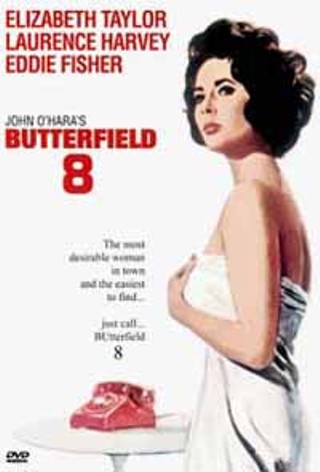
“Mama, face it,” Gloria Wandrous (Elizabeth Taylor) announces in the 1960 film, BUtterfield 8, “I was the slut of all time!”
Personally, I think Gloria is being a little bit too hard on herself. Certainly the film suggests, in its 1960 way, that she’s promiscuous and that she only sleeps with men for money but that doesn’t necessarily make her the slut of all time. For one thing, I would think that the slut of all time would have more options than just a wimpy pianist played by Eddie Fisher or a depressing, self-absorbed businessman played by Laurence Harvey.
“I still say it stinks,” Elizabeth Taylor said, almost immediately after winning her first Oscar for her performance in BUtterfield 8 and she’s kind of right. BUtterfield 8 is not a particularly good film, though not quite as bad as Taylor seemed to believe it to be.
Taylor won the Oscar after suffering a near fatal bout of pneumonia and having to undergo a tracheotomy. Along with saying that the film stunk, Taylor also often said that she only won her first Oscar because she nearly died. That may or may not be true but the thing is, Taylor’s the best thing in this overwritten and overheated mess of a movie. She certainly gives a better and more sympathetic performance than Laurence Harvey, who is cast as her married lover, Wilson Liggett. We’re meant to sympathize with Ligget but Harvey plays him as if he’s in a permanently sour mood and, after just a few minutes of listening to him bitch about every little thing, the viewer will get sick of him. It’s hard to really see what Gloria Wandrous sees in this whiny alcoholic.
Then again, the only other option that the film gives Gloria is Steve Carpenter, the pianist played by Eddie Fisher. Steve can’t decide if he’s in love with his boring girlfriend, Norma (Susan Oliver) or if he’s in love with Gloria. However, Steve has no problem letting Gloria borrow one of Norma’s dresses so that she can wear it when she goes home to visit her mother and I have to say that if I was Norma, Steve would be finding a new bed to sleep in after that. Gloria tells Steve that he needs to decide who he’s in love with but Steve jut can’t do it. Of course, in real life, Eddie Fisher left Debbie Reynolds so that he could marry Elizabeth Taylor. (A year or so later, Taylor left Fisher so that she could marry Richard Burton.)
BUtterfield 8 is one of those films that was undoubtedly considered to be daring when it was first released, seeing as how it acknowledged that people had sex without getting married first. (GASP!) Of course, though the film acknowledges that people have sex, it still makes sure to let us know that no one’s happy afterwards and that promiscuity eventually leads to death. (I mean, BUtterfield 8 may have taken risks but it still knew better than to defy the production code.) Seen today, the entire film is rather tame, talky, and slow but the star power of Elizabeth Taylor still comes through. The film opens with a lengthy sequence of Gloria getting ready for her day and, as you watch it and, more importantly, as you watch Elizabeth Taylor, you find yourself thinking that this is what a movie star is supposed to be. She dominates the film and she manages to credibly deliver even the most overheated pieces of dialogue. (Just try to imagine Jennifer Lawrence delivering the “slut of all time” line and you’ll immediately understand the difference between the movie stars of the past and the movie stars of the present. Of course, you could also say the same thing about trying to imagine a young Elizabeth Taylor in Silver Linings Playbook or The Hunger Games.) In fact, one could argue that Taylor’s performance is almost too good for the material. The film, in its 1960 way, suggests that Gloria would be better off if she just settled down but it’s impossible to imagine Taylor’s Gloria Wandrous settling for the stiffs played by Laurence Harvey and Eddie Fisher.
Though Elizabeth Taylor was correct about BUtterfield 8‘s overall quality, it’s still a good example of what star power can do for an otherwise mediocre film.




 Through the Shattered Lens