30 Days of Noir #16: I Was A Communist For The FBI (dir by Gordon Douglas)


The 1951 noir, I Was A Communist For The FBI, tells the story of Matt Cvetic (Frank Lovejoy).  The film could just as easily be called I Hate Matt.

Seriously, from the minute we first see Matt, he’s got people hating on him.  When he goes to visit his mother, his three brothers all make it clear that he’s not welcome in their house.  When he goes to the local high school to find out why his son has been getting into fights, the principal is cold and rude to him.  Even worse, his son announces that it’s all Matt’s fault!  When Matt goes to his job at a Pittsburgh steel mill, the other members of his union view him with a mix of suspicion and resentment.  When Matt attempts to give his neighbor’s son some batting tips, the boy’s father tells Matt to get away from his child and adds, “Baseball is an American game!”

As you may have guessed from the film’s title, Matt is a communist.  He’s been a member of the Communist Party for nine years and, during that time, he’s seen a lot of bad things.  He’s met wth the shady spies who secretly deliver Russian orders to their comrades in the U.S.  He’s watched as communist leader Jim Blandon (James Millican) has plotted to sow discord among otherwise loyal Americans.  He’s watched as unions have been taken over and money has been raised on the backs of the workers.  If there’s anything that Matt understands about communism, it’s that the majority of its leaders care little about the people that they claim to represent.

Because Matt’s a communist, he basically can’t go anywhere without someone calling him “a dirty red” or a traitor to his country.  However, it quickly becomes apparent that not even his fellow communists trust him.  When Matt leaves one clandestine meeting, he’s followed until he reaches home.  In order to test Matt’s ideological purity, Jim Blandon orders a school teacher named Eve Merrick (Dorothy Hart) to get to know him.  We’re told that Eve is one of many communists who have managed to land a job teaching the children of America.

As you’ve probably once again guessed just by looking at the film’s title, the communists have good reason to be suspicious of Matt.  For 9 years, Matt has been working undercover.  As much as it tears him up that he can’t even tell his family the truth, Matt is determined to do what he has to do to keep America safe.  Sadly, that means that Matt has to be a pariah.  He has to deal with his “comrades” showing up at his own mother’s funeral and sarcastically mocking her religious faith.  When his own brother punches him, he has to accept it and lie about  being “a communist and proud of it!”  As he explains it, the fact that his son hates his “communist” father just makes Matt love his son all the more….

I Was A Communist For The FBI is an interesting film.  On the one hand, it’s a very easy film to criticize.  Yes, it’s totally heavy-handed, to the extent that the film even ends with the Battle Hymn of the Republic playing in the background.  Yes, Frank Lovejoy is a bit on the bland side in the lead role.  Yes, the film does seem to be making the argument that some people are more deserving of civil liberties than others.  As someone who believes in individual freedom above all else, it’s hard for me not to take issue with the way the film glorifies not only the FBI but also government overreach in general.

And yet, it’s a very well-made film.  Director Gordon Douglas hits all the right noir notes, from the shadowy streets to the pervasive sense of unease and paranoia.  James Millican is wonderfully villainous as Jim Blandon and Dorothy Hart also gives a good performance as Eve.  The film itself portrays the communist leadership as being more concerned with profit than ideology.  At one meeting, they brag about how much money they’ve made by infiltrating the unions.  In another meeting, Blandon orders one of his stooges to start promoting fascism, the idea being to divide Americans into two extremist camps and then wait for them destroy themselves.  When the communists start a riot during a labor strike, they attempt to blame it on a Jewish newspaper.  When they’re not fanning the flames of antisemitism, they’re causally using the “n-word.”  Again, it’s all very heavy-handed but, at the same time, it’s also a reminder that there will always be grifters who will attach themselves to any ideological movement, hoping to enrich themselves off of the idealism of others.  In our current hyperpolitical climate, that’s an important lesson to remember.

Finally, if nothing else, I Was A Communist For The FBI is very much a document of its time.  It was based on a true story, though how close it sticks to the actual facts of the case I won’t venture to guess.  Oddly enough, it received an Oscar nomination for Best Documentary, even though it’s clearly not a documentary.  Don’t ask me how to explain that one.  It’s a strange world.
http://www.youtube.com/watch?v=R8zhmCjV71w

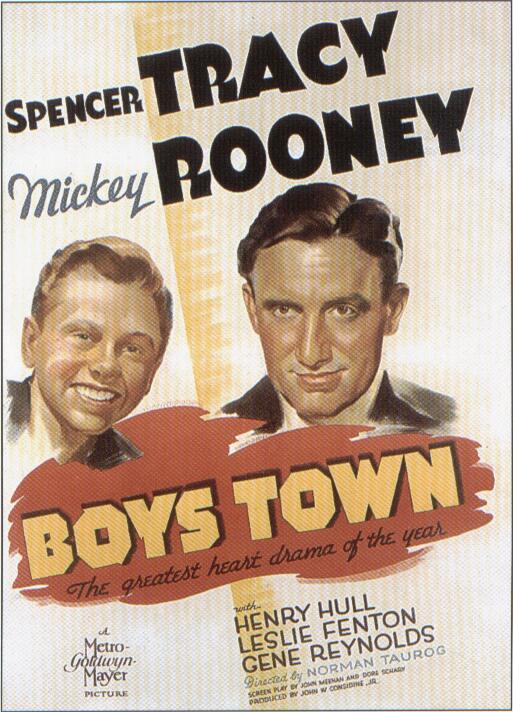
Lisa Reviews An Oscar Nominee: Boys Town (dir by Norman Taurog)


boys_town

Before writing about the 1938 film Boys Town, I want to share a story that might be false but it’s still a nice little story.  Call this an Oscar Urban Legend:

Boys Town is about a real-life community in Nebraska, a home for orphaned and homeless boys that was started by Father Edward Flanagan.  In the film, which was made while Father Flanagan was still very much alive, he was played by Spencer Tracy.  Boys Town was a huge box office success that led to the real Boys Town receiving a lot of favorable publicity.  When Tracy won his Oscar for Boys Town, his entire acceptance speech was devoted to Father Flanagan.

However, a problem arose when an overeager PR person at MGM announced that Spencer Tracy would be donating his Oscar to Boys Town.  Tracy didn’t want to give away his Oscar.  He felt that he had earned it through his acting and that he should be able to keep it.  Tracy, the legend continues, was eventually persuaded to donate his Oscar on the condition that he would get a replacement.

However, when the replacement arrived, the engraving on the award read, “Best Actor — Dick Tracy.”

That’s a fun little story, one that is at least partially true.  (Tracy’s Oscar — or at least one of them — does currently reside at the Boys Town national headquarters.)  It’s also a story that, in many ways, is more interesting than the film itself.

Don’t get me wrong.  Boys Town is not a bad movie.  For me, it was kind of nice to see a movie where a priest was portrayed positively as opposed to being accused of being a pederast.  In a way, Boys Town serves as a nice counterbalance to Spotlight.  But, with all that said, there’s not a surprising moment to be found in Boys Town.  It’s pretty much a standard 1930s juvenile delinquency melodrama.

The movie opens when Father Flanagan giving last rites to a man who is about to be executed.  (Boys Town takes a firm stand against the death penalty, which is one of the more consistent and laudable stands of the modern Church.)  The man says the he never had a chance.  From the time he was a young boy, he was thrown into the reform school system.  Instead of being reformed, he just learned how to be a better criminal.  Father Flanagan is so moved by the doomed man’s words that he starts Boys Town, under the assumption that “there’s no such thing as a bad boy.”

Father Flanagan’s techniques are put to the test when Whitey Marsh (Mickey Rooney ) arrives.  Whitey is angry.  He’s rebellious.  He tries to run away every chance that he gets and, during one such escape attempt, he even gets caught up in a bank robbery.  Can Father Flanagan reach Whitey and prove that there’s no such thing as a bad boy?

Well, you already know the answer to that.  As I said, there’s really nothing surprising to be found in the plot of Boys Town.  It’s just not a very interesting movie, though there is a great shot of a despondent Whitey walking past a several lines of former juvenile delinquents, all kneeling in prayer.  As Father Flanagan, Spencer Tracy is the ideal priest but his role is almost a supporting one.  Believe it or not, the film is dominated by Mickey Rooney, who gives a raw and edgy performance as the angry Whitey Marsh.

(That said, it’s hard to take Whitey seriously as a future gangster when he’s always wearing a bowtie.  Then again, that may have been the height of gangster style in 1938.)

Boys Town was nominated for best picture but lost to You Can’t Take It With You.

Shattered Politics #2: They Won’t Forget (dir by Mervyn LeRoy)


they_won_t_forget-582401011-large

The title of the 1937 film They Won’t Forget works on many levels.

It describes the reaction of a small Southern town, following the brutal murder of teenager Mary Clay (played, in her film debut, by Lana Turner).  The town won’t forget Mary and they won’t forget the terror caused by her murder.  They also won’t forget that local teacher Robert Hale (Edward Norris) was accused of the crime.

The district attorney, Andrew Griffin (Claude Rains), hopes that the people of his state won’t forget his efforts to see Griffin convicted of that crime.  Griffin wants to be elected to the U.S. Senate and he knows that the high profile case could be just what his career needs.

The Governor (Paul Everton) knows that, if he steps into the case and acts on his suspicion that Hale is innocent, the voters of his state will never forget.  And they certainly won’t be willing to forgive.

And, on a larger level, the title lets us know that the South and the North will never forget the Civil War and the conflict between the two regions.  The film opens with three elderly veterans of the Confederate Army, preparing to march in the town’s annual Confederate Memorial Day parade and admitting to each other that, after all these years, it’s difficult to remember much about the war other than the fact that they’re proud that they fought in it.

It’s while the rest of the town is busy watching Griffin and the governor ride in the parade that Mary Clay is murdered.  It’s easy to assume that Hale was the murderer because Hale was one of the few townspeople not to go to the parade.  You see, Hale is originally from New York City.  When he’s accused of murder, it’s equally easy for Griffin and tabloid reporter William A. Brock (Allyn Joslyn) to convince the town people to blame this Northern intruder for both the murder of Mary Clay and, symbolically, for all of the post-Civil War struggles of the South itself.

Meanwhile, up North, Hale is seen as a victim of the South’s intolerance.  A high-profile lawyer (Otto Kruger) is sent down to defend Hale but, as quickly becomes clear, everyone involved in the case is more interested in refighting the Civil War than determining the guilt or innocence of Andrew Hale.

They Won’t Forget is a hard-hitting and fascinating look at politics, justice, and paranoia.  It’s all the more interesting because it’s based on a true story.  In 1913, a 13 year-old girl named Mary Phagan was murdered in Atlanta.  Leo Frank was accused and convicted of the murder.  (In Frank’s case, he was born in Texas but was also Jewish and had previously lived in New York before moving to Atlanta, all of which made him suspicious in the eyes of many.)  On the word of a night watchmen, who many believe was the actual murderer of Mary Phagan, Leo Frank was convicted and sentence to death.  After spending days reviewing all of the evidence and growing convinced that Frank had been wrongly convicted, Georgia’s governor committed an act of political suicide by commuting Frank’s sentence to life imprisonment.  Leo Frank was subsequently lynched and the man who had prosecuted the case against him was subsequently elected governor.

Well-acted and intelligently directed, They Won’t Forget is probably one of the best films of which few people have heard.  Fortunately, it shows up fairly regularly on TCM and, the next time that it does, be sure to watch.  It’s a great film that you won’t easily forget.