Today, in honor of what would have been the birthday of French director Jean-Luc Godard’s birthday, our scene of the day comes from Godard Alphaville, a 1965 film that mixed philosophy with science fiction and film noir.
Let’s talk about love.
Today, in honor of what would have been the birthday of French director Jean-Luc Godard’s birthday, our scene of the day comes from Godard Alphaville, a 1965 film that mixed philosophy with science fiction and film noir.
Let’s talk about love.
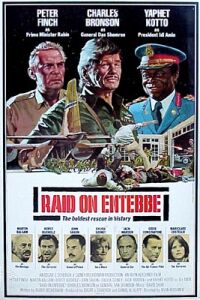 On June 27th, 1976, four terrorists hijacked an Air France flight and diverted it to Entebbe Airport in Uganda. With the blessing of dictator Idi Amin and with the help of a deployment of Ugandan soldiers, the terrorists held all of the Israeli passengers hostage while allowing the non-Jewish passengers to leave. The terrorists issued the usual set of demands. The Israelis responded with Operation Thunderbolt, a daring July 4th raid on the airport that led to death of all the terrorists and the rescue of the hostages. Three hostages were killed in the firefight and a fourth — Dora Bloch — was subsequently murdered in a Ugandan hospital by Idi Amin’s secret police. Only one commando — Yonatan Netanyahu — was lost during the raid. His younger brother, Benjamin, would later become Prime Minister of Israel.
Raid on Entebbe, a docudrama about the operation, was originally produced for NBC though it subsequently received an overseas theatrical release as well. It’s an exciting tribute to the bravery of both the hostages and the commandos who rescued them. Director Irvin Kershner directs in a documentary fashion and gets good performances from a cast full of familiar faces. Charles Bronson, James Woods, Peter Finch, Martin Balsam, Stephen Macht, Horst Buchholz, Sylvia Sidney, Allan Arbus, Jack Warden, John Saxon, and Robert Loggia show up as politicians, commandos, terrorists, and hostages and all of them bring a sense of reality and humanity to their roles.
The film’s best performance comes from Yaphet Kotto, who plays Idi Amin as a strutting buffoon, quick to smile but always watching out for himself. In the film, Amin often pays unannounced visits to the airport, where he lies and tells the hostages that he is doing his best to broker an agreement between the terrorists and Israel. The hostages are forced to applaud Amin’s empty promises and Amin soaks it all up with a huge grin on his face. Forest Whitaker may have won the Oscar for Last King of Scotland but, for me, Yaphet Kotto will always be the definitive Idi Amin.
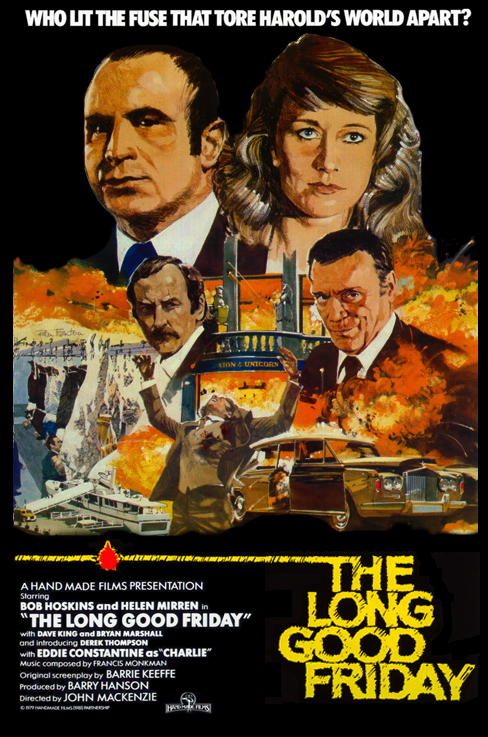
Today, the film community woke up to the news that British actor Bob Hoskins passed away on the 29th. He was 71 years old. Over the course of his career, he appeared in over 100 films and is well-remembered for performances in everything from Brazil to Who Framed Roger Rabbit? to Spiceworld to Felecia’s Journey to Made in Dagenham. However, perhaps his best performance is to be found in a film that’s still not very well-known here in the States.
In 1980’s The Long Good Friday, Bob Hoskins plays Harold Shand. Harold is a crude, violent, and ruthless London gangster who, at the same time, remains oddly likable. Perhaps his likability is due to the fact that, for all of his sociopathic tendencies, Harold does seem to be genuinely devoted to his girlfriend Victoria (Helen Mirren). Or perhaps it’s because Harold is a fighter, a man who refuses to surrender and, as a result, has managed to make something of himself in one of the most rigidly class-conscious countries in the world. Say what you will about his methods, gangster Harold is still more honest than your typical businessman.
However, ultimately, the main reason we root for Harold is because he’s played by Bob Hoskins. Hoskins turns Harold into a true force of a nature, playing him as manic, charismatic, and — as the film progresses — more and more desperate. The genius of Hoskins performance isn’t that he suggests that Harold isn’t as smart as he thinks he is. The genius is that Hoskins lets us know that, despite all of his bluster, Harold understands that he’s not as smart as he’s pretending to be.
As the film opens, Harold is the most powerful man in the London underworld and is on the verge of staking his claim on the legitimate world as well. All he has to do is convince an American gangster (played by Eddie Constantine) to agree to partner with him on a real estate deal.
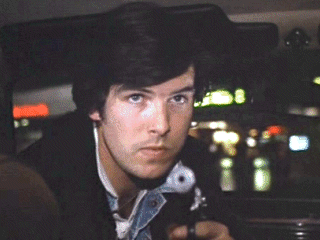
However, two assassins (one of whom is played by a silent and devilishly handsome Pierce Brosnan) are killing his associates. Somebody is blowing up his businesses. Even as Harold desperately tries to impress his American guests, he finds himself under siege by an unknown enemy. At first, Harold assumes that a rival gangster is coming after him but, as the day progresses, it becomes evident that there’s a new threat to Harold’s power.
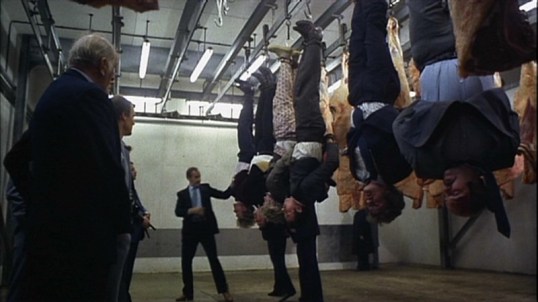
Without Bob Hoskins’ performance, The Long Good Friday is an entertaining gangster film, one that is distinguished by John MacKenzie’s sure direction, Francis Monkman’s energetic and powerful score, and an absolutely perfect final scene. With Hoskins’ performance, The Long Good Friday is one of the best gangster films ever made.
And, as today, it’s a tribute to a truly talented actor.
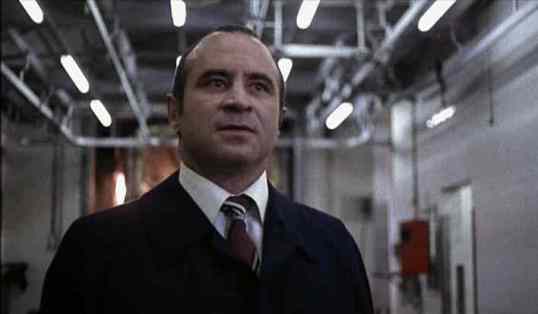
Bob Hoskins, R.I.P.

Sometimes, believe it or not, I feel very insecure when I come on here to talk about movies because, unlike most of my fellow writers and the site’s readers, I’m actually pretty new to the world of pop culture and cult films. Up until 8 years ago, ballet was my only obsession. It was only after I lost that dream that I came to realize that I could feel that same passion for other subjects like history and writing and movies. In those 8 years, I think I’ve done a fairly good job educating myself but there’s still quite a bit that I don’t know and, at times, I’m almost overwhelmed by all the movies that I’ve read so much about but have yet to actually see. And don’t even get me started on anime because, honestly, my ignorance would simply astound you. What I know about anime — beyond Hello Kitty — is pretty much limited to what I’ve read and seen on this site. (I do know what a yandere is, however. Mostly because Arleigh explained it to me on twitter. I still don’t quite understand why my friend Mori kept using that as her own personal nickname for me back during my sophomore year of college but that’s a whole other story…)
The reason I started soul searching here is because I’m about to review a book — The Eurospy Guide by Matt Blake and David Deal — that came out in 2004 and I’m about to review it as if it came out yesterday. For all I know, everyone reading this already has a copy of The Eurospy Guide in their personal collection. You’ve probably already spent 6 years thumbing through this book and reading informative, lively reviews of obscure movies. You may already know what I’ve just discovered. Well, so be it. My education is a work in progress and The Eurospy Guide has become one of my favorite textbooks.
The Eurospy Guide is an overview of a unique genre of films that started in the mid-60s and ended with the decade. These were low-budget rip-offs — the majority of which were made in Italy, Germany, and France — of the Sean Connery-era James Bond films. These were films with titles like Code Name: Jaguar, Secret Agent Super Dragon, More Deadly Than The Male, and Death In a Red Jaguar. For the most part, they starred actors like George Nader, Richard Harrison, and Eddie Constantine who had found the stardom in exploitation cinema that the mainstream had never been willing to give to them. They featured beautiful and underappreciated actresses like Marilu Tolo and Erika Blac and exotic, over-the-top villainy from the likes of Klaus Kinski and Adolfo Celi. Many of these films — especially the Italian ones — were directed by the same men who would later make a name for themselves during the cannibal and zombie boom of the early 80s. Jess Franco did a few (but what genre hasn’t Jess Franco experimented with) and even Lucio Fulci dabbled in the genre. Their stories were frequently incoherent and, just as frequently, that brought them an undeniably surreal charm.
And then again, some of them were just films like Operation Kid Brother, starring Sean Connery’s younger brother, Neil. (Operation Kid Brother was an Italian film, naturally.)
Well, all of the films — from the good to the bad (and no, I’m not going to add the ugly) — are covered and thoroughly reviewed in The Eurospy Guide. Blake and Deal obviously not only love these films but they prove themselves to be grindhouse aficionados after my own heart. Regardless of whether they’re reviewing the sublime or the ludicrous, they approach each film with the same enthusiasm for the potential of pure cinema run amuck. It’s rare to find reviewers who are willing to pay the same respect to a film like The Devil’s Man that they would give to a sanctioned classic like The Deadly Affair.
Along with reviewing a countless number of films, Deal and Blake also include two great appendices in which they detail the review some of the film franchises that came out of the genre and provide biographies of some of the more prominent stars of the eurospy films.
The highest compliment I can pay to The Eurospy Guide is that, even with all the various films guides I own (and I own a lot), I found films reviewed and considered in this book that I haven’t found anywhere else. Everytime I open this book, I learn something that, at least to me, is new. The book was an obvious labor of love for Blake and Deal and I love the results of their labor.
So, if you already own a copy, you rock.
And if you don’t, order it.
 Through the Shattered Lens