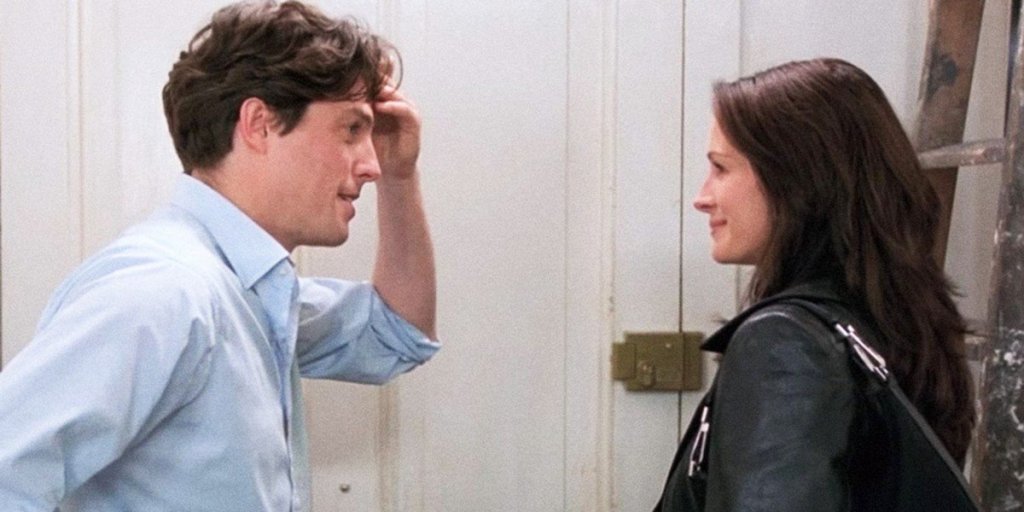
Life takes an unexpected turn for the reserved Englishman William Thacker (Hugh Grant) when the hugely popular American movie star Anna Scott (Julia Roberts) wanders into his humble little travel book shop in the district of Notting Hill in West London. When the initial meeting is followed up by some coincidentally spilled orange juice and an unexpected kiss, William finds himself completely smitten. After Anna leaves, and still in a state of disbelief, William struggles focusing on his normal life with his eccentrically odd flat mate Spike (Rhys Ifans). When Anna surprisingly reaches back out to him wanting to get back together, the sweet and shy William is ecstatic, but he remembers that he’s already obligated himself to attend his sister Honey’s (Emma Chambers) birthday party that night. Wanting to be part of something normal, Anna goes to the party as William’s date, where she has a wonderful, relaxing evening with Honey and their close-knit group of best friends that includes Max (Tim McInnerny), Bella (Gina McKee) and Bernie (Hugh Bonneville), even if she did give them quite the shock when she walked through the door. Everything seems to be going beautifully, but the life of an international film icon tends to be complicated, and William soon finds himself caught up in a whirlwind that includes her “boyfriend,” the arrogant American actor Jeff King (Alec Baldwin). He’s not really her boyfriend anymore, but that seems of little consequence to the press. And then there’s the sudden emergence of racy pictures of Anna from her past in the British tabloids. As much as William loves Anna, will he ever be able to deal with life in Anna’s superstar spotlight?
NOTTING HILL is part of a trilogy of modern-day love stories that I’m sure to watch every year, with the other two being RETURN TO ME (2000) and HITCH (2005). I’ve noticed that these three movies have plot points in common that I find extremely appealing. First, both NOTTING HILL and RETURN TO ME feature main characters who have a group of loyal family and friends who offer uncompromising love and support. William Thacker’s sister and friends clearly care about him and want what’s best for him. If necessary, they’re willing to prove it by being honest with him when he’s unwilling to be honest with himself. One of the best scenes of the film occurs near the end when William tells his group of friends that he’s turned down Anna’s request to continue their relationship, even after she says the famous lines, “I’m also just a girl, standing in front of a boy, asking him to love her.” While his friends struggle to find the right words, the flaky Spike, played superbly by Rhys Ifans, rushes into the meeting and when asked his opinion, says these three words to William, “You daft prick!” A memorable song on the movie’s excellent soundtrack reminds us sometimes that “you say it best when you say nothing at all,” but sometimes words need to be spoken, and Spike cares enough to tell William what he needs to hear. I’ve said it before, but I love it when a movie surrounds its characters with the type of people we’d love to have in our corner in real life. Second, both NOTTING HILL and HITCH feature plot lines that show a “star” falling for a sweet nobody. Maybe it’s because I’m a nobody myself, but the idea of the rich and powerful falling in love with regular people like me always strikes a nerve. Sure, it may be a fantasy, but it’s a fantasy I’m perfectly willing to roll with.
As far as I’m concerned, Julia Roberts and Hugh Grant have never been more appealing than they are in NOTTING HILL. Julia is so beautiful, and I fell in love with her myself for the first time when I watched this movie at the theater in 1999. There are scenes where William is watching Anna Scott on the big screen and the small screen, whether it be a love story or a science fiction movie, and he’s clearly in complete awe of her. As a film buff going back to my early teens, I can relate so easily to his character, whether it be my crush on Elizabeth Shue in the 80’s or Salma Hayek in 90’s. Heck, as recently as a couple of years ago, after interviewing the lovely Jan Gan Boyd who starred with Charles Bronson in ASSASSINATION (1987), I can still identify with a man completely smitten with a beautiful actress. And Hugh Grant is so sweet, witty and funny as William Thacker. This was a big film for Grant, as a few years earlier his promising Hollywood career had somewhat stalled due to his arrest on Sunset Strip in Los Angeles for “lewd conduct in a public place” with a prostitute named Divine Brown. With the irony not lost on me, if you’ve seen NOTTING HILL before you’ll understand that my inclusion of this matter of public record proves the character of Anna Scott to be correct when she explains to William just how difficult it can be to live life in the public eye. Regardless of all that, Hugh Grant is great in the film, and with a few years separating the events, it seems the filmgoing public was ready for forgiveness. NOTTING HILL was a runaway box office success, raking in $365 million dollars at the worldwide box office.
The final thing I want to point out about NOTTING HILL is the incredible talent behind the scenes. Director Roger Michell helmed one of my very favorite Jane Austen adaptations, PERSUASION from 1995, starring Amanda Root and Ciaran Hinds. It’s a perfect movie as far as I’m concerned, and I watch it several times every year. Writer Richard Curtis has written the wonderful films FOUR WEDDINGS AND A FUNERAL (1994), BRIDGET JONES’S DIARY (2001), and LOVE ACTUALLY (2003), and he clearly knows how to push our love buttons. Both Michell and Curtis do the most successful work in their careers here. Now whether or not it’s their very best is a matter of opinion, but it’s definitely great work that I can confidently recommend to anyone.
 Through the Shattered Lens