Italian Horror Showcase: Ghosthouse (dir by Umberto Lenzi)


You have to love the utter shamelessness that was often displayed by the Italian horror directors of the 70s and 80s.

Consider this:

In Italy, both Sam Raimi’s Evil Dead and Evil Dead 2 were huge hits.  Evil Dead was released under the name Las Casa so, of course, Evil Dead 2 was called La Casa 2.

Now, imagine that you’re Umberto Lenzi, a veteran Italian filmmaker who has directed everything from thrillers to westerns to war movies to gangster dramas.  Over the decades, you’ve followed the trends.  Whatever genre was popular at the time is the genre that you worked in.  It’s now the late 80s and, even though the Italian film industry is in decline, Italian horror movies are still popular enough to make money.  So, that’s what you now make.  You’ve made cannibal films.  You’ve made giallo films.  You’ve made zombie films.  Now, it’s time to make a haunted house film.

And how do you make sure that people will spend their money to see your haunted house film?

You call it La Casa 3.

Sure, your film has close to nothing to actually do with either one of the Evil Dead films.  I mean, there is a deserted house and a scary basement and a message on a tape recorder but otherwise, your film is definitely not a part of the Evil Dead universe.   For that matter, your own rather staid directorial style is absolutely nothing like Sam Raimi’s.

Who cares?  Just call your movie La Casa 3 and make some of that Evil Dead money for yourself!

Of course, when the film is released in other countries, the name is going to have to be changed.  After all, no one outside of Italy knows the significance of La Casa.  In some territories, La Casa 3 is actually released under the name Evil Dead 3!  However, in the United Sates, it’s known as Ghosthouse.

As for the film itself, it opens with a murder and ends with a lesson about why you should be careful when crossing the street.  The film deals with a guy who spends all of his time in his apartment, listening to radio frequencies.  He hears someone screaming for help so he drags his girlfriend with him in a search for the source of the scream.  When she suggests that maybe it was a prank, he says, “That wouldn’t be ethical!”

Anyway, their search eventually leads them to an abandoned house in New England.  If the house looks familiar, it’s because it’s the exact same house that Lucio Fulci used for The House By The Cemetery.  It’s a pretty good location, too.  Almost all of Ghosthouse’seerie moments are due to the fact that the house is just naturally spooky.  Anyway it turns out that the house was the scene of a brutal murder.  If you enter the house, you might run into a little girl who is holding a scary clown doll.  As quite a few characters discover over the course of this film, the little girl will kill you just as soon as look at you.

As prolific as Umberto Lenzi was, he never really developed a signature style.  As opposed to the work of other Italian genre directors — like Dario Argento, Mario and Lamberto Bava, Lucio Fulci, Sergio Martino, Anthony Margheriti, and so many others — it’s rare that you ever watch an Umberto Lenzi film and think to yourself, “That is such an Umberto Lenzi moment.  Only Umberto Lenzi could have made this film work.”  As a result, Lenzi’s filmography tends to be a bit more uneven than the work of some of his contemporaries.

If you accept a film like Nightmare City as being an example of Lenzi at his most memorable and something like The Hitcher In The Dark as being Lenzi at his most forgettable, Ghosthouse is somewhere in the middle, between those two extremes.  It has lots of atmosphere and those looking for gore will get what they’re looking for.  At the same time, it doesn’t really add up to much beyond random people coming to the house, seeing something weird, and then dying.  If you’re a fan of horror that doesn’t demand much from the audience, Ghosthouse is a diverting enough waste of time.  If you’re looking for something deeper, I’d suggest rewatching The House By The Cemetery.
Sci-Fi Film Review: Warriors of The Year 2072 (dir by Lucio Fulci)


New Gladiators

Before The Hunger Games

Before The Purge

There was…oh wait, does this sound familiar?  Did you just read those two lines and get hit by a sudden feeling of déjà vu?  Well, that might be because I used those exact same lines to start my review of the 1965 Italian sci-fi film, The Tenth Victim.

They’re still applicable for this review though.  In many ways, the 1984 film Warriors of the Year 2072 (a.k.a. The New Gladiators) is a loose remake of The Tenth Victim.  (I imagine some critics would say it’s more of a rip-off than a remake.  What you label it will probably depend on how much tolerance you have for Italian exploitation films in general.)  Of course, Warriors of the Year 2072 draws inspiration from more than just The Tenth Victim.  A Clockwork Orange, Escape From New York, the Mad Max films, Blade Runner; bits and pieces from all of them show up here.

Even if you didn’t already know it, you might be able to guess that this film was directed by Lucio Fulci.  The film features Fulci regulars Al Cliver (of Zombi 2 fame) and Howard Ross (of New York Ripper fame) in supporting roles.  Cinzia Monreale, who had her throat ripped apart in Fulci’s The Beyond, appears in a cameo in which she again has her throat ripped apart.  (Actually, she just hallucinates having her throat ripped apart and is seen alive afterward, as if Fulci himself is saying, “See, it’s all just film trickery.  Nobody really gets hurt in my movies.”)    Finally, and most obviously, a character graphically loses an eye.  It’s simply not a Fulci film without some sort of graphic ocular trauma.

The film also features a theme that would show up in a lot of Fulci’s post-New York Ripper works.  Warriors of the Year 2072 is about the role of violent entertainment in both maintaining and destroying society.  Which is not to say that the film really has that much to say about it.  Thematically, Warriors of the Year 2072 is all surface level but those themes are still present.

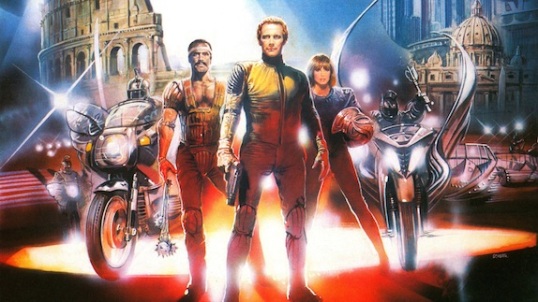
As for the film itself, it takes place in the year 2072, so at least the title is being honest with us.  The world is now run by competing television networks.  The American television network has the highest rated show: Kill Bike, in which men on motorcycles battle to the death.  Cortez (Claudio Cassinelli), the program director for Rome-based WBS-TV, is ordered by the station’s owner, the mysterious Sam, to come up with a program that will be more popular than Kill Bike.  At first, Cortez tries to put on a show called The Danger Game, where people are forced to hallucinate dying in violent ways.  When that show fails to beat Kill Bike, Cortez decided to just rip-off Kill Bike

And let’s just stop a moment to point out the obvious.  Neither The Danger Game nor Kill Bike would feel at all out-of-place on television today.  Remember Fear Factor?  How different is The Danger Game from that old show?

Anyway, Cortez’s new show is basically Kill Bike with a twist.  The motorcycle combat will now take place in the Roman coliseum and the contestants will all be convicted murderers awaiting execution.  Fortunately, the very popular star of Kill Bike — Drake (Jared Martin) — has recently been convicted of murder!  It’s convenient how that worked out…

As we discover through the magic of slow motion flashbacks, Drake was returning home one night when he discovered that his wife had been murdered by three young men who all appeared to be doing a bad impersonation of Malcolm McDowell in A Clockwork Orange.  The three men were then murdered and Drake was convicted.  However, Drake insists that he’s innocent and, even when confronted by laughing hallucinations of the three men, he refuses to attack them.

Could it be that someone is framing Drake?  Of course!  But why…

Well, before we find out the answer to that, we watch as Drake is brought to the coliseum and is trained in gladiatorial battle.  He immediately makes an enemy out of the head guard, the sadistic Raven (Howard Ross, who is hilariously over-the-top).  He also bonds with the other gladiators, one of whom is named Abdul.  Abdul is played by Fred Williamson, largely because it’s not a mid-80s Italian sci-fi dystopia without Fred Williamson.

Warriors of The Year 2072 cannot compare to Fulci at his best.  This is no Zombi 2 or The House By The Cemetery.  At the same time, it’s definitely better than most of the films that Fulci made after The New York Ripper.  Fulci was a supreme stylist and, as a result, Warriors of the Year 2072 is always watchable.  Even when you don’t have the slightest idea what’s going on, you still can’t quite bring yourself to look away.  Yes, the special effects are nothing special.  And yes, it’s obvious that futuristic Rome was just a miniature set.  But the cheapness of the film gives it an odd charm.  It’s the cheapest future imaginable and somehow, it actually feels appropriate.  Why do we always assume the future will be sleek and shiny?  Maybe it’ll look like cardboard, like in Warriors Of The Year 2072!

Warriors of the Year 2072 is a campy, frequently silly, and oddly entertaining look at the future of the human race.  If you’re a Fulci fan or a lover of Italian exploitation cinema, track it down.

http://www.youtube.com/watch?v=L_YyJm5KyhM

A Grindhouse Horror Review: Zombie Holocaust (dir. by Marino Girolami)


Traditionally, I like to start my film reviews with a trailer but, with this trailer, I do feel the need to include a quick warning.  The film being advertised, 1980’s Zombie Holocaust, was released at the height of the Italian exploitation boom and  combined two notably gory genres of horror — the cannibal film and the zombie film.  The trailer below is pretty explicit (even by the standards of the free speech zone known as the Shattered Lens) and is definitely not safe for work.

Like many of the classic Italian grindhouse films, Zombie Holocaust opens in New York City.  A hospital attendant is caught devouring a cadaver in a morgue.  After he attempts to escape by throwing himself out of a window, it’s discovered that 1) he’s a native of the Asian Molucca islands and 2) he’s only one of several natives to have both recently immigrated to New York City and gotten a job at a morgue.  Dead bodies across NYC are being eaten and anthropologist Lori (played by Aelxandra Delli Colli, who is best known for being the only sympathetic character in Lucio Fulci’s New York Ripper) is determined to discover why.

In order to investigate, Lori and Dr. Peter Chandler (played by Ian McCullough, who was also in Fulci’s classic Zombi 2) lead an expedition to the island.  Almost as soon as the expedition arrives, they find themselves being pursued by not only cannibals but zombies as well!  Even worse, it turns out that there’s a mad scientist on the island.  Dr. Obrero (Donald O’Brien, an Irish actor who appeared in a few hundred Italian films of every possible genre) is convinced that he can unlock the secrets of life by experimenting on dead bodies and doing brain transplants.

(To be honest, I’ve seen this film a few times and I’m still not quite sure what exactly Dr. Obrero was trying to accomplish but I guess it doesn’t matter.  He’s a mad scientist with his own private laboratory so I guess he can pretty much do whatever he wants.)

I love Italian zombie films but, for the most part, I try to avoid the cannibal films.  I saw both Cannibal Ferox and Cannibal Apocalypse because they both featured Giovanni Lombardo Radice and I saw Cannibal Holocaust because, seriously, that’s one of those films that any student of cinematic horror has to see at least one time.  But otherwise, I tend to avoid the cannibal films because, to me, they’re just not that much fun to watch.  (And the fact that most of them contain scenes of actual animal cruelty doesn’t help…)

However, Zombie Holocaust is one of the rare cannibal films that I can watch and enjoy because it’s just so ludicrous and over-the-top.  It also helps that the film’s gore is so obviously fake that it becomes almost a postmodern statement on Italian cannibal films.  And, finally, this film has got zombies in it and who doesn’t love zombies?

Of the countless zombie films that came out of Italy during the early 80s, Zombie Holocaust is one of the odder entries in the genre.  While most Italian exploitation films were shameless when it came to imitating other movies, Zombie Holocaust attempts to outdo them all by cramming the conventions of three different genres into one mess of a movie.  As such, the movie starts out as a standard cannibal film just to suddenly become an almost shot-by-shot remake of Zombi 2 before then finally wrapping things up by having Donald O’Brien pop up, acting like Peter Cushing in a Hammer Frankenstein film.  There’s nothing graceful or subtle about this film’s everything-and-the-kitchen-sink approach to its story and, while the end result isn’t exactly pretty, it’s still watchable in much the same way that a televised police chase is watchable.

Director Marino Girolami was a veteran filmmakers who was ending a long career with his work on Zombie Holocaust and you have to admire the fact that, as opposed to many other filmmakers who have found themselves in a similar situation, he made an honest and unapologetic exploitation film, a shameless rip-off of about a thousand other films.  Instead of being embarrassed by the film’s silliness, he instead embraced it and his cast did the same.

Playing the lead role, Scottish actor Ian McCullough plays his character with an attitude that, at times, almost comes across as a parody of stiff upper lip English imperialism.  You may have to be a fan of grindhouse cinema to truly appreciate it but, whenever I’ve sat through this film, I always found myself smiling every time that McCullough discovered that another member of his expedition has been killed and responded with a frustrated, “And none of this would have happened if you had simply done as I had told you to do.”  By the end of the film, I was expecting McCullough to approach the last remaining native and tell him, “You’re a better man than I am, Gunga Din.”

However, the film is truly stolen by Donald O’Brien, who plays the mad scientist with an almost alarming sense of authenticity.  For the most part, nothing that O’Brien says during the film makes the least bit of sense but he delivers the lines with such conviction that it really doesn’t matter.  In one of the film’s most famous scenes, O’Brien delivers the line, “Patient’s screams annoying me…performed removal of vocal chords.”  It takes a special type of actor to make a line like that work and O’Brien was that actor.

Indeed, watching a film like this, it’s hard not to admire the fact that both the filmmakers and the cast managed to stay sane regardless of how ludicrous the film eventually became.  That’s perhaps the best way to describe Zombie Holocaust.  It’s ludicrous but it’s still a lot of fun.

(Speaking of ludicrous and fun, when Zombie Holocaust was released here in the States, it was renamed Dr. Butcher, M.D. and it was apparently advertised by a sound truck known as the Butchermobile.  To me, that sounds like a lot of fun and it again reminds me that I was born a few decades too late.)