The Fabulous Forties #33: Boys of the City (dir by Joseph H. Lewis)


Boysofthecity

The 33rd film in Mill Creek’s Fabulous Forties box set was 1940’s Boys of the City.

As a classic film lover, I have to admit that I groaned a bit when the opening credits announced that Boys of the City starred “East Side Kids.”  The East Side Kids were a group of actors who appeared in a number of B-movies from the 1930s through the 50s.  Many of the actors started out as members of the Dead End Kids and a few more were members of a group known as The Little Tough Guys.  In the 40s, they merged to become the East Side Kids and then eventually, once the East Side Kids started to hit their 30s, they became known as the Bowery Boys.  Their movies started out as tough and gritty melodramas but, by the time they were known as the Bowery Boys, they were making cartoonish comedies.  Occasionally, one of their films will show up on TCM.  Their early serious films (Dead End, Angels With Dirty Faces) remain watchable but, from what little I’ve seen of them, their later comedies appear to be damn near unbearable.

Boys of the City finds the East Side Kids in transition.  The kids still have an edge to them.  They are definitely portrayed as being juvenile delinquents who are walking a thin line between either a short life of crime or a long life of poverty.  But them film itself, while it may not be as cartoonish as the films that were to come in the future, is definitely a comedy.

Basically, the East Side Kids (Bobby Jordan, Leo Gorcey, Hal E. Chester, Frankie Burke, Sunshine Sammy, Donald Haines, David Gorcey, and Algy Williams) have been arrested for vandalism and are given a choice.  They can either go to juvenile hall or they can spend the summer at a camp in upstate New York.  Somewhat reluctantly (and hopefully remembering the unlucky fates of Humphrey Bogart in Dead End and James Cagney in Angels With Dirty Faces), the kids agree to go to the camp.

However, on the way to the camp, their car breaks down and they are forced to stay at the nearby home of a crooked judge (Forrest Taylor) until they can get the car repaired.  The judge, however, is killed and it’s up to the East Side Kids to solve the murder!  Was the judge killed by the gangsters that he was set to testify against?  Was he killed by his niece (Inna Gest)?  Or maybe it was his housekeeper, Agnes (Minerva Urecal, who appears to be parodying Judith Anderson’s performance in Rebecca)?  Or was he murdered by Knuckles (Dave O’Brien), who the judge wrongly sentenced to die and who, following his vindication and release from prison, has become a guardian to the East Side Kids?

Who knows?  Who cares?  I certainly didn’t.

Clocking in at 68 minutes, Boys of the City is a typical 1940s second feature.  Designed to keep audiences entertained without requiring them to think, Boys of the City moves quickly and adds up to nothing.  I know that there are some classic film lovers who can tell the difference between the various East Side Kids (or Dead End Kids or Bowery Boys or whatever you want to call them) but they all pretty much blended together for me.

Not surprisingly for a film made in 1940, Boys of the City is full of casual racism.  Sunshine Sammy plays an East Side Kid named Scruno.  As soon as Scruno sees the cemetery next to the house, his eyes go wide and he says, “G-g-g-ghosts!”  Apparently, that was very popular in the 40s but today, it’s impossible to watch without cringing.

Boys of the City has some interest as a time capsule but otherwise, it’s a film that is easily and happily forgotten about.
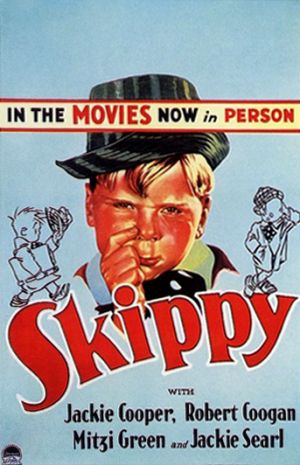
Lisa Reviews An Oscar Nominee: Skippy (dir by Norman Taurog)


Skippy1931

(SPOILERS BELOW!)

Oh my God, they actually killed the dog…

That was my main reaction, this morning, as I watched the 1931 film Skippy.  Skippy aired on TCM earlier this morning and I set the DVR to record it because, long ago, Skippy was nominated for best picture and, for quite some time, it has been my goal to see and review every single film ever nominated for the best picture.

And I have to admit that for the first hour or so, I wasn’t sure if I’d actually be able to get all the way through Skippy.  Skippy is very much a film of the early 30s and you never known how much you appreciate jump cuts, tracking shots, and even the occasional hand-held camera shot until you watch a movie that features none of them.  It’s definitely a different style of story telling and I sometimes found myself struggling to adjust to it.

Add to that, Skippy was a film about children and, while the film’s star, 9 year-old Jackie Cooper, was a natural before the camera, the other child actors often seemed forced.  There was a lot of overacting that, if nothing else, made me appreciate even more Jacob Tremblay’s subtle performance in Room.

There were a few things that I did appreciate about Skippy.  As I’ve stated on the site before, I love history and Skippy was definitely a time capsule.  The film follows 6 year-old Skippy (Jackie Cooper) as he leaves the safety of his upper class home and explores the poor side of the town and the film does a good job of contrasting Skippy’s sheltered home with the nearby neighborhood of Shantyown.  It’s while wandering around Shantytown that Skippy meets and befriend Sooky (Robert Coogan).  Skippy and Sooky accidentally break a windshield that belongs to the evil dogcatcher, Mr. Nubbins (Jack Rube Clifford).  Mr. Nubbins retaliates by taking away Sooky’s dog and demanding that the boys pay him 3 dollars for the dog’s freedom.  Though it’s a mighty struggle that involves many comedic schemes, the boys manage to raise the 3 dollars.  Mr. Nubbins takes the money, says that he’s going to use the money to buy a new windshield, and that he’s going to kill the dog anyway.  So, Skippy and Sooky have to raise three dollars more just to discover that Mr. Nubbins has already shot their dog.

As Sooky sobs, Skippy fights back tears and asks if they can at least have the dog’s body so they can give it a proper burial.

“It’s already been disposed of,” Mr. Nubbins snarls.

And, at this point, I was just sitting there and thinking, “What the HELL!?”  Seriously, I can only imagine what it must have been like to be a child in 1931, watching this film (which was based on a comic strip that all the kids probably read every day), laughing at jokes that were probably quite funny back then, and then suddenly being smacked in the face by Mr. Nubbins announcing that not only was the dog dead but his body had been cremated.  I can only imagine that amount of tears that were shed in those 1931 theaters!

(Making things even worse is the discovery that the town’s rules for dealing with stray dogs were written by none other than Skippy’s father.)

And as I thought more about it, it occurred to me that this is one thing that would never happen in a movie today.  You don’t kill the dog, unless you want Keanu Reeves to show up and kill you.

Sooky breaks into tears as soon as he hears that his dog has been killed.  Skippy manages to hold back until he gets home and then he breaks into sobs.  (According to Jackie Cooper, director Norman Taurog threatened to kill the dog in real life unless Cooper gave him authentic tears.)  Fortunately, all is eventually resolved by both Skippy and Sooky getting new dogs and Skippy’s dad beating up Mr. Nubbins.  Yay!

Anyway, for the most part, Skippy is one of those films that will mostly be interesting to Oscar completists for me.  However, I will always be stunned by the fact that, in the film, Mr. Nubbins actually killed that dog.