The year was 1979 and Fred Silverman, the president of NBC, had an idea.
How about a television series in which each week’s episode would depict a different group of passengers going on a trip? The passengers would all be dealing with their own stories, some of which would be dramatic and some of which would be humorous. With any luck, some of them might even fall in love over the course of their journey!
To keep the audience interested, the show would also feature a cast of regular characters, the crew. Edward Andrews would play the captain, a sensible and by-the-book type. Robert Alda played Doc, the doctor who was also a bon vivant. Patrick Collins was the goofy purser. Nita Talbot played Rose, the perky director of entertainment. Michael DeLano was the bartender who always had the best advice for the passengers….
Does this sound familiar?
If you think that it sounds like Fred Silverman just ripped off The Love Boat …. well, you’re wrong. The Love Boat took place on a boat. Supertrain took place on a train.
At the time that Supertrain went into production, it was the most expensive television production of all time. Before the pilot film was even shot, NBC had spent ten million dollars on the Supertrain sets. Not only was a fake train built but two models were also constructed for the shots of the train moving through the countryside. At the time, the assumption was that the costs would be easily covered by the money that NBC stood to make from broadcasting the 1980 Summer Olympics. Unfortunately, Jimmy Carter decided that the U.S. would be boycotting the Olympics as a way to protest Russia’s invasion of Afghanistan. The only thing that kept NBC from going bankrupt was that the BBC was apparently run by someone even more incompetent than Fred Silverman. The BBC paid $25,oo per episode for the rights to air Supertrain in the UK. Supertrain proved to be such a disaster that the BBC never actually aired the episodes that they had purchased.
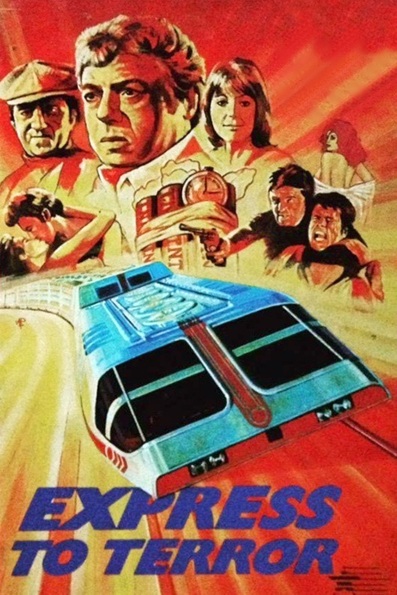
1979’s Express to Terror was the pilot to Supertrain. (It was later released in some territories as a stand-alone film.) Directed by horror impresario Dan Curtis (who was also brought in to produce the series), Express to Terror opens with an apparently drunk Keenan Wynn playing the role of railway baron Winfield Root. Winfield loudly announces to a group of nervous investors that he has created ” an atom-powered steam turbine machine capable of crossing this country in 36 hours!” A few months later, Supertrain sets off from New York to Los Angeles.
The main thing that one notices about the train is that it’s incredibly tacky. For all the money that Winfield Root (not to mention NBC) poured into the thing, it looks awful. The cabins are bland and also seem to be constantly shaking as the train rumbles over its tracks. Whereas The Love Boat featured glorious shots of passengers enjoying themselves on an open-air deck, Express to Terror features a lot of shots of passengers trying to squeeze their way through narrow and crowded hallways. There’s a disco car, which sounds like fun but actually looks like a prom being held in a locker room. There’s a swimming pool but you can’t really lay out by it because it’s on a train. Winfield is among the passengers and he continually refers to the train as being “Supertrain” in conversation, which just sounds dumb. “The next person who stops Supertrain,” he announces “will be walking to L.A!”
The main drama features Steve Lawrence as Mike Post, a Hollywood agent with a gambling problem who thinks that someone on the train is trying to kill him. Actually, the assassin is after a different Mike Post (Don Stroud) but that Mike Post is a criminal who, after entering the witness protection program, changed his name to Jack Fisk. The criminal Post is hoping that the agent Post will be killed by mistake. The criminal Mike Post has a girlfriend named Cindy (Char Fontane) who falls in love with the agent Mike Post. Fred Williamson appears as a football player-turned-assassin. George Hamilton plays a Hollywood executive. Don Meredith is the alcoholic best friend of the agent Mike Post. Stella Stevens is on the train as a diva. So is Vicki Lawrence, playing a naive innocent.
Express to Terror tries to mix comedy and drama but it doesn’t really work because the “Good” Mike Post doesn’t really seem to be worth all the trouble. Steve Lawrence gives a mind-numbingly bad performance in the role and, as a result, “Good” Mike Post really isn’t any more sympathetic than “Bad” Mike Post. The main problem is that “Good” Mike Post comes across as being a coward and there’s only so much time that you can watch a coward act cowardly before you lose sympathy for him. Being scared is one thing. Being so dumb that accidentally gets your fingerprints on a knife that’s just been used to kill a man is another thing.
As for the members of the crew — the captain, the doctor, the bartender, and such, they take a back seat to the drama of the two Mike Posts. It’s a bit odd because no one on the train — not even Winfield Root — seems to be that upset by the fact that one of their passengers is murdered while the train is going through a tunnel. You would think that everyone would be worried about the future of Supertrain at that point. A murder is not good for publicity but Winfield Root is oddly unconcerned about it. I swear, light rail people are almost as heartless as bicyclists!
Of course, the worst thing about Express to Terror is that it promises terror but it doesn’t deliver. When I see a the word “terror” in a film directed by Dan Curtis, I expect a little terror! Other than Steve Lawrence’s overacting, there really wasn’t anything particularly terrifying about Express to Terror.
As for Supertrain, it ran for nine episodes and was promptly canceled. Fred Silverman left NBC and spent the rest of his career as an independent producer. Supertrain’s tracks got too close to the sun and they nearly took down a network.
Previous Icarus Files:
- Cloud Atlas
- Maximum Overdrive
- Glass
- Captive State
- Mother!
- The Man Who Killed Don Quixote
- Last Days
- Plan 9 From Outer Space
- The Last Movie
- 88
- The Bonfire of the Vanities
- Birdemic
- Birdemic 2: The Resurrection
- Last Exit To Brooklyn
- Glen or Glenda
- The Assassination of Trotsky
- Che!
- Brewster McCloud
- American Traitor: The Trial of Axis Sally
- Tough Guys Don’t Dance
- Reach Me
- Revolution
- The Last Tycoon

 Through the Shattered Lens