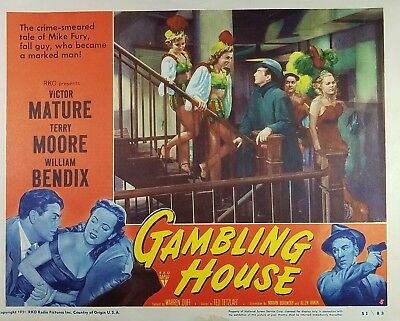
The 1950 film noir, Gambling House, begins with the aftermath of a murder.
A man’s been gunned down in an illegal gambling house. The murderer is gangster named Joe Farrow (William Bendix) but Farrow has no intention of going to prison. Fortunately, another gambler was wounded during the shoot out. Marc Fury (Victor Mature) will survive his injury but he might not survive being a witness. However, Farrow sends his gunmen to make Fury an offer. If Fury agrees to take the rap for the shooting, he’ll not only live but Farrow will pay him a good deal of money. Fury agrees because …. well, what else is he going to do?
Fury is arrested for the murder. He pleads self-defense and he’s acquitted at the trial. So far, so good, right? However, there’s always a complication. First off, there’s the fact that Farrow wasn’t exactly being honest when he promised to pay Fury. Farrow has no intention of giving Fury any money. In fact, now that Fury has been acquitted and the case is officially closed, it might be more convenient just to have Fury killed.
The other problem is that Fury’s trial brings him to the attention of the Immigration and Naturalization Service. The INS takes a look at Fury’s record and they discover that he’s not Marc Fury at all! (I know, it’s a shock. Who would think that a name like Marc Fury would be fake?) It turns out that his original name was Marc Furiotta and he was born in Italy. His family came to the U.S. when Marc was a child. Marc always assumed that he was a citizen but it turns out that his parents were never naturalized and therefore, Marc is in the country illegally! INS wants to deport him. Marc wants to stay in the United States.
Fortunately, Marc will have a chance to try to convince a judge to let him stay in the United States, despite his lengthy criminal record. Until his hearing (or until he makes bail), he’ll be detained at Ellis Island. Marc soon finds himself stuck on Ellis Island, presumably right underneath the base of the Statue of Liberty. (I know the Statue of Liberty isn’t actually on Ellis Island but the imagery just got stuck in my head while I was writing this review and I’ll be damned if I’m going to take it out.) He’s surrounded by earnest immigrants who can’t wait to become American citizens and that awakens his own patriotic feelings. He also meets a social worker named Lynn (Terry Moore) and he falls in love with her. When he appears before the judge, he explains that he can’t put into words why he wants to stay in America. He just know that he does. Awwww, what a wonderful story …. oh wait. He’s still got Joe Farrow trying to kill him, doesn’t he?
Gambling House is an odd film. Actually, it’s something like three different films at once. On the one hand, it’s a low-budget film noir, with menacing tough guys and a morally ambiguous hero and an outwardly respectable villain who is actually a member of the mob. On the other hand, it’s an earnest legal drama about an immigrant who comes to love his adoptive country. And then, on the other hand (that’s right, this movie has three hands), it’s a romcom where cynical Marc ends up falling for idealistic Lynn.
That’s a lot for one, low-budget 90-minute film to carry on its shoulder and sadly, Gambling House struggles to balance all of its different elements. It gets off to a good start, with Victor Mature delivering all of his lines with a scornful disdainful for anyone who looks at him. And the scenes with William Bendix as the mob boss are effective. But none of those scenes seem to belong in the same movie with Marc waiting on Ellis Island and Lynn explaining why she wants to help people become citizens. In the end, this is a film about many things but none of those things are really explored in that much depth.
Though this is a adequately directed and acted film and this is one scene, in which Marc looks at the New York skyline from the holding cell in Ellis Island, that achieves a certain visual poetry, this is still an offer that you can refuse.
Previous Offers You Can’t (or Can) Refuse:

 Through the Shattered Lens