Steve Carson (Charles Starrett) is wanted for murdering the Durango Kid!
I know that sounds confusing because Steve Carson is the Durango Kid. The bandit that Carson shot was just disguised as the Durango Kid but actually, he was just a dim-witted outlaw who was set up by Buck Prescott (Frank Fenton), a rustler who was run out of Texas by Steve and who was trying to find a way to stop Steve from investigating his new scheme to cheat a bunch of ranchers in Santa Fe.
Steve is taken to jail but luckily, Smiley Burnette is around to help him break out. Smiley and Steve head to Santa Fe, where they get jobs working as cowhands at the Eaton Ranch and work to expose Prescott and his gang as being responsible for a series of stampedes. Smiley sings some songs and Steve resurrects the Durango Kid from the dead.
This was one of the later Durango Kid films. The range war plot is one that showed up in many Durango Kid films but Prairie Roundup adds something new to the formula but having Steve framed for murdering himself. Steve could prove his innocence by revealing that he’s actually the Durango Kid but Steve is determined to maintain his secret identity. I’ve seen several Durango Kid films and I still don’t really understand why Steve felt he needed a secret identity in the first place. But Prairie Roundup shows the extent to which he’ll go to keep it.
There’s plenty of fight and horse chases, more than enough to keep western fans happy. Smiley Burnette gets to throw some punches along with singing all of his usual songs. It’s also nice to see the lovely Mary Castle in the role of Toni Eaton, the daughter of one of the ranchers who has been targeted by Prescott. Featuring less stock footage than usual, Prairie Roundup is a worthy entry in the Durango Kid series.
The 1947 film, For You I Did, opens with what would be the finale of many other crime movies, a daring prison break.
The psychotic Matt Guber (Don C. Harvey) has managed to escape from prison, along with a younger prisoner named Johnny Coulter (Paul Langton). From listening to their dialogue as they flee the cops, it quickly becomes obvious that the escape was Guber’s idea and that Johnny is something of an unwilling accomplice. Johnny only had a year left in his sentence but now, thanks to Guber, he’s a wanted man. Making matters even worse is the fact that Guber killed a guard during the escape. Johnny knows that if he turns himself in or if he’s captured, he’ll be considered an accessory to murder.
Guber tells Johnny to go to a nearby roadside diner and deliver a message to his girlfriend, Hope (Cathy Downs). Guber says that he’ll come to the diner in a week to get them. Johnny follows Guber’s orders but, when he reaches the diner, he discovers that Hope has changed her ways and no longer wants anything to do with Guber. Using an assumed name, Johnny gets a job at the diner and soon, he and Hope are falling love.
Johnny gets to know the other workers and customers at the diner. They include Hope’s kind but no-nonsense aunt, Maggie (Marion Kerby), and Hope’s flirtatious cousin, Georgie (Jane Weeks). Working in the kitchen is Smitty (Roman Bohnen), an alcoholic with a tragic backstory. There’s also Alec Shaw (Mischa Auer), a flamboyant con man, and two slow-witted cops (Charles Waldron, Jr. and Rory Mallinson) who always mention that Johnny looks familiar but they just can’t figure out where they’ve seen him before. Johnny gets to know all of them as, for the first time in his life, he finds himself accepted as a part of a community. However, even as Johnny finds happiness, he knows that the clock is ticking. There’s only so long that he can hide his identity and Guber is due to show up at any moment….
Poverty Row is a term that was often used to describe the low-budget B-movies of the 40s and 50s and it’s certainly an apt description of For You I Die. It’s not just the fact that the film is about poor and often desperate characters. It’s also that the film itself looks like it was made for next to nothing. However, the film’s cheap look is actually one of its greatest strengths. Visually, the grainy black-and-white lends the film a gritty atmosphere and the limited and sparsely decorated sets serve to play up not only Johnny’s claustrophobia but to also remind us that, even if Johnny does find some temporary happiness, he still has nowhere to go. That diner is both the beginning and the end of Johnny’s freedom.
Character actor Mischa Auer was probably the biggest name in the cast. He was a well-known screen comedian, one who specialized in playing over-the-top eccentrics. His comedic presence in this relatively somber film feels rather odd. As well, Paul Langton is convincingly sullen in the role of Johnny but he’s not particularly compelling. Far more impressive are Marian Kerby, Cathy Downs, and especially Jane Weeks. As the gleefully amoral Georgie, Weeks steals almost every scene in which she appears while Marion Kerby is everyone’s ideal aunt. Finally, Cathy Downs plays Hope and brings a poignant sense of regret to a role that, as written, could have just been a stereotypical “good girl.” Hope is someone who has made her mistakes but who refuses to be defined for them. In the end, Hope epitomizes …. well, hope.
For You I Die is a taunt and effective film noir and a reminder not to dismiss a film just because it came from Poverty Row.
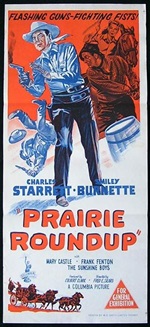 Steve Carson (Charles Starrett) is wanted for murdering the Durango Kid!
 Through the Shattered Lens