6 Classic Trailers For January 8th, 2022


Since this week started with Sergio Leone’s birthday, it only seems appropriate that today’s edition of Lisa Marie’s Favorite Grindhouse Trailers should be dedicated to the Western.  Here are 6 classic Spaghetti western trailers!

  1. The Good, the Bad, and the Ugly (1966)

It only makes sense that we should start things off with a trailer from a Leone film and it makes further sense that film should be The Good, The Bad, and the Ugly.  It’s all here, from the classic Ennio Morricone score to the unforgettable staring contest between Clint Eastwood, Lee Van Cleef, and Eli Wallach.

2. Sabata (1969)

While Clint Eastwood was able to use his appearances in Leone’s westerns to restart his American film career, Lee Van Cleef remained in Italy.  After playing the villainous Angel Eyes, Van Cleef played the hero Sabata.  This trailer is very, very 60s.

3. Django (1966)

Franco Nero never appeared in a Sergio Leone film but he was a favorite of the famous “other Sergio,” Sergio Corbucci.  In Corbucci’s Django, Nero played the haunted title character, making his way across the west with a deadly coffin.

4. Django Kill (1967)

Django was such a hit that a number of other films were made about other haunted, amoral gunslingers named Django.  Whether or not they were all the same Django was left to the audience to decide.  In Django Kill, Tomas Milian played the title character and found himself in a surreal hellscape, surrounded by people who were obsessed with gold.

5. The Great Silence (1968)

The Great Silence was one of the greatest of the spaghetti westerns, featuring Klaus Kinski in one of his best and most villainous roles.  Unfortunately, like many of the better spaghetti westerns, it initially did not get a proper release in the States.  Fortunately, it has since been rediscovered.

6. Once Upon A Time In The West (1968)

And finally, to close things out, here’s one last Sergio Leone trailer.  Sadly underappreciated when first released, Once Upon A Time In The West has since come to be recognized as a masterpiece.

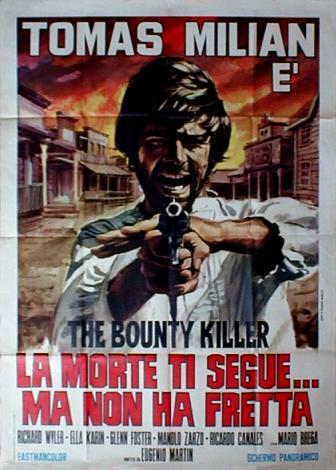
Rest in Peace, Tomas Milian


I have some sad news to report.  The great Tomas Milian, an actor beloved by fans of Italian cinema everywhere, has died.  He was 84.

Perhaps because of the type of films that he made, Milian was never the household name that he deserved to be.  In the United States, his death is not even trending on twitter.  #ThickThighTwitter, which is essentially a bunch of people bodyshaming anyone who happens to be slim, is trending.  Tomas Milian is not.

And it’s a shame because Tomas Milian was one of the best.  He may have been beloved by fans of Italian cinema but Milian was truly an international actor.  He was born in Cuba, the son of a general who committed suicide after being jailed.  Milian left Cuba after his father’s death.  He moved to New York City, was a member of the Actor’s Studio, and became naturalized citizen in 1969.

Milian’s acting career took off when he started making movies in Italy.  He appeared in everything from spy movies to spaghetti westerns to horror films to 1970s police dramas.  Whenever I see one of the many films that Milian made in the 60s and 70s, I’m struck by his intensity.  Milian was one of those power actors who often seems like he might leap off the screen at any moment.  He played driven and often haunted men.  Along with an undeniable charisma, Milian radiated danger.

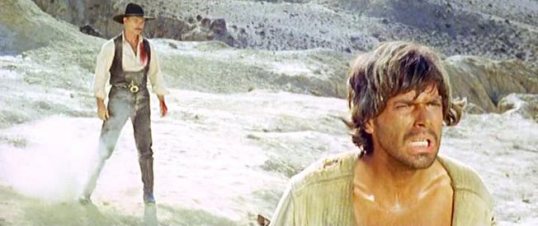
Of the many Westerns he made, The Big Gundown may be his best known.  Here’s Milian with co-star Lee Van Cleef:

My personal favorite of his spaghetti westerns?  The surreal Django Kill:

For me, Tomas Milian was at his most menacing in Lucio Fulci’s underrated (and not for the faint-of-heart) Four Of The Apocalypse:

Four of the Apocalypse was not the only film on which Milian would work with Fulci.  He also played the hero in Fucli’s classic giallo, Don’t Torture a Duckling:

In the 70s, Tomas Milian appeared in several Poliziotteschi, Italian cop films that were largely designed to rip off the success of gritty cop films like The French Connection and Serpico.  Milian was always the ideal rebel cop, though he could play a dangerous criminal just as easily.  Check him out in The Cop In Blue Jeans, perhaps parodying Al Pacino in Serpico:

The films weren’t always good but Milian always commanded the screen.  It’s hard to think of any other actor who was always so much consistently better than the material he had to work with.

With the decline of the Italian film industry, Thomas Milian relocated his career to the United States.  In his later years, he was a character actor who frequently appeared as corrupt military men and politicians.  His best known performance from this time may be his quietly sinister turn in Steven Soderbergh’s Oscar-winning Traffic:

Earlier today, Tomas Milian died of a stoke in Miami.  Rest in peace.


Film Review: Django Kill (dir. by Giulio Questi)


2228_spoiler_DjangoKill_t588

Released in 1967 and directed by Giulio Questi, Django Kill is one of the essential spaghetti westerns.

The film opens with a man literally clawing his way out of a shallow grave.  Played by Tomas Milian and known as the Stranger, the man is a Mexican outlaw who has been buried out in the middle of the desert.  Two sympathetic Indians discover the Stranger and, while they nurse him back to health, he has several flashbacks that explain how he came to be buried alive.

The Stranger was a member of a gang of thieves who stole a cargo of gold.  However, the Americans in the gang betrayed the Mexicans, gunning them down and fleeing with the gold.  The Indians agree to help the Stranger find the rest of his gang on the condition that the Stranger tell them what it was like to be dead.

The Stranger’s former gang, meanwhile, has arrived at a desolate town known as Unhappy Place.  From the minute that the gang first rides into town, we know that there’s something sinister about Unhappy Place.  A naked child stands in the middle of the street while another is used as a footrest by one of the adults.  A distraught woman watches them from behind a barred window.  A lame hedgehog drags itself across the dusty street.  As soon as the gang stops at the local saloon, the locals see the gold that they’re carrying and, in a shockingly brutal scene, the townspeople lynch the outlaws.

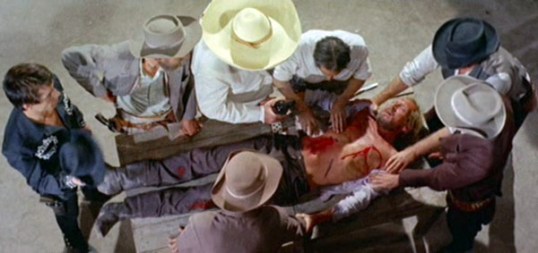
While this is going on, the Stranger rides into town.  Spotting the last living outlaw, the Stranger proceeds to gun him down.  In one of the film’s more infamous scenes, when the townspeople learn that the Stranger is using gold bullets, they proceed to literally rip the outlaw to pieces in an effort to retrieve the golden bullets.

With the outlaws dead, the townspeople claim the gold for themselves.  The Stranger, who was apparently more interested in revenge than getting the gold, stays in town and watches as things get increasingly weird.

How weird?

Well, how about the fact that the Stranger ends up having a romance with a crazy woman who spends her days trapped behind a locked door?

Or how about the fact that the Stranger finds himself in the middle of a power struggle between the townspeople and the flamboyantly homosexual Zorro (played, in grandly villainous fashion, by Roberto Camardiel) who rides into town with a gang of cowboys who are all dressed in black outfits with white embroidery?  In another one of the film’s infamous scenes, Zorro and his cowboys kidnap and gang rape the son of the town’s saloonkeeper.

(A young Ray Lovelock, who would go on to be one of the best actors to regularly work in Italian exploitation plays the son.)

Or how about the scene where Zorro plays with a bunch of Civil War figures while arguing with his pet parrot?  When Zorro offers the parrot a drink, the parrot replies, “I want more!”

Or, how about the fact that the Stranger, at one point, has to deal with several vampire bats while literally hanging from a cross?

Graphically violent and full of bizarre and disturbing imagery, Django Kill is one of the strangest westerns ever made and that strangeness keeps the film interesting even when the story doesn’t make much sense.  While Django Kill may not be the masterpiece that several claim it to (the film runs on a bit long and the dubbing of the English language version was absolutely terrible), it’s still one of the most compulsively watchable films that I’ve ever seen.  Just when you think the film can’t get any stranger, it does.

Django Kill was filmed under the title of If You Live, Shoot!  However, in a move typical of Italian cinema, the film was retitled to take advantage of the popularity of Sergio Corbucci’s Django.  The implication, of course, is that Tomas Milian is playing the same character here that Franco Nero played in Corbucci’s film.  Of course, nothing could be further from the truth.  Even in the crudely dubbed English version of the film, Milian is never referred to by name.  Instead, he’s simply known as the Stranger and, appropriately enough, the film feels more like a surreal take on Sergio Leone’s Dollar trilogy as opposed to being a part of the Django series.

That said, regardless of whether it’s a legitimate Django film or not, Django Kill …. If You Live, Shoot! is more than worth watching.  In fact, it’s essential for anyone who loves Italian exploitation films.
060312-DjangoKill-Post2