Lisa Marie Bowman Does It At Casa de mi Padre (dir. by Matt Piedmont)


Having seen the new Spanish-language comedy Casa de mi Padre on Friday, I now know what I want for Christmas.  I want a big white tiger that can talk and sit in trees and laugh, just like the big white cat that shows up and serves as spirit guide to Will Ferrell.

Seriously, let’s make it happen!

As for Case de mi Padre, the film is a deliberately absurd homage to both telenovelas and the B-movies of the 70s.  Armando Alvarez (played by Will Ferrell) is a stupid but good-hearted Mexican rancher whose drug dealer brother (Diego Luna) is on the verge of marrying the niece (played by Genesis Rodriguez) of another drug dealer (Gael Garcia Bernal).  Ferrell, of course, falls in love with Rodriguez and this leads to a deliriously over-the-top wedding party massacre and … well, listen the plot isn’t important.  The plot makes no sense.  It’s not supposed to make sense.  It’s not only a Will Ferrell movie, it’s a Will Ferrell movie based on telenovelas.  In short, the film is deliberately designed not to make any sense and, on that count, it succeeds admirably.

Despite a lot of funny moments and Ferrell’s admirable commitment to the film, Casa de mi Padre ultimately works better as a concept than an actual film.  In the past, Ferrell’s comedies have worked because they’ve satirized pompous institutions and people who generally take themselves far too seriously, with the obvious example being Anchorman‘s cast of self-important television reporters.  However, the majority of telenovelas are already essentially satiric in their intent.  Casa de mi Padre finds itself in the odd position of satirizing satire and, as a result, it never feels as outrageous as an actual telenovela.  The end result is hardly perfect but it’s silly enough to be consistently amusing.


Casa de mi Padre is a pretty uneven film that’s never as funny as you want it to be but I would be lying if I said I didn’t enjoy watching it.  Will Ferrell’s strength as both a comedic and a dramatic actor is his willingness to totally commit to his performance.  No matter how ludicrous or silly things get, Ferrell gives 100% and that’s never been more obvious than in his performance here.  Not only does he deliver all of his dialogue in Spanish (apparently he learned his lines phonetically) but he also totally throws himself into the melodrama of it all. 

A similar commitment can be seen in just about every frame of the film.  For me, the film’s best moments come from the small details that the filmmakers take the time to get right.  It’s there in every scene from the film’s deliberately tacky sets to the way that the characters randomly break out into overdone laughter to the fact that every female character in the film down to even the maids who work for Ferrell’s father wander around showing off miles of cleavage.  Perhaps my favorite scene in the film is when Ferrell and Rodriguez go for a horse ride and it’s obvious from the way the scene is framed that neither one of them is actually sitting on a horse.  These are the type of details that will leave boring mainstream audiences scratching their heads but for those of us who speak B-movie, these are the details that make this film worth seeing.
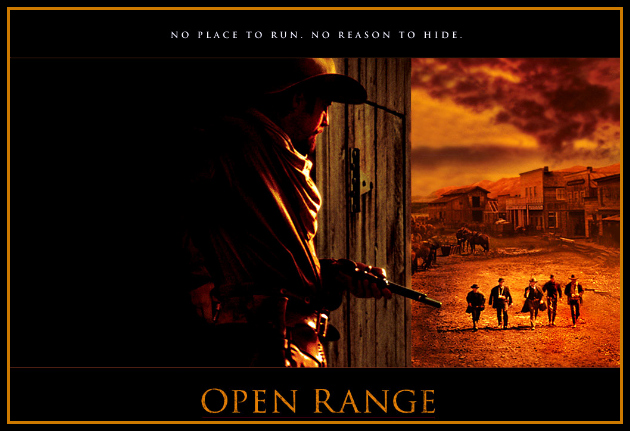
Review: Open Range (dir. by Kevin Costner)


2003 marked a sort of a small comeback for Kevin Costner both as a director and as an actor. The work in question was the very well-done Western, Open Range. Open Range was a moderately budgeted film which has more in common with Costner’s first directorial work, Dances with Wolves than his last big-budget flop, The Postman.

The film was an adaptation of the Lauran Paine novel, The Open Range Men, and it captures much of the themes found in the novel. This was probably due to the fact that screenwriter Craig Storper didn’t deviate from the novel’s basic story. There were no superfluous action sequences and gunfights to ratchet up the action. Everything about Open Range was about the gradual and inevitable final confrontation between the “free-grazers” and the “barbed-wire” men. The free-grazers were played by Kevin Costner and Robert Duvall as Charles Waite and Boss Spearman, respectively. On the other side of the conflict was Michael Gambon playing Denton Baxter, the ruthless land-baron whose attempt to keep the free-grazers from grazing on his land also hides another agenda. Caught in-between these two strong-willed groups were the people in the town Baxter pretty much controls through his “town marshal” (played with fake bravado by James Russo) and the herd helpers under Boss Spearman’s employ.

The theme of freedom to roam the open country versus the rights of a landowner echoes throughout the film. Set in the latter end of the 19th-century, Open Range shows the clash of the more natural ways of the Old West slowly eroding to be replaced by the more industrial, monopolistic practices that became prevalent during the 1880’s, also known in US History as the Gilded Age. Even the personalities of the conflicting characters mirror this theme as the free-grazers only want to use the land as it has been used for years upon years and thats sharing between all men of the West. The land-baron has other ideas in mind and everything boils down to him owning everything around him, even if it means using ruthless tactics to gather even more property.

Open Range also has a bit of modernism in its subplot of Charley Waite’s growing attraction to the sister of the town doctor and the same sister’s well-rounded characterization. It’s not often that a traditional Western shows women in a very positive light instead of the usual submissive and stay-at-home characters of Western’s past. This could also be attributed to the wonderful, underrated performance by Annette Bening who plays Sue Barlow, the doctor’s sister and Charley Waite’s love interest. Bening doesn’t play Sue as the traditional Western female. She also doesn’t go overboard and turn Sue into a 20th-century feminist. She instead plays the character as someone who knows her place in the world, but also one who is strong-willed and willing to stand for what is right.

Open Range was a wonderful throwback to what made such modern Westerns like Unforgiven and Tombstone such a success both for traditionalists and new fans. Kevin Costner’s direction was very low-key. Allowing the story to tell itself at its own pace until the final confrontation. The final gunfight in the end gets a lot of well-earned attention from critics and fans. The entire sequence takes at least 10-15 minutes from start to finish. The fight itself was done in a realistic fashion. There was no sharpshooter dead-eyes in this film, but individuals who had skill but still missed. It was a fight where it wasn’t who was the fastest, but who was the calmest under fire. There’s also a suddenness to the brutality in the final gunfight that demystifies the old-style Western shootouts of past. Some complained that the film was very slow and took too long to get to the “good stuff”, but I actually thought the gradual pacing of most of the film’s length gave the final confrontation even more impact. Costner seem to have learned the lesson all good directors know: less means more.

Open Range won’t go down as a great piece of film making. It surely won’t go down as one of the best in history. What Open Range did accomplish was putting the Western back to its epic and majestic roots, but at the same time keeping the intimacy of a character-driven story. In time, Open Range would probably go down as one of the underrated gems of the last decade and find a place next to its closest comparison, Unforgiven, as one of the best Westerns of the new era.