The Unnominated: Office Space (dir by Mike Judge)


Though the Academy of Motion Picture Arts and Sciences claim that the Oscars honor the best of the year, we all know that there are always worthy films and performances that end up getting overlooked.  Sometimes, it’s because the competition too fierce.  Sometimes, it’s because the film itself was too controversial.  Often, it’s just a case of a film’s quality not being fully recognized until years after its initial released.  This series of reviews takes a look at the films and performances that should have been nominated but were, for whatever reason, overlooked.  These are the Unnominated.

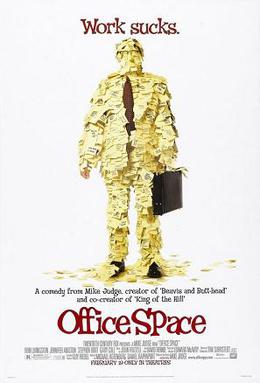
The other night, Erin and I started a new Labor Day weekend tradition of watching the 1999 comedy, Office Space.

As we watched Mike Judge’s first live-action film, it occurred to me that Office Space is a film that unites all of my friends.  It doesn’t matter whether they work in an office like Peter (Ron Livingston), Samir (Ajay Naidu), or Michael Bolton (David Herman) or if they work in a restaurant like Joanna (Jennifer Aniston) or even if they’re an independent contractor like Peter’s loud neighbor, Lawrence (Diedrich Bader).  It doesn’t matter if they would rather be fishing like Peter or watching reruns of Kung Fu like Joanna.  Everyone that I know has said that they can relate to Office Space.  Everyone has had to deal with a passive-aggressive jerk of a boss like Bill Lumbergh (Gary Cole).  Everyone has known a crazy co-worker like the red stapler-obsessed Milton (Stephen Root).  Everyone dreads the arrival of consultants like the Bobs (John C. McGinely and Paul Willson).  Everyone resents being told that doing the bare minimum is not enough, whether it’s just sitting in your cubicle or wearing 15 pieces of flair.  Everyone dreams of sleeping late and not stressing about TPS reports.  Everyone dreams of screwing over their company in a way that’s so clever that they’ll never be caught.  (And I think everyone secretly knows that they would screw it up by putting a decimal point in the wrong place.)  Everyone wants to destroy the oldest and least reliable piece of equipment at work.  Everyone wants to feel like they can just announce that they’re going to quit and spend the rest of their life doing what they would do if they had a million dollars.

Considering the fact that the film has now become universally beloved, it’s interesting that Office Space opened to mixed reviews and middling box office.  The studio wasn’t sure how to sell a live action film from the director of Beavis and Butt-Head and King of the Hill and many critics focused on the film’s rather loosely-constructed, episodic narrative and overlooked the fact that the film captured all of the small details that drive people crazy about their work.  Audiences, though, discovered the film on video and undoubtedly enjoyed watching it after a long day of dealing with their own annoying boss.  The film’s star, Ron Livingston, has said that many people have approached him and told him that he inspired them quit their jobs.  “That’s kind of a heavy-load to carry.”

For a film that centers around office workers updating data so that computer systems don’t cash in 2000, Office Space has aged remarkably well.  Ron Livingston, David Herman, and Ajay Naidu are an instantly sympathetic and likable trio of nerdy heroes.  Stephen Root’s panic as he realizes that he will be the only employee not to get a piece of cake remains both poignant and funny.  Gary Cole is still the boss from Hell.  I still laugh at John C. McGinley’s rage when his praise of Peter as a “straight-shooter with upper management potential” is dismissed by Peter’s boss.  We can all relate to Jennifer Aniston’s dislike of flair and her hatred for Brian (Todd Duffey).  The jump to conclusion mat would probably be even more popular today than back in 1999.

Of course, Office Space was not nominated for any Oscars.  That’s not really a shock.  It’s an episodic comedy that was directed by a Texas filmmaker who was, at the time, best-known for a cartoon about two brain-dead teenagers.  Obviously, it wasn’t going to be nominated for anything, even though I think more people have probably watched Office Space over the past few days than have watched American Beauty.  Oscars aren’t everything, though.  Office Space remains both a great work film and a great Texas film.
Previous entries in The Unnominated:

  1. Auto Focus 
  2. Star 80
  3. Monty Python and The Holy Grail
  4. Johnny Got His Gun
  5. Saint Jack

Film Review: Atlas Shrugged, Part II (dir by John Putch)


2012’s Atlas Shrugged: Part II picks up where Part I left off.

The time is still the near future.  (Part I specifically set the story as taking place five years into the future.  Part II declines to use a specific date but it does feature some news personalities playing themselves so it’s still clearly only meant to be a few years from 2012.)  The economy has gotten even worse.  The poor are only getting poorer while the rich are getting richer.  Under the direction of Head of State Thompson (Ray Wise) and his main economic advisor, Wesley Mouch (Paul McCrane), the government has nationalized nearly every business.  Halfway through the film, Thompson declares a national emergency and uses the Fair Share Law to invoke Directive 10-289.  All inventors, businessmen, and other creative people are required to sign their patents over to the government and to stop trying to develop now techniques.  Wages are frozen.  No one can be fired and no one can be hired.  Creative thinking is discouraged.  Asking questions or expressing doubt is forbidden.  People are encouraged to snitch on anyone not following the Directive.  Thompson and Mouch insist that it’s for the “good of the people,” and anyone who disagrees runs the risk of being dragged into court and sent to prison for ten years.  Meanwhile, gas now costs $42.00 a gallon.  One of the funnier moments of the film features someone paying $865.72 to fill up a truck.

Dagny Taggart (Samantha Mathis), the Vice President of Taggart Transcontinental Railways, is still trying to discover who invented an experimental motor that she found hidden away in a mine.  The motor could potentially change the way that goods are transported but it appears to be missing one component.  Unfortunately, all of the great scientists and inventors have been vanishing, with many of them leaving behind notes that ask, “Who is John Galt?”  Meanwhile, Dagny’s lover, Hank Rearden (Jason Beghe), fights to protect Rearden Metal from being taken over by the government and Dagny’s brother, James (Patrick Fabian), sells out to Wesley Mouch with the end result being that there’s no one left at Taggart Transcontinental with the intelligence or the experience necessary to keep two trains from colliding in a tunnel.

Given that Ayn Rand herself was an atheist who wrote very critically of religion, it’s interesting how much of Atlas Shrugged: Part II feels like one of those evangelical films where the Rapture comes and the entire world falls apart because all of the believers have suddenly vanished.  In the case of Atlas Shrugged, the world falls apart because all of the creatives and all of the leaders of industry and all of the innovative thinkers have abandoned it so that they can create a new community with John Galt.  (They’ve “stopped the motor of the world.”)  In many ways, this is the ultimate in wish fulfillment, a way of declaring, “They’ll miss me when I’m gone!”  Indeed, the majority of people who keep a copy of Rand’s novel displayed on their bookcase do so because they believe that they would be one of the lucky ones who was approached by Galt.  No one expects that they’ll be the person left behind to try to run the railroad.  It’s a bit like how like the most strident Marxist activists always assume they’ll be the ones organizing the workers as opposed to being a worker themselves.

Not surprisingly, the same critics who attacked Part I didn’t care much for Atlas Shrugged Part II.  When I first saw it, I thought the film was a bit too long and I was annoyed that, with the exception of a few minutes at the end, the film didn’t really seem to move the story forward.  At the same time, just as with the first film, I appreciated the fact that the second film was proudly contrarian in its portrayal of the government as being inherently incompetent.  After all, this was 2012, back in the “good government” era, when a lot of people still reflexively assumed that the government was staffed only by hyper-competent policy wonks who knew what they were doing and who were only concerned with making sure that “the trains ran on time,” to borrow an old expression.

Rewatching the film this weekend, I have to say that I actually appreciated Atlas Shrugged Part II a bit more than the first time I watched it.  Yes, Part II was still a bit too long and the domestic drama between Hank and his wife fell flat but Part II is still a marked improvement on the first film.  Some of that is because Part II had a higher budget than Part I and, as a result, it didn’t look as cheap as the first film.  The corporate offices looked like actual corporate offices and the factories looked like real factories.  Secondly, the second film had an entirely different cast from the first film.  Samantha Mathis, Jason Beghe, and especially Patrick Fabian were clear improvements on the actors who previously played their roles.  That’s especially important when it comes to Mathis and Beghe because, as opposed to the first film, Part II convinces the viewer that  Dagny and Hank actually are as important as they think they are.  When the trains collide in the tunnel, the viewer never doubts that Mathis’s Dagny could have prevented the disaster if not for the government’s attempts to force her out of her own company.  As well, the viewer never doubts that Beghe’s Hank would fight to the end to protect his business, even if it means prison.  One wouldn’t have necessarily believed that while watching the first film.

Finally, having lived through the COVID era, the film’s portrait of government overreach and incompetence feels a lot more plausible when watched today.  One doesn’t have to be a fan of Rand’s philosophy or agree with her solutions to see the parallels between Directive 10-289 and the policies that led to children being kept out of schools and numerous small business having to shut their doors.  In an era when most people’s faith in governmental institutions has been broken to such an extent that it might never be fixed in our lifetime, Atlas Shrugged Part II resonates.  Whereas the film once felt subversive, now it feels downright prophetic.