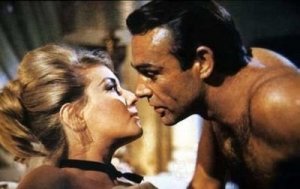
James Bond Review: Thunderball (dir. by Terence Young)


The Shattered Lens is taking on all of the Bond Films, one a day until the U.S. Release of Skyfall on November 9th. Today, we approach the fourth Bond Picture, Thunderball. Before I start, I should note that this film actually has a bit of controversy behind it. Thunderball had the potential to become one of the first Bond films, but a law suit in 1961 stating that Ian Fleming’s novel for the story was based on the screenplay for the film. Producer Kevin McClory was able to win the lawsuit and hold on to the rights. This would later result in 1983’s Never Say Never Again, with Sean Connery returning to play the same role in the same story as he did in 1965. In the meantime, Dr. No, From Russia With Love and Goldfinger were released with great success.

Before watching the movie, I watched a 1965 documentary from NBC called “The Incredible World of James Bond”, which talked about Ian Fleming, James Bond, and the overall popularity of the character. By the time Goldfinger came out, you’d find lines around theatres all around the world. People were buying colognes and watches – if it had 007 written on it, it was an easy sale. Both the books and the movies were doing extremely well. So with Thunderball being the latest release, it was similar to having perhaps the next Harry Potter or Twilight film on the way. I also learned that Q (Desmond Llewelyn) actually has a name, Major Boothroyd. That was cool to discover.

I wish I could say that I enjoyed Thunderball.  It’s the only Bond film I’ve never seen and the production values for the film were some of the most elaborate around at the time of it’s release. They went out of their way to create submersible machines and other equipment, but the fact that so much of the film took place underwater really caused me to lose interest in what was going on. Granted, it may be fun for many people, but I really wanted to them to give me a few more locales under than the major underwater harpoon fight that occurs near the film’s action climax. Both Tom Jones’ theme song (which describes Bond’s approach to things) and John Barry’s score help to set the mood of the story.

Thunderball continues the SPECTRE story started with Dr. No. Originally, this was supposed to be SMERSH, but that was a real group, much like the KGB or CIA. For movie purposes, SMERSH became SPECTRE to avoid giving any of the Bond stories an anti-nation slant. This would also be done with Quantum of Solace, the organization being something private rather than being any kind of counter intelligence group. This time around, the story opens with Bond attending the funeral of one of the SPECTRE members, and on seeing his wife getting into a car on her own (something I didn’t see as wrong), he follows her to her home to confront her. It’s revealed that the widow is actually the SPECTRE agent (I wasn’t expecting the punch that revealed it), and in the fight Bond ends up killing him. He makes a quick exit and uses a jet pack to get out of the building, where his Aston Martin is waiting for him. It was kind of interesting to see that there was that kind of technology in the 60s.

SPECTRE agent Emilio Largo (Adolfo Celi) is given the task to acquire two Nuclear weapons and decides he’s going to blow up Miami if he doesn’t get his way. Bond is assigned to stop him, and along the way he meets Domino (Claudine Auger), who assists him on this.

At the time of it’s release, Thunderball was a major hit and even won an Academy Award. It managed to come out at the height of Connery’s career as the secret agent. It does suffer from one or two flaws. As most of the story takes place on or near a beach, there are tons of underwater sequences, including a full out battle. Even Finding Nemo took some time to stay on the surface once in a while. This doesn’t make Thunderball a terrible film at all, it simply focuses the story on one element. I would have liked a little more variety.

Q’s gadgets for Bond this time around included a Geiger Counter, a rebreather, an underwater camera, and a personal flare gun, all for the life aquatic.

Overall, Thunderball’s a good film to watch if you’re doing what we’re doing here and are watching the films in a series. You may find yourself a little bothered by the amount of underwater scenes, but the movie still manages to keep some of the spy vibe of the earlier films. Below is Tom Jones’ theme to the film. Tomorrow, the Shattered Lens will take on the David Niven / Peter Sellers version of Casino Royale.

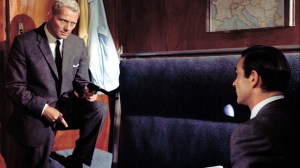
James Bond Review – Goldfinger (dir. by Guy Hamilton)


The Shattered Lens continues the Bond Marathon leading up to the release of Skyfall with 1964’s Goldfinger. Normally, one would figure that the third film in a series is the one with the most danger of ruining everything. You’ve already had two successful stories and you’re asking audiences to come back for yet another round. Yet Goldfinger manages to be considered a favorite by many, and even managed to be the first 007 film to win an Academy Award (for Sound Effects). It does this by expanding on what was already done.

Building on the format that From Russia With Love started, Goldfinger opens with the gun barrel animation and Bond already on a mission. As he reaches what looks like an oil field under the cover of night, he manages to sabotage it (with a little help from C4 or possibly C3, given the time) and arrive back in a neighboring town before it explodes. Heading to his hotel room, he finds a young lady waiting for him who tries to capture his attentions before he catches sight of a thug in the reflection of her eyes. In the fight that ensues, Bond’s quick thinking and a bathtub full of water makes all of the difference. This prologue will become commonplace in all of the EON Production Bond films save for Dr. No (of course) and Quantum of Solace, which gives you the gun barrel at the end of that film.

Sean Connery reprises his role as MI6’s best agent, finding himself in Miami, where he interrupts the card game of one Auric Goldfinger (Gert Frobe), cheating with the help of Jill Masterson (Shirley Eaton). When Bond is caught off guard and knocked out, he wakes up to find Jill dead in her bed, covered in gold paint. The scene actually sparked a number of rumors that Eaton had died in the process of filming it, and as it was mentioned in the film, without leaving a free space near the base of the spine, the actress suffered “skin asphyxiation”. This was later tested on the Discovery Channel’s Mythbusters, and while skin doesn’t “breathe” the way Fleming wrote, your sweat can’t get out of clogged pores. You end up dying of heat stroke. Guess my science teachers were right there, to a degree. The image is so popular, it was even referenced by Quantum of Solace, though Oil was the substance of choice used there.

Bond is given the mission to track Goldfinger and figure out what he’s up, but not without a quick visit to Q Branch. It’s here where we find James’ new car, the Aston Martin DB5, and are introduced to one of longest professional relationships between an automotive company and a production one. Aston Martin would go on to cover nearly every Bond film save for a few (Goldeneye quickly comes to mind), but I’ll profile that relationship in a separate article. The car is outfitted with machine guns, oil slicks, smoke screens and even an ejector seat, believe it or not. Among the gadgets he’s given are two trackers (one large and one small). In terms of the overall series, this is the point where 007 seemingly becomes more of a gadget hound than relying on his actual abilities. I always felt that the ones in From Russia With Love supported him just when he needed it. In Goldfinger, they come across as utility belt like items, though functional all the same.

One of the other standouts in the film is Goldfinger’s henchman, OddJob (Harold Sakata). With a bowler hat that served as a razor disc, he’s one of the most iconic villains in the series, perhaps second only to Richard Kiel’s Jaws. Tomorrow Never Dies and even Goldeneye went on to use henchmen (or henchwomen in Famke Jassen’s case) to great effect.

In going after Goldfinger, Bond runs into Tilly Masterson (Tania Mallet), who mistakenly tries to kill him. They’re eventually caught an in classic 007 Fashion, Bond is placed in a situation that causes one to ask why no one has ever tried to kill him outright. The laser scene that has Bond tied to a table features one of the most famous lines in Goldfinger. When Bond asks Auric if he expects him to talk because of the laser that’s due to cut him in two, Goldfinger stops, turns to face him and exclaims, “No, Mister Bond! I expect you to die!” Needless to say, Goldfinger changes his mind after Bond mentions “Operation Grand Slam”, a plot to seemingly rob Fort Knox. It’s only later that we find that Goldfinger isn’t out to rob the reserve, he’s planning on detonating a nuclear weapon in it that would make all of the nation’s gold radioactive (and all of his gold worth billions, as a result). This is all showcased in a grand sequence involving Pussy Galore’s flight team and some knockout gas. As a kid, I loved it.

Finally, what Bond film would be complete without a Bond Girl? For Goldfinger, we have Honor Blackman’s Pussy Galore. In doing some research on this, I found that according to an article in Empire Magazine, in order to get the name by the American censors, the movie producers took them out to dinner. They decided to not interfere with the name, but it was never exactly listed in any of the US marketing promos. I’d always wondered about that, myself.

As a Bond Girl, Pussy was great in that she handled herself well with both weapons and hand to hand combat. Honor Blackman was well versed in Judo, so her action scenes with Sean Connery were easy to make. Cold and to the point, Pussy Galore wasn’t the “crying over a broken nail” type, but this being the 60’s, they still had the character succumb to Bond’s advances. Personally, I’m not exactly cool with that, but understand that given the time period and possibly the audience, it had to be written as such. Future Bond Girls would make up for it. At least it was good to see that there was a Bond Girl who could stand toe to toe with Bond.

Regarding the casting, one thing that’s also interesting to note that Gert Frobe, who played Goldfinger had a heavy German accent, so heavy in fact that his lines had to be dubbed by someone else. All of the Bond regulars from previous films make a return – Desmond Llewelyn as Q, Lois Maxwell as Miss Moneypenny, in particular. Felix Leiter would be played by a different actor (my favorite being David Hedison from License to Kill).

The impact of Goldfinger has been huge over the years. It’s one of the films everyone usually recalls, and even famed Video Game creator Hideo Kojima pays homage to the film by way of the theme song used in it’s game “Metal Gear Solid 3: Snake Eater”, as the game takes place in the same time period as Goldfinger.

Overall, Goldfinger remains one of the strongest parts of the 007 saga. Tomorrow, the Shattered Lens takes on Thunderball, the Fourth Connery film and the controversy surrounding it. I’ll leave you with Shirley Bassey’s iconic theme to the film.

James Bond Film Review: From Russia With Love (dir. by Terrence Young)


Hi there!  The name’s Bowman, Lisa Marie Bowman.  And tonight, I’m continuing the Shattered Lens’ look at the James Bond film franchise by reviewing 1963’s From Russia With Love.

The 2nd film in the Bond film series, From Russia With Love is considered by many to be one of the best entries in the franchise.  I happen to agree with them.  There’s a lot of talk right now that Skyfall could be the first James Bond film to receive an Oscar nomination for best picture.  Personally, I think From Russia With Love (and not Tom Jones) should have been named the best picture of 1963,  (Seriously, has anyone actually tried to watch Tom Jones recently?)

From Russia With Love opens with a tuxedo-clad James Bond sneaking around outside the type of opulent estate that every Bond villain seems to own.  Suddenly, Bond is attacked by a hulking assassin named Red Grant (played by a pre-Jaws Robert Shaw) and, as the audience watches shocked, Bond is apparently killed.  It’s only after Bond’s dead and on the ground that we learn the truth.  The man in the tuxedo wasn’t James Bond at all — instead, he was just some random henchman in a James Bond mask!  It turns out that Grant works for the villainous organization SPECTRE and this is all part of his training routine.  Now, you would be justified in wondering why SPECTRE would go through the trouble to make a next-to-perfect James Bond mask for a simple training routine but. ultimately, it doesn’t matter.  It’s a great sequence, that manages to be both fun and suspenseful at the same time.  It’s also a great set-up for the rest of the film.

SPECTRE and its mysterious leader (and this is the first time in which we get to see that iconic image of a hand stroking a white cat while a disembodied voice says evil things) want Bond dead.  The job of arranging Bond’s assassination is given to Kronsteen (played by Vladek Sheybal, who has a truly fascinating skeletal face).  When he’s not off being evil, Kronsteen is a chess grandmaster and, not surprisingly, he views his assignment as if it’s just one big chess game.  In order to kill Bond, he knows that he’s going to need a pawn.

That’s where Tatiana Romanova (played by Daniela Bianchi) comes in.  Tatiana is a cipher clerk at the Russian Embassy in Istanbul.  She is approached and given an assignment by Rosa Klebb (Lotte Lenya), a Russian intelligence agent who, unknown to Tatiana, is also working for SPECTRE.  Tatiana contacts MI6 and tells them that she’s willing to defect but only to James Bond.  Tatiana explains that she came across Bond’s picture in a Soviet Intelligence file and the insinuation is that she fell in love (or, at the very least, lust) with that picture.

(Interestingly enough, this parallels the fact that audiences had previously seen Sean Connery in Dr. No and, like Tatiana, spent the year between the two films fantasizing about James Bond themselves.  In that way, Tatiana is the perfect audience surrogate.)

James Bond is sent to Istanbul by M (Bernard Lee) but before he goes, he meets with the head of Q branch.  Desmond Llewelyn makes his first appearance in the Bond franchise here.  In a historic moment of film history, he gives Bond his first booby-trapped briefcase.

When Bond arrives in Istanbul, he meets with station head Kerim Bey (played by Pedro Armanderiz, who tragically committed suicide before From Russia With Love was released).  With the help of Kerim Bey and Tatiana (who Bond first meets with she turns up, naked, in his bed), Bond steals the Lektor decoder device from the Russian consulate.  Though Bond doesn’t realize this, he’s aided in this task by none other than Red Grant.  Grant has been following Bond and perversely, he’s been protecting Bond from KGB assassins so that he might have the chance to kill Bond himself.

Bringing the Lektor device with them, Bond, Tatiana, and Kerim Bey board the Orient Express.  It’s on the train that they meet Nash, a British agent who says that he’s been sent by MI6 to help make sure that Bond and Tatiana safely make it back to England.  Of course, what the audience knows, is that the somewhat smug Nash is none other then … Red Grant!

I love From Russia With Love.  Everything that makes the James Bond series so special — romance, memorable villains, spectacular locations, exciting action, and a rather sardonic sense of humor — is present in From Russia With Love.  Playing Bond for the second time, Connery is more confident with the role here than he was in Dr. No and, as opposed to some of his later appearances in the series, Connery appears to be enjoying bringing this iconic character to life.  There’s none of the boredom that marred some of Connery’s later performances.  Instead, Connery is exciting to watch and it helps that he and Bianchi have a very real chemistry in this film.  As opposed to some Bond girls, Tatiana is a believable, multi-layered character and you actually care what happens to her.  The relationship between Tatiana and Bond feels real and, therefore, the film has a surprising emotional resonance to it.

As opposed to Dr. No, with its somewhat bland title character, the villains in From Russia With Love are a fascinating quartet of rogues.  Lotte Lenya brings an unexpected amount of depth to the role of Rosa and her final battle with Bond is one of the best in the history of the franchise.  Even more exciting than Bond’s fight with Rosa is his final fight with Red Grant.  As played by Robert Shaw, Grant comes across as if he’s the literal personification of Bond’s dark side.  Both men are killers and both are rather smug about it but the difference is that Bond is capable of caring about Tatiana whereas Grant has surrendered whatever emotions he may have once had.  Shaw’s performance so dominates the film that, when I rewatched the film, I was surprised to discover that Grant is only in a handful of scenes.

If Dr. No was an enjoyable B-movie, then From Russia With Love was a cinematic masterpiece that transcended the limitations of genre.  If Dr. No established the basic conventions of James Bond, From Russia With Love showed that those conventions could be used to make a great film.

Tomorrow, we’ll be taking a look at the third film in the Bond franchise, Goldfinger.