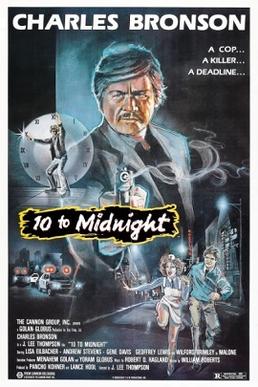
Charles Bronson is Leo Kessler, a veteran detective who’s seen it all and has grown sick of a system of justice that he thinks favors criminals over their victims. When girls start getting murdered, he immediately suspects the arrogant Warren Stacy, played by Gene Davis in the best role of his career. When Kessler and his partner Paul McCann (Andrew Stevens) start putting the pressure on Stacy, the killer responds by going after Kessler’s daughter Laurie (Lisa Eilbacher). Needless to say, our hero will do anything to stop the madman, ANYTHING!
10 TO MIDNIGHT is a special movie in my house because it’s my wife’s favorite Charles Bronson film, even when she didn’t have any overall appreciation for Bronson as an actor. Luckily for her, she had me to introduce her to the rest of the iconic actor’s voluminous catalog of movies. I saw 10 TO MIDNIGHT myself when I was pretty young, probably 13 or so. I remember being scared that first night after I watched the movie when I was trying to go to sleep. My wife and I watched it today on my old VHS tape that I’ve owned going back to the late 1980’s.
There are several elements that elevate 10 TO MIDNIGHT above the average cop / slasher thrillers of the 1980’s. First, it’s Charles Bronson in the lead role. Bronson has such a strong presence on screen that his presence alone elevates almost any material. He looks great in the film, and the role gives him some good opportunities, as both a mentor to the young cop, and even more importantly, as a dad who wants to do better for his daughter. It’s a solid role that seems to fit Bronson like a glove. Second, we know from the very beginning of the movie that Warren Stacy is in fact the killer. We also know that the law seems to be working in his favor. And because of that, we’re on Kessler’s side as he goes to extreme lengths to stop his reign of terror. Finally, the script and director J. Lee Thompson go all in on the sex and violence. Examples include Stacy killing his often naked victims while he himself is in the nude. There is much talk in the film about items of a sexual nature and Stacy even has a sexual release device that almost has to be seen to be believed. It definitely adds a decadent and voyeuristic feel to the proceedings. And I haven’t even mentioned yet that it has one of the very best endings of any Bronson film, second only to THE MECHANIC, in my humble opinion.
I highly recommend 10 TO MIDNIGHT!
For a more detailed review of 10 TO MIDNIGHT, check out Lisa’s review from a couple of years back below:
A series of murders have occurred at Harrison State Prison in California. What better way to investigate the crimes and catch the guilty than to send in an undercover cop? Who can enter a California prison and investigate the crime without drawing too much attention to himself? It would have to be someone who could blend in with the population without seeming out of place.
How about Jean-Claude Van Damme?
Van Damme, in one of his early films, stars as Louis Burke, a Canadian with a Belgian accent who comes to Los Angeles to track down a serial killer known as the Sandman (Patrick Kilpatrick, who was last seen running for governor of California in 2021) and then just sticks around. Burke enters the prison and somehow, he is not immediately tagged as being a B-movie star who is working for the police. I guess California prisons are full of Belgian kickboxers.
A realistic portrait of prison and police work, this is not. But it is Van Damme at his most berserk, flexing his muscles and shouting at his enemies and getting hit in the head by a flying wrench at one point. To the surprise of no one, the Sandman eventually ends up in the prison with Burke and it leads to an epic showdown that takes place in the middle of a prison riot. The fight is exciting because Van Damme and Kilpatrick were two tough actors who, at that point in their careers, had nothing to lose by going all out on screen.
(Of the three major B-action stars of the 90s, Dolph Lundgren was the one you watched because he could actually act. Steven Seagal was the one you watched because you hoped someone would beat him up. Jean-Claude Van Damme was the one you watched because he could actually do everything he did in the movies in real life as well.)
There are many good actors to be found in Death Warrant, playing paper-thin characters. Robert Guillaume is the one-eyed clerk who takes Burke under his wing. Larry Hankin is the biggest weasel in the prison. Art LaFleuer is the prison guard from Hell. George Dickerson is the obviously corrupt official. Abdul Salaam El-Razzac is the voodoo priest who watches over the prison. Cynthia Gibb is the attorney who pays Burke a conjugal visit. It’s good to see them all.
Death Warrant is a dumb and entertaining B-movie that doesn’t take itself too seriously. It’s not Van Damme’s best but it’s not his worst either. It’s Damme fun.
The 1983 film, 10 to Midnight, opens with LAPD detective Leo Kessler (played by legendary tough guy Charles Bronson) sitting at his desk in a police station. He’s typing up a report and taking his time about it. A reporter who is in search of a story starts to bother Leo.
“Jerry,” Leo tells him, “I’m not a nice person. I’m a mean, selfish son-of-a-bitch. I know you want a story but I want a killer and what I want comes first.”
It’s a classic opening, even if Leo isn’t being totally honest. Yes, he can be a little bit selfish but he’s really not as mean as he pretends to be. He may not know how to talk to his daughter Laurie (Lisa Eilbacher) but he is also very protective of her and he wants to be a better father than he’s been in the past. He may roll his eyes when he discovers that Detective Paul McAnn (Andrew Stevens) is the son of a sociology professor but he still tries to act as a mentor to his younger partner. Leo may complain that the criminal justice system “protects those maggots like they’re an endangered species” but that’s just because he’s seen some truly disturbing things during his time on the force and, let’s face it, Leo has a point. When one of Laurie’s friends is murdered, Leo is convinced that Warren Stacy (Gene Davis) is the murderer and he’s determined to do whatever he has to do to get Warren off the streets. “All those girls,” Leo snarls when he sees Warren, his tone letting us know that his mission to stop Warren is about more than just doing his job.
Warren Stacy is handsome, athletic, and he has good taste in movies. (He’s especially a fan of Butch Cassidy and the Sundance Kid. Just don’t try to trick him by saying Steve McQueen played the Sundance Kid.) Warren is also a total creep, the type of guy who complains that a murder victim “wasn’t a good person,” because she trashed him in her diary. When Leo takes a look around Warren’s apartment, he finds not only porn but also a penis pump. (“It’s for jacking off!” Leo yells at Warren, enunciating the line as only Charles Bronson could.) Warren is also a murderer but he’s a clever murderer, the type who sets himself up with an alibi by acting obnoxiously in a movie theater. Warren strips nude before killing his victims, in order to make sure that he doesn’t leave behind any evidence. (This film was made in the days before DNA testing.)
Leo knows that Warren is guilty but, as both his gruff-but-fair captain (Wilford Brimley, naturally) and the D.A. (Robert F. Lyons) point out, he has no way to prove it. When Warren starts to stalk Laurie and her friends (including Kelly Preston), Leo decides that he has no choice but to frame Warren. But when Warren’s amoral attorney, Dave Dante (Geoffrey Lewis, giving a wonderfully sleazy performance), threatens to call McAnn to the stand, McAnn has to decide whether to tell the truth or to join Leo in framing a guilty man.
10 to Midnight is a violent, vulgar, and undoubtedly exploitive film, one that features a ham-fisted message about how the justice system is more concerned with protecting the rights of the accused as opposed to lives of the innocent. And yet, in its gloriously pulpy way, this is also one of Bronson’s best films. It’s certainly my personal favorite of the films that he made for Cannon.
Director J. Lee Thompson and Charles Bronson were frequent collaborators and Thompson obviously knew how to get the best out of the notoriously reserved actor. Bronson was not known for his tremendous range but he still gives one of his strongest performances in 10 to Midnight, playing Leo as being not just a determined cop but also as an aging man who is confused by the way the world is changing around him. Stopping Warren isn’t just about justice. It’s also about fighting back against the the type of world that would create a Warren Stacy and then allow him to remain on the streets in the first place. Interestingly, though Leo doesn’t hesitate when it comes to framing Warren, he is also sympathetic to McAnn’s objections. Unlike other Bronson characters, Leo doesn’t hold a grudge when his partner questions his methods. Instead, he simply know that McAnn hasn’t spent enough time in the real world to understand what’s at stake. McAnn hasn’t given into cynicism. He hasn’t decided that the best way to deal with his job is to be a “mean son of a bitch.” Bronson and Andrew Stevens, who had worked together in the past, have a believable dynamic. McAnn looks up to Leo but is also conflicted by his actions. Leo may be annoyed by McAnn’s reluctance but he also respects him for trying to be an honest cop. Their partnership feels real in a way that sets 10 to Midnight apart from so many other films about an older cop having to deal with an idealistic partner.
One of the most interesting things about the film is Leo’s relationship with his daughter, Laurie. Over the course of the film, Leo and Laurie go from barely speaking to bonding over liquor and their shared regrets about the state of the justice system. When McAnn first meets Laurie, she’s offended when McAnn suggests that she takes after her father. But, as the film progresses, she comes to realize that she and Leo have much in common. (To be honest, I related quite a bit to Laurie, especially as I’ve recently come to better appreciate how much of my own independent nature was inherited from my father.) Lisa Eilbacher and Charles Bronson are believable as father-and-daughter and they play off of each other well. The scenes between Laurie and Leo give 10 to Midnight a bit more depth than one might otherwise expect from a Bronson Cannon film. Leo isn’t just trying to protect his daughter and her roommates from a serial killer. He’s also trying to be the father who he wishes he had been when she was younger. He’s trying to make up for lost time, even as he also tries to keep Warren Stacy away from his family.
As played by Gene Davis, Warren Stacy is one of the most loathsome cinematic villains of all time. Warren’s crimes are disturbing enough. (Indeed, the surreal sight of a naked and blood-covered Warren Stacy stalking through a dark apartment is pure nightmare fuel.) What makes Warren particularly frightening is that we’ve all had to deal with a Warren Stacy at some point in our life. He’s the sarcastic and easily offended incel who thought he was entitled to a phone number or a date or perhaps even more. As I rewatched this movie last night, I wondered how many Warrens I had met in my life. How many potential serial killers have any of us unknowingly had to deal with? Warren tries to strut through life, smirking and going out of his way to let everyone know that he knows more than they do but the minute that Leo turns the table on him, Warren starts whining about he’s being treated unfairly. During his final, disturbing rampage, Warren yells that his victims aren’t being honest with him, blaming them for his actions. The film deserves a lot of credit for not turning Warren into some sort of diabolical and erudite supervillain. He’s not Hannibal Lecter. Instead, like all real-life serial killers, he’s a loser who is looking for power over those to whom he feels inferior and for revenge on a world that he feels owes him something. He’s a realistic monster and that makes him all the more frightening and the film all the more powerful. Warren is the type of killer who, even as I sit here typing this, could be walking down anyone’s street. He’s such a complete monster that it’s undeniably cathartic whenever Leo goes after him.
How delusional is Warren Stacy? He’s delusional enough to actually taunt Charles Bronson! At one point, Warren informs Leo that he can’t be punished for being sick. Warren announces that, when he’s arrested, he might go away for a while but he’ll be back and there’s nothing Leo can do about it. (The suggestion, of course, is that Warren will be back because he committed his crimes in California and all the judges were appointed by a bunch of bleeding heart governors. Warren may not say that out loud but we all know that is the film’s subtext. Some people may agree with the film, some people may disagree. Myself, I’m against the death penalty because I think it’s a prime example of government overreach but I still cheered the first time that I heard Clint Eastwood say, “Well, I’m all torn up about his rights,” in Dirty Harry.) How does Leo react to Warren’s taunts? I can’t spoil the film’s best moment but I can tell you that 10 to Midnight features one of Bronson’s greatest (and, after what we’ve just seen Warren do, most emotionally satisfying) one-lines.
The title has nothing to do with anything that happens in the film. In typical Cannon fashion, the film’s producers came up with a snappy title (and 10 to Midnight is a good one) and then slapped it onto a script that was previously called Bloody Sunday. Fortunately, as long as Bronson is doing what he does best, it doesn’t matter if the title makes sense. And make no mistake. 10 to Midnight is Bronson at his best.
After a piece of the Skylab space station crashes into rural Spain, first the cows and then the wolves are infected by a cosmic virus that turns them into cannibalistic monsters. Soon, the virus spreads to a nearby town and the villagers also start to transform into mindless flesheaters. While NASA tries to contain the virus and keep the rest of the world from finding out, three American college students drive their RV into the village. Damon (Dennis Christopher), Michael (Martin Hewitt), and Samantha (Lynn-Holly Johnson) soon find themselves fighting for survival as they are pursued by both the mutants and the government. Working with a helpful scientist, they try to recover an antidote before it is too late.
Also released under the title Alien Predator, The Falling deserves a lot of credit for knowing exactly what it is. It’s a low budget, B-movie and it doesn’t try to convince us that it’s anything else. As soon as I saw the red buggy that was hooked up to the book of the RV, I knew that this was going to be good. Eventually, Michael gets in the dune buggy and gets chased around the village by the flesheaters and the movie starts to feel like an extended episode of Starsky and Hutch. The three leads are likable, even if they are also too old to be believable college students. Christopher makes jokes and tries to sound like James Cagney, Hewitt does a Rod Serling impersonation, and Lynn-Holly Johnson looks good while screaming. People who watch movies like this for the gore will appreciate the exploding head scene. All in all, The Falling is an enjoyable “bad” movie.



 Through the Shattered Lens