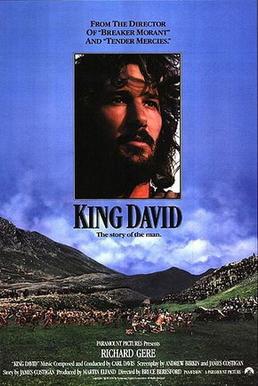
Film Review: King David (dir by Bruce Beresford)


A film about David, the young shepherd and musician who eventually became the second king of Israel?

That sounds like a great idea!

After all, David is one of the most compelling figures in history.  Whether it’s the slaying of Goliath or his ill-fated friendship with Jonathan or his uneasy relationship with Saul, every detail about David’s youth feels perfect for cinematic drama.  And then, once David become king of Israel, the drama doesn’t end.  David finds himself dealing with both politics and temptation.  He falls in lust with Bathsheba and, in a moment of terrible weakness, he arranges for her husband to be killed in battle.  His own son, Absalom, turns against him and then, despite David’s very clear orders to the contrary, Absalom is executed while he helplessly hangs from a tree.  For every triumph in David’s life (like the time he used a slingshot to take down Goliath), there’s a tragedy.  For all of David’s attempts to be a good and wise king, he still struggles with his own weaknesses.  Every detail of David’s life seems like it belongs on the big screen.

So, now that we’ve agreed that the life of David would be perfect for a movie, consider this: A film about David, a master of both poetry and politics who was known for his deep emotions, starring Richard Gere?

Uhmmmm….

The 1985 film, King David, has all the potential to be a great film but it’s pretty much doomed by the fact that David is played by Richard Gere.  Today, of course, Richard Gere is an above average character actor who is well-cast as older, seemingly successful men who have never quite conquered their own self-doubt.  That’s not the Richard Gere who shows up in King David.  The Richard Gere who shows up in King David is the blank-faced, youngish Richard Gere who was best-known for films like An Officer and a Gentleman and American Gigolo.  Richard Gere is so miscast as David that just the sight of him takes you out of the film’s reality.  While the film plays out, you find yourself saying, “Richard Gere just killed Goliath.  Richard Gere just spied on Bathsheba.  Richard Gere is dancing through the streets of Jerusalem.”

There are a few good things about King David.  Edward Woodward gives a good performance as Saul, who has always been overshadowed David but who was, in his own way, almost as compelling a character.  The film does a credible-enough job recreating the ancient world and it’s entertaining to see the iconic Italian actor George Eastman show up as Goliath.  Far too often, though, King David becomes one of those films where every big action scene is shown in slow motion and there’s too many close-ups of swords being tossed into the air.

According to Wikipedia (that’s right, I did some “serious” research for this review), King David was actually made because it was felt that the film would be able to draw in the same audience that loved Star Wars.  That turned out to not be true as the film was a huge flop and apparently damaged a lot of careers.  But, flop or not, it was still on TV last night, which just proves that movies are forever.
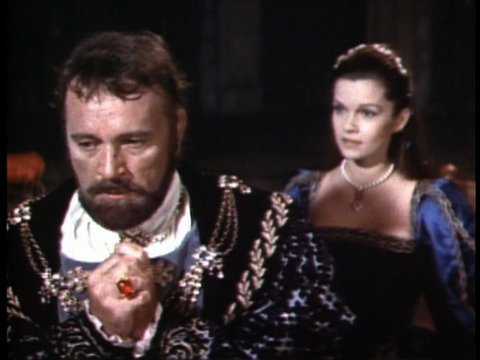
Cleaning Out The DVR, Again #8: Anne of the Thousand Days (dir by Charles Jarrott)


Anne

After I finished writing my review of Rolling Thunder, I continued the process of cleaning out my DVR by watching the 1969 film, Anne of the Thousand Days.  How does a film like Anne of the Thousand Days compare to a film like Rolling Thunder?

They might as well have been conceived, written, directed, and released on different planets.

I recorded Anne of The Thousand Days off of TCM on March 26th.  The main reason that I set the DVR to record it was because Anne was a best picture nominee.  It may seem strange to think that this rather conventional film was nominated the same year as Butch Cassidy and the Sundance Kid, Z, and Midnight Cowboy.  It gets even stranger when you consider what wasn’t nominated that year: Medium Cool, If…, Last Summer, They Shoot Horses, Don’t They?, Alice’s Restaurant, The Wild Bunch, Once Upon A Time In The West, and a long list of other films.  In fact, if I wanted to, I could probably spend this entire review listing all of the 1969 films that feel like a more appropriate best picture nominee than Anne of the Thousand Days.

And yet, Anne was nominated for best picture.  In fact, it received a total of 10 Oscar nominations, the most of any film that year.  Tellingly most of the nominations were in the technical categories and the only Oscar that it won was for its costumes.  Genevieve Bujold received a nomination for playing the title character and Richard Burton became the third actor to receive a nomination for playing King Henry VIII.

As for the film, Anne of the Thousand Days tells the oft-told story of King Henry VIII and his marriage to Anne Boleyn.  Told in flashback as both Henry and Anne wait for her to be executed on charges of adultery, the film shows us how middle-aged Henry VIII first met and fell in love with 18 year-old Anne Boleyn.  Standing in the way of Henry’s pursuit of Anne was the fact that 1) Anne intensely disliked him, 2) Anne was already engaged, 3) Anne’s sister was already Henry’s mistress, and 4) Henry was already married to Catherine of Aragon (Irene Papas).

Fortunately, Henry happens to be king and being king comes with its perks.

For instance, as king, he can order Anne and her fiancée to break up.  As king, he can casually dismiss his former mistress.  And, as king, Henry has the power that Anne finds to be the ultimate aphrodisiac.  At first, Anne merely loves the fact that Henry is obsessed with her.  But slowly, she comes to love Henry as a man as well…

The only problem is that Henry is still married and Catherine is still popular with the people.  Even after Henry divorces her and marries Anne, the common people refuse to accept Anne as their queen.  When Sir Thomas More (William Squire) refuses to recognize Anne as queen, Anne demands that More be executed.  When Henry initially shows reluctance, Anne announces that she will not sleep with him until More is dead.

Needless to say, Thomas More is quickly executed.

However, Henry’s attention has already moved on to Jane Seymour (Lesley Paterson) and, desperate to get Anne out of his life, he arranges for Cardinal Cromwell (John Colicos) to frame Anne on charges of adultery and incest.  With Anne facing a humiliating trial and the possibility of execution, Henry makes her an offer.  If she agrees to an annulment, he’ll free her.  However, their daughter — Elizabeth — will lose her claim to the throne…

It’s telling that Charles Jarrott did not receive an Oscar nomination for his work as Anne of the Thousand Day‘s director.  There are a lot of technically good things about Anne of the Thousand Days but, despite all of the melodrama and sex and historical detail to be found in Anne, it never comes to life as a movie.  The costumes are to die for, the sets are impressive, and the cast is full of talented British character actors but the whole movie just feels oddly flat.  Try as it may, it can never convince us that either Henry VIII or Anne Boleyn is worth all the trouble.

Anne of the Thousand Days was obviously a big production, which probably explains all the Oscar nominations.  But otherwise, it’s one of the more forgettable best picture nominees.