Film Review: Murder on the Orient Express (dir by Sidney Lumet)


There’s been a murder on the Orient Express!

In the middle of the night, a shady American businessman (Richard Widmark) was stabbed to death.  Now, with the train momentarily stalled due to a blizzard, its up to the world’s greatest detective, Hercule Poirot (Albert Finney), to solve the crime.  With only hours to go before the snow is cleared off the tracks and the case is handed over to the local authorities, Hercule must work with Bianchi (Martin Balsam) and Dr. Constantine (George Coulouris) to figure out who among the all-star cast is a murderer.

Is it the neurotic missionary played by Ingrid Bergman?  Is it the diplomat played by Michael York or his wife, played by Jacqueline Bisset?  Is it the military man played by Sean Connery?  How about Anthony Perkins or John Gielgud?  Maybe it’s Lauren Bacall or could it be Wendy Hiller or Rachel Roberts or even Vanessa Redgrave?  Who could it be and how are they linked to a previous kidnapping, one that led to the murder of an infant and the subsequent death of everyone else in the household?

Well, the obvious answer, of course, is that it had to be Sean Connery, right?  I mean, we’ve all seen From Russia With Love.  We know what that man is capable of doing on a train.  Or what about Dr. No?  Connery shot a man in cold blood in that one and then he smirked about it.  Now, obviously, Connery was playing James Bond in those films but still, from the minute we see him in Murder on the Orient Express, we know that he’s a potential killer.  At the height of his career, Connery had the look of a killer.  A sexy killer, but a killer nonetheless….

Actually, the solution to the mystery is a bit more complicated but you already knew that.  One of the more challenging things about watching the 1974 version of Murder on the Orient Express is that, in all probability, the viewer will already know how the victim came to be dead.  As convoluted as the plot may be, the solution is also famous enough that even those who haven’t seen the 1974 film, the remake, or read Agatha Christie’s original novel will probably already know what Poirot is going to discover.

That was something that director Sidney Lumet obviously understood.  Hence, instead of focusing on the mystery, he focuses on the performers.  His version of Murder on the Orient Express is full of character actors who, along with being talented, were also theatrical in the best possible way.  The film is essentially a series of monologues, with each actor getting a few minutes to show off before Poirot stepped up to explain what had happened.  None of the performances are exactly subtle but it doesn’t matter because everyone appears to be having a good time.  (Finney, in particular, seems to fall in love with his occasionally indecipherable accent.)  Any film that has Anthony Perkins, John Gielgud, Lauren Bacall, Sean Connery, Ingrid Bergman, and Albert Finney all acting up a storm is going to be entertaining to watch.

Though it’s been a bit overshadowed by the Kenneth Branagh version, the original Murder on the Orient Express holds up well.  I have to admit that Sidney Lumet always seems like he would have been a bit of an odd choice to direct this film.  I mean, just consider that he made this film in-between directing Serpico and Dog Day Afternoon.  However, Lumet pulls it off, largely by staying out of the way of his amazing cast and letting them act up a storm.  It looks like it was a fun movie to shoot.  It’s certainly a fun movie to watch, even if we do already know the solution.

Cleaning Out The DVR, Again #8: Anne of the Thousand Days (dir by Charles Jarrott)


Anne

After I finished writing my review of Rolling Thunder, I continued the process of cleaning out my DVR by watching the 1969 film, Anne of the Thousand Days.  How does a film like Anne of the Thousand Days compare to a film like Rolling Thunder?

They might as well have been conceived, written, directed, and released on different planets.

I recorded Anne of The Thousand Days off of TCM on March 26th.  The main reason that I set the DVR to record it was because Anne was a best picture nominee.  It may seem strange to think that this rather conventional film was nominated the same year as Butch Cassidy and the Sundance Kid, Z, and Midnight Cowboy.  It gets even stranger when you consider what wasn’t nominated that year: Medium Cool, If…, Last Summer, They Shoot Horses, Don’t They?, Alice’s Restaurant, The Wild Bunch, Once Upon A Time In The West, and a long list of other films.  In fact, if I wanted to, I could probably spend this entire review listing all of the 1969 films that feel like a more appropriate best picture nominee than Anne of the Thousand Days.

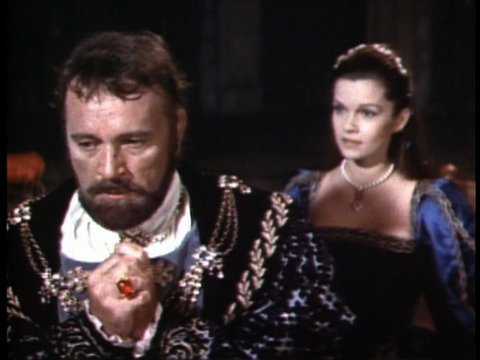
And yet, Anne was nominated for best picture.  In fact, it received a total of 10 Oscar nominations, the most of any film that year.  Tellingly most of the nominations were in the technical categories and the only Oscar that it won was for its costumes.  Genevieve Bujold received a nomination for playing the title character and Richard Burton became the third actor to receive a nomination for playing King Henry VIII.

As for the film, Anne of the Thousand Days tells the oft-told story of King Henry VIII and his marriage to Anne Boleyn.  Told in flashback as both Henry and Anne wait for her to be executed on charges of adultery, the film shows us how middle-aged Henry VIII first met and fell in love with 18 year-old Anne Boleyn.  Standing in the way of Henry’s pursuit of Anne was the fact that 1) Anne intensely disliked him, 2) Anne was already engaged, 3) Anne’s sister was already Henry’s mistress, and 4) Henry was already married to Catherine of Aragon (Irene Papas).

Fortunately, Henry happens to be king and being king comes with its perks.

For instance, as king, he can order Anne and her fiancée to break up.  As king, he can casually dismiss his former mistress.  And, as king, Henry has the power that Anne finds to be the ultimate aphrodisiac.  At first, Anne merely loves the fact that Henry is obsessed with her.  But slowly, she comes to love Henry as a man as well…

The only problem is that Henry is still married and Catherine is still popular with the people.  Even after Henry divorces her and marries Anne, the common people refuse to accept Anne as their queen.  When Sir Thomas More (William Squire) refuses to recognize Anne as queen, Anne demands that More be executed.  When Henry initially shows reluctance, Anne announces that she will not sleep with him until More is dead.

Needless to say, Thomas More is quickly executed.

However, Henry’s attention has already moved on to Jane Seymour (Lesley Paterson) and, desperate to get Anne out of his life, he arranges for Cardinal Cromwell (John Colicos) to frame Anne on charges of adultery and incest.  With Anne facing a humiliating trial and the possibility of execution, Henry makes her an offer.  If she agrees to an annulment, he’ll free her.  However, their daughter — Elizabeth — will lose her claim to the throne…

It’s telling that Charles Jarrott did not receive an Oscar nomination for his work as Anne of the Thousand Day‘s director.  There are a lot of technically good things about Anne of the Thousand Days but, despite all of the melodrama and sex and historical detail to be found in Anne, it never comes to life as a movie.  The costumes are to die for, the sets are impressive, and the cast is full of talented British character actors but the whole movie just feels oddly flat.  Try as it may, it can never convince us that either Henry VIII or Anne Boleyn is worth all the trouble.

Anne of the Thousand Days was obviously a big production, which probably explains all the Oscar nominations.  But otherwise, it’s one of the more forgettable best picture nominees.