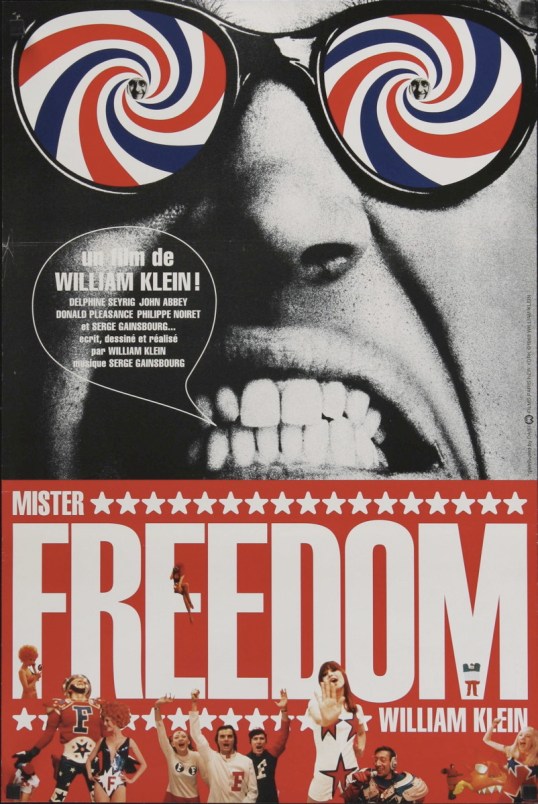
Mr. Freedom, William Klein’s 1968 political satire, is a strange one.
The film opens with a riot in the inner city. A scowling Southern sheriff (played by John Abbey) goes into his apartment and, when he comes back out, he’s transformed into Mr. Freedom, a patriotic super hero whose is costumed in a red, white, and blue football uniform. Mr. Freedom proceeds to invade a black household where, while firing two guns, he sings his theme song.
“F-R-Double E-Double D-OM! FREEDDOM!”
That’s right, he misspelled freedom.
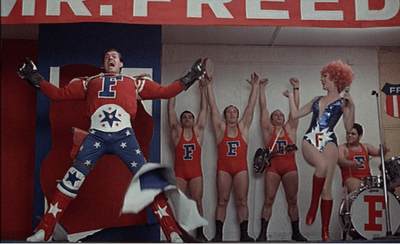
It turns out that Mr. Freedom works for Freedom, Inc. His boss is Dr. Freedom (played by Donald Pleasance) who communicates with Mr. Freedom via a flickering TV screen. Dr. Freedom is concerned that France is on the verge of turning communist and he sends Mr. Freedom to Paris in order to “win the hearts and minds” of the French.
William Klein, himself, was an American expatriate who lived in France and is best known for being both a fashion photographer and a documentarian. His view of America is epitomized by the sight of Mr. Freedom (wearing a gigantic cowboy hat) wandering around Paris and assaulting random tourists. With the help of a prostitute played by Delphine Seyrig, Mr. Freedom attempts to rally the French to the side of freedom and to defeat the schemes of Red China Man. When the French don’t prove enthusiastic enough, Mr. Freedom responds by making plans to blow the country up.
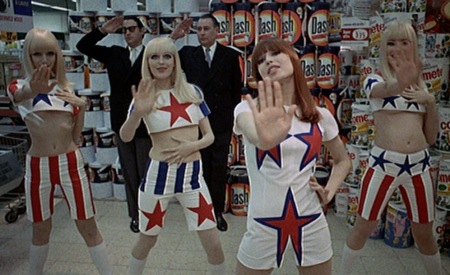 Unlike a lot of left-wing films, which celebrate the American establishment by pretending to attack it, Mr. Freedom is sincere in its politics. It’s obvious that William Klein set out to make the most anti-American film that he could and he succeeded. Mr. Freedom is an irredeemable character. When the film begins, Mr. Freedom is quickly established as being an idiot and, at the end of the film, he has somehow become an even bigger idiot. Perhaps not surprisingly, a lot of people over at the imdb have compared Mr. Freedom’s quest to conquer France to America’s current policy towards the Middle East.
If you’ve read some of my previous reviews, you would be justified in expecting that this is where I would condemn Mr. Freedom for being heavy-handed and tediously left-wing. After all, I’m the girl who condemned Avatar for being predictable environmental propaganda. And yes, I did find Mr. Freedom to be heavy-handed but I actually enjoyed it.
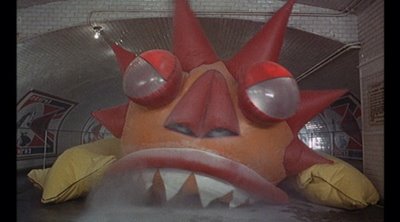
Even if you didn’t know that William Klein was an award-winning photographer both before and after he started making films, you would be able to guess it after taking one look at Mr. Freedom. The film’s narrative is undeniably uneven but visually, it’s a feast for the eyes. From the costumes worn by Mr. Freedom and his disciples to the design of Mr. Freedom’s secret headquarters, the screen is full of bold, primary colors and Klein shows a taste and appreciation for the bizarre that makes it easier to deal with the film’s moments of peachiness. Perhaps my favorite scene in the film involves Mr. Freedom confronting Red China Man. Red China Man, it turns out, is a gigantic dragon-shaped balloon.
See Mr. Freedom.
There’s nothing else like it.

 Through the Shattered Lens