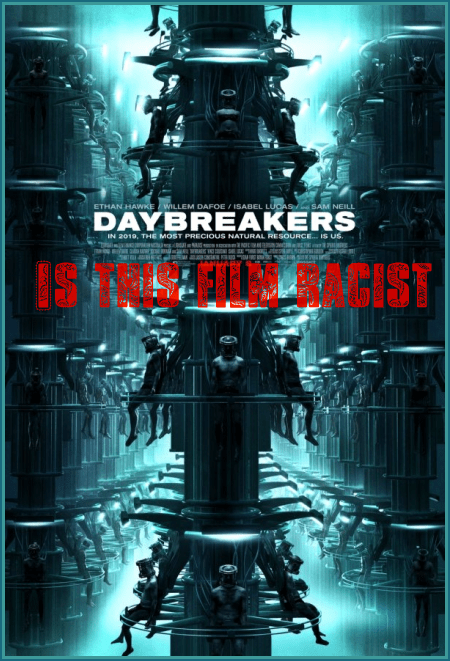
While watching The Spierig Brothers’ latest genre offering something bothered me as I sat in the theater. The feeling of unease and discomfort was there (it may have been the theaters nachos but now I’m not so sure). It wasn’t until I was home from watching Daybreakers that it finally hit me. The film’s many social overtones in addition to the liberal amount of gore and blood displayed in the last half-hour also hid an insidious cliche that’s been used far too many times in genre storytelling. I speak of the “white man guilt” syndrome which pervades many popular stories and films.
How could I say that this little vampire scifi/horror film was perpetuating a racist tone in its storytelling? I assure you that it wasn’t easy to see but my eyes were finally opened up to that distinct possibility once I properly digested things.
First, let me give a brief synopsis of what the film is all about. Without going into too much detail about the plot not already spoiled in the trailers, Daybreakers tells the story of a future 2019 where a vampiric virus has swept across the globe, turning most of the population into vampires (with all the traditional colorings and habits). Humans are now the minority in this future Earth. Humans who have become the natural resource the world’s new dominant lifeform needs to consume. But this is a natural resource that is dwindling in supply as less and less humans have been found by the machinery of the vampire elite and overlords. Yadda-yadda and more yadda we’re introduced to one vampire who hates what he has become and hates even more what his kind has done to the minority that are the surviving humans. He wants to find a cure for what he and his race have become so as to make everything all better. Again after more stuff happens he soon comes across a band of these minority humans who suddenly trust the very thing they hate and fear the most. Soon one of these humans approaches him and tells him that he’s their only hope for survival. Lo and behold, he does end up helping them and thus he exsanguinates (literally at times) the guilt which had been eating in the inside.
Just recalling all of that makes me even more sure that Daybreakers is racist in how it portrays its main protagonist. Let’s start with the fact that the hero is white. He’s even whiter than usual since the vampire in him has made him averse to tanning. The head of the all-powerful military-industrial corporation (see they’re also military because they have security with guns and soldiers to find new resources) he works for is evil-incarnate and also white (thus we’re led to believe that being white means one is evil). This hero vampire wants to save the humans and thats why he refuses to drink human blood like the rest of his kind. He talks about his kind using up the blood resource without any thought that doing so means destroying this minority tribe of whats left of the human race.
While the cure he has been searching for to cure not just himself of vampirism but all others like him does get found it is this white vampire with a guilty conscience that ends up figuring out how to replicate the cure. While it was these minority band of humans who had it all along it took one of their enemy who has a change of heart to save them. By saving them he also sheds the guilt of his own majority race’s actions and behaviors toward this minority group by literally becoming one of them as well. By becoming one of them he’s experienced first-hand what this minority group has suffered at the hand of his kind. But in the end, he’s also the only hope this group has to ever living happily ever after.
Do you not see the pattern of “white man guilt” which insidiously weaves it’s way into a story where most people wouldn’t see without the help of those who sees them plain as day. The vampire society intent on exploiting the remaining minority tribe of humans sees themselves as civilized and even gave the humans a chance to assimilate (as told in the beginning), but being the “noble savages” that these humans are refuse to do so because they value the natural way of things before the virus which made humanity became crazed parasites.
Why did it take a white, angst-ridden, reluctant vampire to finally find the cure? Why not let the humans who actually had it in their possession to find it themselves and cut the middle-man out of it? It’s these questions which need to be asked to help initiate a dialogue about how racism is still prevalent in Hollywood and with the white people who help finance such films. People whose guilt about what their ancestors have done have made them genetically culpable of their racist sins. Anyone who can’t see this racism in this narratively-flawed, albeit very gory ending of a vampire flick are hiding in a cave and refuses to believe that racism exist in everything (as long as it’s told by a white person). If minorities refuse to sound out the clarion call to discuss such a divisive issue then it is up to those white people who feel such guilt about what their forefathers have done to do so. I mean, if the people being oppressed and belittled can’t see it for themselves, then the guilt-ridden white America will do it for them whether they want it or not.
So, just like James Cameron’s Avatar and Neill Blomkamp’s District 9 (both of which have been labeled as racist in their own way), I do believe that Daybreakers just continues to perpetuate the insidious evil that is racism by way of “white man guilt” in these films. The fact that the filmmakers are a couple of white brothers from Australia just makes the point even clearer.
In conclusion, as I read all that I just wrote I do believe that I’m nothing but full of political-correctness crap who shouldn’t be taken seriously when it comes to actually discussing race relations and how it affects current society. Maybe the fact that I’m not white made me open up my eyes to the load of crap I just wrote and that sometimes a film is just a film. I’m sure bringing that last part up would label me a racist as well.


 Through the Shattered Lens