What if you were dying and no one cared?
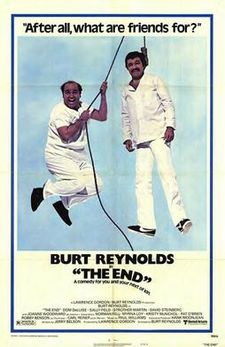
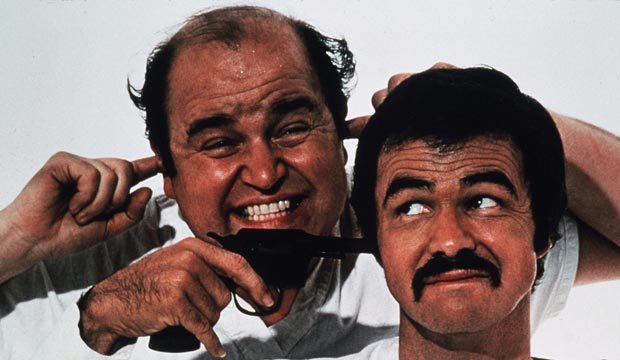
That is the theme of The End, which is probably the darkest film that Burt Reynolds ever starred in, let alone directed. Burt plays Sonny Lawson, a shallow real estate developer who is told that he has a fatal blood disease and that, over the next six months, he is going to die a slow and painful death. After seeking and failing to find comfort with both religion and sex, Sonny decides to kill himself. The only problem is that every time he tries, he fails. He can’t even successfully end things. When he meets an mental patient named Marlon Borunki (Dom DeLuise), he hires the man to murder him. Marlon is determined to get the job done, even if Sonny himself later changes his mind.
Yes, it’s a comedy.
The script for The End was written by Jerry Belson in 1971. Though Belson also worked on the scripts for Spielberg’s Close Encounters of the Third Kind and Always, he was best-known for his work on sitcoms. (Belson was an early collaborator of Garry Marshall’s.) The End was originally written with Woody Allen in mind but when Allen passed on it to concentrate on directing his own movies about death, the script spent five years in limbo. Reynolds later said that, when he eventually came across The End, he knew he had to do it because it was the only script that reflected “my strange sense of comedy.” United Artists was uncertain whether there was much box office potential in a film about a self-centered man dying and they required Reynolds to first make the commercially successful Hooper before they would produce The End.
The End was made for 3 million dollars and it went on to gross 40 million. That the film was a box office success is a testament to the late 70s starpower of Burt Reynolds because it’s hard to think of any other mainstream comedy that goes as much out of its way to alienate the audience as The End does. While watching The End for the first time, most viewers will probably expect two things to happen. First off, Sonny will learn to appreciate life and be a better person. Secondly, it will turn out that his fatal diagnosis was incorrect. Instead, neither of those happen. Sonny is going to die no matter what and he never becomes a better person. What’s more is that he never even shows any real interest in becoming a better person. The film’s signature scene comes when Sonny prays to God and offers to give up all of his money if he survives, just to immediately start backtracking on the amount. It’s funny but it’s also a sign that if you’re looking for traditional Hollywood sentiment, you’re not going to find it here.
Burt not only stared in The End but he also directed it and, as was usually the case whenever he directed a film, the cast is a mix of friends and Hollywood veterans. Sally Field plays Sonny’s flakey, hippie girlfriend while Robby Benson is cast as a young priest who fails to provide Sonny with any spiritual comfort. Joanne Woodward plays his estranged wife and Kristy McNichol plays his daughter. Myrna Loy and Pat O’Brien play his parents. Norman Fell, Carl Reiner, and Strother Martin play various doctors. The movie is stolen by Dom DeLuise, playing the only person who seems to care that Sonny’s dying, if just because it offers him an excuse to kill Sonny before the disease does. DeLuise was a brilliant comedic actor whose talents were often underused in films. The End sets DeLuise free and he gives a totally uninhibited performance.
Despite DeLuise’s performance, The End doesn’t always work as well as it seems like it should. Though Reynolds always said that this film perfectly captured his sense of humor, his direction often seems to be struggling to strike the right balance between comedy and tragedy and, until DeLuise shows up, the movie frequently drags. As a character, the only interesting thing about Sonny is that he’s being played by Burt Reynolds. That is both the film’s main flaw and the film’s biggest strength. Sonny may not be interesting but, because we’re not used to seeing Burt cast as such a self-loathing, self-pitying character, it is interesting to watch a major star so thoroughly reveal all of his fears and insecurities.
If you’re a Burt Reynolds fan, The End is an interesting film, despite all of its flaws. Burt often described this as being one of his favorite and most personal films. It’s a side of Burt Reynolds that few of his other films had the courage to show.
 John Bourgignon (John Candy) is a man of many talents. He’s a limo driver. He’s a drummer. He is an occasional actor, having starred in Kung Fu U. for his friend, director Sal DiPasquale (Eugene Levy). John is also improbably engaged to Nancy Reece (Alley Mills), the daughter of Congressman and presidential candidate Ed Reese (Pat Hingle). As the wedding approaches, John deals with a number of things. He chauffeurs around a group of Spanish Beatles impersonators. He finds himself handcuffed to a fugitive (Ernie Hudson) who dies at an inopportune time. A cult leader (Richard Libertini) attempts to brainwash John into assassinating Ed, though the process might just turn John into a “schmuck.”
 Through the Shattered Lens