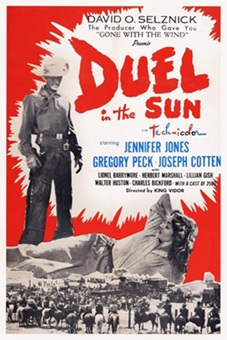
Duel In The Sun (1946, directed by King Vidor)


After her father is executed for killing her mother and her mother’s lover, “half-breed” Pearl Chavez (Jennifer Jones) is sent to live with her father’s second cousin, Laura Beth McCanles (Lillian Gish).  Laura is the wife of rancher, politician, and all-around racist Senator Jackson McCanles (Lionel Barrymore).  Worried that Pearl’s beauty and uninhibited manner will get her into trouble, Laura arranges for Pearl to meet with a minister known as The Sinkller (Walter Huston) who instructs Pearl on how to be a “good” girl.

Wanting to make Pearl bad and his, Lewton “Lewt” McCanles (Gregory Peck) becomes obsessed with Pearl and is soon forcing himself on her on a regular basis.  When the good McCanles brother, Jesse (Joseph Cotten), leaves the ranch despite being in love with Pearl, Pearl tries to find a good husband in the form of Sam Pierce (Charles Bickford).  Lewt responds by gunning Sam down and then goes on the run.  It all leads to an overwrought duel in the sun as the two doomed lovers take aim at each other.

Duel In The Sun is credited to veteran director King Vidor and there are a few shots of the western landscape that do feel typical of Vidor’s work.  However, Duel In The Sun’s true auteur was its producer, David O. Selznick.  Still looking to recapture his earlier success with Gone With The Wind and eager to make his future wife, Jennifer Jones, into an even bigger star than she was, Selznick obsessed over every detail of Duel In The Sun, pushing Vidor and a host of other directors (including Josef von Sternberg, William Dieterle, William Cameron Menzies, Otto Brower, and Sidney Franklin)  to make the film more steamy, more melodramatic, more violent, and more visually epic.  Reportedly, while Video was trying to shoot the film’s titular duel, he had to call cut several times when Selznick ran into the scene with a water bottle to spray more “sweat” onto Jones and Peck.  Today, the stiff Peck seems miscast as the black sheep of the family, the reserved Jones is even more miscast as a mestiza, and the plot is clearly too simplistic to carry the film’s epic ambitions.  A few impressive shots aside, Duel In The Sun is just boring,  In the 40s, though, the film’s relative openness about sex generated enough controversy to make Duel In The Sun into a box office hit.  It was one of the two top-grossing westerns of the 40s, beating out Red River, My Darling Clementine, Fort Apache, The Ox-Bow Incident, and several other films that were actually good.

Unlike Jones, Peck, and even usually reliable stalwart like Lionel Barrymore and Walter Huston, Joseph Cotten at least emerges from this film with his dignity intact.  Playing the good brother, Cotten gets to underplay while everyone else is overplaying and it turns out to be the right approach for him.  Surviving Duel In The Sun was no easy feat but Cotten pulled it off.

Gothic Art: Alfred Hitchcock’s REBECCA (United Artists 1940)


gary loggins's avatarcracked rear viewer

REBECCA is unquestionably a cinematic masterpiece. I remember watching it for the first time in a high school film class, enthralled as much by its technical aspects as the story itself. This was Alfred Hitchcock’s  first American film, though with a decidedly British flavor, and his only to win the Best Picture Oscar. There’s a lot of film noir shadings to this adaptation of Daphne DuMaurier’s  Gothic novel, as well as that distinctive Hitchcock Touch.

“Last night I dreamt I went to Manderley again”, begins Joan Fontaine’s narration, as the camera pans down a dark road overgrown with brush and weeds, fog rolling in all around, as we come up on the once majestic castle called Manderley, now lying in ruins. This first shot was all done with miniatures, another wonderful example of Hitchcock’s innovative use of the camera, looking and feeling totally believable (take that, CGI!). Flashbacks bring us to when Fontaine’s character, who’s…

View original post 570 more words

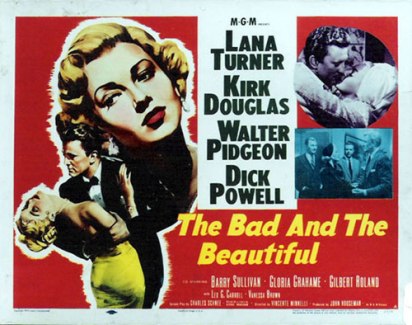
Lisa Marie Reviews The Oscar Winners: The Bad and the Beautiful (dir by Vincente Minnelli)


BadAndTheBeautiful1952hs800

What can I say about The Bad and the Beautiful?

Released in 1952 and directed by Vincente Minnelli, The Bad and the Beautiful is arguably one of the greatest films ever made.  It’s certainly one of my favorite films.

Perhaps appropriately, The Bad and the Beautiful is a film about the movies.

Jonathan Shields (played in a truly amazing performance by Kirk Douglas) is a legendary film producer.  He’s won Oscars, he’s got a reputation for being a genius, and, as the film begins, he is one of the most hated men in Hollywood.  It’s been years since Shields made a succesful film but he thinks that he’s finally come up with a movie that can put him back on top.  His assistant, Harry Pebbel (played with a weary dignity by Walter Pidgeon), invites Hollywood’s best director, actress, and screenwriter to a meeting and he proceeds to spend the rest of the film trying to convince them to help Jonathan make his comeback.

The only problem is that all three of them hate Jonathan Shields and have sworn that they’ll never work with him again.  Through the use of flashbacks, we see how each of them first met Jonathan and how each eventually came to despise him.

Director Fred Amiel (Barry Sullivan) first met Jonathan when Jonathan hired him to pretend to be a mourner at his father’s funeral.  With Jonathan’s help, Fred moves up from directing B-movies to finally getting a chance to make his dream movie, an adaptation of a believably pretentious novel called The Far Off Mountain.  With Jonathan’s help, Fred even gets womanizing film star Gaucho Ribera (a hilariously vain Gilbert Roland) to agree to star in Fred’s movie.  Jonathan also introduces Fred to Georgia (Lana Turner), the alcoholic daughter of Jonathan’s mentor.

Jonathan eventually makes Georgia into a film star and Georgia falls in love with him.  Of all the major actresses of the 1950s, Lana Turner seems to get the least amount of respect from film historians.  She’s more remembered today as the epitome of glamour and scandal but, in The Bad and the Beautiful, Turner gives one of the best performances of her career.  In her best scene, Georgia has a nervous breakdown while driving in the rain and, for those few minutes, you forget that you’re watching an iconic film star.  Instead, you’re just amazed by the performance.

Finally, the screenwriter is James Lee Bartlow (Dick Powell), an intellectual novelist who is brought to Hollywood by Jonathan.  While the reluctant Bartlow finds himself being seduced by J0nathan, his flighty wife (Gloria Grahame) is seduced by Gaucho.

The Bad and the Beautiful is perhaps one of the few perfect movies ever made, a film that qualifies as both art and entertainment.  There are so many reasons why I love this film that its hard for me to describe them all.  The film snob in me loves the fact that Minnelli directed The Bad and the Beautiful as if it were a classic black-and-white film noir.  The entire film is lit and shot to emphasize shadows and moral ambiguity.  As played by Kirk Douglas, Jonathan Shields is as seductive and dangerous a figure as Barbara Stanwyck in Double Indemnity.  My inner film historian loves the fact that the film is full of barely disguised portraits of real life Hollywood figures like David O. Selznick, Val Lewton, Alfred Hitchcock, and Diane Barrymore.  Finally, and perhaps most importantly, my girly girl side loves that this film is basically a big melodramatic soap opera.  Lana Turner’s outfits are to die for and Jonathan Shields is the ultimate bad boy that we can’t help but love.

The Bad and the Beautiful received 6 Oscar nominations but it wasn’t nominated for best picture.  (This snub is all the more surprising when you consider what the Academy did name as the best picture of 1952 — Cecil B. DeMille’s The Greatest Show on Earth.)  Out of those six nominations, the Bad and the Beautiful won five Oscars.  (Of all the film’s nominees, only Kirk Douglas failed to win.)  As of this writing, The Bad and the Beautiful still holds the record for most Oscars won by a film that failed to be nominated for best picture.