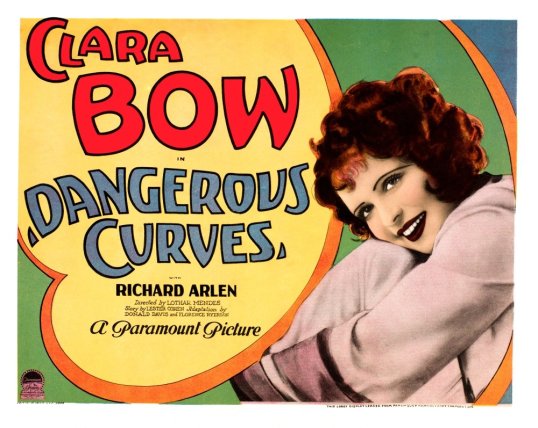
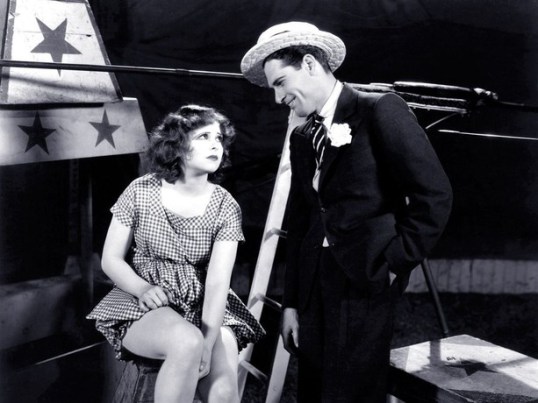
The 1929 film, Dangerous Curves, takes place at the circus.
Larry Lee (Richard Arlen) is a tightrope walker and, when we first meet him, he’s a bit of a cad. He knows he’s the best and he knows that the crowds are specifically showing up to watch him risk his life on a nightly basis. Every woman at the circus is crushing on him but Larry hardly notices because he’s used to being desired. He’s in love with his tightrope-walking partner, Zara (Kay Francis). Everyone can tell that Zara is manipulative and not even loyal to her relationship with Larry. She wastes his money and Larry sometimes spends so much time thinking about her that it breaks his concentration on the tight rope.
Eventually, Larry discovers that Zara has been cheating on him! When Larry finds out about Zara and Tony (David Newell), he cannot get the image of them kissing out of his head. When he tries to walk across the tight rope, he loses his focus and, as the audience gasps, Larry falls to the ground below. (In an impressively-edited sequence, we see Larry falling from about five different angles before we finally see him hitting the ground.) Larry recovers but his confidence has been broken. Instead of returning to the circus, he just wants to drink and obsess on Zara and Tony.
Can bareback rider Patricia Delaney (Clara Bow) convince him to return to the circus? Can she give him the confidence to once again walk across the tightrope? Will Larry then teach Pat how do the tightrope act herself? Will Larry finally realize that Pat loves him and that he loves her? And how will Pat react when, after all she’s done for Larry, he suddenly decides that he wants to bring Zara back into the act?
Dangerous Curves is a mix of melodrama and romance, all taking place at the circus. It’s also a pre-code film, which means it’s a bit more honest about the relationships between the characters and Larry’s subsequent drinking problem than it would have been if the film had been made just a few years later. As a result, this is a melodrama with an edge. The members of the circus community are living on the fringes of polite society and they’ve built their own community, one that is based on their unique talents. Larry’s sin isn’t so much that he’s arrogant and tempermental. It’s that he doesn’t properly respect the community of which he’s a part. He thinks he’s above the rest of the circus. His fall from the high wire humbles him. His relationship with Patricia eventually redeems him.
That said, the main appeal of this film is that it features Clara Bow in one of her early sound-era performances. Bow became a star during the silent era but, unlike many of her contemporaries, she was able to make the transition to sound. I absolutely love Clara Bow and this film features one of her best performances. She’s determined and energetic and she plays the stereotypical “good” girl with just enough of a mischievous glint in her eye to make her compelling. She may be willing to help Larry get back on the tightrope and then subsequently learn how to walk the tightrope herself but she also shows that she’s not going to put up with him taking her for granted. As well, both Clara and Kay Francis get to wear a lot of cute outfits, which is always one of the pleasures of a pre-code film.
Dangerous Curves is worth watching for the chance to see Clara Bow at her best.
 Through the Shattered Lens