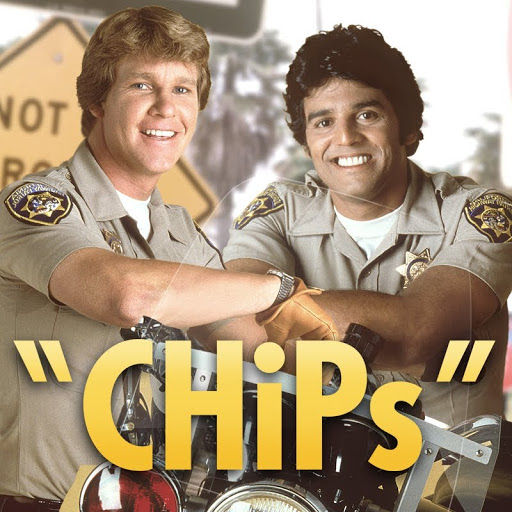
Welcome to Late Night Retro Television Reviews, a feature where we review some of our favorite and least favorite shows of the past! On Mondays, I will be reviewing CHiPs, which ran on NBC from 1977 to 1983. The entire show is currently streaming on Prime!
It’s arson and basketball on CHiPs!
Episode 4.12 “Home Fires Burning”
(Dir by Charles Bail, originally aired on February 1st, 1981)
Two arsonists (David Hayward and Michael Cavanugh) are setting RVs on fire as a part of an insurance scam. One man (Jack Kruschen) who hires the arsonists is horrified when their carelessness leads to a security guard getting seriously injured. If the guard dies, the man is looking at serious jail time! (Luckily, the guard doesn’t die and apparently, everyone just forgets about sending his boss to jail.)
Luckily, Baker is there to help track the arsonists down. Ponch, on the other hand, is busy putting together a Highway Patrol basketball team. It’s hard not to notice how much time the Highway Patrol spends on stuff like basketball, dirt bike competitions, and drag car racing. Somehow, Ponch has gone from being the department’s screw-up to now being the guy who is automatically given all of the responsibility. It’s the Ponch Show and everyone knows it.
This episode was directed by veteran stuntman Charles Bail and it does have some spectacular stunts. (A car jumping through an exploding RV was my favorite.) And let’s be honest. I could sit here and spend hours talking about CHiPs became the Ponch Show during the fourth season and how the rest of the cast was underutilized. And I would be totally correct. But the stunts and the car crashes are the main appeal of this show and this episode featured several examples of each.
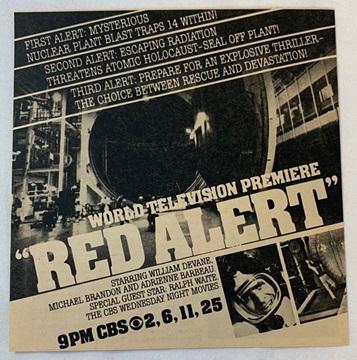
The 1977 made-for-television movie, Red Alert, opens with a man walking through a cemetery on a rainy day. As we watch Howard Ives (Jim Siedow) move amongst the tombstones, we hear his thoughts. He’s a sad and bitter man, wondering why he’s wasted so many years of his life at work. He thinks about someone close to him who has died. He’s obviously very troubled.
(Of course, any horror fans in the audience will immediately recognize Jim Siedow from his role as the Drayton Sawyer in the the original Texas Chainsaw Massacre. He was troubled in that film as well!)
Howard works at the local nuclear power plant. Ominously, when the film cuts to the plant, the first thing we see is a leak of very hot water. I don’t know much about nuclear power plants but I imagine any type of leak is not a good thing. The water leak causes the computer that runs the plant assuming that a nuclear disaster is minutes away from happening. The compound is automatically sealed off, trapping fourteen men (including Howard), inside the reactor. As Commander Stone (Ralph Waite) tries to keep a possible nuclear disaster from occurring, two investigators (played by William Devane and Michael Brandon) try to determined whether the accident was the result of a malfunction or of deliberate sabotage. When the local sheriff (M. Emmet Walsh) informs them that Howard Ives’s wife has committed suicide, the investigators look into the troubled man’s history. Eventually, the two investigators realize that the only way to prevent a nuclear disaster is by risking their lives by entering the sealed-off power plant. The two investigators attempt to do their work under the cover of night and without causing a panic. Needless to say, it doesn’t work. One of them calls his wife (Adrienne Barbeau) and tells her that she needs to leave the area. She tells her mother, who then tells her neighbor and soon the airport is crowded with people looking to get out of town.
Red Alert contrasts the intuitive approach of the two inspector with Commander Stone’s insistence that every bit of a data be fed to his computer before any decisions are made. Stone’s hands are so tied by protocol and red tape that he stands by while the fourteen men who are trapped in the nuclear power plant die. Wisely, though, the film doesn’t turn Stone into a cardboard villain. He’s very much aware of what will happen if the plant suffers a core meltdown. When one of his assistants mentions that he hasn’t been given any instructions on how to evacuate the town in case the plant does explode, Stone tells him that no plans have ever been drawn up because the plans would be useless. There would be no way to evacuate everyone in time.
In the end, Red Alert is scary not because it deals with nuclear power but because it presents us with a world where no one — not even Devane and Brandon’s heroic investigators — seems to know what to do. Everyone is slowed down by a combination of red tape and their own personal angst. Devane is a strong investigator because, as a widower whose only son died in Vietnam, he has no family to worry about. Unlike everyone else in Red Alert, he has nothing left to lose. In the end, the film suggests that the only way to save the world is to cut yourself off from it.
Red Alert is a compelling and intelligent thriller, one that is well-acted by the entire cast and which builds up to strong conclusion. The film’s anti-nuclear message is a bit heavy-handed but I imagine it was an accurate reflection of the fears that people were feeling at the time. Today, the film works best as a warning about bureaucracy and depending too much on AI to make important, life-or-death decisions. In the end, it’s human ingenuity that saves the day and that message is timeless.
Welcome to Retro Television Reviews, a feature where we review some of our favorite and least favorite shows of the past! On Sundays, I will be reviewing the made-for-television movies that used to be a primetime mainstay. Today’s film is 1981’s Fallen Angel! It can be viewed on Tubi.
Jennifer Phillips (Dana Hill) is 12 years old and struggling to find her place in the world. Sometimes, she wants to be a gymnast. Sometimes, she wants to be an actress. She misses her late father. She has a difficult time communicating with her mother, an often-exhausted waitress named Sherry (Melinda Dillon). She is definitely not happy that Sherry is dating the well-meaning but rather dorky Frank Dawson (Ronny Cox). Jennifer wants to watch an awards show. Frank changes the channel to a baseball game. That pretty much sums up their relationship.
One night, Jennifer escapes the unhappiness of her home life by going to an arcade. That’s where she is approached by Howard Nichols (Richard Masur), a seemingly friendly older man who takes her picture and then tells her that she’s just as beautiful as Farrah Fawcett and Olivia Newton-John. Jennifer replies that she doesn’t think that she should talk to Howard because he’s a stranger. Howard tells her that’s very smart of her and then explains that he coaches the local girls softball team and that he thinks Jennifer would make a great shortstop.
You can probably guess where this is going and you’re absolutely right. Soon, Jennifer is spending all of her time with Howard, who tells her that he understands what she’s going through even if her parents don’t. Howard’s an amateur photographer and he’s constantly asking Jennifer to pose for him. He tells Jennifer that she probably shouldn’t tell any adults about their “special friendship” because they just wouldn’t understand. He even buys Jennifer a puppy, one that he threatens to take back to the pound whenever it appears that Jennifer is trying to step away from him.
Howard is not only a pedophile but he also works for a pornography ring and, as Jennifer soon finds out, he’s actually got several young people living with him and posing for pictures. Jennifer’s mother eventually becomes concerned about what Jennifer is doing when she leaves the house and she even comes to suspect that friendly old Howard is not quite as friendly as he pretends to be. But is it too late?
Yikes! I watched this film on Tubi and I cringed through the whole thing. Of course, that’s the reaction that Fallen Angel was going for. This is a film that was made to encourage parents to maybe be a little concerned about with whom their children are spending their free time. Jennifer is fortunate that her mom eventually figures out what is going on but, as the film makes clear, a lot of victims are not so lucky. This film is pure paranoia fuel but in the best way possible. There are some things that every parent should be paranoid about and the adult who only spends time with people 20 years younger than him is definitely one of those things. The film is well-made, well-written, and well-acted. Richard Masur, with his friendly manner and his manipulate tone, will give you nightmares.
“Oh we must be doin’ somethin right to last 200 years…”
— Haven Hamilton (Henry Gibson) in Nashville (1975)
The 1975 Best Picture nominee Nashville is the epitome of an ensemble film. It follows 24 characters as they spend five days wandering around Nashville, Tennessee. Some of them are country music superstars, some of them are groupies, some of them are singers looking for a first break, and at least one of them is an assassin. The one thing that they all have in common is that they’re lost in America. Released barely a year after the resignation of Richard Nixon and at a time when Americans were still struggling to come to terms with the turmoil of the 60s, Nashville is a film that asks whether or not America’s best days are behind it and seems to be saying that they may very well be. (That’s a question that’s still being asked today in 2015.) It’s appropriate, therefore, that Nashville both takes place in and is named after a city that everyone associates with perhaps the most stereotypically American genre of music that there is.
Nashville follows 24 characters, some of whom are more interesting than others. For five days, these characters wander around town, occasionally noticing each other but far more often failing to make any sort of connection.
Haven Hamilton (Henry Gibson) is a veteran star, a somewhat comical character who sings vapid songs about home and family and who smiles for the public while privately revealing himself to be petty and vain. His son, Bud (Dave Peel), is a Harvard graduate who acts as his father’s business manager. Oddly enough, Haven is an unlikable character until the end of the film when he suddenly reveals himself to be one of the few characters strong enough to keep Nashville for descending into chaos. Meanwhile, Bud seems to be a nice and modest guy until he takes part in humiliating another character.
Haven’s lover is Lady Pearl (Barbara Baxley), who owns a nightclub and spends most of the film drinking. Much like Haven, she starts out as a vaguely comical character until she finally gets a chance to reveal her true self. In Pearl’s case, it comes when she delivers a bitter monologue about volunteering for Bobby Kennedy’s presidential campaign.
Haven’s lawyer is Delbert Reece (Ned Beatty), an obsequies good old boy who is married to gospel singer Linnea (Lily Tomlin). They have two deaf children. Linnea has learned sign language. Delbert has not. Over the course of the film, both Delbert and Linnea will be tempted to cheat. Only one of them actually will.
And then there’s Barbara Jean (Ronee Blakley), a mentally unstable singer who has come to Nashville with her manipulative husband/manager, Barnett (Allen Garfield). Almost every character in the film wants something from Barbara Jean. A mostly silent Vietnam veteran named Kelly (Scott Glenn) claims that his mother knows Barbara Jean. A nerdy guy named Kenny (David Hayward) comes to Nashville just to see her perform.
Both Kelly and Kenny end up getting to know Mr. Green (Keenan Wynn), a rare Nashville resident who doesn’t seem to care about music. However, Mr. Green’s spacey niece, L.A. Joan (Shelly Duvall), is obsessed with having sex with as many musicians as possible.
Among those being targeted by L.A. Joan is Tom Frank (Keith Carradine), one-third of the folk trio Bill, Mary, and Tom. Unknown to Bill (Allan F. Nicholls), Tom is sleeping with Bill’s wife, Mary (Cristina Raines). Unknown to Mary, Tom is sleeping with almost every other woman in Nashville as well. When Tom takes to the stage at Pearl’s nightclub and sings a song called I’m Easy, the audience is full of women who think that he’s specifically singing to them.
Another one of Tom’s songs, the appropriately titled “It Don’t Worry Me,” is frequently sung by Albuquerque (Barbara Harris), who spend the entire film trying to get discovered while hiding out from her much older husband, Star (Bert Remsen).
Another aspiring star is Sulleen Grey (Gwen Welles), who is a tone deaf waitress who suffers the film’s greatest humiliation when she agrees to perform at a political fund raiser without understanding that she’s expected to strip while singing. Trying to look after Sulleen is Wade (Robert DoQui), who has just been released from prison.
And then there’s the loners, the characters who tend to pop up almost randomly. Norman (David Arkin) is a limo driver who, like everyone else in Nashville, wants to be a star. The hilariously bitchy Connie White (Karen Black) and the bland Tommy Brown (Timothy Brown) already are stars. (The character of Tommy Brown is one of Nashville’s oddities. He’s listed, in the credits, as being a major character but he only appears in a few scenes and never really gets a storyline of his own.) There’s the Tricycle Man (Jeff Goldblum), a silent magician who mysteriously appears and disappears throughout the film.
And, finally, there’s Opal (Geraldine Chaplin), an apparently crazed woman who is wandering around Nashville and pretending to be a reporter for the BBC. (It’s never specifically stated that Opal is a fake but it’s fairly obvious that she is.) How you feel about the character of Opal will probably determine how you feel about Nashville as a whole. If you find Opal to be a heavy-handed caricature, you’ll probably feel the same way about the rest of the film. If you find the character of Opal to be genuinely amusing with her increasingly pretentious musings, you’ll probably enjoy Nashville.
There is one more very important character in Nashville. He’s the character who literally holds the film together. He’s also the reason why I’m including Nashville in this series of reviews about political films. That character is named Hal Phillip Walker and, though he’s never actually seen in the film, he’s still the driving force behind most of what happens. Walker is a third-party presidential candidate, a man who seems to be universally admired despite the fact that his campaign appears to just be a collection of vapid platitudes. Walker’s campaign manager, John Triplette (Michael Murphy), comes to Nashville and sets up the Walker For President rally. That’s where Nashville reaches its violent and not-all-together optimistic climax.
Reportedly, Nashville is a favorite film of Paul Thomas Anderson’s and you can see the influence of Nashville in many of Anderson’s films, from the large ensemble to the moments of bizarre humor to the refusal to pass judgement on any of the characters to the inevitable violence that ends the film. Also, much like Anderson’s films, Nashville seems to be a film that was specifically made to divide audiences. You’re either going to think that Nashville is a brilliantly satirical piece of Americana or you’re going to think it’s a self-indulgent and self-important mess.
As for me, I think it’s great and I think that, after you watch it, you should track down and read Jan Stuart’s The Nashville Chronicles: The Making of Robert Altman’s Masterpiece. It’s the perfect companion for a great film.


 Through the Shattered Lens