Doctor Who — The Sea Devils (1972, directed by Michael Briant)


Having been captured by UNIT at the end of The Daemons, the Master (Roger Delgado) is now a imprisoned on a small island in the English channel.  He claims that he is reformed and he now spends most of his days watching the BBC.  (Has he not been punished enough?)

When the Doctor (Jon Pertwee) and Jo Grant (Katy Manning) visit the Master to try to learn the location of his TARDIS, they come up empty.  They do, however, learn that several ships have gone missing and, understandably, they suspect that the Master is involved.

They’re correct.  The Master has duped his warden, Trenchard (Clive Morton), into helping him steal electrical equipment so that he can contact The Sea Devils, a race of bipedal reptiles the live under the sea.  The Sea Devils, much like their cousins, the Silurians, were the original inhabitants of Earth.  They’ve now woken from hibernation to discover that mankind — who they last knew to be a collection of barely evolved monkeys — have taken over the planet.  And they’re not happy about it.

The Silurians and the Sea Devils appeared in three serials during the original run of Doctor Who and all of them followed the same basic plot.  The Silurians or the Sea Devils woke up from their hibernation.  The Doctor tried to broker a peace with humanity.  Humanity reacted by blowing them up.  The Sea Devils were usually more reluctant to make peace than the Silurians.  In The Sea Devils, the Doctor himself is forced to sabotage their base to keep them from attacking humanity but that’s nothing compared to the atomic bomb that the British government wanted to drop on them.  Whenever a Silurian or a Sea Devil shows up, it means that the Doctor is going to disappointed in humanity once again.

The Sea Devils is a serial of which I have fond memories because Malcolm Hulke’s novelization was the first Doctor Who book that I ever read.  (Malcolm Hulke also wrote the serial itself.)  I read the book before I even saw the show.  The novelization was my introduction to the Doctor, UNIT, and especially the Master.  Hulke was one of the best writers of the Doctor Who novelizations, taking the time to add depth to the characters.  This was especially true of Trenchard, who is portrayed far more sympathetically in the novel than he was on the show.

The Sea Devils also features one of Roger Delgado’s finest turns as the Master.  This was the Master’s first appearance during the ninth season of Doctor Who and Delgado shows that, even when imprisoned, the Master never stops manipulating and scheming.  This episode shows why Delgado’s Master was such a classic villain and truly a worthy opponent of the Doctor.  Delgado does such a good job in the scenes where The Master pretends to be reformed that it’s easy to understand how he managed to trick Trenchard.  At the end of the serial, The Master makes another escape, again by fooling the humans around him.  Delgado made The Master into a magnetic and compelling villain.

Roger Delgado appeared twice more as the Master before his untimely death in an auto accident.  Jon Pertwee later said that Delgado’s death was one of the reasons that he decided to step away from the role of the Doctor.  The Master would eventually return and he would be played by several different actors.  For me, the true Master will always be Roger Delgado.

Horror On the Lens: The Blood Beast Terror (dir by Vernon Sewell)


Today’s horror n the lens is the 1968 British film, The Blood Beast Terror!  This film stars the great Peter Cushing and it is perhaps the only film to ever feature a …. WERE-MOTH!

Seriously, how can you resist Peter Cushing and a Were-Moth?

Back to School #7: if… (dir by Lindsay Anderson)


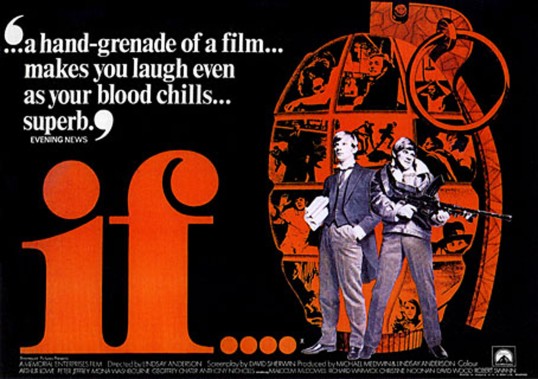
For today’s final entry in our series of Back to School reviews, let’s close out the 60s by taking a look at a 1968 British film.  Directed by Lindsay Anderson, if… not only won the Grand Prix du Festival International du Film (now known as the Palme d’Or) at the 1969 Cannes Film Festival but it also featured the film debut of future icon Malcolm McDowell.

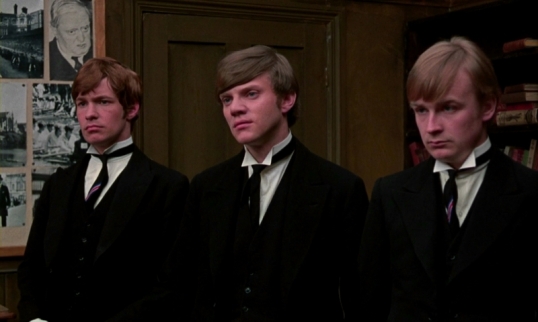
if… takes place at a British public school (or, as we would call it here in the States, a private school) that is mired in a long tradition of conformity and oppression.  For roughly the first half of the film, we see how the school works.  The teachers are stern and out-of-touch.  The headmaster (Peter Jeffrey) considers himself to be something of a reformer and is clueless as to just how little respect the students have for him.  Discipline is maintained by the Whips,sadistic upperclassmen who revel in their power and who spend most of their time speculating about which one of them will claim 13 year-old Bobby Phillips (Rupert Webster) as his own.  Three students — Mick Travis (Malcolm McDowell), Johnny (David Wood), and Wallace (Richard Warwick) — are considered to be nonconformists and soon find themselves being targeted by both the school’s faculty and the Whips.  During this first half, the film plays out as harsh but relatively realistic.

And then something happens.

If2

About 45 minutes into the film, if… starts to grow increasingly more and more surreal.  In a scene that plays out in languid, sensual slow motion, the otherwise dim-witted Wallace gracefully exercises on a high bar while an entranced Bobby Phillips watches.  When Rowntree and his fellow whips decide to punish Mick, Johnny, and Wallace with a particularly brutal caning, the disturbing sound of it echoes throughout the entire school.  During a war game, Mick fires an automatic rifle full of blanks at the chaplain and is subsequently forced to apologize while the chaplain sits up in a drawer kept in the headmaster’s office.  Mrs. Kemp, the wife of the housemaster, wanders naked through the dormitory.  Perhaps most famously, the film goes from randomly being in color to black-and-white and then back again, all adding to the movie’s dreamlike feel.

Perhaps most importantly, Johnny and Mick manage to sneak off campus and spend a day roaming around the city.  After they steal a motorcycle from a showroom, they stop at a cafe where they are served coffee by a character known only as the Girl (Christine Noonan).  The Girl tells Mick that sometimes she’s a tiger and soon, they are wrestling naked on the floor while Johnny sits in a corner booth and drinks his coffee.  Later, when Mick returns to the school, he looks through a telescope and sees the Girl staring back at him and waving.

Johnny, the Girl, and Mick

And finally, the Girl shows up while Mick, Johnny, Wallace, and Bobby are cleaning out a storeroom as a part of their punishment for scaring the chaplain.  Among the dusty shelves, they find not only a jar containing a fetus but a cache of weapons as well.  This leads to the film’s famous conclusion, a shocking act of violence that, in the 60s, was probably viewed as a show of solidarity with rebellious youth everywhere but, when seen in this time and age, draws disturbing parallels with the American tradition of school shootings.

Seen today, if… remains a surprisingly potent celebration of rebellion and a harsh condemnation of conformist society.  Occasionally pretentious in that wonderful way that only a British film made in 1968 could be, if… is also a surprisingly stinging satire that doesn’t leave anyone — even the film’s heroes — untouched.  Perhaps best of all, if… is also the film debut of Malcolm McDowell and he gives a strong performance here.  It’s easy to understand why, after seeing if…, Stanley Kubrick cast McDowell in A Clockwork Orange.  Interestingly enough, despite if’s apocalyptic ending, McDowell would play Mick Travis twice more, in Anderson’s O Lucky Man, a film that is even more surreal than if…, and in Britannia Hospital.

Tomorrow, we’ll continue our journey back to school by taking a trip to the 70s!

If