The TSL’s Horror Grindhouse: Guru, The Mad Monk (dir by Andy Milligan)


The 1970 film Guru, the Mad Monk opens with a woman being dragged, by two men, down a New York sidewalk.  In the background, you can clearly hear the sounds of Manhattan morning traffic as people head to work or school, presumably barely noticing that a movie is being made one block over.

Now, normally, that might not be a problem.  In fact, it’s the kind of things that you tend to expect from an independent film made in the early 70s.  Cinema verite was all the rage back then and many films from that period would incorporate documentary techniques, shooting on location and making use of actual bystanders and the sound of actual traffic.  However, Guru, the Mad Monk is supposed to be taking place on the isolated (and fictional) prison island of Mortavia.  Even more importantly, it’s supposed to be taking place in 1480.  Now, obviously, all historical films require a certain suspension of disbelief.  I mean, we know that no cinematic version of the 15th Century is going to be a 100% accurate and we really should be happy about that because the the 1400s were a pretty disgusting time to be alive.  I mean, we don’t need to see people tossing a chamber pot out of their bedroom window in order to accept that a film is taking place in a certain time period.  However, what we do need is for there not to be two scenes that feature the sounds of cars driving by the film’s set.  One half expects some random person to wander into the shot and hail a taxi.

Guru, the Mad Monk was directed by Andy Milligan, who is a legendary name as far as grindhouse filmmaking is concerned.  Milligan was an off-off broadway playwright-turned-exploitation filmmaker who didn’t let a lack of money and/or discernible talent prevent him from directing an estimated 29 films.  Milligan’s films are distinguished by angry (if usually incoherent) storylines, flamboyant performances from a stock company made up of local Staten Island actors, cheap gore effects, and poor sound quality.  One reason why you especially notice the sound quality is because a typical Milligan film is surprisingly talky.  It makes sense when you consider that Milligan developed his artistic vision while working in theater but, as a director, Milligan never seemed to figure out how to break free from the inherent stageyness of his scripts.

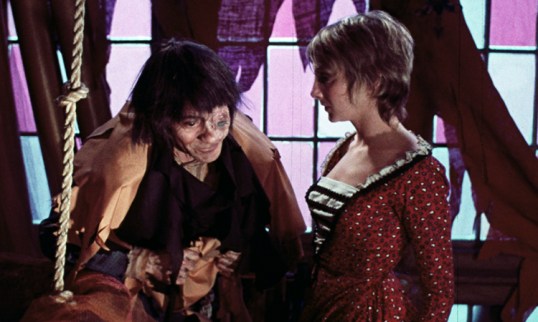
And yet, there’s also an odd and, at times, rather dream-like intensity to most of Milligan’s films.  Some of that is undoubtedly due to the fact that a typical Milligan film lacks any sort of intentional humor.  For instance, Guru features a supporting character named, believe it or not, Igor.  And yes, Igor (played by Jack Spencer)) is a hunchback.  And typically, you would think any filmmaker including a hunchback named Igor in a horror film made after 1940 would have to be having a little bit of fun with the cliches of the genre.  But no, Guru, The Mad Monk was obviously meant to be a very serious film and very much a reflection of the negative worldview that seemed to permeate all of Milligan’s films.  Guru, The Mad Monk is a dark film where almost everyone is corrupt and guilty of something and, watching the film, you get the feeling that its darkness is coming straight for Milligan’s heart.

Notice the white scooter in the background as these 15 century clergymen hold a meeting in Guru, The Mad Monk.

As for what the film’s about …. well, that’s hard to say.  The plot is rather difficult to follow.  Father Guru (played, in flamboyantly evil style, by Neil Flanagan) is the governor of the prison island of Mortavia.  (St. Peter’s, an Episcopal Church in Manhattan, stands in for the prison.)  Guru is usually quick to execute his prisoners so that his mistress, Lady Olga (Jacqueline Webb), can drink their blood.  It’s hard to say whether Lady Olga is supposed to be a real vampire or not.  When we first meet her, she just comes across as being a Lady Bathory-type but then there’s another scene where she appear to be wearing fake fangs and declares herself to be the “Soul of Darkness” so who knows for sure?

In between all of the eye gougings and beheadings that one would typically expect to find in a Milligan film, there’s also a love story as jailer Carl (Paul Lieber) falls in love with the latest prisoner, Nadja (Susan Israel).  Nadja is due to be executed but Guru agrees to spare her life if Carl will dig up some bodies and sell them to a nearby university.  Carl agrees but it soon turns out that he made a mistake trusting Father Guru.  It all leads to the expected bloodbath, along with Guru raving about the joys of living a life where “I preach one thing but continue to believe another!”

Clocking in at just 57 minutes, it’s a weird film.  Typically, I tend to defend films like this because, regardless of their flaws, they at least represent the director’s unique vision of the world.  That’s always been my defense when it’s come to Ed Wood, for instance.  But, when it comes to Milligan …. eh.  I mean, from a historical perspective, anyone who is interested in classic grindhouse and independent filmmaking has to see at least one Andy Milligan film.  And it can be said that you’ll never mistake an Andy Milligan film for anyone else’s.  But, at the same time, I have to admit that watching Guru was the longest 57 minutes of my life.

So, no …. unless you’re on some sort of Andy Milligan kick, I don’t really recommend Guru, The Mad Monk.

Sorry, Igor.
The TSL’s Horror Grindhouse: Single White Female 2: The Psycho (dir by Keith Samples)


13 years after the release of the first Single White Female and a countless host of imitations, an official sequel was released straight-to-video in 2005.  Subtitled “The Psycho,” (because apparently, Jennifer Jason Leigh was totally stable in the first film), Single White Female 2 tells the story of what happens when one roommate becomes obsessed with the other.  It all leads to murder and sexual infidelity and sudden hairstyle changes.

Maybe you’re thinking that this sounds exactly like the first Single White Female.  And, okay, there are some similarities.  But just consider some of the differences!

1. In the first Single White Female, Jennifer Jason Leigh’s character grows obsessed with Bridget Fonda after moving into Fonda’s apartment.  In Single White Female 2, Tess (played by Allison Lange) becomes obsessed with Holly (Kristen Miller) after Holly moves into Tess’s apartment.  See, this time, the psycho has her name on the lease.  HUGE DIFFERENCE!

2. In the first Single White Female, the plot is set in action after Bridget Fonda discovers that Steven Weber cheated on her.  In the sequel, the plot is set in motion by Holly’s original roommate, Jan (Brooke Burns), seducing a client who Holly was also sleeping with.  Again, that’s a huge difference and it also leads us to wonder if maybe Holly just sucks at choosing roommates.

3. In the first Single White Female, Jennifer Jason Leigh played an unstable bookstore employee.  In the sequel, Tess is a nurse who has a history of killing people who she feels would be happier dead.  In other words, Tess is a psycho with a mission.

4. In the first Single White Female, Jennifer Jason Leigh’s character hung out in a sleazy S&M club.  In the sequel, Tess actually performs on stage.

5. The first Single White Female actually looked like a real movie whereas the sequel has the flat and rather bland look of a film shot for and on video.

6. In the first Single White Female, you could understand why an insecure person would want to steal Bridget Fonda’s identity.  In the sequel, Holly’s identity doesn’t seem to be interesting enough to justify trying to steal.

7. In the first Single White Female, Jennifer Jason Leigh gave a performance that inspired both fear and sympathy.  In the sequel, Tess is just your typical straight-to-video movie psycho.  There’s no indication that she could have ever been anything other than a straight-to-video movie psycho.

8. The first Single White Female was a good film, almost despite itself.  The sequel is rather dull.

So, I guess my point here is that, if you want to watch a movie about a roommate stealing someone’s identity and getting a new haircut, the first Single White Female is the one to go with.  The sequel doesn’t really add anything worthwhile to the story, nor does it improve on it in any way.  Give some credit to Brooke Burns, who plays Holly’s untrustworthy ex-roommate and who, at the very least, seems to understand the type of movie in which she’s appearing.  Brooke Burns gets the worst lines but she at least seems to be having fun delivering them.  Otherwise, it’s best just to forget about this sequel.

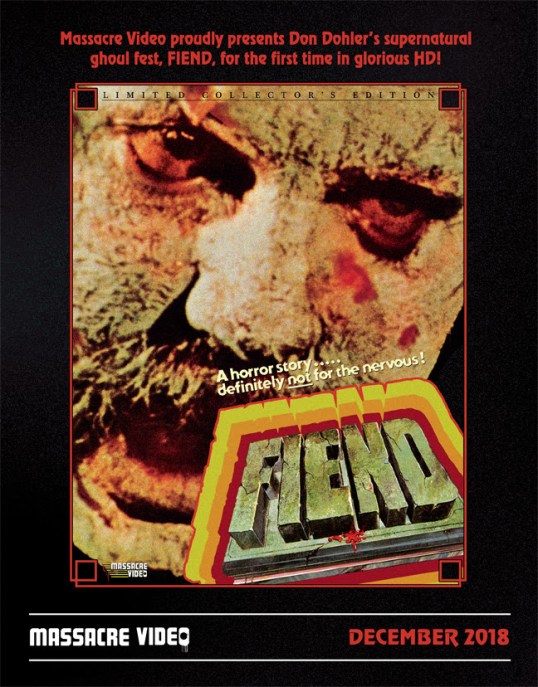
The TSL’s Horror Grindhouse: Fiend (dir by Don Dohler)


The 1980 film, Fiend, is a movie that should be viewed by every aspiring indie filmmaker.  I’m going to tell you why in a few paragraphs but first, allow me to tell you what Fiend is.

Fiend opens with ominous music and a shot of a seemingly deserted cemetery.  While the camera tracks it’s way from headstone to headstone, we become aware of a red light that seems to be floating above the ground, as if it’s searching for something.  The light suddenly plunges into a grave.  A few seconds later, the man who was in the grave claws his way to the surface.  Just one look at him reveals that he’s been dead for quite some time.  However, you might be distracted from the facial decay by the fact that the man is glowing.

The man staggers about, eventually coming across a young woman who has been abandoned in the cemetery by her jerk of a boyfriend.  The man grabs her from behind and wraps his hands around her neck.  Briefly, the man’s glow seems to pulse and then it fades away.  The man is no longer a decaying corpse.  Now, he’s just a middle-aged guy with a huge mustache.  He looks like he should be teaching a remedial math class.

(Perhaps not coincidentally, Don Leifert, the actor playing our living corpse, actually was a teacher.)

Now calling himself Eric Longfellow, the man moves into a nice house in the suburbs and establishes himself as a music instructor.  Longfellow tends to keep to himself, which certainly makes the neighbors a bit curious about him.  Longfellow would probably be more sociable if not for the fact that, every few days or so, he starts to decay.  For that reason, he has to have a constant supply of victims so that he can suck out their life force and renew himself.  Helping him out with this issue is Dennis Frye (played by George Stover, who was apparently a civil servant when he wasn’t acting), who is kind of squirmy and owns some of the ugliest suits ever tailored.  (I assume that Dennis Frye’s name is an homage to Dwight Frye, who played Renfield in the Bela Lugosi-version of Dracula.)

Now, of course, you can only suck the life force out of so many people before people start to notice that something strange is going on.  Longfellow is unfortunate enough to live next door to Gary Kender (Richard Nelson), who is a plain-spoken, beer-drinking guy who just happens to have a mustache that’s almost as huge as Longfellow’s.  Gary doesn’t trust Longfellow so he starts to do some research on his mysterious new neighbor….

Now, here’s the thing to remember about Fiend.  It was made foe $6,000.  That would translate to about $18,000 today.  Either way, it’s a tiny budget.  And yet, it’s an effective (if occasionally goofy) little film and, more often that not, it’s effective precisely because it was shot for next to nothing.  The grainy images give the film a feeling of immediacy.  Though the majority of the murders may have happened in broad daylight because day is easier to light than night, all those daytime murders contribute to the sense of unease, the feeling that no one’s safe at any time.  Even the amateur quality of the performances contribute to the film’s overall dream-like feel.  Director Don Dohler may not have been able to afford expensive special effects or realistic gore but, as a result of that, his direction emphasizes atmosphere over jump scares.  I mean, don’t get me wrong.  This is definitely an amateur film, full of clunky dialogue and the occasional slow scene.  But so what?  Even those flaws add to the film’s nicely surreal atmosphere.

I mean, consider this.  Don Dohler made this film nearly 40 years ago and he spent less money on the entire production than most films spend during one day of shooting.  It was released in only a handful of theaters and I imagine it probably didn’t get rave reviews from the mainstream critics.  And yet, here we are, decades later, and Fiend still has a growing cult of admirers.  It’s available on YouTube and, if you do watch it, I encourage you to read the comments posted underneath the video.  Several of them are from people who either worked on the film or who knew Don Dohler and Don Leifert.  For the most part, everyone seems to have fond memories of both this film and the filmmakers.

Fiend works because, instead of surrendering to the film’s low budget, Don Dohler used it to his advantage.  There’s a lesson there for us all.

Horror on the Lens: Raiders of the Living Dead (dir by Samuel M. Sherman and Brett Piper)


Hi there and welcome to October!  This is our favorite time of the year here at the Shattered Lens because October is horror month.  For the past three years, we have celebrated every October by reviewing and showing some of our favorite horror movies, shows, books, and music.  That’s a tradition that I’m looking forward to helping to continue this year.

Let’s start things off with the 1986 epic, Raiders of the Living Dead!

I reviewed this film last year but to recap, it’s the story of a creepy boy, a laser gun, a reporter, and a bunch of zombies.  There’s a mad scientist involved, too.  There always is.  The movie opens with a truck being hijacked and then the action shifts to a power plant and, honestly, I have no idea what any of it means.  Technically, Raiders of the Living Dead is not exactly a good film but it is a film unlike any other that you’ve seen.  If nothing else, it’s a film that you watch and you can’t help but admire the fact that it somehow got made and went on to find a small but kind of appreciative cult audience.  It’s just a very strange film and a good one to start October with, no?

Plus, it has got the greatest zombie-centric theme song ever!  The opening credits alone are worth the price of admission (which, incidentally, is free because those of us at the Shattered Lens love you!)

So, here is Raiders of the Living Dead. 

Enjoy!

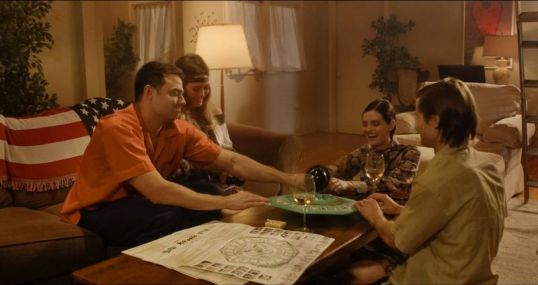
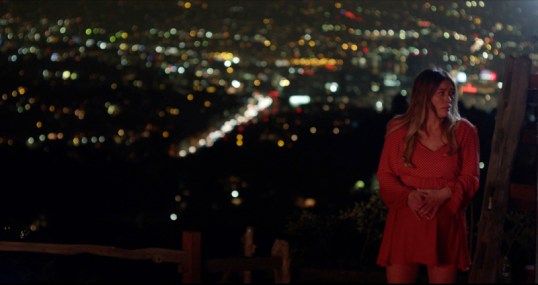
The TSL’s Grindhouse: The Haunting of Sharon Tate (dir by Daniel Farrands)


The Haunting of Sharon Tate is a frustrating film to review.

On the one hand, it’s an undeniably well-made horror film.  It’s surprisingly well-paced.  It creates an atmosphere of nonstop dread.  It’s the type of movie that makes you keep an eye on the shadows in the room.  This is the type of movie that makes your heart race and leaves you uneasy about every unexpected noise that you hear.  It’s a dark and disturbing horror film and it features an excellent lead performance from Hillary Duff in the title role.  While watching the film, you care about her and you don’t want anything bad to happen to her.  That makes the film’s shocks and scares all the more frightening.

On the other hand, though, The Haunting of Sharon Tate features a premise that will leave even the most dedicated grindhouse horror fan feeling more than a bit icky.

The Haunting of Sharon Tate is hardly the first horror film to be based on the infamous Manson murders.  In fact, it’s not even the only one to be released this year.  We’re approaching the 50th anniversary of the Tate murders so last May saw the release of Charlie Says and Quentin Tarantino’s highly-anticipated Once Upon A Time In Hollywood is set to be released in July.  What sets The Haunting of Sharon Tate apart from the other Manson films is that it’s told totally from the point-of-view of Manson’s victims.  Manson is only seen briefly and the other members of his so-called “Family” wander through the movie like dead-eyed zombies.  This is the rare Manson film that doesn’t try to portray that grubby little racist hippie as being some sort of outlaw folk hero and, regardless of what you think of the rest of the film, that’s definitely a good thing.

Instead, this movie focuses on Sharon Tate.  The film opens with a black-and-white recreation of an interview that Sharon gave a year before her murder, in which she discusses whether or not dreams can tell the future.  We then jump forward to August of 1969.  Sharon is 8-months pregnant and staying at 10050 Cielo Drive.  Her husband, Roman Polanski (who is kept off-screen for the entire movie), is in Europe.  Staying with Sharon is her ex-boyfriend, Jay Sebring (Jonathan Bennett) and her friends, heiress Abigail Folger (played by real-life heiress Lydia Hearst) and Abigail’s boyfriend, Wojciech Frykowsky (Pawel Szajda).  Also on the property is caretaker Steve Parent (Ryan Cargill), who is staying in a trailer and enjoys working on electronics.

(For the most part, the film sticks to the generally established facts when it comes to depicting the friendship between Sharon, Jay, Abigail, and Fykowsky.  However, it takes a lot of liberties with its portrayal of Steve Parent.  As opposed to how he’s portrayed in the film, Parent was actually an 18 year-old friend of the property’s caretaker who, because he was in the wrong place at the wrong time, became the first victim of the Tate murders.  By most accounts, he never met Sharon or any of the other inhabitants of the main house.)

In the film, Sharon is haunted by premonitions.  She has dreams in which she sees her friends being murdered by feral human beings.  She gets disturbing phone calls and she hears weird voices talking about someone named Charlie.  Her friends keep telling her that the nightmares are just a result of the stress that she’s under but Sharon is convinced that they’re a warning.  (Oddly, some of the scenes in which her friends dismiss her concerns are reminiscent of Polanski’s Rosemary’s Baby.)  After an hour of build up, the Family finally arrives at Ceilo Drive and, because of her dreams, Sharon is ready for them and able to fight back.  Or is she?  Can history be changed? the film asks, Or has our fate already been determined?

So, here’s the good thing about The Haunting of Sharon Tate:  It’s clearly on Sharon’s side.  It doesn’t glorify Manson and his family.  Hilary Duff gives a touching and, at times, heart-breaking performance as Sharon Tate and the film holds her up as a symbol of hope, optimism, kindness, and everything else that was lost as a result of Manson’s crimes.  The film itself is well-directed and genuinely scary and the final shot is haunting.

Here’s the bad thing about The Haunting of Sharon Tate:  It may be well-made but it’s still exploiting a real-life tragedy, one in which six people lost their lives.  (That’s not counting all of the other murders that Manson ordered.)  To be honest, if the film was called The Haunting of Jessica Smith, I probably wouldn’t have any reservations about recommending it to horror fans.  Instead, it’s called The Haunting of Sharon Tate and that makes it very hard to watch the film with a clear conscience.  Do the film’s technical strengths make up for the film’s inherent ickiness?  That’s the question that every viewer will have to ask and answer for themselves.

I will say this: I do think that The Haunting of Sharon Tate is a thousand times better than something like Wolves At The Door, in which Sharon was portrayed with all the depth of a Friday the 13th summer camp counselor.  The Haunting of Sharon Tate left me feeling feeling frightened, disturbed, and, because of my struggle to reconcile the film’s technical strengths with its morally dubious premise, more than a little annoyed.  It also left me mourning for Sharon Tate and every other victim of Manson and his brainwashed gang of zombies.  Is the film a tribute to Sharon or a crass exploitation of her memory?  At times, it seems to be both which is one reason why it’s such a frustrating film.

Well-made and problematic to the extreme, The Haunting of Sharon Tate is as close to a modern grindhouse film as we’re going to get in today’s antiseptic age.  Whether or not that’s a good enough reason to sit through it is a question that each viewer will have to decide for themselves.

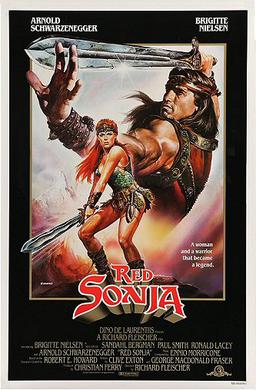
The TSL’s Grindhouse: Red Sonja (dir by Richard Fleischer)


The 1985 film, Red Sonja, invites us to take a journey to a forgotten age, a time of a mythical kingdoms, evil sorcery, epic sword fights, and annoying little child kings who spent a lot of time shouting.  It’s a time of wonder, danger, heroism, and, of course, Arnold Schwarzenegger.

Reportedly, the once and future governor of California has frequently named Red Sonja as being the worst film in which he ever appeared.  When you consider some of the other films that have featured Gov. Schwarzenegger, that’s indeed a bold statement.  In Red Sonja, Schwarzenegger plays Lord Kalidor.  Interestingly enough, Lord Kalidor is absent for the majority of the film.  He shows up briefly at the beginning of the film and then he vanishes for quite a bit of Red Sonja‘s 89-minute running time.  Whenever Schwarzenegger does show up, he wears the smirk of a man who knows that he’s going to get paid a lot of money for doing very little actual work.

The majority of the film focuses on Sonja (Brigitte Nielsen), a warrior who lives in one of those vanished ages, perhaps after the War of the Rings but before the sinking of Atlantis.  When we first see her, she’s being spoken to by what appears to be a puff of smoke, which is apparently meant to be some sort of warrior goddess.  The puff of smoke fills tells Sonja about everything that happened to her before the start of the movie, though we never do learn why Sonja needs to be told her own backstory.  After rejecting the sexual advances of the evil Queen Gedren (Sandahl Begman), Sonja was forced to watch as her parents and brother were murdered and then she was raped and left for the dead by the Gedren’s soldiers.  The Goddess promises to make Sonja into a superior warrior, on the condition that Sonja agree to never have sex with a man unless that man can first beat her in fair combat.  Sonja agrees and is sent off to get trained by the Grand Master.  It’s kinda like Kill Bill, if Bill was a puff of smoke.

Jump forward to …. well, I’m not sure how many years pass.  To be honest, it’s next to impossible to really discern any sort of coherent logic to the film’s narrative progression so let’s just give up on that.  What’s important is that there’s this temple and, inside the temple, there’s a glowing green talisman.  Apparently, the talisman created the world but now it needs to be carefully watched over before being destroyed.  Only women are allowed to handle the talisman (Yay!) but they’re not allowed to destroy it unless directed by a man.  (Booooo!)  The temple priestesses are waiting for Lord Kalidor to arrive so that they can get rid of the talisman.  However, Queen Gedren shows up first.  Not only does she steal the talisman but she kills the priestesses as well.

One of the priestesses was Varna (Janet Agren, who you might recognize from Lucio Fulci’s City of the Living Dead).  Varna just happens to be the sister of Sonja.  (Sonja is now known as Red Sonja, because she had red hair.  From now on, I want to be known as Red Lisa.)  Now, Sonja has yet another reason to want to kill Gedren!  Rejecting Kalidor’s help, Sonja heads off for revenge.  Along the way, she meets an annoying child king named Tarn (Ernie Reyes, Jr.), who is upset that Gedren previously destroyed his kingdom.  Despite hating him, Sonja allows Tarn and his guardian, Falkon (Paul L. Smith), to tag along with her.  Despite not being an official member of the revenge party, Kalidor decides to follow after them because he wants to beat Red Sonja in fair combat, if you get what I mean.

Red Sonja is a spectacularly silly film.  The dialogue is stilted.  Even by the standards of the 1980s ,the special effects are poorly executed.  This the type of film where the evil Queen nearly destroys the world not because she has any sort of grand scheme but instead, just because she’s evil and that’s what evil people do.  Brigitte Nielsen delivers her lines with a forced solemnity while Schwarzenegger, Bergman, and the great Paul L. Smith seem to be struggling not to start laughing.

And yet, there’s a sneaky charm to be found in all of the silliness.  For instance, when Sonja does finally reach the queen’s castle, she has to cross a bridge that appears to basically be the skeleton of giant rhinoceros.  No none in the film seems to be surprised to come across a skeleton a giant rhinoceros and, to be honest, there’s no reason for it to be there.  It’s just there and it’s so wonderfully out-of-place that it becomes rather fascinating.  Add to that, while the portrayal of the evil lesbian queen is problematic in all sorts of ways, this is a film about a strong female warrior who doesn’t need a man to rescue her and that was probably even more rare in 1985 than it is today!

Watching Red Sonja, you get the feeling that nobody involved in the film took it all that seriously and that perhaps the best way to handle the movie is to just sit back and have a laugh.  It’s dumb, it’s campy, it often makes no sense but, at the same time, it’s still a lot easier to follow than Game of Thrones.   Like many bad films, it’s only bad if you watch it alone.  Watch it with a group of your snarkiest friends and you’ll have a totally different experience.

6 Trailers For Christmas


It’s a holiday and you know what that means!

Or maybe you don’t.  Sometimes, I forget that not everyone can read my mind.  Anyway, I used to do a weekly post of my favorite grindhouse trailers.  Eventually, it went from being a weekly thing to being an occasional thing, largely due to the fact that there’s only so many trailers available on YouTube.  Now, Lisa Marie’s Favorite Grindhouse and Exploitation Film Trailers is something that I usually bring out on a holiday.

Like today!

So, here are 6 trailers for the holiday season!

Christmas Evil (1980)

Believe it or not, this is actually a really good movie.  In fact, it’s probably the best killer Santa movie ever made.  The ending will blow your mind.

Don’t Open Till Christmas (1984)

This, on the other hand, is one of the worst Christmas movies ever.  I reviewed it a few years ago.

Black Christmas (1974)

Long before he made A Christmas Story, Bob Clark directed this classic holiday-themed horror film.

Black Christmas (2006)

Of course, as happens with any classic Canadian horror film from the 70s, Black Christmas was remade in the aughts.

Santa Claus Conquers The Martians (1964)

There was no way that I wasn’t going to include this trailer.

And finally, we have a trailer that’s not really a Christmas film but it’s so trippy, festive, and oddly disturbing that I had to share it.

Pinocchio’s Birthday Party (1973)

Happy holidays!

The TSL’s Daily Horror Grindhouse: Vampire Circus (dir by Robert Young)


One of the greatest Hammer vampire films didn’t even star Christopher Lee.  In fact, it wasn’t even a Dracula film.  Instead, it was the story of a circus.

1971’s Vampire Circus tells the dark story of a Serbian village called Stetl.  Early in the 19th century, the children of Stetl are dying.  The superstitious villagers believe that Count Mitterhaus (Robert Tayman) might be responsible.  In fact, they suspect that Count Metterhaus might be a vampire!  Why?  Well, first off, he only seems to be around during the night.  Secondly, he lives in a big spooky castle.  Third, he’s a count and don’t all counts eventually become vampires?

Now, it would be nice to say that all this turned out to be a case of the villagers letting their imaginations get the better of them but nope.  It turns out that they’re pretty much right.  One night, the local teacher, Albert Muller (Laurence Payne), sees his own wife, Anna (Domini Blythe) leading a child towards the dark castle.  It turns out that Anna has fallen under the spell of Count Mitterhaus.  The villagers promptly drive a stake through the Count’s heart, though he manages to do two things before dying.  First off, he curses the town and announces that the blood of their children will give him new life.  Secondly, he tells Anna to escape and track down his brother.

Fifteen years later and, as one might expect, Stetl is a town under siege.  However, the town is not being attacked by vampires.  (Not yet anyway.)  Instead, the town has been hit by the plague and, as a result, it’s been isolated from the outside world.  Men with guns have surrounded the town and are under orders to kill anyone who tries to leave or enter.  Some in the village believe that this is the result of the Count’s dying curse while others just see it as more evidence of man’s inhumanity to man.  Regardless, it’s not good situation.

Fortunately, escape arrives in the form of the Circus of the Night!  That’s right, a gypsy carnival suddenly appears in town.  How did it manage to slip by the blockade?  Who knows and who cares?  What’s important is that the villagers, especially their children, need an escape from their grim existence and the Circus seems to offer something for everyone.  There are dancers.  There are acrobats.  There’s the mysterious tiger woman.  There’s a mirror that makes you see strange things.  And, of course, the are vampires….

That’s not really a shock, of course.  The name of the film is Vampire Circus, after all.  What always takes me by surprise is just how ruthless and cruel the vampires are in this film.  Even by the standards of a 1970s Hammer film, this is a blood-filled movie but, even beyond that, the vampires almost exclusively seem to target children.  Fortunately, all of Stetl’s children tend to be a bit obnoxious but it’s still a shock to see two fresh-faced boys get lured into a mirror where they are both promptly attacked by a vampire.  (And don’t even get me started on what happens when one of the vampires comes across a boarding school.)  Make no mistake, this circus is not made up of the type of self-tortured, romanticized vampires that have dominated recent films.  These vampire are utterly viscous and without conscience.  In other words, these vampires are actually frightening.

The members of the circus are, themselves, a memorable bunch.  David Prowse is the hulking strongman.  Lalla Ward and Robin Sachs are the achingly pretty, innocent-faced twin acrobats who greedily drink the blood of anyone foolish enough to wander off with them.  Some members of the circus can transform into animals.  What’s interesting is that not all of the members of the circus are vampires.  Some of them, I guess, are just groupies.

Featuring the reddest blood that you’re ever likely to see and a cast of memorably eccentric character actors, Vampire Circus often feels more like an extremely dark fairy tale than a typical Hammer vampire film.  Clocking in at 87 minutes, Vampire Circus is a briskly paced dream of carnivals and monsters.


The TSL’s Horror Grindhouse: Blood for Dracula (dir by Paul Morrissey)


Count Dracula (played by Udo Kier) has a problem.  In order to stay strong and healthy, he needs a constant supply of virgin blood.  (Or, as Kier puts in, “weergen blood.”)  Unfortunately, he lives in 1920s Romania and apparently, there just aren’t many virgins left in Eastern Europe.

However, Dracula’s assistant, Anton (Arno Juerging) has a solution.  Dracula just needs to move to Italy!  After all, Italy is the home of the Vatican and it’s just been taken over by Mussolini and the fascists.  Surely, no one in Italy is having sex!  Dracula should be able to find all the virgins that he needs in Italy!

So, Dracula climbs into his coffin and Anton drives him to Italy.  Once they arrive, they meet an Italian land owner,  Il Marchese di Fiore (played by Italian neorealist director Vittorio De Sica).  The Marchese is convinced that Dracula is a wealthy nobleman and he says that Dracula can marry any of his four daughters.  He assures Dracula that they’re all virgins but Dracula soon discovers that two of them are not.  It turns out that, thanks to the estate’s Marxist handyman, Mario (Joe Dallesandro), it’s getting as difficult to find a virgin in Italy as it was in Romania!

After completing work on Flesh For Frankenstein, director Paul Morrissey and actors Udo Kier, Joe Dallesandro, and Arno Juerging immediately started work on Blood for Dracula.  Though Blood for Dracula never quite matches the excesses of Flesh for Frankenstein, it still taps into the same satiric vein that provided the lifeblood that gave life to Flesh for Frankenstein.  Once again, the sets and costumes are ornate.  Once again, the frequently ludicrous dialogue is delivered with the straightest of faces.  Once again, Udo Kier goes over-the-top as a famous monster.  And, once again, Joe Dallesandro plays his role with a thick and anachronistic New York accent and he looks damn good doing it.

Ironically, one of the differences between Flesh for Frankenstein and Blood for Dracula is that there’s quite a bit less blood in the Dracula film.  Then again, that’s also kind of the point.  Dracula literally can’t find any blood to drink and, as a result, he’s become weak and anemic.  Udo Kier is perhaps the sickliest-looking Dracula in the history of Dracula movies.  By the time that he meets the Marchese’s four daughters, he’s so sick that he literally seems like he might fade away at any second.  As ludicrous as the film sometimes is, you can’t help but sympathize with Dracula.  All he wants is some virgin blood and the communists aren’t even willing to let him have that.  Blood for Dracula is, in its own twisted way, a much more melancholy film than Flesh For Frankenstein.  Or, at least it is until the finale, at which point one character gets violently dismembered but still continues to rant and rave even after losing the majority of their limbs.

When Blood for Dracula was released in 1974, it was originally called Andy Warhol’s Dracula, though Warhol had little to do with the movie beyond allowing his name to be used.  As with Flesh for Frankenstein, Antonio Margheriti was credited in some prints as a co-director, largely so the film could receive financial support from the Italian government.

Sadly, there would be no Andy Warhol’s The Mummy or Andy Warhol’s Wolfman.  One can only imagine what wonders Kier, Dallesandro, and Morrissey could have worked with those.


The TSL’s Horror Grindhouse: Flesh For Frankenstein (dir by Paul Morrissey)


Here are just a few things to be experienced in 1973’s Flesh For Frankenstein:

A fanatical Baron von Frankenstein (Udo Kier) needs a brain for his latest creation so his assistant, Otto (Arno Jurging) goes out with a giant pair of hedge clippers, snips off a divinity student’s head, and then runs off with it.

An incredibly sexy farmhand named Nicholas (Joe Dallesandro) speaks with a thick and very modern New York accent, despite living in Germany in the 19th century.  Meanwhile, everyone around him speaks with an extra-thick German accent.

The Baron announces to Otto, “To know life, you must fuck death in the gall bladder!”

Nicholas has an affair the Baroness von Frankenstein (Monique van Voreen), who in one scene loudly sucks on Nicolas’s armpit.

The Baron gets rather obviously turned on while removing organs from a body.

The Baron’s children decapitate their dolls and take a perverse pleasure in being cruel.  Some of this could possibly be because the Baron and the Baroness are also brother and sister.

The Baron rants and raves about how, by bringing the dead back to life, he will be able to create the perfect Serbian race, one that will only take orders from him and which will …. well, do something.  The Baron has a lot of plans but he’s not always clear on just what exactly the point of it all is.

Speaking of points, one character eventually gets a spear driven through his back an out of his chest.  Despite the fact that his heart is literally hanging off the tip of the spear, he still manages to get out a very long and very emotional monologue before dying.

Now, of course, you have to remember about that scene with the heart is that Flesh for Frankenstein was originally shot in 3D, which means that audiences in 1973 would have literally had that heart dangling over their heads while waiting for that endless monologue to stop.  How the audience would react to that would have a lot to do with whether or not they were in on the joke.

And make no mistake, Flesh For Frankenstein is not a film that’s meant to be taken too seriously.  It’s a satire of …. well, just about everything.  Baron Frankenstein, with his sexual hang-ups and his obsession with creating a perfect male and a perfect female so that they can have perfect Serbian children, is the ultimate parody of the mad scientists who usually populate these films and Udo Keir gives a truly mad performance in the role.  One need only compare Keir’s Frankenstein to the coldly cruel version that Peter Cushing played in Hammer’s “serious” Frankenstein films to see just how much Keir embraced the concept of pure batshit insanity.  Whereas Keir joyfully overacts every moment that he’s on-screen, Joe Dallesandro pokes fun at the traditional image of the strong, silent hero by barely reacting to anything at all.  The film’s nonstop flow of blood parodies the excesses of the horror genre while Nicholas’s affair with the Baroness satirizes not only Marxism but also an infinite number of European art films.  Flesh for Frankenstein is a film that is so deliberately excessive that it often feels as if it’s daring you to stop watching.  Of course, you don’t stop watching because you know the movie will probably start making fun of you as soon as you turn your back on it.

Flesh For Frankenstein is also known as Andy Warhol’s Frankenstein.  Warhol actually had little do with the movie, beyond lending his name.  The film was directed by Paul Morrissey, who served as Warhol’s “house director” during the Factory years.  The best Factory films were defined by the combination of Warhol’s detachment with Morrissey’s political and religious conservatism.  With Flesh For Frankenstein, Morrissey not only satirizes what he viewed as being the excesses of European and horor cinema but he also satirizes the fact that there’s an audience for his satire.  Flesh For Frankenstein is definitely not a film for everyone but, in this case, that can be considered a compliment.  It’s an audacious and wonderfully over-the-top movie, one that would be followed by Blood for Dracula.

One final note: Because the film was made in Italy, Antonio Margheriti was credited as being a co-director on the film with Morrissey.  While Margheriti did do some second unit work, it is generally agreed that he was not, in any way, a co-director.  Apparently, Margheriti was credited as being a co-director so that the film could receive financial aid from the Italian government.  This scheme later led to both Margheriti and producer Carlo Ponti being charged with criminal fraud.